

Key Takeaways
Quantum physics rediscovered what Kashmir's sages described a millennium ago
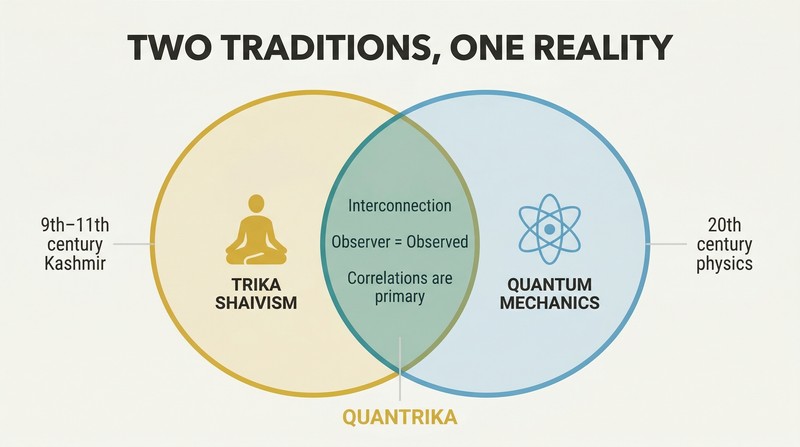
A startling convergence exists between Trika Shaivism — a non-dualistic philosophical tradition from 9th-century Kashmir — and quantum mechanics, the 20th century's most revolutionary physics. Both arrive at the same core insight: reality is fundamentally interconnected, the boundary between observer and observed is porous, and correlations (not isolated entities) are what matter most.
Trika Shaivism, systematized by sages Vasugupta and the polymath Abhinavagupta (circa 975 – 1025 CE), asserts that Paramashiva — supreme consciousness — permeates everything. Quantum mechanics, through entanglement and the observer effect, reveals that particles don't exist in fixed states independent of measurement. The author, a Cambridge-trained physicist, calls this shared territory "Quantrika" — a synthesis space where ancient metaphysics and modern physics illuminate each other's deepest claims.
Trika Shaivism builds spirituality on consciousness, not ritual or renunciation
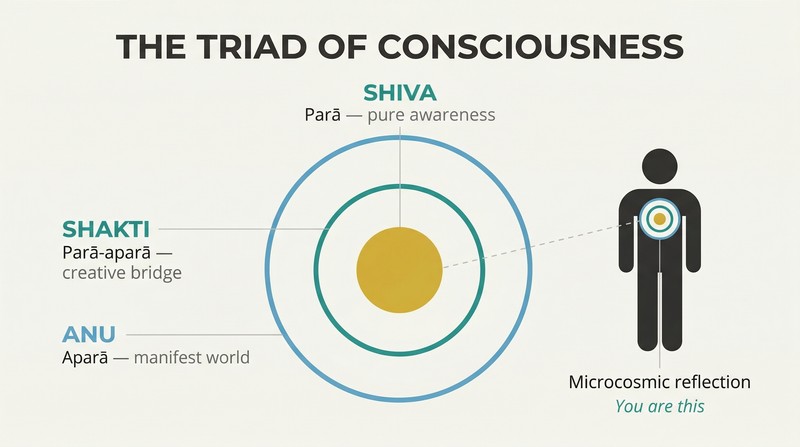
While other Shaiva traditions emphasize ritual purity or ascetic withdrawal, Trika Shaivism critiqued the dominant Śaiva Siddhanta school for exaggerating ritual's role in salvation. Instead, it proposed liberation through direct mystical experience and gnosis. "Trika" means triad — three fundamental principles:
1. Shiva: Supreme Consciousness
2. Shakti: Divine creative energy
3. Anu: the individual soul
Consciousness operates at three levels: parā (pure, unmanifest awareness), parā-aparā (the bridge between absolute and relative), and aparā (the manifest world of diversity). Every individual soul is a "microcosmic reflection" of this universal consciousness. The practice isn't about acquiring spiritual capital — it's about recognizing what you already are through meditation, self-inquiry, and direct experience (pratyaksha ).
Both quantum measurement and Trika meditation dissolve the subject-object wall
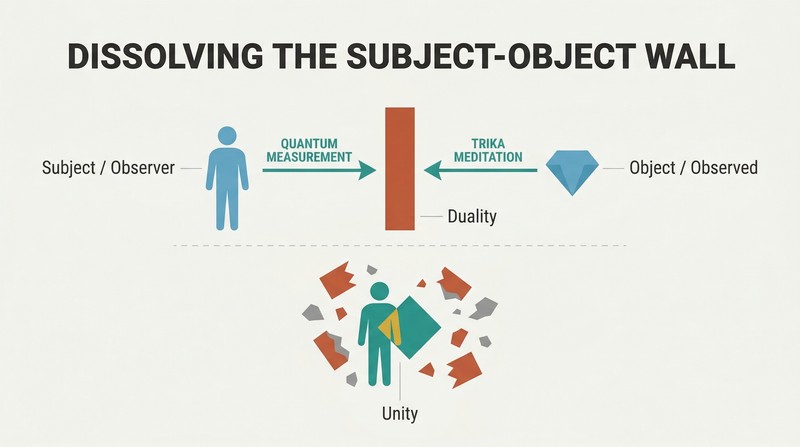
The subject-object binary — the separation between observer and observed — structures nearly all Western thought from Descartes through Kant. Both Trika Shaivism and quantum mechanics dismantle it. In quantum physics, the observer effect shows measurement doesn't passively record properties but actively collapses the wave function. The system and observer become entangled.
In Trika Shaivism, the Śivasūtra teaches that dissolving duality transforms action into creation itself. Abhinavagupta's spiritual method instructs practitioners to neither abandon nor accept any particular thought — simply witness. This dissolves the rigid line between self and world. The author argues this parallel isn't merely metaphorical: both traditions describe the same structural relationship, arrived at through radically different methodologies — contemplation and experimentation.
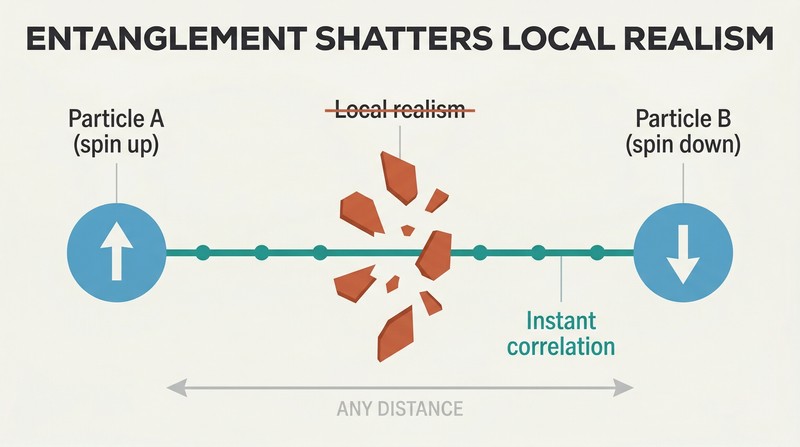
Entangled particles shatter local realism: separation is physics' deepest illusion
Bell test experiments proved that entangled particles exhibit correlations exceeding what any local hidden variable theory permits — confirming quantum mechanics and refuting Einstein's hope that hidden variables would restore classical determinism. When you measure one entangled particle, its partner's state is instantaneously correlated regardless of distance.
The EPR paradox (Einstein, Podolsky, Rosen, 1935) questioned quantum completeness; Bell's theorem (1964) settled the debate experimentally. Three key loopholes — detection efficiency, locality, and freedom-of-choice — have been progressively closed. Real-world applications already exist: continuous 24-hour quantum key distribution over 20 kilometers, Google's quantum annealer processing up to 100 million times faster than classical computers, and quantum-enhanced imaging that surpasses the diffraction limit.
The world is Shiva's real self-projection, not an illusion to escape
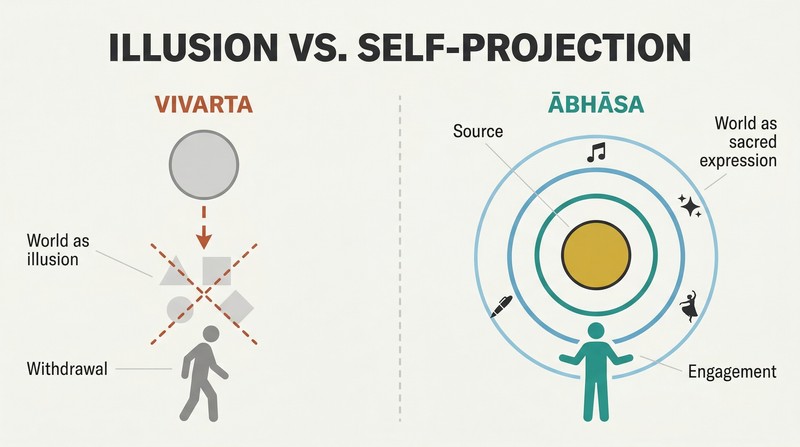
Trika Shaivism makes a crucial distinction from Advaita Vedanta. While Advaita teaches the world is vivarta — an illusion superimposed on brahman — Trika describes creation as ābhāsa: Shiva's genuine self-projection. The world is real. It's not something to transcend through withdrawal but to recognize as divine expression.
Through thirty-six tattvas (principles of reality), Trika Shaivism maps how consciousness unfolds from pure Shiva through Shakti into manifest diversity. This matters practically: instead of renouncing the world as illusion, practitioners engage with it as sacred expression. The tradition celebrates divine recognition through art, music, dance, and poetry — creative expression becomes a medium for spiritual realization, not a distraction from it.
Reality vibrates — spanda and quantum fields share a dynamic pulsation
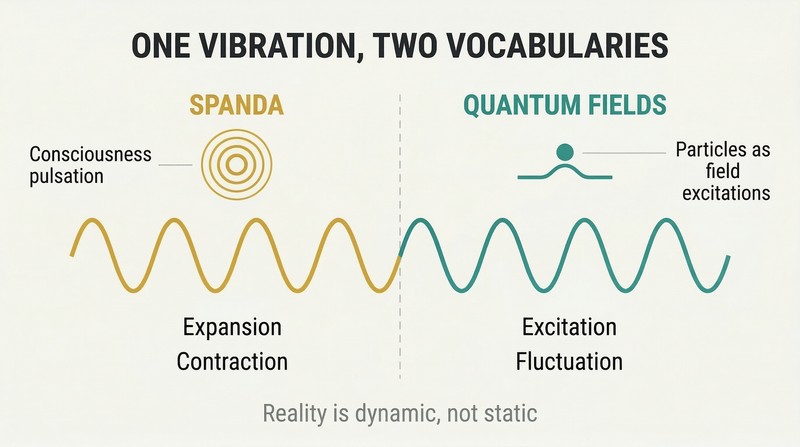
Spanda — the primordial vibration of consciousness — is Trika Shaivism's most distinctive concept. Codified in the Spandakārikā, it describes consciousness not as static awareness but as dynamic pulsation: expansion and contraction, creation and dissolution. Attunement to spanda means aligning with the creative impulse underlying all manifestation.
This resonates with quantum field theory, where particles are excitations of underlying fields pervading spacetime. The author's own thesis, developed with Nobel laureate Brian Josephson, proposes that quantum vacuum fluctuations are "self-selected" — not random noise but self-regulating phenomena. During cosmic inflation, these fluctuations stretched from subatomic to cosmic scales, seeding the galaxies and large-scale structures we observe today. Both frameworks describe reality as fundamentally vibratory rather than solid.
Coordination creates what isolation cannot: from neurons to entangled particles
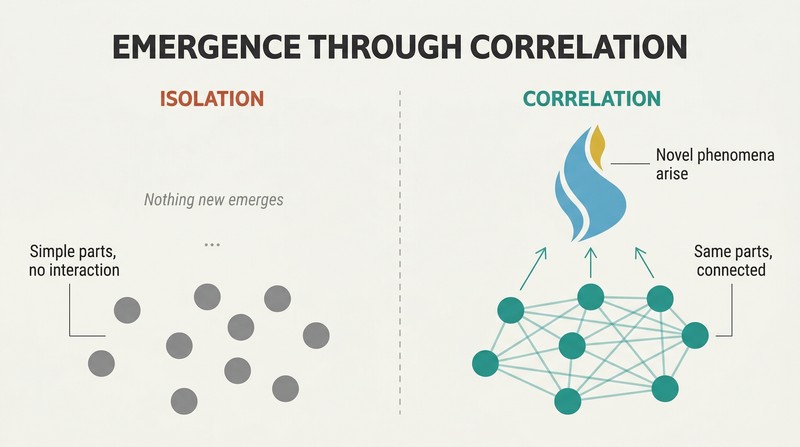
Emergence is the key principle. The brain's billions of neurons are individually simple, but their coordinated interactions produce consciousness. Iron-based superconductors, discovered in 2008, achieve zero-resistance electricity despite iron's disruptive magnetic properties — because electrons engage in precise coordinated patterns. In both cases, the system's behavior cannot be predicted from its parts alone.
The author posits this as the book's central physical insight: correlations between components — not the components themselves — generate genuinely novel phenomena. In quantum mechanics, entanglement creates correlations exceeding anything classical physics permits. In Trika Shaivism, the interplay between Shiva (consciousness) and Shakti (energy) produces the manifest universe. Both frameworks suggest relationship and correlation, not isolated substance, constitute reality's fabric.
Observation doesn't just record reality — it co-creates it
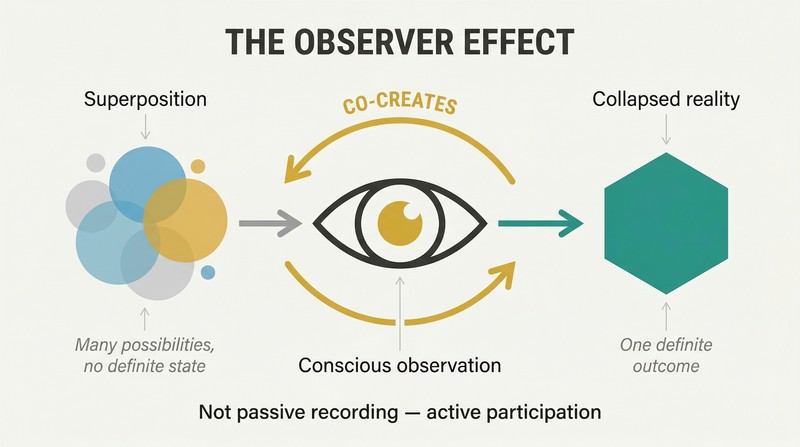
The quantum observer effect reveals that measurement collapses a particle's wave function from superposition into a single definite outcome. Before observation, a quantum system exists as a probabilistic cloud; after measurement, it snaps into one reality. The Copenhagen interpretation, championed by Niels Bohr, makes observation foundational to what emerges.
Trika Shaivism shares this participatory view. Its practice of pratyabhijñā — recognizing one's own divine nature — is itself an act of observation that transforms the observer. Meditation, self-inquiry, and contemplation aren't merely mental exercises; they are acts of conscious reality co-creation. Both frameworks reject the notion of fixed reality independent of participation. Whether consciousness itself causes wave function collapse or decoherence alone explains it remains the field's deepest open question.
Treat paradox as a doorway to truth, not a problem to solve
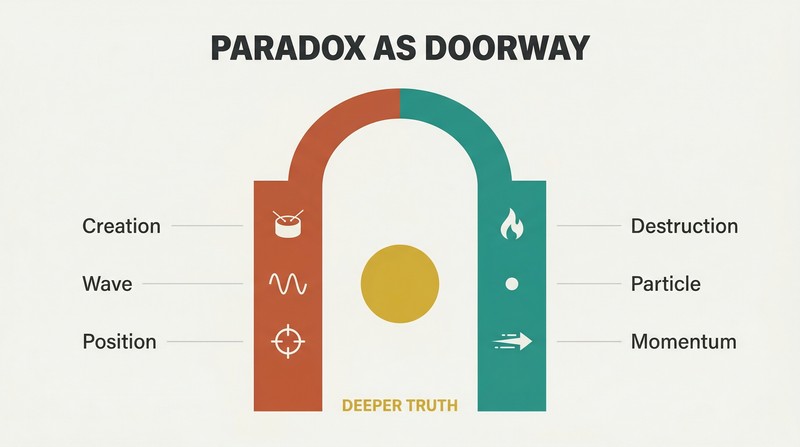
Shiva Nataraja dances with creation and annihilation simultaneously, wearing an unconcerned smile. This image encapsulates Trika Shaivism's embrace of paradox: opposites coexist and illuminate each other. The tradition's via-negativa approach — neti neti, "not this, not that" — defines truth by what it isn't, stretching logic toward what lies beyond all categories.
Quantum mechanics presents parallel paradoxes: wave-particle duality (particles behave as waves OR particles depending on measurement), the uncertainty principle (measuring position destroys momentum knowledge), and entanglement (correlations that seem to violate locality yet never transmit usable information faster than light). In both traditions, paradox isn't a failure of understanding but a structural feature of reality's depth that invites contemplation rather than resolution.
Handle mysticism-physics parallels as resonances, not equations
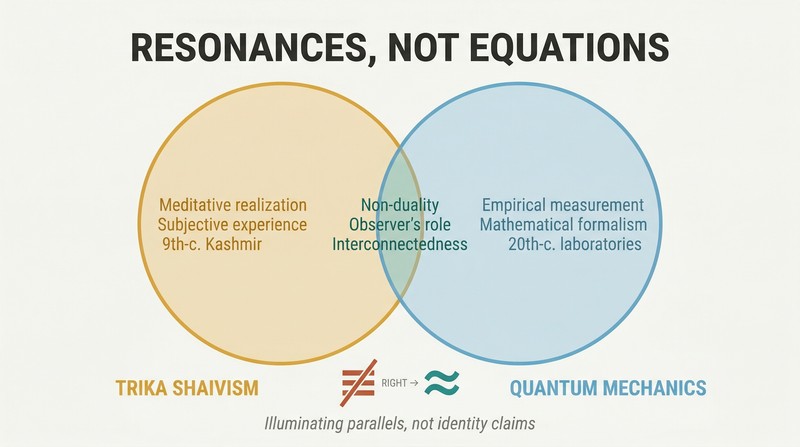
The author explicitly warns against forced comparisons. Trika Shaivism emerged from 9th-century Kashmir's spiritual landscape; quantum mechanics from 20th-century European laboratories. Their epistemologies differ radically — one privileges subjective meditative realization, the other demands empirical measurement and mathematical formalism.
Key pitfalls identified include:
1. Contextual differences in language, culture, and foundational assumptions
2. Multiple interpretive schools within each tradition (Shaivite sects; Copenhagen, many-worlds, and Bohmian QM interpretations)
3. Risk of reductionism — oversimplifying either domain to fit the other
4. Epistemological gaps — meditative insights don't directly equate to lab measurements
The productive approach is identifying shared philosophical themes — non-duality, the observer's role, interconnectedness — while respecting each tradition's methodology. These are illuminating resonances, not identity claims.
Analysis
Guha Majumdar's project occupies a rare position in the mysticism-and-physics genre: he's a Cambridge quantum physicist who takes both Trika Shaivism's metaphysics and quantum formalism seriously without collapsing one into the other. This distinguishes the book from the 'quantum woo' tradition (Capra's Tao of Physics, Chopra's popular works) that often crudely maps quantum buzzwords onto New Age frameworks. The author's repeated methodological caveats — resonances, not equivalences — represent genuine intellectual discipline.
The strongest original contribution is the 'correlations facilitate novel phenomena' thesis, co-developed with Nobel laureate Brian Josephson. Where most science-spirituality books remain at the analogy level, this claim has actual physics content: self-selected fluctuations in quantum fields are self-regulating, not random, and their role in seeding cosmic structure during inflation provides empirical grounding.
The ābhāsa distinction — the world as Shiva's real self-projection rather than Advaita's maya-illusion — is philosophically sophisticated and maps better onto quantum measurement outcomes (which are real, definite results) than the more commonly cited Advaita framework. This represents genuine comparative philosophical work rather than surface-level pattern matching.
Where the book struggles is structure and accessibility. At 47,000 words, it often reads as an exhaustive survey — painstakingly fair to Nyaya, Jainism, Buddhism, multiple Shaivite schools, poststructuralism, and various QM interpretations — but this encyclopedic fairness dilutes the central argument. The heavy Sanskrit terminology, while authentic, creates accessibility barriers.
The most provocative unresolved question — whether Integrated Information Theory might converge with decoherence models to formally connect consciousness and quantum measurement — is wisely raised but not overclaimed. For readers, the book's real value lies in its mental models: the dissolution of rigid observer-observed boundaries applies far beyond physics, from cognitive science to organizational design to personal self-understanding.
Review Summary
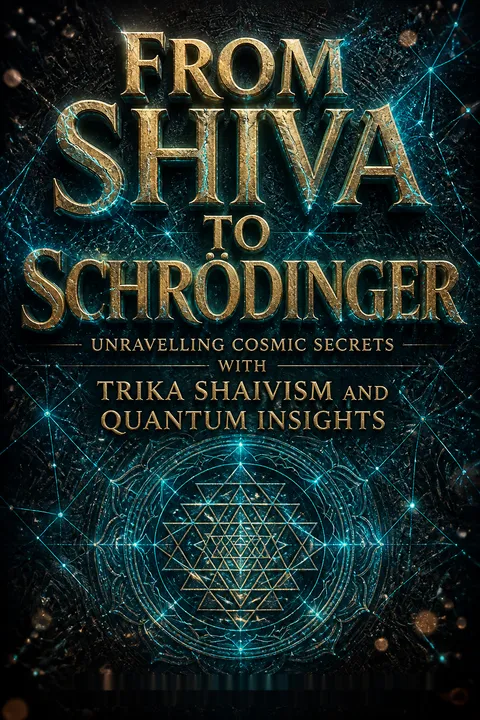
From Shiva to Schrödinger receives high praise for bridging ancient Trika Shaivism philosophy with modern quantum physics. Readers appreciate its exploration of non-duality, interconnectedness, and consciousness, drawing parallels between spiritual teachings and scientific discoveries. The book is commended for its clear explanations of complex topics, making it accessible to diverse audiences. While some find it dense, most reviewers consider it a thought-provoking read that challenges conventional perspectives on reality and existence. Critics are few, with most readers finding the book insightful and transformative.
Glossary
Trika Shaivism
Non-dual Kashmir philosophical traditionA philosophical and spiritual tradition from Kashmir, India (9th–11th century CE), centered on three principles: Shiva (Supreme Consciousness), Shakti (Divine Energy), and anu (individual soul). Systematized by Vasugupta and Abhinavagupta, it asserts all existence is a non-dual expression of divine consciousness, distinguishing itself from Advaita Vedanta by viewing the manifest world as a real projection (ābhāsa) rather than illusion.
Spanda
Primordial vibration of consciousnessA central concept in Trika Shaivism referring to the dynamic pulsation or vibration of consciousness, codified in the Spandakārikā. Spanda represents the creative impulse underlying all manifestation — the interplay of expansion and contraction that gives rise to the universe. It is the vibratory essence through which formless consciousness becomes manifest form, paralleling quantum field theory's description of particles as excitations of underlying fields.
Pratyabhijñā
Recognition of one's divine natureSanskrit for 'recognition' or 'revelation,' referring to the central spiritual practice and philosophical school within Trika Shaivism. It involves recognizing that individual consciousness (pramātā) is identical to supreme consciousness (anuttara). Not merely intellectual understanding, pratyabhijñā is direct experiential realization that dissolves the illusion of separation between self and divine, overcoming barriers including ego, conditioning, and attachment.
Ābhāsa
Real self-projection of ShivaThe Trika Shaivism concept that the manifest world is a genuine self-projection of Shiva's consciousness, not an illusion. This contrasts with Advaita Vedanta's vivarta (superimposition), where the world is merely an apparent illusion overlaid on brahman. In the ābhāsa framework, the universe is real and sacred — consciousness expressing itself through diverse forms while remaining undivided. The thirty-six tattvas map this projection process.
Quantrika
Trika-quantum mechanics synthesis spaceThe author's term for the intellectual territory where Trika Shaivism and quantum mechanics intersect. It represents the exploration of structural parallels — such as non-duality and entanglement, observer roles in both traditions, and the primacy of correlations — while respecting their distinct methodologies and epistemologies. The term signals resonances to be explored, not equivalences to be claimed.
Self-selected fluctuations
Self-regulating quantum vacuum variationsA thesis proposed by the author with Nobel laureate Brian Josephson (2020), arguing that quantum vacuum fluctuations are not random noise but self-regulating phenomena arising from quantum fields' underlying structure. These fluctuations have measurable effects (the Lamb shift in hydrogen, the Casimir effect between conductive plates) and are believed to have seeded the universe's large-scale structure during cosmic inflation, stretching from subatomic to cosmic scales.
Pramātā and Prameya
Knower (subject) and known (object)Foundational epistemological concepts in Indian philosophy. Pramātā is the subject or knower — the conscious entity engaged in knowing. Prameya is the object of knowledge. In Trika Shaivism, pramātā spans seven levels from sakala (most conditioned, operating with all three malas or impurities) to śiva pramātā (pure consciousness where perceiver and perception merge). Their interdependence is central to dissolving the subject-object binary.
Śaktipāt
Descent of divine graceIn Kashmir Shaivism, the transmission of spiritual energy and awakening from teacher to student, categorized into multiple intensity levels. At the highest (tīvra-tīvra), it produces immediate liberation and oneness with Shiva. At intermediate levels, it creates desire for spiritual seeking or guru guidance. At the lowest (manda), it implies slow progress over many lifetimes. Considered essential for spiritual advancement in the guru-disciple tradition.
Pratyaksha
Direct experiential knowledgeThe highest form of knowledge in Trika Shaivism — immediate, unmediated experience of reality that transcends conceptual understanding. Characterized by being direct (unfiltered by mind), self-verifying (carrying its own certainty), intuitive (non-conceptual), and encompassing the totality of perception beyond physical senses. Cultivated through meditation, self-inquiry, and yogic practices. Contrasted with indirect knowledge gained through inference, authority, or scriptural study.
FAQ
1. What is "From Shiva to Schrödinger" by Mrittunjoy Guha Majumdar about?
- Bridging Spirituality and Science: The book explores the profound connections between Trika Shaivism (a non-dualistic Indian spiritual tradition) and the revolutionary principles of quantum mechanics.
- Subject-Object Binary: It investigates the parallels between metaphysical concepts like the subject-object dichotomy in Trika Shaivism and similar debates in quantum physics.
- Consciousness and Reality: The author delves into how both traditions address the nature of consciousness, the observer’s role, and the fundamental nature of reality.
- Interdisciplinary Approach: The book synthesizes philosophy, metaphysics, and modern physics to offer a holistic understanding of existence.
2. Why should I read "From Shiva to Schrödinger" by Mrittunjoy Guha Majumdar?
- Unique Comparative Analysis: The book offers a rare, in-depth comparison between ancient Indian philosophy and cutting-edge quantum physics, appealing to seekers of both spiritual and scientific knowledge.
- Deepens Understanding of Reality: It provides new perspectives on consciousness, non-duality, and the interconnectedness of all things, challenging conventional worldviews.
- Accessible Yet Scholarly: The author presents complex ideas in a structured, accessible manner, making it suitable for both lay readers and academics.
- Practical and Philosophical Insights: Readers gain tools for self-inquiry, meditation, and a deeper appreciation of the universe’s mysteries.
3. What are the key takeaways from "From Shiva to Schrödinger" by Mrittunjoy Guha Majumdar?
- Non-Duality is Central: Both Trika Shaivism and quantum mechanics point toward a fundamental unity underlying apparent diversity and separation.
- Observer’s Role is Crucial: The act of observation shapes reality in both spiritual and scientific contexts, highlighting the participatory nature of the universe.
- Subject-Object Binary is Illusory: The perceived separation between self and world is challenged, with both traditions advocating for transcending this duality.
- Integration of Knowledge Systems: The book encourages integrating metaphysical, philosophical, and scientific approaches for a more comprehensive understanding of existence.
4. How does "From Shiva to Schrödinger" define and explain Trika Shaivism?
- Non-Dualistic Philosophy: Trika Shaivism, also known as Kashmir Shaivism, teaches that ultimate reality (Paramashiva) is a unified consciousness manifesting as Shiva (consciousness), Shakti (energy), and anu (individual soul).
- Spanda and Pratyabhijñā: Key concepts include spanda (the primordial vibration of consciousness) and pratyabhijñā (recognition of one’s true divine nature).
- Path to Liberation: The tradition emphasizes direct experience, meditation, and the guidance of a guru (śaktipāt) for spiritual awakening and liberation.
- Integration with Daily Life: Trika Shaivism encourages the integration of spiritual insights into everyday living, celebrating creativity, art, and devotion as expressions of the divine.
5. What are the main principles of quantum mechanics discussed in "From Shiva to Schrödinger"?
- Superposition and Uncertainty: The book explains quantum superposition (systems existing in multiple states) and Heisenberg’s uncertainty principle (limits to simultaneous measurement of certain properties).
- Quantum Entanglement: It covers entanglement, where particles remain interconnected regardless of distance, challenging classical notions of locality.
- Observer Effect: The act of measurement or observation is shown to influence quantum systems, raising questions about the nature of reality.
- Decoherence and Quantum-Classical Transition: The text discusses how quantum systems lose coherence and transition to classical behavior due to environmental interactions.
6. How does "From Shiva to Schrödinger" connect the subject-object binary to both Trika Shaivism and quantum physics?
- Philosophical Roots: The subject-object binary refers to the perceived separation between the observer (subject) and the observed (object), a central issue in both Western and Indic philosophies.
- Trika Shaivism’s View: Trika Shaivism teaches that this binary is ultimately illusory, with both subject and object arising from the same consciousness.
- Quantum Mechanics Parallel: In quantum physics, the observer’s presence affects the system, blurring the lines between subject and object and challenging the idea of an independent reality.
- Transcendence of Duality: Both traditions advocate for transcending this binary to realize a deeper unity and interconnectedness.
7. What is the role of consciousness in "From Shiva to Schrödinger" according to both Trika Shaivism and quantum mechanics?
- Consciousness as Fundamental: Trika Shaivism posits consciousness as the essence of all existence, with reality being a dynamic play of consciousness.
- States and Fluxes: The tradition describes various states and fluxes of consciousness (knowing, willing, feeling) and emphasizes self-recognition as the path to liberation.
- Quantum Mechanics’ Perspective: Some interpretations of quantum mechanics suggest consciousness may play a role in the collapse of the wave function, though this remains debated.
- Interconnectedness and Agency: Both fields highlight the participatory role of consciousness in shaping reality and stress the interconnectedness of observer and observed.
8. How does "From Shiva to Schrödinger" explain quantum entanglement and its philosophical implications?
- Definition and Phenomenon: Quantum entanglement is described as the instantaneous correlation between particles, regardless of distance, defying classical locality.
- Challenges to Classical Reality: Entanglement questions the independence of objects and suggests a deeper, non-local interconnectedness.
- Philosophical Resonance: The phenomenon aligns with Trika Shaivism’s view of unity and the illusion of separation, suggesting that all entities are fundamentally linked.
- Implications for Free Will and Causality: Entanglement raises questions about determinism, causality, and the nature of information and consciousness.
9. What is the significance of non-duality and complementarity in "From Shiva to Schrödinger"?
- Non-Duality in Trika Shaivism: Non-duality is the recognition that all existence is a unified whole, with apparent differences being expressions of the same reality.
- Complementarity in Quantum Mechanics: The principle of complementarity (e.g., wave-particle duality) shows that mutually exclusive perspectives are needed for a complete understanding of quantum systems.
- Challenging Dualistic Thinking: Both concepts challenge binary thinking and encourage embracing paradox and unity within diversity.
- Practical and Philosophical Impact: Recognizing non-duality and complementarity fosters a more holistic, inclusive, and compassionate worldview.
10. How does "From Shiva to Schrödinger" address the illusion of separation and the idea of unity?
- Separation as Illusion: Both Trika Shaivism and quantum mechanics challenge the perception of separateness, viewing it as a product of limited perception or conditioning.
- Unity in Practice: Trika Shaivism teaches practices (meditation, self-inquiry) to transcend egoic identification and realize one’s unity with all existence.
- Quantum Interconnectedness: Quantum entanglement and non-locality provide scientific evidence for interconnectedness at the fundamental level.
- Implications for Ethics and Society: Recognizing unity encourages compassion, empathy, and a sense of global responsibility.
11. What practical methods or advice does "From Shiva to Schrödinger" offer for integrating its insights into daily life?
- Meditation and Self-Inquiry: The book recommends meditation, mantra recitation, and self-inquiry as means to experience direct knowledge (pratyaksha) and transcend duality.
- Awareness and Mindfulness: Cultivating awareness of thoughts, emotions, and beliefs helps align with the creative power of consciousness.
- Transcending Limiting Beliefs: The text encourages questioning conditioned patterns and egoic limitations to realize one’s inherent divinity.
- Ethical Conduct and Service: Aligning intentions with the greater good and practicing compassion are emphasized as ways to manifest unity in action.
12. What are the best quotes from "From Shiva to Schrödinger" by Mrittunjoy Guha Majumdar and what do they mean?
- “The awareness that seeks to know is the very object of its own seeking.” – Highlights the reflexive nature of consciousness and the inseparability of subject and object.
- “Correlations can facilitate the transition of action to novel phenomena.” – Suggests that interconnectedness is the basis for emergence and creativity in both mind and matter.
- “Nothing perceived is independent of perception and perception differs not from the perceiver, therefore the universe is nothing but the perceiver.” (Abhinavagupta) – Emphasizes the non-dualistic view that reality is a manifestation of consciousness.
- “When we measure something, we are forcing an undetermined, undefined world to assume an experimental value. We are not measuring the world, we are creating it.” (Niels Bohr) – Underlines the participatory role of the observer in shaping reality, resonating with both quantum mechanics and Trika Shaivism.
- “By recognising the illusory nature of this divide and engaging in practices that cultivate direct perception, awareness, devotion, and non-dual awareness, practitioners can merge the subject and object into a unified whole.” – Summarizes the transformative goal of the book: to transcend duality and realize unity.
Download PDF
Download EPUB
.epub digital book format is ideal for reading ebooks on phones, tablets, and e-readers.








































