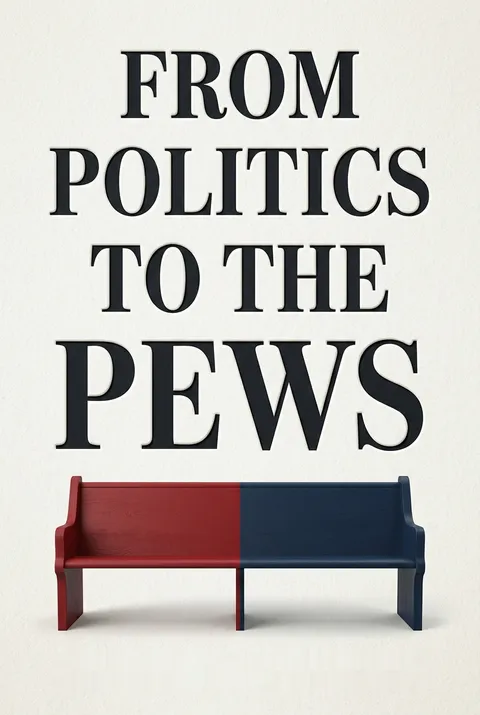

Key Takeaways
1. The "God Gap" in American politics is a recent, significant divide.
Today, the highly devout and frequent churchgoers tend to identify with and support the Republican Party, while religious nonidentifiers and infrequent attenders generally support the Democratic Party.
A stark reality. American politics is increasingly characterized by a "God gap," where religious affiliation and involvement strongly correlate with partisan identity. This divide is not merely about denominational differences but about the level of religiosity, with devout individuals aligning with Republicans and less religious or secular individuals aligning with Democrats. This gap is as significant as, or even surpasses, other well-known sociodemographic divides like gender or education.
Beyond denominations. Historically, political parties differed along denominational lines, with Catholics often leaning Democratic and mainline Protestants Republican. However, starting in the 1970s and 1980s, this shifted dramatically. The new cleavage is based on religiosity itself, uniting previously disparate groups like religious Catholics and evangelical Protestants under the Republican banner, while secular individuals from various backgrounds gravitate towards the Democratic Party.
Observable trends. Data from the General Social Survey (GSS) and American National Election Study (ANES) consistently show this pattern. For instance:
- Weekly churchgoers are significantly more likely to be Republican.
- Biblical literalists show a higher probability of identifying as Republican.
- Religious "nones" (nonidentifiers) are overwhelmingly Democratic.
This trend is most pronounced among white Americans, though it exists across many religious traditions.
2. Conventional wisdom misinterprets the cause of the "God Gap."
Conventional wisdom suggests that religion has produced this God gap, with religious voters sorting into the Republican Party and secular and less religious voters joining the Democratic Party’s ranks.
The common assumption. The prevailing explanation for the "God gap" posits that individuals' pre-existing religious identities and levels of involvement drive their political preferences. This view assumes that as political parties began to differentiate themselves on moral and religious issues, voters simply chose the party that best reflected their established religious beliefs and practices. Karen, the devout Republican, and Fran, the secular Democrat, are seen as examples of individuals whose faith (or lack thereof) dictated their political allegiance.
Why this view is appealing. This conventional explanation is intuitively attractive for several reasons:
- Hereditary trait: Religion is often seen as a stable, inherited characteristic, making it a plausible driver of other attitudes.
- Indoctrination: Religious institutions provide strong worldviews and moral guidance, making it seem natural for them to influence political stances.
- Political shortcuts: For many citizens, who are often politically disengaged, religious cues could serve as simple heuristics for political decision-making.
However, this perspective overlooks the dynamic nature of religious identity and the powerful influence of partisanship.
An incomplete picture. While religion undoubtedly influences politics, assuming it's a one-way street provides an incomplete understanding of the current landscape. This book challenges the notion that religious identity is impervious to political influence, suggesting that the relationship is more reciprocal. The conventional view fails to consider that the very social groups presumed to be the parties' key constituencies might themselves be shaped by politics.
3. Partisanship, not just religion, profoundly shapes religious identity.
Rather, this book shows that partisan identities can profoundly shape identification with and engagement in the religious sphere.
A reciprocal relationship. The core argument of this book is that the influence between religion and politics is not unidirectional. Instead, partisan identities can significantly impact an individual's religious affiliation and involvement. This means that the "God gap" isn't solely a result of religious people becoming Republicans and secular people becoming Democrats; it's also a result of Republicans becoming more religious and Democrats becoming less religious.
Beyond political preferences. Partisanship is more than just a voting preference; it functions as a powerful social identity. Like identifying with a sports team, partisans develop affective ties, root for their chosen party, and often view out-party members negatively. This strong social identity can extend its influence beyond the political realm, shaping seemingly non-political aspects of an individual's life, including their relationship with organized religion.
Challenging assumptions. This perspective fundamentally alters our understanding of American political history and the formation of social identities. If politics plays a role in shaping religious identities, then the strong bonds observed between religious and political attachments are not just about religion influencing politics, but also about a self-reinforcing cycle where political identity molds religious engagement. This reciprocal dynamic suggests that the political factors creating contemporary electoral politics can also alter the very makeup of the social groups that are presumed to be its drivers.
4. A "life-cycle theory" explains when politics influences religious choices.
A novel theory that draws on what we know about Americans’ religious and political socialization experiences generates predictions about when partisanship can affect religious affiliation and involvement.
Timing is everything. The book introduces a "life-cycle theory" to explain when partisanship is most likely to influence religious identity. This theory posits that the distinct developmental timelines of religious and political socialization create specific windows of opportunity for partisan influence. It's not that religion is always vulnerable to politics, but its susceptibility changes over a person's life.
Two key processes. The theory integrates two established sociological and political science concepts:
- Impressionable years hypothesis: Political identities, especially partisanship, tend to crystallize during adolescence and early adulthood. After this period, partisan identity becomes stable and powerful.
- Religious life-cycle: Individuals often distance themselves from religion during their teenage and young adult years, only to reconsider their involvement later in adulthood, often when starting families.
The overlap of these two processes creates a unique period where partisan identity is strong, while religious identity is fluid.
A window of influence. This critical juncture, typically when young adults are deciding whether and how to re-engage with religious communities (often prompted by marriage and parenthood), is when their already solidified partisan identities can exert a significant and lasting influence on their religious choices. Once these religious decisions are made and identities solidify in adulthood, partisanship's direct impact on religious identity tends to wane.
5. Young adulthood is a critical window for religious and political identity formation.
Partisan identities typically crystallize in adolescence and early adulthood, which is the very time when many people have distanced themselves from religion.
Adolescent religious exodus. Research consistently shows that teenagers and young adults often experience a decline in religious involvement and identification. This "natural falling away" from religion is driven by various factors, including:
- Seeking independence: Distancing from parental beliefs and practices.
- Life disruptions: Leaving home, changing peer groups, focusing on personal/professional success.
- Incongruent behaviors: Engaging in activities (e.g., binge drinking, premarital sex) that conflict with religious teachings.
During this period, religious identities are generally weak and not highly salient, even if individuals retain some personal beliefs.
Partisanship solidifies. Conversely, adolescence and young adulthood are precisely when political identities, particularly party identification, are formed and become stable. Influences from family and the broader political environment (e.g., major elections, societal events) shape these long-term political outlooks. Once formed, partisan identities are remarkably stable, often lasting a lifetime, and function as powerful social identities.
The crucial overlap. The life-cycle theory highlights this temporal asymmetry: partisanship solidifies when religious ties are weakest. As these young adults transition into full adulthood, often marrying and having children, they face decisions about their religious involvement. At this point, their established partisan identity can act as a lens through which they make these religious choices, aligning their religious engagement with their political leanings.
6. The modern political environment drives Republicans to be more religious, Democrats less so.
Once the parties and party elites diverged on questions related to religiosity, Americans could draw on their partisan identities when making religious choices.
Elite-driven divergence. The life-cycle theory, while identifying when partisanship can influence religion, doesn't dictate the direction of that influence. The specific direction—Republicans becoming more religious and Democrats less so—is a product of the changing political environment since the 1970s. During this era, Republican and Democratic elites began to stake out divergent positions on moral issues, the role of faith in public life, and religious outreach.
Cues from the top. This elite-level polarization provided clear signals to voters:
- Republican alignment: The Republican Party became increasingly associated with religious values, conservative moral stances (e.g., on abortion, gay marriage), and actively courted religious groups like the New Christian Right.
- Democratic alignment: The Democratic Party, by contrast, became linked with culturally liberal positions and a stricter separation of church and state, even if individual Democratic politicians still expressed personal faith.
These cues allowed partisans to perceive a clear delineation between the parties along a religious dimension.
Cognitive dissonance and homophily. Faced with this new political landscape, partisans, especially those in the critical life stage, sought to reduce cognitive dissonance by aligning their religious identities with their political ones. Republicans, seeing their party as "religious," became more involved in faith, while Democrats, seeing their party as less so, distanced themselves. Additionally, partisan homophily (associating with like-minded individuals) reinforced these trends, as social networks became more politically and religiously homogeneous.
7. Political knowledge amplifies partisan-driven religious sorting.
Respondents with medium and high levels of political knowledge produce the results presented in the previous chapters.
Knowledge as a prerequisite. For partisanship to influence religious decisions, individuals must first be aware of the political environment—specifically, how the parties differ on religious and moral issues. Political knowledge acts as a crucial moderator: more knowledgeable partisans are more likely to perceive and internalize these elite cues, leading to a stronger alignment between their religious and political identities. Less knowledgeable partisans, lacking this awareness, are less likely to undergo such changes.
Empirical evidence. Studies show that the partisan-driven religious sorting observed in longitudinal data and experiments is predominantly driven by individuals with moderate to high levels of political knowledge or education. For instance:
- In the Youth-Parent Socialization Panel Study, the divergence in church attendance between Republicans and Democrats was significant only among those with medium and high political knowledge.
- Experiments priming partisan identity or exposing respondents to information about the Faith and Freedom Coalition showed stronger effects among more educated partisans.
This suggests that active awareness of the political-religious divide is key for conscious identity alignment.
Consequences for religious composition. This knowledge-dependent sorting has significant implications for the composition of religious communities. If politically knowledgeable Republicans are drawn into religion and knowledgeable Democrats are pushed away, churches become increasingly politically homogeneous. This creates a feedback loop where:
- Religious Republicans are more politically engaged.
- Religious Democrats are less politically engaged (and often feel like political minorities in their congregations).
This dynamic affects the ability of churches to mobilize voters and the types of political information individuals encounter within their religious social networks.
8. African Americans defy the typical "God Gap" pattern due to unique histories.
African Americans’ religious and political attachments demonstrate that the religiosity gap found in American politics does not apply to everyone.
A unique constellation of identities. African Americans present a notable exception to the general "God gap" trend. They are simultaneously one of the most religiously devout demographic groups in the United States and the most consistently Democratic partisan bloc. This dual identity challenges the notion that high religiosity inevitably leads to Republican affiliation.
Historical and theological roots. Several factors explain this unique relationship:
- Racial homogeneity of black churches: Black churches historically served as social, economic, and political centers for the black community, fostering a strong link between racial and religious identity.
- Black Protestant theology: Emphasizes social justice and equality, aligning well with Democratic economic and social policies, unlike the individualistic piety often found in white evangelical theology.
- Democratic politicking in churches: Black churches have a long history of active political mobilization, often in support of liberal policies and Democratic candidates, reinforcing the alignment of faith and Democratic politics.
These factors mean that for many African Americans, being both religious and Democratic does not create cognitive dissonance.
Religious trajectories differ. While young African Americans, like their white counterparts, experience a decline in religiosity during adolescence, their return to religious involvement in adulthood does not follow the white partisan pattern. Instead, black Democrats' religious trajectories resemble those of white Republicans, showing increased religious engagement. This suggests that their Democratic identity reinforces, rather than weakens, their religious commitment, as their faith is deeply intertwined with their racial and political experiences.
9. The life-cycle theory is generalizable across different political contexts.
The theory should therefore be a useful guide as new issues emerge, new groups form, and the parties change their policy positions and electoral strategies.
Beyond the modern "God Gap." While the book primarily uses the contemporary political environment (post-1970s) to illustrate the life-cycle theory, the theory itself is not limited to this specific context. It posits a general mechanism for when partisanship is most likely to influence religious identity, regardless of the specific nature of the political-religious linkage. This makes the theory a versatile tool for understanding religious change in various historical and future scenarios.
The 1960 election as a case study. The 1960 presidential election, with John F. Kennedy as the first Catholic president, offers a compelling historical test. In this era, the salient religious-political divide was denominational (Catholic vs. Protestant), not religiosity-based. The theory predicts that:
- Among Catholics with children, Republican affiliation would lead to less religious involvement than Democratic affiliation (due to Kennedy's Catholicism).
- Among Protestants with children, Republican affiliation would lead to more religious involvement than Democratic affiliation (due to anti-Catholic sentiment among Protestant elites).
Data from the 1956-1960 ANES panel confirm these predictions, showing partisan-driven religious changes in directions consistent with the specific political cues of that time.
A flexible framework. This historical application demonstrates the theory's generalizability. It highlights that as political parties evolve, new issues gain salience, and different groups become politically active, the life-cycle theory can predict how these shifts might influence the religious landscape. The specific direction of religious change will depend on the nature of the political cues, but the timing of influence remains consistent with the life-cycle stages.
10. Partisan-driven religious sorting has profound, self-reinforcing consequences.
The Republican Party can directly target voters who are likely responsive to religious rhetoric and faith-based politics through churches and religious organizations.
Reinforcing cleavages. The reciprocal relationship between partisanship and religious identity creates powerful, self-reinforcing social and political cleavages. As Republicans become more religious and Democrats less so, their social networks become more homogeneous, reducing exposure to diverse viewpoints. This can further entrench partisan animosity and make political compromise more difficult, as the "out-party" is increasingly seen as not just politically different, but socially and morally distinct.
Implications for political mobilization. This sorting profoundly impacts political strategy:
- Republican advantage: The Republican Party gains a "doubly captive audience" in religious communities. Voters who are already religious and have become more religious due to their Republican identity are highly receptive to faith-based appeals, making churches fertile ground for mobilization.
- Democratic challenge: Democrats cannot leverage "secularism" in the same way, as non-religious individuals are often not actively anti-religious but simply disengaged. Religious appeals from Democrats may also fall flat or even alienate their less religious base.
This asymmetry fundamentally alters the parties' bases and their respective abilities to energize supporters.
Rethinking social group influence. The book challenges the traditional assumption that social group membership is causally prior to politics. If politics influences the formation and strength of social identities, then the observed correlations between identity strength and political outcomes may be misleading. This calls for a re-evaluation of how social groups influence public opinion, suggesting that their power might be partially a function of who chooses to affiliate strongly with them in the first place. The "religious sort" is not just a demographic trend; it's a dynamic process with deep implications for American democracy.
Download PDF
Download EPUB
.epub digital book format is ideal for reading ebooks on phones, tablets, and e-readers.








































