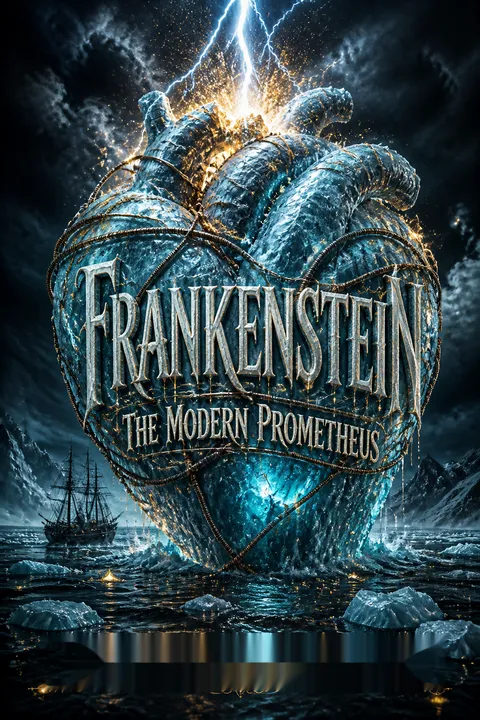

Plot Summary
Letters Across the Ice
Captain Robert Walton writes to his sister from the Arctic, driven by dreams of discovery and glory. His letters reveal a lonely soul, yearning for companionship and meaning. Amidst the frozen wastes, Walton's ship encounters a mysterious, emaciated stranger—Victor Frankenstein—pursuing a monstrous figure across the ice. Victor, broken and desperate, warns Walton of the dangers of unchecked ambition. Their meeting sets the stage for Victor's tragic tale, as Walton becomes both confidant and witness to a story of creation, loss, and the limits of human aspiration. The icy landscape mirrors the isolation and peril that will haunt every character, foreshadowing the chilling events to come.
Victor's Idyllic Childhood
Victor Frankenstein grows up in Geneva, cherished by devoted parents and surrounded by affection. His childhood is marked by harmony, curiosity, and the arrival of Elizabeth Lavenza, his "more than sister," whose gentle spirit becomes his guiding light. Victor's friendship with Henry Clerval, a boy of imagination and kindness, further enriches his early years. The family's compassion extends to Justine Moritz, a servant treated as kin. These formative experiences instill in Victor a sense of duty, love, and the desire to understand the world's mysteries. Yet, beneath the surface, his restless intellect and yearning for knowledge begin to stir, setting the stage for future tragedy.
The Spark of Obsession
Victor's fascination with the secrets of nature intensifies as he discovers the works of ancient alchemists and modern scientists. A thunderstorm and a lesson in electricity ignite his imagination, leading him to the University of Ingolstadt. There, under the guidance of Professors Krempe and Waldman, Victor's studies become all-consuming. He isolates himself, driven by the ambition to unlock the mysteries of life and death. The death of his mother deepens his resolve, and he becomes obsessed with the idea of conquering mortality. Victor's intellectual passion, once innocent, transforms into a dangerous fixation, blinding him to the consequences of his relentless pursuit.
Creation's Horrific Dawn
After years of feverish labor, Victor succeeds in animating a creature assembled from dead bodies. The moment of triumph turns instantly to terror and revulsion as he beholds the grotesque being he has made. Overwhelmed by horror and guilt, Victor flees, abandoning his creation. He collapses into illness, haunted by nightmares and the fear of what he has unleashed. Henry Clerval arrives, nursing Victor back to health, but the shadow of the monster lingers. Victor's dream of scientific glory has become a waking nightmare, and the consequences of his actions begin to ripple outward, threatening all he holds dear.
Abandonment and Collapse
Victor's abandonment of his creation marks the beginning of his psychological and moral collapse. He is plagued by guilt, paranoia, and a profound sense of responsibility for an evil he cannot face. Letters from Elizabeth and news from home offer little comfort. Victor's health deteriorates, and he recoils from his former passions. The monster, left alone and rejected, disappears into the world, his fate unknown. Victor's inability to confront his actions or confide in others isolates him further, setting the stage for tragedy as the monster's presence begins to haunt the fringes of his life.
Shadows Over Geneva
Victor receives a letter from his father: his youngest brother, William, has been murdered. Returning to Geneva, Victor is tormented by the suspicion that his creation is the killer. On a stormy night, he glimpses the monster near the scene of the crime, confirming his fears. Yet, unable to reveal the truth, Victor remains silent. The family is plunged into grief, and suspicion falls on Justine Moritz, who is found with a locket belonging to William. The innocent are ensnared by the consequences of Victor's secret, as the monster's vengeance begins to unfold.
Innocence Condemned
Despite her innocence, Justine is accused of William's murder. The evidence is circumstantial, but her confusion and the discovery of the locket seal her fate. Elizabeth passionately defends her, but the court is unmoved. Justine, under pressure and fearing damnation, confesses falsely, hoping for absolution. She is executed, and Victor is consumed by guilt, knowing he alone is responsible for the deaths of both William and Justine. The family is devastated, and Victor's silence becomes a heavy burden, as the monster's indirect cruelty claims its first victims.
Guilt and Despair
Wracked by guilt and unable to confess, Victor withdraws from his family and friends. He contemplates suicide but is restrained by thoughts of Elizabeth and his father. Seeking relief, he journeys into the Alps, hoping that the grandeur of nature will soothe his soul. Amidst the sublime landscapes, Victor's anguish is momentarily eased, but the sense of doom persists. The beauty of the world stands in stark contrast to the darkness within him, and he remains haunted by the knowledge that his creation is at large, capable of further harm.
The Monster's Awakening
The monster, abandoned and alone, awakens to a world of confusion and pain. He learns to survive in the wilderness, gradually discovering the pleasures of light, warmth, and food. Drawn to a family of cottagers, he observes them in secret, yearning for companionship and acceptance. Through watching them, he learns language, empathy, and the complexities of human society. The monster's innocence and hope are palpable, but his growing self-awareness brings the painful realization of his own deformity and isolation. His longing for love and belonging becomes the core of his existence.
Lessons in Humanity
The monster's education continues as he learns to read and understand human history, morality, and emotion. He discovers books—"Paradise Lost," "Plutarch's Lives," "The Sorrows of Werter"—and Victor's own journal, which reveals the horror of his creation. Emboldened, the monster attempts to reveal himself to the blind old man, hoping for kindness. Instead, he is violently rejected by the family he adores. Heartbroken and enraged, the monster's hope turns to bitterness. He vows revenge on his creator, blaming Victor for his misery and the cruelty of mankind.
Rejection and Revenge
Cast out and consumed by rage, the monster burns the cottage and sets out to find Victor. Along the way, he saves a girl from drowning, only to be shot by her companion. His attempts at goodness are met with violence, deepening his hatred. Arriving in Geneva, he encounters William and, upon learning the boy's identity, kills him in a fit of anger. He frames Justine by placing the locket on her. The monster confronts Victor in the Alps, recounting his suffering and demanding that Victor create a female companion to share his exile and end his loneliness.
The Monster's Demand
The monster's eloquent appeal moves Victor, who is torn between horror and pity. The creature promises to disappear forever if granted a mate, threatening further violence if denied. Victor reluctantly agrees, fearing for his loved ones. The bargain is struck: Victor will create a female monster, and in return, the original creature will leave humanity in peace. The uneasy truce is fraught with dread, as Victor's conscience battles his fear and responsibility. The stage is set for a new cycle of creation, secrecy, and impending disaster.
The Promise and the Pursuit
Victor returns to Geneva, tormented by his promise and the threat hanging over his family. Seeking knowledge for his new task, he travels to England with Clerval, delaying the inevitable. The journey is marked by beauty and melancholy, as Victor's inner turmoil grows. In Scotland, he isolates himself on a remote island to begin his work. The monster's presence is a constant, menacing reminder. Victor's dread intensifies as he contemplates the consequences of creating another being, fearing the birth of a new race of monsters and the destruction of humanity.
The Second Creation
As Victor nears completion of the female creature, he is seized by horror at the potential consequences. He destroys his work, refusing to unleash another monster upon the world. The original creature, witnessing this betrayal, vows revenge: "I shall be with you on your wedding night." Victor is consumed by fear and guilt. Soon after, Clerval is found murdered, and Victor is accused of the crime. Imprisoned and delirious, he is eventually exonerated, but the loss of his friend and the monster's threat haunt him. The cycle of vengeance escalates, and Victor's world unravels.
Ruin and Retribution
Victor, shattered and bereaved, returns home. He marries Elizabeth, hoping for a brief respite from sorrow. But the monster's promise is fulfilled: on their wedding night, Elizabeth is murdered. Victor's father dies of grief, leaving Victor utterly alone. Consumed by rage and despair, Victor vows to hunt the monster to the ends of the earth. The pursuit becomes his sole purpose, as he chases his creation across Europe and into the frozen north, driven by vengeance and the hope of ending the cycle of suffering.
The Final Losses
Victor's relentless chase leads him through desolate landscapes, sustained only by hatred and the desire for retribution. The monster taunts him with messages, always remaining just out of reach. Victor's health deteriorates, and he is driven to the brink of madness. The pursuit becomes a reflection of his own ruin, as he sacrifices everything—family, friends, and self—for the sake of vengeance. The boundaries between hunter and hunted blur, and Victor's tragedy becomes complete as he nears the end of his strength and story.
The Chase Northward
Victor's pursuit brings him to the Arctic, where he is rescued by Walton's crew. On the brink of death, Victor recounts his tale, warning Walton against the dangers of unchecked ambition and the pursuit of forbidden knowledge. As the ice closes in, Walton's crew mutinies, and the expedition is abandoned. Victor dies, his quest unfulfilled, leaving behind a legacy of suffering and regret. The monster appears, mourning his creator and expressing remorse for his crimes. He vows to end his own life, disappearing into the icy wilderness, leaving only questions and sorrow in his wake.
Endings in the Arctic
Walton, deeply affected by Victor's story and the monster's final words, reflects on the dangers of obsession and the cost of transgressing natural boundaries. The narrative closes with a sense of unresolved grief and the haunting image of the monster vanishing into the frozen north, seeking oblivion. The cycle of creation and destruction is complete, leaving behind a cautionary tale about the perils of pride, isolation, and the longing for connection. The frozen landscape becomes a symbol of both the grandeur and the desolation that human ambition can bring.
Analysis
Mary Shelley's Frankenstein endures as a profound meditation on the dangers of unchecked ambition, the responsibilities of creation, and the human need for empathy and connection. At its core, the novel interrogates the limits of scientific progress and the ethical obligations that accompany power. Victor's tragic arc warns against the hubris of playing God, while the monster's journey exposes the corrosive effects of isolation and prejudice. The story's layered narrative structure invites readers to empathize with both creator and creation, blurring the boundaries between victim and villain. Shelley's use of nature, symbolism, and myth situates the personal tragedy within a broader philosophical context, questioning what it means to be human and the costs of transgressing natural boundaries. In a modern context, Frankenstein resonates as a cautionary tale about technological advancement, the perils of alienation, and the enduring need for compassion. Its lessons remain urgent: knowledge without wisdom is dangerous, and the failure to recognize the humanity in others can lead to ruin for both self and society.
Review Summary
Frankenstein receives widespread praise for its philosophical depth, emotional resonance, and beautiful prose, with many readers surprised by its introspective qualities. Reviewers consistently sympathize with the Creature over Victor, whom most find insufferable, narcissistic, and irresponsible. The novel's exploration of identity, loneliness, rejection, and the ethics of creation resonates strongly across cultures and languages. Several readers note that Victor emerges as the true monster, while the Creature simply yearns for love and connection. A few critics find the pacing slow and Victor's monologues excessive, but most consider it an essential, thought-provoking classic.
People Also Read



Characters
Victor Frankenstein
Victor is a gifted scientist whose insatiable curiosity and desire for glory lead him to create life from death. Raised in a loving, privileged family, he is shaped by early loss and a deep sense of responsibility. Victor's psychological complexity is marked by obsession, guilt, and self-loathing. His inability to foresee or accept the consequences of his actions isolates him from those he loves. As tragedy unfolds, Victor becomes consumed by remorse and vengeance, ultimately sacrificing everything in pursuit of his creation. His journey is a cautionary tale about the dangers of unchecked ambition, the limits of human knowledge, and the necessity of empathy and humility.
The Monster (Frankenstein's Creature)
Created by Victor and abandoned at birth, the monster is both physically powerful and emotionally sensitive. His early experiences are marked by confusion, pain, and a desperate longing for acceptance. Through observation and learning, he develops language, empathy, and a deep understanding of human nature. Repeatedly rejected and abused, he turns to vengeance, holding Victor responsible for his misery. The monster's psychological arc moves from innocence to bitterness, his actions driven by a need for connection and justice. He embodies themes of alienation, the corrupting power of isolation, and the consequences of neglect and prejudice.
Robert Walton
Walton is the captain of an Arctic expedition, whose letters frame the novel. Driven by dreams of discovery and greatness, he is both a seeker of knowledge and a man in search of companionship. Walton's encounter with Victor serves as a mirror and warning, highlighting the dangers of obsession and the human need for empathy. His willingness to listen and ultimately heed Victor's caution marks his growth, as he chooses the safety of his crew over personal glory. Walton's narrative voice provides a lens through which the story's themes are explored and contextualized.
Elizabeth Lavenza
Adopted into the Frankenstein family, Elizabeth is Victor's cousin, confidante, and eventual fiancée. Her kindness, beauty, and moral clarity serve as a stabilizing force in Victor's life. Elizabeth's compassion extends to all, including Justine, and she embodies the virtues of selflessness and loyalty. Despite her strength, she is ultimately a victim of Victor's secrecy and the monster's vengeance. Her death marks the final collapse of Victor's world, symbolizing the destruction of innocence and the cost of unchecked ambition.
Henry Clerval
Clerval is Victor's childhood friend, whose imagination, empathy, and zest for life contrast with Victor's brooding intensity. He supports Victor through illness and despair, offering companionship and hope. Clerval's own ambitions are noble, focused on helping others and exploring the world's wonders. His murder by the monster is a devastating blow, representing the loss of innocence and the collateral damage of Victor's actions. Clerval's presence highlights the importance of friendship, creativity, and moral grounding.
The De Lacey Family (De Lacey, Felix, Agatha, Safie)
The De Laceys are a family exiled by injustice, living in poverty but united by love and virtue. The blind patriarch, De Lacey, is compassionate and open-minded, while Felix and Agatha are devoted and hardworking. Safie, the "Arabian," brings hope and joy to the household. Through observing them, the monster learns language, empathy, and the complexities of human society. Their eventual rejection of the monster, despite his gentleness, underscores the destructive power of prejudice and the longing for acceptance.
Justine Moritz
Justine is a servant in the Frankenstein household, treated as a member of the family. Her gentle nature and loyalty make her beloved by all. Falsely accused and executed for William's murder, Justine's fate is a direct result of Victor's secrecy and the monster's vengeance. Her trial and death highlight the failures of justice, the vulnerability of the innocent, and the devastating consequences of silence and cowardice.
Alphonse Frankenstein
Victor's father is a figure of wisdom, compassion, and stability. He provides guidance and support, striving to protect his family from sorrow. Alphonse's inability to penetrate Victor's secrecy and his eventual death from grief illustrate the limits of parental power and the destructive ripple effects of Victor's choices. His presence underscores themes of duty, love, and the fragility of happiness.
Margaret Saville
Walton's sister, Margaret, is the addressee of his letters and serves as the novel's ultimate audience. Though she never appears directly, her presence frames the narrative, emphasizing the importance of communication, empathy, and the sharing of human experience. Margaret's role as confidante and observer invites readers to reflect on the story's lessons and the responsibilities of those who bear witness to suffering.
Professor Waldman
Waldman is a professor at Ingolstadt whose encouragement and vision inspire Victor's scientific pursuits. His openness to new ideas and respect for past thinkers ignite Victor's ambition, setting him on the path to creation. Waldman's influence is double-edged, fostering both intellectual growth and the seeds of obsession. He represents the power of mentorship and the ethical responsibilities of educators.
Plot Devices
Framed Narrative and Nested Storytelling
The novel employs a layered narrative structure: Walton's letters to his sister frame Victor's first-person account, which in turn contains the monster's own story. This device creates distance and ambiguity, inviting readers to question the reliability of each narrator and the nature of truth. The shifting perspectives deepen the psychological complexity, allowing for empathy with both creator and creation. The structure also mirrors the themes of isolation and the longing for connection, as each character seeks understanding through storytelling.
Foreshadowing and Prophecy
From the outset, the narrative is suffused with foreboding. Walton's ambition echoes Victor's, and Victor's warnings to Walton serve as both prophecy and caution. The monster's threats—"I shall be with you on your wedding night"—create suspense and a sense of inescapable fate. Dreams, omens, and repeated references to ancient myths (Prometheus, Paradise Lost) reinforce the sense that the characters are caught in a tragic cycle, unable to escape the consequences of their actions.
Symbolism and Motifs
The novel is rich in symbols: the sublime landscapes of the Alps and Arctic reflect the characters' inner turmoil; light represents knowledge and discovery, but also danger and destruction; darkness signifies ignorance, fear, and the unknown. The motif of doubling—Victor and the monster as mirror images—explores themes of identity, responsibility, and the duality of human nature. The recurring image of ice and coldness underscores isolation and the limits of human power.
Epistolary Form and Direct Address
The use of letters and direct address to Margaret Saville creates intimacy and immediacy, drawing readers into the emotional world of the characters. The epistolary form allows for reflection, self-justification, and the exploration of memory and regret. It also emphasizes the importance of communication and the dangers of isolation, as characters struggle to share their burdens and seek understanding.
The Pursuit and the Chase
The novel's latter half is driven by the motif of pursuit: Victor chases the monster across continents, while the monster haunts Victor's every step. This device heightens suspense and dramatizes the psychological entanglement of creator and creation. The chase becomes a metaphor for obsession, guilt, and the impossibility of escape from one's actions.
Download PDF
Download EPUB
.epub digital book format is ideal for reading ebooks on phones, tablets, and e-readers.








































