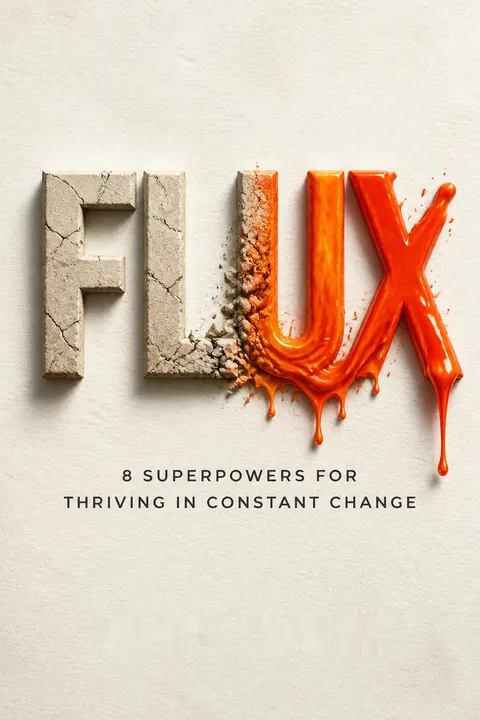

Key Takeaways
1. Embrace Flux: The New Normal of Constant Change
The pace of change has never been as fast as it is today, and yet, it is likely to never again be this slow.
A world in flux. We are living in an era of unprecedented, relentless change, impacting every aspect of life from global pandemics and economic shifts to personal careers and family dynamics. This constant upheaval, which the author terms our "new-now-next-never normal," leaves many feeling unmoored and overwhelmed. The future promises not more stability, but more uncertainty, making traditional approaches to life and work obsolete.
Old scripts are breaking. Humans naturally prefer stability and resist change, especially when it's imposed. Our "old scripts"—societal expectations, career paths, and definitions of success—were built for a predictable world that no longer exists. These outdated filters lead to fear, anxiety, and paralysis when confronted with today's rapid, unpredictable shifts.
A call to reorient. To thrive, we must radically reshape our relationship with uncertainty. This involves moving beyond mere "change management" to a fundamental reorientation of our attitude. The book introduces the "Theory of Flux" as a guide to navigate this new reality, helping us see every change as an opportunity rather than a threat.
2. Cultivate a Flux Mindset: See Opportunity, Not Threat
A Flux Mindset sees change as an opportunity, not a threat, by being clear and grounded in your values.
Your internal compass. A Flux Mindset is the foundational state of mind, body, and spirit that grounds and holds you when everything else changes. It's an internal compass rooted in your core values, enabling you to perceive change as an opportunity rather than a source of fear. This mindset builds on the concept of a "growth mindset" by specifically addressing how one responds when change hits.
Elements of the mindset. Key elements include clarity on core values, comfort with paradox, and the ability to view uncertainty with hope and curiosity. This contrasts sharply with an "old mindset" that views life as a ladder to climb, careers as fixed paths, and change as a threat. Developing this mindset helps you identify your "fluxiness"—your current relationship to change.
Writing your new script. Opening a Flux Mindset is the first step in writing your "new script," which is uniquely yours and empowers you to become who you truly are, even amidst chaos. It provides stability and clarity, acting as your North Star, drishti, surfboard, and terra firma all at once, guiding you through life's ever-shifting landscape.
3. Slow Down to See More and Make Wiser Decisions
To thrive in a fast-paced world, slow your own pace.
The paradox of speed. In a world that constantly pushes us to run faster, true success and growth come from doing the opposite: learning to run slower. The old script equates speed with progress, but in a world where the finish line constantly shifts, frantic rushing leads to burnout, stress, and poor outcomes. Slowing down is not laziness; it's a deliberate, sustainable pace.
Benefits of deceleration. Running slower leads to wiser decisions, greater resilience, improved health, and a stronger connection with emotions and intuition. It paradoxically creates more time, reduces anxiety, and enhances productivity in meaningful ways. This superpower allows for growth that only comes with rest and reflection, helping us avoid running past life itself.
Practices for presence. Cultures like the Dutch, with their concept of niksen (doing nothing without productive purpose), and Chinese Buddhism, with wu wei (action through least action), offer ancient wisdom on the power of slowing down. Practical strategies include:
- Stillness and silence practices
- Patience cultivation
- "Not-to-do" lists
- Micro-sabbaticals and nature bathing
- Technology detoxes (Shabbat)
These practices shift focus from external demands to internal awareness, optimizing for presence over mere productivity.
4. Uncover the Invisible and Embrace Getting Lost for Discovery
Lost really has two disparate meanings. Losing things is about the familiar falling away, getting lost is about the unfamiliar appearing.
Beyond the obvious. Our social and cultural scripts train us to see certain things while remaining blind to others, limiting our scope of focus. When the world flips, this narrow vision can be devastating. The superpower of "seeing what's invisible" means adjusting your gaze to perceive what's on the periphery, what's upside down, or what you've been trained to ignore.
The gift of disorientation. Getting lost, far from being a failure, is how you find your way in a landscape of constant change. It means being comfortable with the unknown and actively seeking out the unfamiliar. This contrasts with the old script's view of getting lost as a liability or a "loss," which often triggers fear and frustration.
Cultural wisdom for navigation. Different cultures offer profound insights into embracing the unknown:
- Wēijī (Chinese for crisis): danger + change point, seeing opportunity in challenge.
- Bardo (Tibetan/Indian Buddhism): a liminal space for transition and transformation.
- Wabi sabi (Japanese): love of imperfection and impermanence.
- Kintsugi (Japanese): seeing beauty in what's broken, repairing with gold.
- Coddiwompling: traveling purposefully towards an as-yet-unknown destination.
These concepts help us reframe disorientation as a path to new insights, resilience, and a richer understanding of ourselves and the world.
5. Build on Trust, Not Fear, to Unleash Collective Genius
The best way to find out if you can trust somebody is to trust them.
A global trust crisis. Society is plagued by a pervasive mistrust in institutions, leaders, and one another, often fueled by an "old script" that assumes humans are inherently untrustworthy. This default to suspicion leads to systems designed from mistrust, which stifle curiosity, disconnect people, and destroy collective genius. The author defines trust as "a confident relationship to the unknown."
Mistrust's destructive design. Systems built on mistrust, such as excessive legal contracts, exorbitant executive pay, and surveillance capitalism, actively undermine human connection and foster inequality. For example, the dramatic increase in CEO-to-worker pay ratios since the 1980s has eroded trust within organizations. These designs prioritize self-interest over genuine care, leading to a "death by a thousand cuts" for human relationships.
Designing from trust. The "new script" advocates for "designing from trust," treating untrustworthiness as the exception, not the norm. This approach, rooted in ancient wisdom and universal human consciousness, unlocks creativity and fosters abundance. Examples include:
- Wikipedia's open editing model
- Netflix's five-word expense policy ("Act in Netflix's best interests")
- BlaBlaCar's ride-sharing platform
- Microfinance's success with collateral-free loans
- Open-source software development
Starting with trust is a powerful superpower that repairs relationships, strengthens credibility, and fosters a more humane and collaborative world.
6. Define Your "Enough" to Find Contentment and Abundance
He who knows that enough is enough will always have enough.
Beyond "more is better." The old script relentlessly pushes "more is better," convincing individuals and society that they are never doing, earning, or achieving enough. This consumerist mindset leads to perpetual insufficiency, insatiability, and a "hedonic treadmill" where satisfaction is fleeting. This quest for "more" often sacrifices essential priorities like equality, well-being, and meaningful relationships.
The power of sufficiency. Knowing your "enough" means understanding sufficiency and satisfaction, not more and not less. It's the opposite of miserliness; it creates room for generosity and plenitude. In a world in flux, clarity on your "enough" is crucial, as it provides stability and flexibility to adapt when change hits, reducing anxiety and expanding your capacity to thrive.
Shifting metrics and practices. Leading with "enough" means prioritizing relationships over transactions and long-term well-being over short-term profits. Practical ways to cultivate this superpower include:
- Subtract before adding: Decluttering physical possessions, negative relationships, or unnecessary obligations to create space.
- Give: Embracing authentic generosity, like the potlatch tradition where wealth is shared to strengthen community.
- Seek contentment: Understanding that true contentment comes from within ("unconditional wholeness"), unlike fleeting external happiness.
- Drop superhero capes: Letting go of perfectionism and the pretense of being "more" to embrace your authentic self.
Knowing you are enough, just as you are, is a fundamental pillar of the new script.
7. Craft a Portfolio Career for Resilience and Meaning
For success and satisfaction in a world in flux, treat your career as a portfolio to curate rather than a path to pursue.
Beyond the linear path. The traditional linear career path—climbing a corporate ladder, specializing in one domain—is increasingly outdated. The future of work is fluid, characterized by the rise of independent workers, remote work, and automation. A "portfolio career" offers a diversified professional identity, built on resilient roots and customized to individual strengths and evolving interests.
Benefits of diversification. A portfolio career provides:
- Diversified income sources, offering more security than a single job.
- Ownership of your professional journey, as it can't be simply taken away.
- An expanded professional community and unique identity.
- Increased meaning and flexibility in your work.
- Automation-proof skills by combining unique capabilities.
This approach moves beyond "I-shaped" specialists to "π-shaped" or "X-shaped" individuals with breadth, depth, and adaptability.
Building and curating your portfolio. Creating a portfolio career involves:
- Identifying existing assets: Listing every role (paid/unpaid), skill, and passion.
- Becoming "the only": Discovering your ikigai (reason for being) – the unique intersection of what you're good at, what you love, what the world needs, and what you can be paid for.
- Cross-pollinating: Applying skills and expertise across unexpected arenas, translating insights between different domains.
- Redefining identity: Transcending a single job title to embrace a multifaceted professional self.
- Continuous curation: Regularly rebalancing, modernizing, and expanding your portfolio to mirror your growth.
This approach aligns with lifelong learning, making "What are you learning?" the new "What do you do?"
8. Reclaim Your Humanity and Serve Others in a Robotic World
In a world with more robots, your key to thrive is to be all the more human—and to use your humanity to help others.
Technology's double-edged sword. While technology offers unprecedented connectivity and efficiency, it also subtly disconnects us from our confidence, feelings, and agency. Increased screen time and automation risk numbing our senses and replacing genuine human consciousness with algorithms. The old script's emphasis on being "tough" and winning at all costs further alienates us from our authentic selves.
The power of being human. This superpower calls for putting "human" back in humanity, resetting our relationship with technology, and embracing our full being. It celebrates vulnerability as strength, shares power, and recognizes interdependence. Being fully human means showing up with emotions, empathy, ethics, integrity, and intuition, capable of celebrating wins and mourning losses—qualities technology can never replicate.
Yin your yang. The world suffers from a "yang overdose"—a dominance of bright, linear, active, and dominating energy, often at the expense of yin's soft, holistic, collaborative, and nurturing qualities. Rebalancing yin and yang, regardless of gender, is crucial for individual and societal harmony. This shift transforms competitive "VUCA" (volatile, uncertain, complex, ambiguous) responses into collaborative, inclusive leadership.
Boost your DQ. Digital Intelligence (DQ) is essential for navigating the digital world responsibly. It's not about coding, but about digital safety, identity, literacy, rights, and communication. A high DQ means knowing when to disconnect, manage screen time, and prioritize human connection over digital distractions, ensuring technology serves humankind, not the other way around.
9. Release the Future's Grip to Empower Your Agency
When I let go of what I am, I become what I might be.
The illusion of control. Many are taught to predict and control the future, but this is an illusion in a world of constant flux. Clinging to expectations about how things "should" unfold leads to frustration and paralysis when plans inevitably change. The ability to let go of this perceived control is where real power and freedom are found.
Letting go as strength. Letting go is not giving up; it's the ultimate Flux Superpower. It means releasing the illusion of controlling external circumstances to focus on what you can control: your response. This frees up time, space, and resources, transforming fear and frustration into fuel for purpose and inner peace. Ancient wisdom, like aparigraha (non-attachment) in Hinduism and Jainism, highlights letting go as the highest form of human strength.
Three shifts for a flux-forward future:
- From predict to prepare: Acknowledge that many futures are possible; invest energy in crafting responses to what could happen, rather than trying to predict what will.
- From "things will go to plan" to "plans will change": Embrace change as the rule, not the exception, improving adaptability and foresight. Scenario mapping is a powerful tool for exploring multiple possibilities.
- From known to unknown: Shift focus from repeating past solutions to being in awe of life's mysteries, expanding your horizon and inviting new possibilities.
Reawakening your agency—your feeling of being in charge of your life—is central to this superpower, allowing you to contribute meaningfully to outcomes even when you can't control them.
10. Write Your New Script for a Continuously Evolving Life
A self that goes on changing is a self that goes on living.
Flux as a lifelong practice. Navigating constant change and cultivating a Flux Mindset is not a one-time fix but a continuous journey of improvement, not perfection. Every day offers opportunities to practice the Flux Superpowers, which amplify each other over time. Starting with any superpower or any change, big or small, will initiate this transformative process.
Integrating flux into all aspects of life. The principles of Flux are scale-free and applicable across individual, organizational, and societal levels.
- Personal life: Engage with nature, our best teacher of constant change, and rediscover ancient wisdom that prioritizes relationships, sustainability, and inner knowing.
- Organizations: Challenge old scripts of "more for some" and "business as usual." Foster cultures of trust, "enough for all," and collaborative leadership. Share this book to spark conversations and co-create new organizational scripts.
- Family: Discuss Flux with children, sharing honest stories about change and fostering empathy, interdependence, and an understanding of privilege.
- The world: Become an ambassador of flux, contributing to a robust "fluxicon" (lexicon for flux) and leveling up collective "flux capacity" to build a brighter, more humane future for all generations.
The power of choice. Ultimately, you can either let change make you, or you can make change. As old scripts crack and your Flux Mindset opens, your Superpowers emerge, enabling you to run calmer, see the invisible, let go of outdated futures, and remain present while building what's next. This is learning to flux, and your new script is waiting to be written.
Review Summary
Flux receives mostly positive reviews (3.93/5), praised as a timely guide for navigating constant change through eight "superpowers" including running slower, seeing what's invisible, getting lost, starting with trust, knowing your "enough," creating a portfolio career, being human, and letting go of the future. Readers appreciate Rinne's personal storytelling, practical wisdom, and challenges to "old scripts" about productivity and success. Some critics found it too abstract, lacking specificity, or more self-help than expected. The book resonates particularly with those experiencing career transitions or seeking to embrace rather than fear uncertainty.
People Also Read



Download PDF
Download EPUB
.epub digital book format is ideal for reading ebooks on phones, tablets, and e-readers.








































