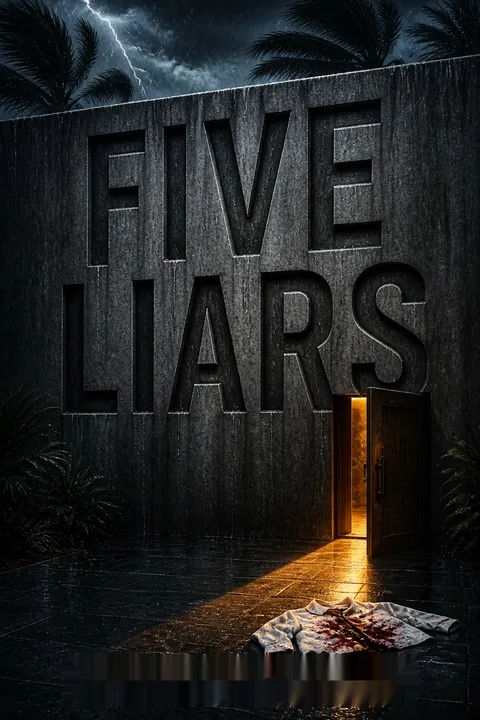

Plot Summary
Island Arrival, Ominous Signs
as Brit Jones, her fiancé Joe, and a tight group of friends—including best friend Lisa, work friend Brenda, and Joe's best man Darren—arrive in storm-threatened Punta Cana for a bachelor-bachelorette "White Lie Party." From the outset, unease seeps in via local omens: a snarling street dog, a driver's warning that "someone will die," and oppressive humidity. Each arriving guest brings hidden anxieties—Lisa's need for control, Darren's tarot-predicted doom, Brenda's heartbreak, Joe's too-good-to-be-true generosity, and Brit's fixation on keeping everything perfect. The gleaming, remote villa inspires both awe and foreboding. Behind the white walls, undercurrents of mistrust and unfinished business churn, foreshadowing that paradise is only surface-deep.
White Lies Invited
The group's arrival is shaped by exclusivity and the peculiar "white lie" theme—everyone must submit a falsehood about themselves, to be revealed during the party. But none truly respond. This innocuous request reveals something darker: these guests, ostensibly the bride and groom's dearest, don't really know or trust one another. Brenda, Brit's office subordinate, wonders why she's even among them; Lisa, the planner, obsesses over details and feels like an outsider in her own event. Social contracts are fragile; invitations come with both expectations and subtle threats: tell your secrets, play along, or be exposed. The villa's isolation, with spotty cell service and no Wi-Fi, ups the ante—these five are on their own, disconnected from the outside world as tensions begin to ferment.
Remnants of a Past Hurt
The narrative shifts to "then," revealing a basement where abused foster kids survive under cruel "caretakers." Powerless, isolated, and desperate, this small community fractures under the arrival of a "new girl," who disrupts fragile alliances. In the present, guests' compulsive behaviors—rituals, food anxieties, controlling games—echo these old wounds. The "White Lie" game mirrors the foster kids' reality: forced to invent stories about themselves for survival. Who was victim, who collaborator? The ominous presence of past trauma will blend with present betrayals to deadly effect, suggesting at least one among them is still acting out childhood vengeance.
Perfect Parties, Broken Trust
The initial excitement of luxury gives way to competition and suspicion. Lisa bristles at being sidelined by Brit's work friend; Brit's compulsiveness about perfection is heightened by minor slights and missing details. Full attention turns to the party games Lisa meticulously planned—meant to create fun, but instead sowing discomfort. Joe's attempts at smoothness mask rising panic over minor disruptions, and Darren's jokes irritate the others. The heat outside is matched by a growing emotional chill inside: humor becomes barbed, "accidental" insults land hard, and no one can shake the feeling that something, or someone, is out of place.
The Locked Room Mystery
When the villa's food delivery and Brit's luggage both disappear, the group is left hungry and anxious. As storm sirens begin, Brenda and Darren, the two most peripheral guests, discover a locked storage closet—unusual for a company-run rental with no owners' possessions. The missing key, and the uncertainties about who should have it, spark arguments and paranoia. As the hurricane descends, it becomes clear: the house is full of literal and figurative locked doors. Who controls entry and exit? Who is being shut out—or in? Desperation mounts as darkness falls.
Storm Gathers, Secrets Stir
With the hurricane in full swing and power out, the villa grows freezing due to a still-running air conditioner—almost as unnatural as the interpersonal atmosphere. Flashlights flicker, windows rattle, and no outside help is possible. The group scrambles for provisions, and in the chaos, a board game (a Ouija board) is uncovered—an invitation to court supernatural danger. Physical peril outside echoes psychological danger within. The storm and their isolation press everyone's secrets closer to the surface. Then, the Ouija board delivers a chilling message: "YOU ARE IN DANGER."
Luggage Vanishes, Alliances Shift
The sudden vanishing of Brit and Joe's expensive luggage, left outside momentarily, is blamed first on the elements, then on each other. Paranoia and accusations escalate—theft, sabotage, and "mistaken" memories erode trust further. Brenda insists the luggage was never there; Joe gaslights those who challenge his recalled reality. Tension splits along invisible lines: Lisa and Brit's long codependent alliance grows brittle, Darren and Brenda, as relative outsiders, share a wary bond, and Joe seems to have his own agenda. Someone is orchestrating small disruptions for larger effect.
Games and Glass—Truth Emerges
With hunger, cold, and stress running high, Lisa insists on an "icebreaker" game. Questions meant to foster friendship instead spark unease: accusations of secret lives, relationships not as they seem, and deep resentments surface. Testy exchanges about old vacations, hidden pregnancies, and who truly invited whom turn friends into adversaries. Lisa's obsession with detail allows her to manipulate the sequence and selection of questions, making some truths inescapable. Among the "white lies" and forced confessions, literal glass is broken—wine shatters, and with it, any last sense of safety.
Dinner Delayed, Doubts Escalate
As the storm intensifies, resources run out and the missing caterers add to growing frustration. Attempts to communicate outside the villa fail—cell service is gone, the internet is blocked, the landline inexplicably dead. The group's hunger and discomfort, once physical, become psychic: each person is starved for reassurance or an explanation that will never come. As nerves fray, small disagreements turn into panicked blame. The villa's isolation is now absolute, their vulnerability total. Someone has made sure there is no way out.
The Chill Within Walls
Lisa and Brit's relationship deteriorates as suspicions turn inward: Lisa accuses Brit of hiding her family secrets, playing dumb about her past, and being "the liar" among them. Joe and Brit's otherwise perfect partnership is exposed as fragile, both hiding truths. The group is forced to huddle physically for warmth and emotional security as the temperature drops—mirroring the freeze in their ability to communicate or trust. What began as bickering between friends becomes something darker: fear of each other.
Icebreakers Reveal Hidden Tensions
The party's icebreaker questions transform into cross-examinations, exposing not just white lies but potentially criminal behavior. Darren and Joe's "lifelong brotherhood" is revealed as fractured, colored by betrayal, and possibly by financial fraud. Darren's attempt to force a confession from Brit is interrupted, but damage is done—the wrong secrets are now unearthed, and the right ones remain hidden. Someone, possibly Lisa with her obsessive preparation, is steering the narrative for their own purposes, using intimate knowledge and staged games to pit the group against itself.
Darkness, Sirens, and Locked Doors
Sirens blare, windows shatter, power is lost, and the house is battered by the hurricane. More crucial, though, is the sudden discovery of blood on the staircase and a locked bedroom door that should not be locked, behind which Lisa is unresponsive. Brit, frantic, suspects Darren, while Darren and Brenda, in turn, suspect Joe. Friendships fracture into open accusations. The inability to break into Lisa's room is a terrifying escalation: if she can't be reached, is she dead? Or is someone hiding something on her behalf?
Blood on the Stairs
As the group frantically tries to save Lisa, blood pooling on the stairs proves all earlier fears are justified. Accusations devolve into chaos; no one trusts anyone's account of events. Darren and Joe, forced into a shaky partnership, risk the storm to access Lisa's balcony from outside. The literal storm outside is inseparable from the storm of suspicion within. Everyone is sure someone among them is capable of violence. The only question is who will strike next.
Flashlights, Accusations, and Panic
Lisa is retrieved from her locked room, alive but battered, with memory loss about the attack that nearly killed her. Blame shifts from Darren, who claims innocence, to a "hidden perpetrator." Outside, as Joe and Darren are separated by a dangerous ladder fall, inside, Brenda and Brit find a box in a now-unlocked closet containing individually wrapped, cryptic T-shirts bearing accusations: "I Am Not A Liar," "I Am Not A Murderer," and others. The group's private shames are now public warnings. The energy in the house is at a fever pitch of accusation and fear.
White Shirts, Black Secrets
As the T-shirt messages are sorted, they map directly onto each guest's hidden guilt or shame—liar, cheater, fraud, imposter, murderer. It becomes clear that the "White Lie Party" is a literal and symbolic trial: someone is orchestrating the exposure of their deepest, darkest secrets. Who wrote which accusation, and why? Hidden correspondence surfaces, showing that at least one among them is not who they claim to be and intends to see the others punished. No one knows who to trust.
Survivor's Bond Forms
With Darren critically injured and Lisa still foggy from her head wound, Brenda and Brit form a new, desperate alliance—"sister survivors." They realize that nothing about this trip was accidental: the party games were a set-up, the lockouts intentional, the resource cutoff by design. Even old friendships are corrupted—Lisa and Brit's lifelong bond is shown to be a cover for manipulation and mutual betrayal. The girlhood traumas that shaped them all now recur in adult violence. Survival means rewriting old, toxic pacts.
Poisoned Childhoods Remembered
The novel reveals the foster girls' history—starvation, punishment, competing for affection and security by betraying and bullying each other, all under the guise of found family. This is not backstory: it's motive. In the present, the guests' psychological tics and survival instincts are those of children from the basement. The terrible night when rescuers arrived, and multiple murders occurred, is retold—with shifting versions of who was perpetrator, who was victim, who was scapegoated. The "White Lie" at the heart of their friendship is a literal cover-up of murder.
Betrayals—Past and Present
As secrets are exposed, motives for revenge emerge. Joe is revealed as a financial fraud and possibly a murderer; Lisa as a lifelong manipulator and accomplice; Brenda as both imposter and survivor; Brit as someone who has lied to everyone, including herself. As the group tries to escape, new betrayals occur—doors are locked, knives go missing, and the alliance that just formed shatters. Someone is orchestrating the chaos to ensure no one escapes unpunished.
The Real Party Host
Tamara, thought to be merely Darren's estranged girlfriend, is revealed as the real "party host"—the architect of revenge who manipulated events behind the scenes. Tamara and Brenda, foster sisters with a literal blood debt, have spent years plotting to avenge the way Brit and Lisa set them up as teen scapegoats in a double murder. Darren's "accidental" fall was deliberate. Brit and Joe's whirlwind romance and this trip were all bait. The villa was bought and booby-trapped for this precise purpose: to enact one final "Basement Game" where only the cunning survive.
Murderer Named, Motive Unveiled
In a gun-wielding standoff, betrayals stack on betrayals as Tamara kills Joe, the house's power structure upended. Lisa is exposed—not only as accomplice but as the one with the capacity for violence that shocked others from the start. Brenda, realizing Tamara has now become the abuser, acts, pushing Tamara and Lisa to their deaths. In the aftermath, Brit and Brenda survive by rewriting the story: who killed whom is ambiguous, but the pact is this—two will stay, one will go. Old secrets die hard, and the lone survivor has the privilege of controlling the narrative, but at great cost.
Analysis
"Five Liars" is a taut, postmodern psychological thriller that reimagines the locked-room murder mystery for the contemporary era—one in which trauma, privilege, and social performance are as deadly as any weapon. The novel's true innovation lies in its interplay between acts of survival and acts of betrayal: childhood adversity is not a tragic backdrop, but the very crucible that forges killers and manipulators out of would-be victims. The White Lie Party is more than a theme; it's a trial, with each T-shirt an indictment or confession, and each participant complicit in their own downfall. The narrative structure—with its dizzying timelines, unreliable memories, and sudden reversals of truth—forces the reader into the position of the guests: suspicious, wary, never certain who to trust or what is real. In the end, survival is shown not as a matter of virtue, but of adaptability and ruthlessness; the person most willing to let go of the old story is left to control the new one. "Five Liars" offers bitter lessons: that the cycle of abuse is hard to escape, that friendship may be just another version of alliance or convenience, and that the only way two people can keep a secret is if one is dead. The survivors' return to everyday life is a false promise—new horizons may be bright, but old shadows linger, always threatening to return.
People Also Read
Characters
Brit Jones
Brit is the center of social gravity—flawlessly outward, deeply troubled within. Her drive for control, and her need for adulation, spring from a traumatic foster childhood spent scheming, surviving, and forming toxic alliances. She is both victim and perpetrator: a child manipulated by others but also ruthless when threatened. Brit's perfectionism masks guilt for past betrayals, particularly for setting up fellow foster sisters to take the fall for a double murder. As the villa ordeal unfolds, Brit's leadership collapses; she is cast as "the liar," forced at last to confront the consequences of her manipulations. Her bond with Lisa, and eventual partnership with Brenda, demonstrate her deep need for female solidarity, but also her willingness to abandon anyone to save herself.
Lisa Reynard
Lisa, Brit's lifelong friend and event planner, is both her confidante and shadow—eager to serve, desperate to be included. Her need to orchestrate every detail stems from being powerless as a foster child, and from a single, life-defining act: unlocking the basement that led to carnage, perpetuating a cover-up to protect Brit. Lisa's outward helpfulness and practical mindset are masks over deep insecurity and rivalry toward Brit. Unacknowledged rage emerges when forced out of her behind-the-scenes role, and she is willing to manipulate or even threaten when she feels betrayed. Ultimately, Lisa is cast as "the murderer"—not for murder alone, but for being the enabler who keeps cycles of violence spinning.
Joe Briggs
Joe seems the dream fiancé—generous, affable, and always "the best for my Britter-Bug." But his image masks a desperate, cornered man. In truth, he is a financial con artist running a Ponzi scheme, using love and money to buy trust. Joe's inability to maintain his lies sparks the trip's unraveling: as his secrets come out, he grows unstable and violent, blamed for the group's dire condition and, ultimately, for Darren's death. He is both victim and agent of the gathering doom—his downfall the result of greed and the expectation that love is just another thing to purchase.
Darren L. Jost
Darren is Joe's childhood friend and overgrown adolescent, hiding insecurity behind jokes, womanizing, and a string of inventions. Tarot readings mark him for doom ("death, bad"), and he walks through the narrative as both potential threat and intended target. His bond with Brenda is genuine, if awkward; his dynamic with Joe, poisoned by exploitation, becomes the catalyst for violence when he uncovers Joe's fraud. Darren is cast as "the cheater" but dies as an innocent caught in others' traps—his real sin is loyalty to the wrong people.
Brenda Peterson
Brenda is initially Brit's shy work subordinate, painfully aware she is the odd one out. But she is also Tamara's foster-sister and avenging partner, using her administrative access to plant herself at the center of the group's dysfunction. Brenda is both "the imposter" (her real identity hidden) and the most clear-eyed—the only one able to form a new, healthy alliance at story's end. Brenda's complicity in Tamara's revenge, and her final act in destroying her tormentors, suggest that victimhood can become weaponized. Her survival is a matter of both luck and hard-earned ruthlessness.
Tamara
First introduced as Darren's oddball girlfriend, Tamara is the true architect of the whole ordeal—a foster survivor profoundly shaped by betrayal. Her fixations—on fairness, on revenge for her wrongful framing long ago—have boiled into criminal brilliance. She manipulates events from afar (emails, party setup, resource cutoffs) and up close (hurting, menacing, and ultimately enacting primal justice). Tamara is relentless: smartest in the room, most observant, and ultimately able to turn the others' psychological wounds into weapons. Hers is not madness but coldly logical retaliation.
Ginger
In formative flashbacks, Ginger is the monstrous foster mother—unkind, neglectful, and cruel. Her favoritism and gluttony become the default template for the "survival games" the girls will later play against one another. Her death, at the hands of the girls she oppressed, is both an origin story and a never-closed wound: every secret pact, every alliance, every act of sabotage in the present is a echo of the chaos she sowed.
Walter
Walter, Ginger's husband, is less prominent but equally culpable—a shadowy presence whose failure to protect the girls enables their abuse. Killed during the climactic night in the childhood home, his death, like Ginger's, becomes the formative trauma that warps all subsequent relationships and trust.
The New Girl (Brit, as a child)
The "new girl" revealed in flashbacks to be young Brit, arrives at the foster home and upends the status quo by forging her own alliances and betraying those around her. Her actions, whether calculated or products of survival, serve as the spark for the chain of vengeance that fires the story's plot. As an adult, her inability to shake off the urge to dominate and deceive becomes her greatest vulnerability.
The Past
Less an individual, more a living influence, the past threads through the narrative—every character acts and reacts not to present circumstances but out of old fear, old rage, and the betrayals of childhood. The very villa is constructed as a stage for reenactment. The past ensures that the "basement game" never ends; it is the source and judge of every "white lie" told among them.
Plot Devices
Fractured Narrative, Dual Timelines
"Five Liars" expertly manipulates timelines—the self-contained horror of the present-day villa is punctuated by traumatic childhood flashbacks. Present scenes bleed into "then" chapters, where the darkest crime—a foster home murder—lays the groundwork for present betrayals. Each "revelation" in the adult storyline is mirrored by a similar reveal in the past, establishing cycles of victimhood and vengeance, and implicating every character as both abuser and abused.
The White Lie Game and Party
The "White Lie Party" is both party theme and structural conceit—a vehicle for exposure and for manipulation, with the T-shirts serving as verdicts for each main character. The game, initiated through forged emails and forced confessions, recreates old childhood power games: "tell the truth or suffer." Each twist of the party (missing shirts, accusatory messages) is orchestrated to drag the victims' worst secrets to light, setting up each for suspicion or death.
Locked-Room Mystery, Isolated Setting
The storm-besieged villa—beautiful, opulent, and absolutely inescapable—serves as a modernized locked-room. Communications fail by design, no help is forthcoming, and every room contains locked doors, hidden boxes, or lethal secrets. The environment guarantees that only those who outwit both the physical barriers and each other will escape—if anyone does.
Manipulation of Memory and Narrative Control
Throughout the novel, memory is unreliable—characters insist on events others deny (the luggage, locked doors, "who invited whom"), and the deliberate erasure or scrambling of evidence seeds doubt. Several characters wield narrative control (Lisa, through planning and games; Tamara, through surveillance and orchestration) to set up others as targets, both for violence and for the suspicions of the group. The use of forged emails and party instructions further blurs the line between reality and deception.
The Past as Motive, Not Just Backstory
The childhood foster home scenes are not "flashbacks" for flavor but reveal the root mysteries: who learned to betray first, and whose secret actions caused the lasting rift? The same girls, grown up, are forced to reenact their old roles under new guises. Everything literal (locked doors, betrayal, murder) originated in the "then"—the storm now is an echo of the psychic storms that nearly drowned them as children.
"One Will Go"—Fatalistic Foreshadowing
The recurring riddle—"three lined up, two will stay, one will go"—is both a nod to childhood games and a chilling prophecy. At every moment, the text teases that some will survive only by the death of others, and the final chapters fulfill that promise. From tarot warnings to the consequences of each broken alliance, the plot lays out its dooms for all but the most cunning and adaptable.
Download PDF
Download EPUB
.epub digital book format is ideal for reading ebooks on phones, tablets, and e-readers.








































