
Key Takeaways
1. Discursive Design: Objects for Thinking, Not Just Consuming
To emphasize, we imagine an expansion upon, not a replacement for, design’s traditional work (though its current social and environmental responsibility can vastly improve).
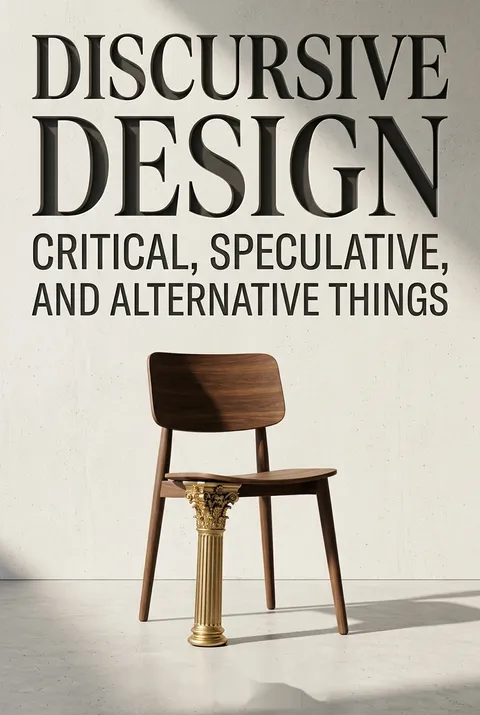
Expanding design's role. Discursive design re-imagines the purpose of designed objects, shifting focus from mere utility and consumption to intellectual engagement. It posits that objects can serve as "intellectual prostheses," deliberately crafted to convey ideas and stimulate reflection, much like tools extend physical capabilities. This approach doesn't seek to replace traditional product design but to expand its potential for societal contribution.
"Good for thinking." Drawing inspiration from anthropologist Claude Lévi-Strauss's concept of "bonnes à penser," discursive design creates "goods for thinking." Instead of objects being valued solely for their practical function ("good to eat"), they are designed to embody complex ideas and values, prompting audiences to look beyond surface aesthetics and utility. This encourages an "anthropological gaze," where artifacts are decoded for their deeper sociocultural meanings.
Legitimizing a new field. This book aims to legitimize, problematize, and conceptualize discursive design as a vital, albeit young, field. It encompasses various "species" like critical design, speculative design, and design fiction, all united by their primary intention to communicate ideas and rouse reflection. By encouraging designers to engage with complex issues, discursive design extends the profession's reach into policy-making, activism, research, and education.
2. Challenging Design's Status Quo with a Four-Field Framework
The problem is that the identity of product design is still so closely tied to utility, service, need, and want, that it is difficult to get beyond a solution-based approach.
Critiquing traditional limitations. The book argues that traditional product design has been complacent, limited by deterministic approaches like functionalism, formalism, and commercialism. These "isms" prioritize utility, aesthetics, and profit, hindering design's potential for deeper intellectual and social engagement. For example:
- Functionalism: Overemphasizes utility, neglecting mind, spirit, and soul.
- Commercialism: Disregards design value outside profit-driven markets.
- Ethnocentrism: Fails to account for and value diverse cultures.
Introducing the Four-Field Framework. To address these limitations and provide a clearer understanding of design's expanding scope, a framework is proposed based on why designers design, rather than what or how. This framework includes:
- Commercial Design: Driven by profit (e.g., Apple iPhone).
- Responsible Design: Focused on serving the underserved (e.g., Hippo Water Roller).
- Experimental Design: Centered on exploration and discovery (e.g., Teresa van Dongen's Ambio lamp).
- Discursive Design: Aimed at audience reflection through ideas (e.g., Paolo Cardini's MONOtask series).
Navigating hybridity. The framework acknowledges that design projects often exhibit hybridity, blending multiple agendas. For instance, a responsible design might also have experimental elements. This approach helps designers clarify their primary intentions, make informed decisions amidst competing demands, and communicate their work more effectively to diverse stakeholders, moving beyond simplistic categorizations.
3. Discourse and Discoursing: The Essence of Communicative Design
Discursive design uses artifacts as the prime vehicle for discoursing a discourse.
Defining discourse and discoursing. The book distinguishes between "discourse" as a system of thought or knowledge (the content) and "discoursing" as the act of communicating (the process). Drawing from Michel Foucault, discourse is understood as powerful, situated systems of ideas, values, and beliefs that shape human existence. Discursive design engages with these substantive issues, aiming to contribute meaningfully to relevant topics.
The About-For-Through framework. To clarify how discourse relates to design, the "About-For-Through" framework is introduced:
- Discourse-about-design: Design history, theory, and criticism.
- Discourse-for-design: Knowledge informing design activity.
- Discourse-through-design: Where discursive design is located, using artifacts to embody and engender discourse.
Artifacts as communicative tools. While all objects can be interpreted discursively, discursive designs are intentionally created with communication as their primary purpose. They are not merely consequences of existing discourses but deliberate carriers of them. This means designers leverage product type, functionality, and appearance to explicitly encode meaning, aiming to "say" something about or to individuals and society.
4. The Road to Reflection: Guiding the Audience's Intellectual Journey
The fundamental operational goal of discursive design is reflection; only after this can higher-order goals of achieving new, preferred attitudes, behaviors, beliefs, values, actions, and so on occur.
Prioritizing reflection. Successful discursive design hinges on guiding the audience toward reflection on the designer's discourse. This "first revolution of the mind" is the essential precursor to any subsequent changes in attitudes, beliefs, or actions. Without reflection, even well-intentioned discursive efforts may fall short of their ultimate goals.
Six steps to reflection. A practical, six-step model outlines the audience's journey:
- Encounter: The audience first comes into contact with the artifact.
- Inspect: The artifact must be intriguing enough to capture attention.
- Recognize: The audience must understand the artifact's discursive agenda.
- Decipher: The audience translates the artifact's aesthetics and semantics into a coherent message.
- Interpret: The audience grasps the meaning of the message.
- Reflect: The audience internalizes and thinks deeply about the message.
Navigating communicative challenges. This process is complex and non-linear, with potential for "noise" and misinterpretation at each stage. Discursive designers must strategically craft artifacts and their surrounding "symbolic environment" to maximize the likelihood of successful communication. This involves understanding that communication through objects is inherently less precise than language, but offers unique experiential and emotive power.
5. Intentionality: Mindsets and Aims for Purposeful Discursive Practice
As a designer you are not there to reduce culture but to improve culture.
Guiding design decisions. Discursive design is presented as a deliberate, goal-seeking process, where the designer's intention is the primary guiding force. This clarity of intent helps navigate the myriad design options and reconcile competing demands, ensuring that efforts are directed toward specific communicative outcomes. This is especially crucial for independent discursive designers who often define their own project parameters.
Five motivational mindsets. Designers approach projects with distinct attitudes:
- Declarative: Clear opinion, seeks to proclaim or criticize.
- Suggestive: Softer assertion, proposes alternatives.
- Inquisitive: Seeks understanding, probes questions.
- Facilitative: Supports partners, instrumental to others' goals.
- Disruptive: Obstructs competing discourses, challenges status quo.
Five specific project aims. Beyond mindsets, designers define specific communicative goals:
- Remind: Reinforce existing thoughts (e.g., Buildings of Disaster souvenirs).
- Inform: Offer new understanding (e.g., Fruit City map of public fruit trees).
- Provoke: Incite reactionary response (e.g., Electronic Tattoo).
- Inspire: Motivate positive thoughts/feelings (e.g., Ella Barbie).
- Persuade: Convince of a position (e.g., Passage for assisted suicide).
Understanding for impact. A designer's deep understanding of the chosen discourse is paramount for ethical responsibility, efficacy, and credibility. Without sufficient knowledge, projects risk propagating misinformation, being ineffective, or lacking authority, especially when addressing complex, external topics beyond design.
6. Crafting the Message: Content and Form for Effective Communication
The fate of all objects is decided in language.
Message-content: Generality vs. specificity. Discursive design offers an endless range of message-content, from broad societal issues (e.g., climate change) to specific technological implications (e.g., biofuels). Designers must negotiate the level of specificity, understanding that broad topics may be easier to communicate but less impactful, while specific topics can be more enlightening but harder to convey precisely through artifacts. This choice influences the intensity, generalizability, and actionability of the discourse.
Message-form: Structuring ideas. Beyond content, the "message-form" (or mode of discourse) is crucial. Drawing from literary composition theory, ten forms are presented as generative tools for structuring ideas:
- Analysis, Description, Classification, Exemplification, Definition
- Comparison-Contrast, Analogy
- Narration, Process, Cause-and-Effect
Designer as author. This facet emphasizes the designer's role as an author, crafting the intellectual material before shaping the physical artifact. For example, a project on childhood obesity could use "exemplification" by showing successful interventions (Pixelate game) or "cause-and-effect" by linking sugary drinks to health issues (Only 1° Can Change Us cups). Multiple message-forms can be combined within a single project to enhance communication, as seen in Dunne & Raby's "United Micro Kingdoms."
7. Designing Dissonance: Scenarios and Artifacts as Provocative Tools
There’s a sweet spot in the middle, where people are scratching their heads, because they’re not quite sure if this is good or bad.
The power of dissonance. Discursive design's effectiveness hinges on creating "dissonance"—a useful friction generated when the audience encounters something that is both recognized and unrecognizable. This "strangely familiar" quality signals that the artifact is not a conventional product, prompting deeper reflection on the underlying discourse. Getting this dissonance "just right" is the core craft of discursive design.
Discursive scenarios: Setting the stage. The "discursive scenario" is the story or context in which the artifact exists, evoking a particular world or future. Designers act as playwrights, creating:
- Rhetorical users: Imagined users within the scenario, distinct from the actual audience.
- Implicit scenarios: Evoked solely by the artifact's physicality (e.g., Julia Lohmann's Cow bench).
- Explicit scenarios: Articulated through narratives, videos, or text (e.g., Sputniko!'s Menstruation Machine video).
Five dimensions of dissonance for scenarios and artifacts: Designers manipulate these to tune the "driving frequency" of their message:
- Clarity: How well the scenario/artifact is understood (from clear to ambiguous).
- Reality: How plausible or real the scenario/artifact seems (from real to unreal).
- Familiarity: How strange or novel the scenario/artifact is (from familiar to unfamiliar).
- Veracity: How truthful or earnest the scenario/artifact is (from truthful to deceptive).
- Desirability: How agreeable or preferable the scenario/artifact is (from desirable to undesirable).
Artifacts as bridges to worlds. Principal artifacts (the designed objects) are often bridges to these scenarios and worlds. They can take center stage (e.g., Khashayar Naimanan's Hidden Wealth nails) or play a supporting role to an explicit narrative (e.g., Agi Haines' Transfigurations babies). The choice of artifact type (physical model, digital rendering, etc.) and its level of refinement also contribute to the desired dissonance.
8. Audience-Centered Design: Strategic Engagement Beyond the User
It is not only, or even primarily, about the stuff that we make, but the communities they’re for and are formed around them.
Shifting focus to audience. Discursive design necessitates an "audience-centered" approach, recognizing that its primary goal is communication and reflection, not just utility for a user. While users (real or rhetorical) are integral to the artifact's meaning, the ultimate target is the audience's intellect. This calls for designers to develop "audience personas" and strategic dissemination plans, rather than relying on passive exhibition.
Three audience relationships. The audience can engage with discursive artifacts in different ways:
- Audience imagines a rhetorical user: Artifacts are observed, and use is conceptualized (e.g., 24110 Nuclear Waste Repository).
- Audience is aware of actual use: Knowledge of others' use adds potency (e.g., Homeless Vehicle Project).
- Audience as user: Direct physical interaction with the artifact (e.g., Umbrellas for the Civil but Discontent Man).
Four dimensions of audience engagement. When designing for audiences, especially when actual use is involved, designers consider:
- Control: The degree of authority the audience has over their experience or the dissemination.
- Involvement: The depth of engagement, from passive viewing to active participation.
- Frequency: How often the audience encounters or uses the artifact.
- Duration: The length of time the audience engages with the artifact.
Beyond social engagement. While most discursive design focuses on social engagement, these audience considerations are also vital for practical application, applied research, and basic research. Understanding the audience's role, whether as patients, research subjects, or policymakers, allows for more tailored and effective discursive interventions.
9. Context and Interaction: Orchestrating the Discursive Experience
Ideally, the future is ethically constructed through people-design-people relationships.
Context as the "theater." The dissemination context is akin to the theater where the discursive "play" is performed. This includes physical spaces (lab, field, showroom, clinic, forums, marketplace) and environmental attributes that influence audience reception. Designers must deliberately choose or design contexts that support their discourse, leveraging advantages and mitigating disadvantages.
Four dimensions of context. Designers consider:
- Attention: How the context affects the audience's focus and willingness to engage.
- Meaning: The symbolic attributes of the context that shape interpretation.
- Mood: The emotional qualities of the environment.
- Management: The designer's control over the dissemination process and audience interaction.
Interaction: Connecting the triad. Interaction involves the dynamic relationships between the designer, the artifact, and the "users" (audience/rhetorical users/actual users). The goal is to deepen engagement and improve communication.
- User-artifact interaction: From creation (e.g., DIY Water Filter) to meeting (e.g., Prayer Companion), use (e.g., Camera Restricta), maintenance (e.g., Grow Your Own Lamb), disposal (e.g., Obscura 1C), and ownership (e.g., OpenSurgery).
- User-designer interaction: Designers can improve conveyance, foster meaningful communication, personalize messages, assemble publics, and build followings through direct engagement.
- Designer-artifact interaction: The designer's relationship with the artifact, from its provenance to adaptation and end-of-life reconstitution, can also convey meaning.
10. Impact and Accountability: Measuring Discursive Design's Value
I think the job very often is to inspire, but with proof; that is the key—inspire with proof.
Defining impact. Impact addresses the beneficial results of discursive design, extending beyond mere audience reflection. It can occur at societal, business, professional, and personal levels. While discursive design always aims for a mental response, broader impact is not guaranteed and is often challenging to measure.
Three successive stages of impact. Impact is understood in progressive stages:
- Primary Impact: Preferred/Instrumental/Relevant Thinking (e.g., audience recognizes the problem of corporate tax avoidance in Taxodus).
- Secondary Impact: Preferred/Relevant Actions (e.g., consumers boycott companies or advocate for policy changes).
- Tertiary Impact: Preferred Social Conditions/Actionable Insights/New Knowledge (e.g., new tax laws are enacted, or researchers gain actionable insights for new products).
Challenges in determining impact. Measuring impact is complex due to:
- Latency: The time it takes for effects to manifest.
- Unintended consequences: Both positive and negative, which complicate assessment.
- Variable contexts: Impact can differ across audiences and environments.
- False indicators: Broad exposure doesn't guarantee deep impact.
The need for accountability. Despite these challenges, demonstrating impact is crucial for legitimizing discursive design, attracting collaborators, and ensuring ethical practice. Designers are encouraged to plan for impact assessment, leveraging design research and marketing tools, and to be realistic about the likelihood of achieving transformative change.
11. The Future of Discursive Design: Evolution, Ethics, and Expanded Reach
What is required for the significant renovation of our [design] field and for the effective expansion of the contributory promise of critical design is a rich and vigorous relationship between a post-critical practice that is not seduced by solution-ism . . . ; a speculative practice that continues to examine the deeper social, political, cultural and systemic origins of the problems we face; and a healthy culture of criticism to keep us honest.
Post-criticality and action. Discursive design is at a pivotal stage, reflecting on debates from critical and post-critical architecture. The future demands both critical reflection and a commitment to action. While intellectual outcomes are valuable, there's a growing imperative for discursive design to contribute to tangible change, moving beyond mere commentary to actively shaping preferred futures. This involves integrating discursive goals with practical results, whether through social engagement, practical application, or research.
New educational models and partnerships. To address its current shortcomings, particularly in understanding complex social topics, discursive design needs:
- Interdisciplinary education: Training designers in social sciences/humanities, or bringing non-designers into the field.
- Collaborative teaching: Co-taught studios with experts from diverse fields.
- Strategic partnerships: Collaborating with marketing firms for dissemination, or with corporations/governments for foresight and research.
Leveraging new tools and ethical standards. The field must embrace new technologies like VR, AR, AI, and crowdfunding platforms for enhanced communication and interaction, while critically engaging with their ethical implications. Furthermore, the book calls for the discursive design community to develop ethical and performance standards, fostering a culture of self-reflection and accountability. This ongoing, agonistic debate about "what should be" is vital for the field's maturation and its ability to contribute meaningfully to a complex world.
People Also Read

Download PDF
Download EPUB
.epub digital book format is ideal for reading ebooks on phones, tablets, and e-readers.








































