


Key Takeaways
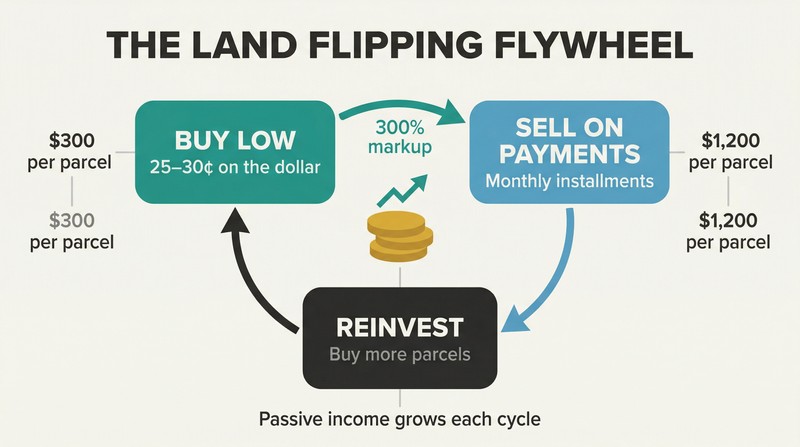
Buy land for pennies, sell it on monthly payments, repeat
The entire book distilled to one move. Mark Podolsky spent his last $3,000 at a New Mexico tax auction, bought 10 half-acre parcels at $300 each, and sold them all within 30 days at $1,200 each — a 300% return. His next auction turned $9,000 into over $90,000 in six months. The model is deceptively simple: find landowners willing to sell for 25 – 30 cents on the dollar, buy their raw land, then resell it — ideally on monthly installment plans that generate recurring passive income.
You don't need experience or capital. Podolsky started dead broke, fighting with his wife about organic baby food. He's since completed over 5,000 deals, claims he's never lost money on a single parcel, and now works roughly two hours per week managing the operation.
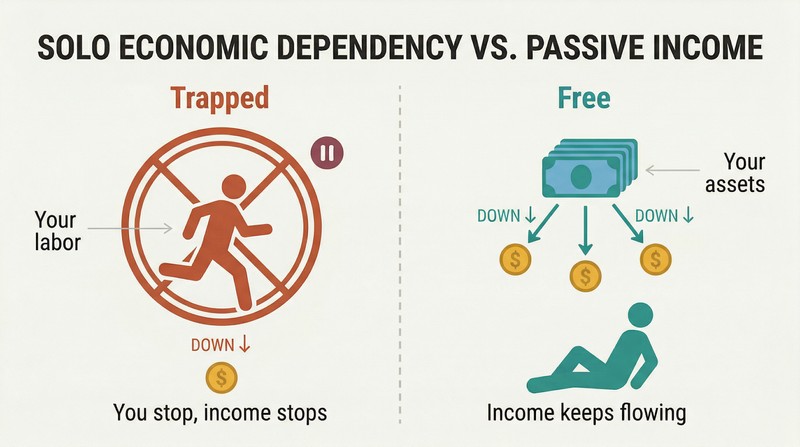
If your income dies when you stop working, you're sick
Podolsky calls it solo economic dependency — the condition where your earnings depend entirely on your continued labor. It afflicts not just cubicle workers but also dentists, lawyers, and freelancers who think they're independent but are actually chained to their practices. As a former dental business broker, Podolsky saw the reality: the dentist only made money with his hands in someone's mouth.
Most Americans are in a Red Queen's Race — running as fast as they can just to stay in place, with most families unable to scrape together even $1,000 in savings. The cure isn't working harder; it's building assets that produce income whether you show up or not. That's what owner-financed land notes are designed to provide.
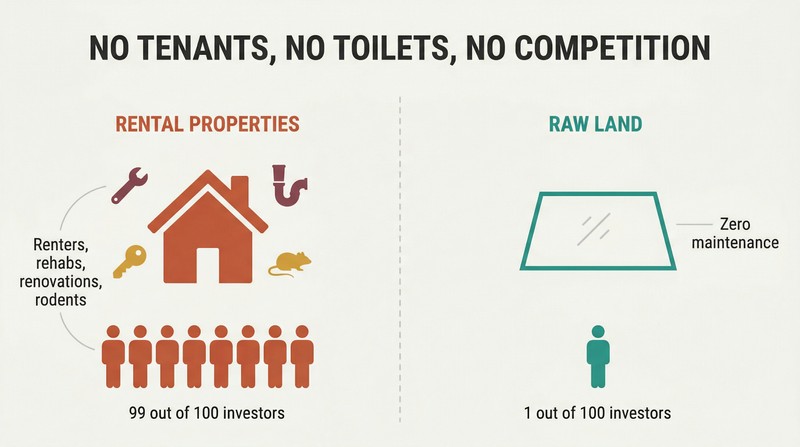
Raw land has no tenants, no toilets, and almost no competition
Land sidesteps the "four Rs" of traditional real estate — renters, rehabs, renovations, and rodents. Podolsky's neighbor, an anesthesiologist with 22 rental properties, spends every weekend handling tenant emergencies. Podolsky owns 80+ properties in a family trust and does zero maintenance. Raw land just sits there — no plumbing breaks, no evictions, no contractor delays.
The competitive landscape is barren. At any Real Estate Investor Association meeting with 100 people, 99 will be house flippers, wholesalers, or landlords. Land investors might number one or two. Unlike stocks, you control the asset completely — you set pricing, choose location, and decide on improvements. And unlike housing, multibillion-dollar hedge funds aren't competing with you for rural five-acre parcels.
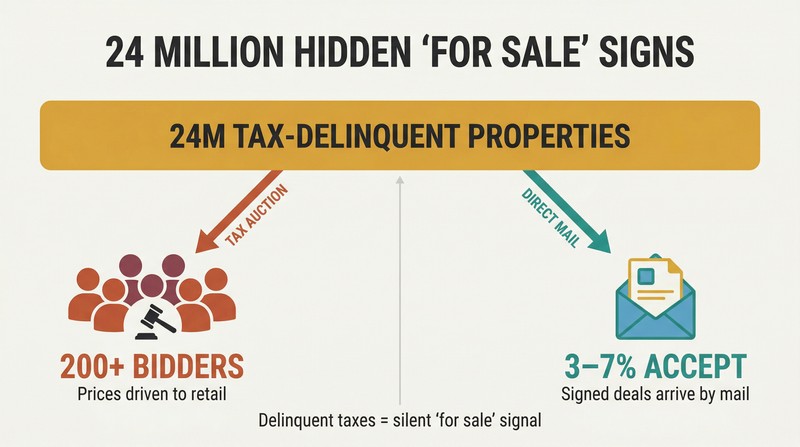
24 million tax-delinquent owners are secretly advertising land for sale
Distressed sellers are everywhere. According to TaxSaleLists.com, roughly 24 million U.S. properties have delinquent taxes. These owners inherited unwanted parcels, invested in busted growth areas, or simply can't afford the bills anymore. Many would gladly sell for a fraction of market value — some even give land away free just to escape the annual tax burden.
Skip the auctions entirely. Rather than competing at tax deed auctions — where 200 bidders can drive prices to retail — Podolsky writes direct "take it or leave it" offer letters to delinquent owners before foreclosure. His students consistently get 3 – 7% acceptance rates per 100 letters mailed. No phone negotiations, no appraisal conversations — just signed purchase agreements arriving in the mail.
Divide the median comparable price by four — that's your offer
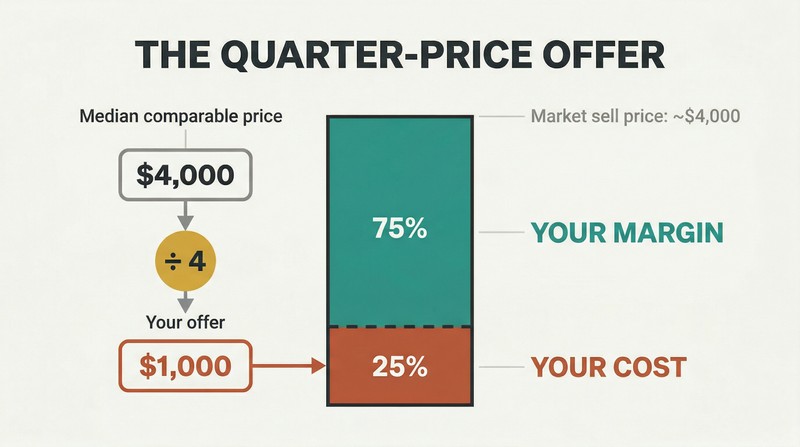
The pricing formula is brutally simple. Research comparable sales on land websites for your target county, calculate the median price, and divide by four. If one- to two-acre parcels in your county sell for $4,000, you offer $1,000. This creates what Podolsky calls a "300% margin of safety" and leaves enormous room for profit on the sell side.
Expect angry rejections — and ignore them. Some sellers mail back profanity-laced refusals. That's irrelevant. What matters is the 3 – 5% who sign and return the purchase agreement. Podolsky stresses a critical point: don't research back taxes or property details before mailing. You're in the offer business, not the appraisal business. Deep due diligence comes only after an acceptance arrives.
Owner financing turns one-time flips into monthly subscriptions
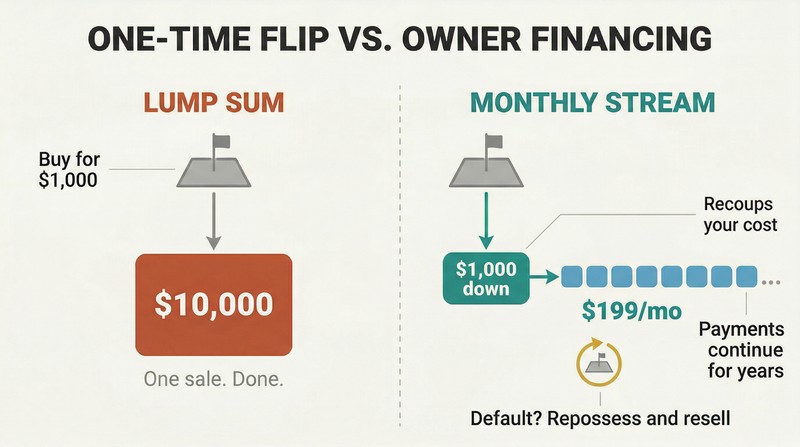
This is the passive income engine. Instead of selling land for a lump sum, sell it on a note with interest — structured like a car payment. Buy a parcel for $1,000, sell it for $10,000 with $1,000 down and $199/month. You often recoup your initial investment from just the down payment alone, then collect monthly payments for years. Student Tate Litchfield bought 40 acres in Oregon for $5,000 and sold it for $22,900 — $3,000 down plus $499/month.
Owner financing completes Podolsky's perfect business framework — adding recurring revenue and built-in switching costs (defaulting means losing the property). If a buyer defaults, you repossess the land at a lower cost basis and resell it, often making even more the second time.
Earning $800K/year won't help if spending always catches up
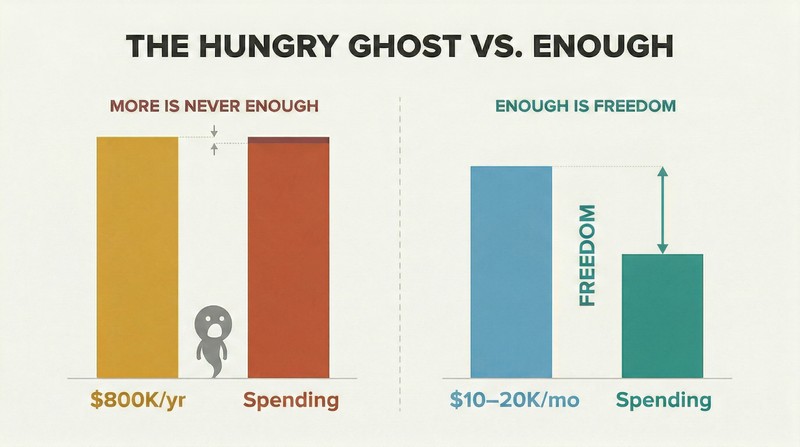
Podolsky learned this through collapse. Making over $800K annually flipping land, he bought a million-dollar house, a Lexus, hired a nanny and housekeeper, and enrolled his kids in private school. He calls this Parkinson's Law of Money — spending expands to consume available income — and borrowed the Buddhist concept of the "hungry ghost," a creature that can never eat enough. When the 2008 recession hit, the lifestyle imploded. He short-sold the house, sold the car, and suffered a panic attack that sent him to the hospital.
The aftermath was liberating. Therapy helped him rediscover what mattered: family game nights, hiking, gratitude. Happiness research shows marginal gains flatline around $250K. His revised target: $10K – $20K/month in passive income — enough for freedom, not enough to feed a ghost.
Never stop mailing offers — deal flow is everything
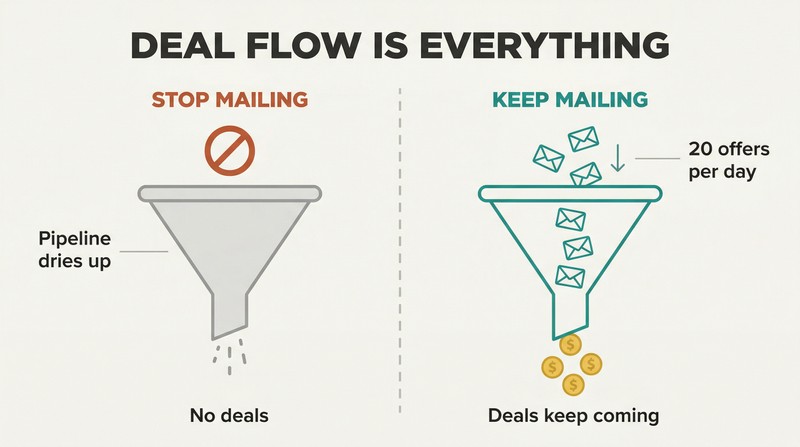
Mailing is the lifeblood. Podolsky's mantra for beginners: "twenty in the box" — twenty offer letters per day, yielding 100 per week, enough to evaluate your response rate and keep deals flowing. Student Fred stopped mailing when things got busy, watched his pipeline dry up, developed shiny object syndrome chasing forex and house-flipping programs — until 10 dormant properties suddenly sold in one week, proving the model worked all along.
The biggest mistake Podolsky sees is students pausing the mail when things get busy or discouraging. Every property sells eventually — he claims a 100% sell rate since 2001. But the machine only works if you keep feeding it. As he puts it, deals are like buses: another one is always rolling down the road if you wait a few minutes.
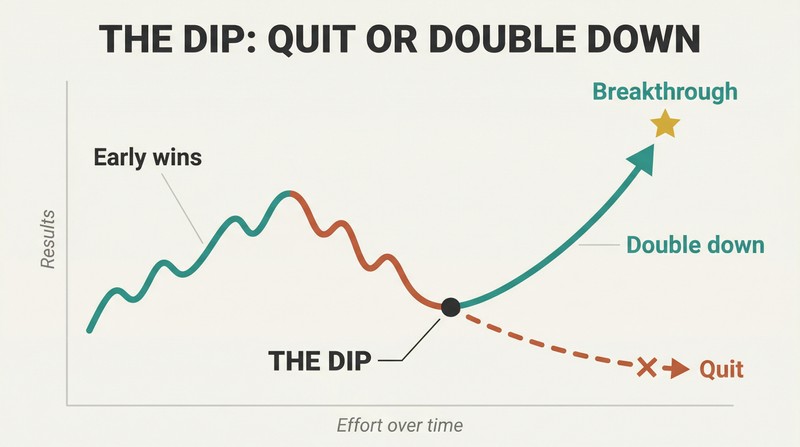
Expect the dip, then double down instead of bailing
Every land business hits a plateau. Borrowing from Seth Godin's The Dip, Podolsky describes the inevitable pattern: initial small wins, then a maddening stretch where nothing happens despite more effort. Student John listed a property and got zero inquiries for months. He retooled his strategy and doubled down. Then overnight, a thrilled buyer appeared and the deal closed.
Survive it by focusing on controllables. You can't control whether buyers appear, but you can control daily actions: county research completed, offers mailed, properties priced correctly, ads posted. If all controllable boxes are checked, results become inevitable. Podolsky warns that the worst business decisions are emotional reactions to temporary dips. If the model is proven, quitting during a dip is the costliest mistake you can make.
Automate until your 13-year-old could run the business
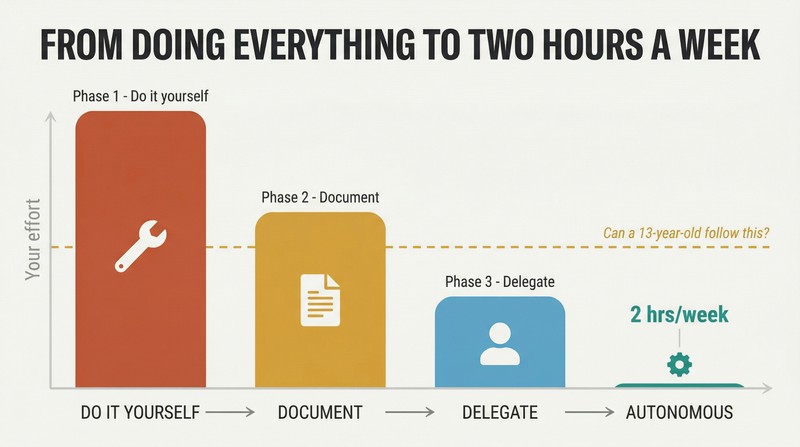
Podolsky works two hours per week "in" his business. He manages an acquisition manager and virtual assistants in the Philippines at $3 – 5/hour who handle list scrubbing, due diligence, mailings, and note management. His clarity test: if his 13-year-old daughter can't understand the process documentation, he rewrites it until she can. This ensures no single person — including him — is indispensable.
But don't automate prematurely. Referencing Michael Gerber's The E-Myth, Podolsky insists most entrepreneurs build a job, not a business. First, do the work yourself — scrub at least one tax-delinquent list, close a few deals, feel the frustration. Only then document the process and delegate. He committed to 36 months of focused daily effort before his systems were fully autonomous. The payoff: passive income that arrives while he sleeps.
Analysis
Dirt Rich is simultaneously a genuine business playbook and a masterful sales funnel. Podolsky disarms skepticism by front-loading his entire model in the preface, then draws readers deeper into a narrative that strategically withholds execution details — proprietary letter templates, county lists, software tools — behind paid programs. This tension between generosity and commerce is the book's defining feature.
The core model exploits a genuine market inefficiency. Raw land sits in a blind spot between institutional investors chasing housing and retail investors following stocks and crypto. With nearly 24 million tax-delinquent properties and virtually no organized competition, the arbitrage opportunity is real and unusually durable, since the informational asymmetry that enables it is structural, not temporary. The behavioral insight is equally sharp: sellers who've stopped paying taxes have psychologically disowned their land, making them receptive to offers that any rational market participant would reject. Adding owner financing transforms a simple buy-low-sell-high operation into a recurring revenue machine — genuinely elegant financial engineering.
What elevates the book beyond typical real estate pitches is the Parkinson's Law of Money narrative. Podolsky's confession of earning $800K while becoming progressively miserable — culminating in a panic attack and forced downsizing — provides emotional credibility that pure how-to content cannot. This vulnerability also anchors the $10K – $20K/month passive income target as reasonable rather than fantastical.
The framework of solo economic dependency deserves attention beyond land investing. It reframes trading time for money as a diagnosable condition rather than an inevitable reality. Combined with the four perfect business criteria — no inventory, recurring revenue, switching costs, pricing power — this provides an analytical lens applicable to evaluating any business opportunity or career path.
Skeptics should note the survivorship bias in student testimonials and the implausibility of 5,000+ deals with zero losses. Markets shift, competition can emerge, and the author's paid ecosystem creates incentive structures worth examining. Still, the underlying logic — buy distressed assets cheaply, add value through financing and marketing, automate operations — represents sound financial thinking that transcends any single niche.
Review Summary
Dirt Rich receives mixed reviews, with an average rating of 3.96/5. Readers appreciate the innovative approach to land investing and passive income potential. Many find the book informative and easy to understand, praising its straightforward advice. However, some criticize it for lacking detailed implementation steps and being overly promotional of the author's paid programs. Critics also note grammatical errors and excessive filler content. Despite these drawbacks, several readers consider it a valuable introduction to land investing, inspiring them to explore the field further.
People Also Read




Glossary
Solo economic dependency
Income requires your constant laborA condition Podolsky identifies where a person's income stops entirely when they stop working. It afflicts employees, freelancers, and even professionals like dentists and lawyers whose earnings depend on their personal presence. The cure, per Podolsky, is building assets that generate passive income independent of your direct labor.
Parkinson's Law of Money
Spending rises to match incomePodolsky's adaptation of the original Parkinson's Law ('work expands to fill the time allotted'). Applied to finances, it describes how spending automatically expands to consume available income, regardless of how much that income grows. Combined with what he calls 'hungry ghost syndrome'—a Buddhist concept for insatiable craving—it explains why high earners can still feel broke and trapped.
The perfect business
Four-criteria business evaluation frameworkA framework Podolsky developed with his early mentor Raj for evaluating any business model. The four criteria are: (1) no physical inventory, (2) a one-time sale followed by recurring revenue, (3) built-in pain or hassle for the customer to opt out, and (4) a niche without competitive pricing pressures. Raw land with owner financing meets all four.
Scrubbing a list
Cleaning raw tax-delinquent dataThe process of taking a raw tax-delinquent property list from a county treasurer—typically a messy spreadsheet full of codes, amounts, and property descriptions—and filtering it into a clean mailing list. This involves removing duplicate owners, other land investors, out-of-country owners, and organizing data into usable columns (APN, owner name, address, parcel size, land use code).
Twenty in the box
Daily minimum offer mailing targetPodolsky's mantra for beginning land investors: mail at least twenty offer letters per day. This produces roughly 100 offers per week—enough volume to evaluate response rates (targeting 3–5% acceptance) and maintain consistent deal flow. The simplicity is intentional: almost anyone can stuff and stamp twenty envelopes in under an hour, making it a sustainable daily habit.
FAQ
What's "Dirt Rich" about?
- Overview: "Dirt Rich" by Mark Podolsky is about creating passive income through land investing without the typical hassles associated with real estate, such as dealing with tenants or renovations.
- Author's Journey: The book details Podolsky's journey from a corporate job to financial freedom through land investing, sharing his personal experiences and lessons learned.
- Focus on Land: It emphasizes the unique benefits of land as an investment, highlighting its low maintenance and potential for high returns.
- Practical Guide: The book serves as a practical guide, offering step-by-step instructions on how to start and succeed in the land investing business.
Why should I read "Dirt Rich"?
- Passive Income Strategy: It provides a unique strategy for generating passive income, which can be appealing for those looking to escape the traditional 9-to-5 grind.
- Real-Life Success: The book is based on the author's real-life success, offering proven methods rather than theoretical advice.
- Comprehensive Guide: It covers everything from finding deals to closing sales, making it a comprehensive resource for aspiring land investors.
- Inspiration and Motivation: Podolsky's personal story and insights can inspire and motivate readers to pursue their own financial freedom.
What are the key takeaways of "Dirt Rich"?
- Land Investing Benefits: Land is a low-maintenance, high-return investment with less competition compared to other real estate markets.
- Systematic Approach: Success in land investing requires a systematic approach, including due diligence, marketing, and automation.
- Mindset and Grit: A successful investor needs the right mindset, including resilience and the ability to embrace challenges.
- Financial Freedom: The ultimate goal is to achieve financial freedom and flexibility, allowing for a lifestyle of choice and fulfillment.
How does Mark Podolsky define "passive income" in "Dirt Rich"?
- Beyond Traditional Definitions: Podolsky defines passive income as money earned with minimal ongoing effort after initial systems are set up.
- Automation and Delegation: He emphasizes the importance of automation and delegation in achieving true passive income.
- Land Notes: In the context of land investing, passive income is generated through owner-financed land sales, creating a steady cash flow.
- Long-Term Strategy: Passive income is seen as a long-term strategy that requires upfront work but pays off with consistent returns over time.
What is the "Disease of Solo Economic Dependency" according to "Dirt Rich"?
- Definition: Solo economic dependency is the reliance on a single source of income, typically from a job, which limits financial freedom.
- Vulnerability: It highlights the vulnerability of depending solely on active income, as it can be disrupted by job loss or economic downturns.
- Solution: Podolsky advocates for diversifying income streams through land investing to break free from this dependency.
- Financial Security: The goal is to achieve financial security and independence by creating multiple sources of passive income.
What is the "perfect business" model described in "Dirt Rich"?
- Characteristics: The perfect business has no physical inventory, offers recurring revenue, and has minimal competitive pricing pressures.
- Land Investing Fit: Land investing fits this model as it involves low maintenance, unique assets, and the potential for owner financing.
- Recurring Revenue: By selling land with owner financing, investors can create a steady stream of income from installment payments.
- Scalability: The business model is scalable, allowing investors to grow their portfolio and income over time.
How does Mark Podolsky suggest finding land deals in "Dirt Rich"?
- Tax Delinquent Lists: Podolsky recommends obtaining lists of tax-delinquent properties from county assessors as a starting point.
- Direct Mail Offers: He advises sending direct mail offers to these property owners, proposing to buy their land at a discount.
- No Negotiation: The approach is to make straightforward offers without engaging in lengthy negotiations, focusing on motivated sellers.
- Volume and Consistency: Success comes from consistently sending out offers and building a pipeline of potential deals.
What is the "due diligence" process in land investing according to "Dirt Rich"?
- Verification: Due diligence involves verifying the property's details, including ownership, title status, and any liens or encumbrances.
- Property Assessment: It includes assessing the property's location, access, and potential issues like zoning restrictions or environmental concerns.
- Remote Research: Podolsky emphasizes that much of this research can be done remotely using online resources and local contacts.
- Risk Mitigation: The process is crucial for mitigating risks and ensuring that the investment is sound and profitable.
What role does automation play in "Dirt Rich"?
- Efficiency: Automation is key to managing the land investing business efficiently, reducing the time spent on repetitive tasks.
- Tools and Systems: Podolsky discusses using tools and systems to automate processes like marketing, due diligence, and payment collection.
- Scalability: Automation allows investors to scale their business without being bogged down by day-to-day operations.
- Focus on Growth: By automating routine tasks, investors can focus on strategic growth and expanding their portfolio.
What are the best quotes from "Dirt Rich" and what do they mean?
- "Buy assets pennies on the dollar." This quote emphasizes the importance of acquiring undervalued properties to maximize returns.
- "Embrace the suck." It highlights the need to persevere through challenges and setbacks to achieve success.
- "There’s a pig for every barn." This means that every piece of land has a potential buyer, reinforcing the idea that all properties can be sold.
- "I can make more money, but I can’t get more time." This underscores the value of time and the importance of creating a lifestyle that prioritizes freedom and flexibility.
How does "Dirt Rich" address the mindset needed for success in land investing?
- Resilience: Podolsky stresses the importance of resilience and the ability to push through difficult times.
- Growth Mindset: A growth mindset is crucial for learning from mistakes and continuously improving one's approach.
- Focus on Goals: Successful investors maintain a clear focus on their long-term goals and the steps needed to achieve them.
- Adaptability: Being adaptable and open to new strategies and technologies is key to staying competitive in the market.
What is the significance of "deal flow" in "Dirt Rich"?
- Lifeblood of Business: Deal flow is described as the lifeblood of the land investing business, essential for maintaining a steady income.
- Consistent Offers: Consistently sending out offers is crucial for generating a continuous stream of potential deals.
- Pipeline Management: Managing a pipeline of deals ensures that investors always have properties to buy and sell.
- Avoiding Stagnation: Regular deal flow prevents business stagnation and keeps the investor's portfolio active and profitable.
Download PDF
Download EPUB
.epub digital book format is ideal for reading ebooks on phones, tablets, and e-readers.








































