


Key Takeaways
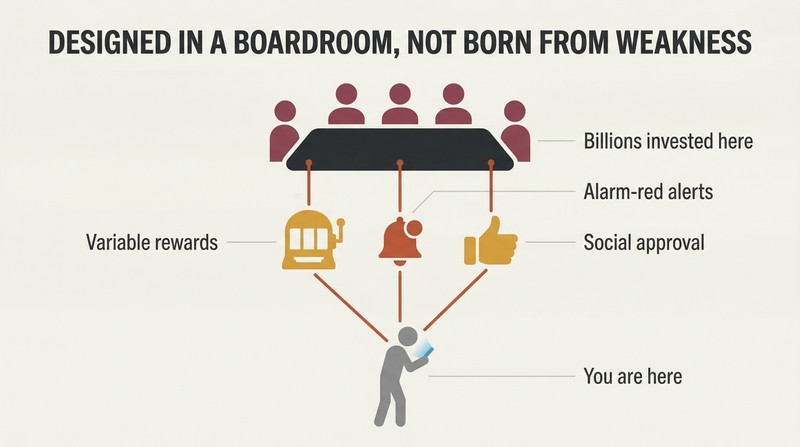
Your compulsive screen habit was designed in a boardroom, not born from weakness
Tech companies engineer addiction. Tristan Harris, a former Google engineer turned whistleblower, confirmed on 60 Minutes that smartphones function like slot machines — using intermittent positive reinforcement, the same mechanism that kept pigeons pecking in classic psychology experiments. Facebook's notification icon was originally blue; they changed it to alarm-red because "no one used it," and clicking skyrocketed.
Social approval drives the trap. Sean Parker, Facebook's founding president, admitted the design philosophy was "How do we consume as much of your time and conscious attention as possible?" Our Paleolithic brains treat likes, tags, and streaks as tribal survival signals. Leah Pearlman, who helped develop the Like button, now hires someone else to manage her Facebook to avoid its manipulation.
Focus your online life on a few tools that serve your deepest values
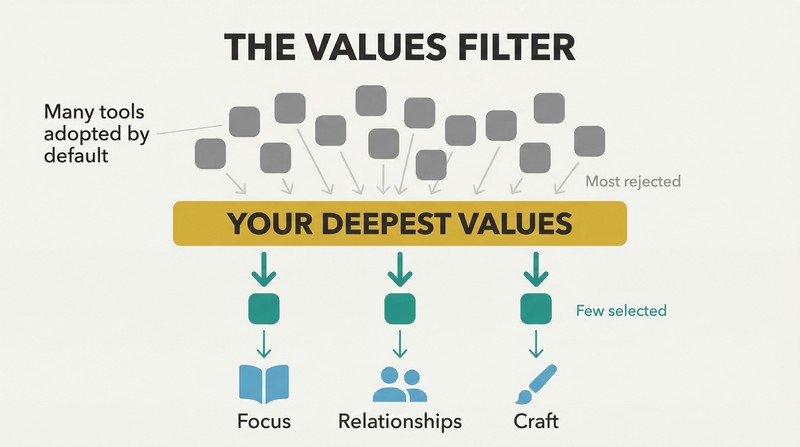
Digital minimalism is a philosophy of technology use where you focus your online time on a small number of carefully selected and optimized activities that strongly support things you value — and happily miss out on everything else. It contrasts with the default maximalist mind-set, where any potential benefit justifies adopting a new tool.
This isn't about rejecting technology. Tyler quit all social media, started volunteering and reading four books a month, and earned a promotion from increased focus. Dave restricted Instagram to posting one art project weekly — freeing time to draw daily lunchbox pictures for his three kids. Carina kept Facebook but reduced her friends to 14 council members and unfollowed them all, keeping her newsfeed empty. She spends minutes per week; the average user spends over fifty minutes per day.
Measure each app's cost in minutes of your life, not just its benefits
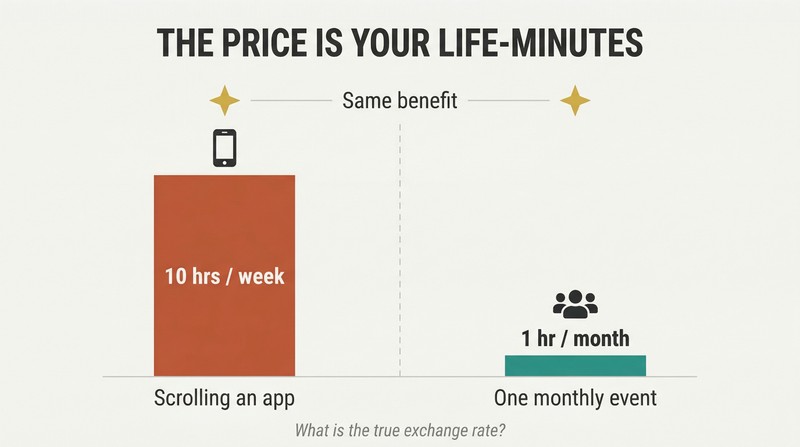
Thoreau's "new economics" from Walden reframes cost: the price of a thing is the amount of life required to be exchanged for it. His Concord neighbors worked sixty-acre farms to afford venetian blinds and fancy wagons — luxuries that devoured more life than they returned. This same calculation applies to digital tools.
Consider Twitter: if it consumes ten hours per week but mainly offers occasional interesting connections, you could attend one event per month and chat with three people — gaining similar value for roughly thirty-seven fewer hours. Individual apps seem harmless in isolation, but their cumulative cost in life-minutes compounds. Like Thoreau's overburdened farmers, you end up "crushed and smothered" under demands that return only trinkets.
Reset your entire digital life with a 30-day declutter
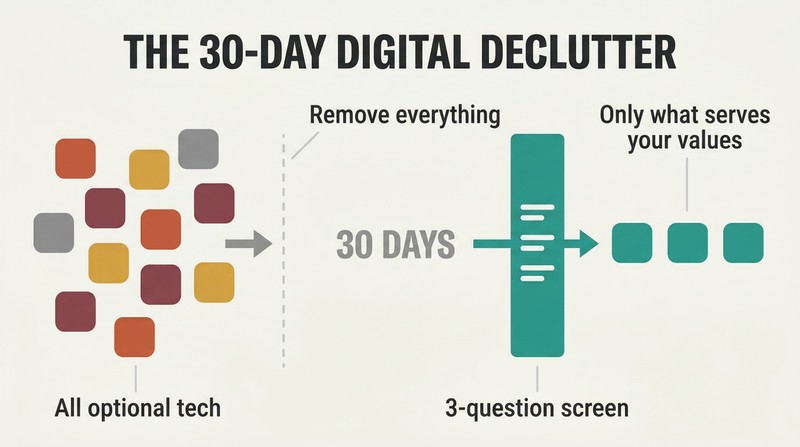
The digital declutter is Newport's prescribed method for adopting digital minimalism. For 30 days, step away from optional technologies — apps, social media, streaming, games. Use the break to rediscover analog activities. Then reintroduce technologies one by one through the Minimalist Technology Screen:
1. Does this directly support something I deeply value?
2. Is this the best way to use technology for that value?
3. What operating procedures will constrain when and how I use it?
Newport tested this with 1,600 volunteers. Most found detox symptoms faded within two weeks. One participant knew the hourly weather in four cities during week one — her compulsion to check something was that strong. By week two, the craving dissolved entirely.
Protect daily time alone with your thoughts — it's non-negotiable
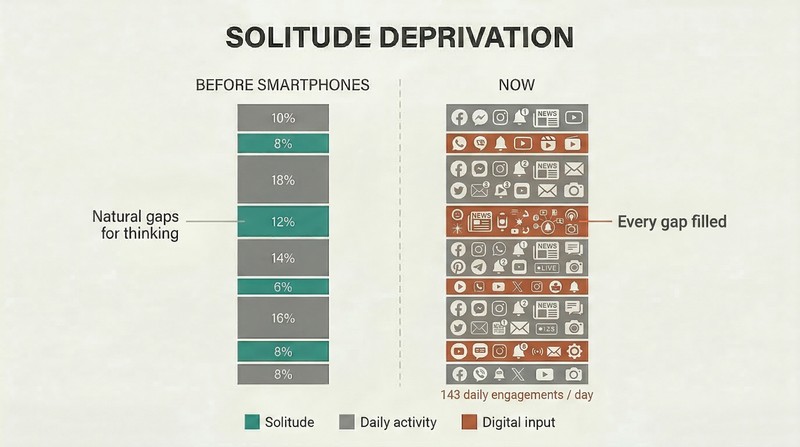
Solitude deprivation — spending close to zero time alone with your own thoughts, free from input from other minds — is now widespread for the first time in human history. The iPod made continuous distraction possible; the smartphone made it effortless. The average person picks up their phone 39 times daily, logging three hours of screen time, and those numbers likely skew low.
The consequences are measurable. Teens born after 1995 — the first generation raised on smartphones — show unprecedented spikes in anxiety and depression, coinciding exactly with ubiquitous smartphone ownership around 2012. Lincoln wrote the Emancipation Proclamation during solitary evenings at a cottage three miles from the White House. Martin Luther King found his courage alone at a kitchen table. Everyone benefits from regular doses of solitude; anyone who eliminates it entirely will suffer.
Stop clicking 'Like' — it trains your brain to accept crumbs as a meal
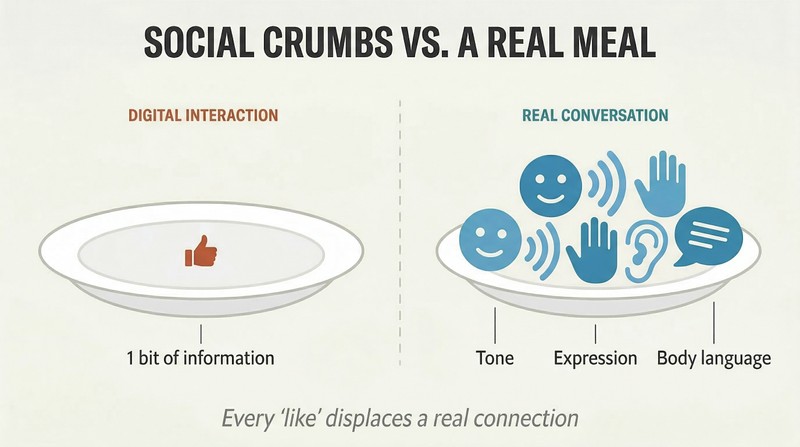
Research reveals a paradox: specific social media behaviors (like receiving a comment from a close friend) modestly boost well-being, but overall use makes people lonelier and less happy. The explanation is displacement — the more you interact online, the less time you invest in real conversation. Holly Shakya's study of 5,200 subjects found Facebook's negative effects on mental health roughly equal the positive effects of offline interaction — a direct trade-off.
Our brains crave rich analog cues — tone, facial expressions, body language — processed by networks honed over millions of years. A like provides exactly one bit of information. That's not driving a Ferrari under the speed limit; it's towing a Ferrari behind a mule. Stop liking, stop commenting, and redirect that energy toward phone calls, visits, or shared meals.
Build strenuous analog hobbies before you cut screen time
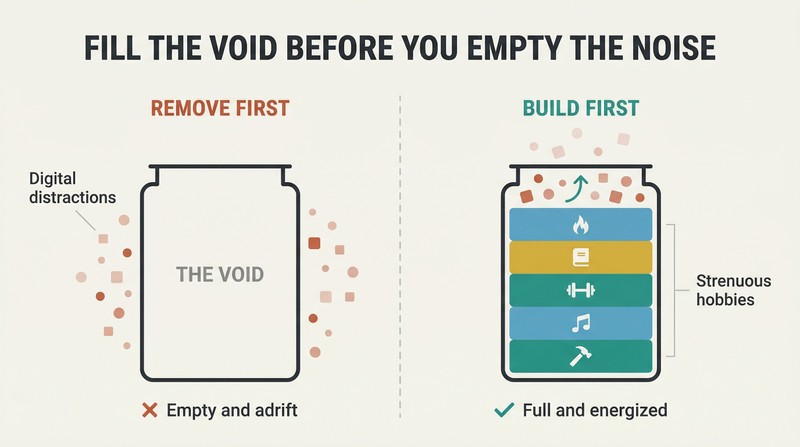
Aristotle argued that a good life requires activities pursued purely for their own satisfaction. When people try digital detoxes without replacing screen time, they feel adrift — not craving a specific app, but having nothing compelling to fill the void. Low-quality distractions were papering over a barren leisure life.
The Bennett Principle (from Arnold Bennett's 1910 self-help guide) holds that expending more energy in leisure actually energizes you. Pete Adeney, who retired in his early thirties, doesn't own a TV — he renovates buildings, welds metal, and plays instruments. Liz Thames heats her Vermont homestead with hand-harvested firewood. Theodore Roosevelt boxed, practiced jujitsu, and read a book per day. Demanding activity consistently beats passive consumption for both happiness and energy.
Delete social media apps from your phone — use the browser only
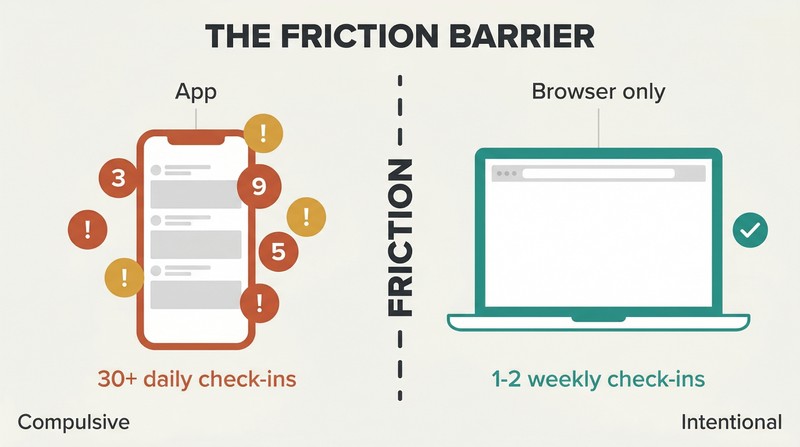
Mobile drives 88% of Facebook's ad revenue. Smartphone apps are specifically designed to be stickier than desktop versions — swipe-to-refresh feeds, alarm-red notification badges, and auto-play videos are mobile-only innovations. Removing the apps from your phone while keeping browser access is a surgical strike that preserves core benefits while dismantling attention traps.
Newport found surprising results when he informally advised readers to try this. A nontrivial percentage who deleted apps stopped using social media entirely — revealing that services they called indispensable were providing nothing more than convenient distraction. Those who continued dropped to one or two browser check-ins per week. The small friction of opening a laptop and logging in was enough to shatter the compulsive cycle.
Set conversation office hours so real calls replace digital pings
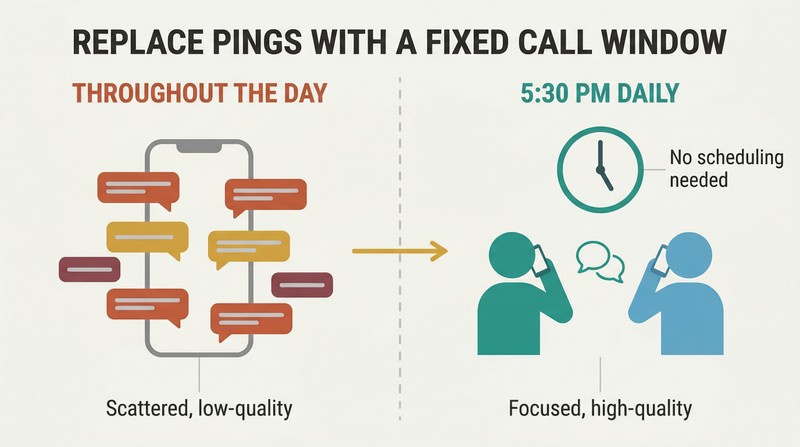
A Silicon Valley executive tells friends he's always available to talk at 5:30 p.m. on weekdays — his daily commute window. No scheduling required; just call. When someone sends a complicated question by text, he replies: "Call me at 5:30 any day." This converts time-consuming low-quality connections into real conversation, and he enjoys a richer social life than most people Newport knows.
You can adapt this. Try coffee shop hours at a regular table, evening walks where friends can join, or expanded office hours for colleagues. The key insight is that people crave real conversation but avoid initiating calls because they fear being intrusive. Fixed, publicized availability removes this friction entirely, making high-quality interaction the path of least resistance.
Evaluate new tech the way the Amish do: start with values, work backward
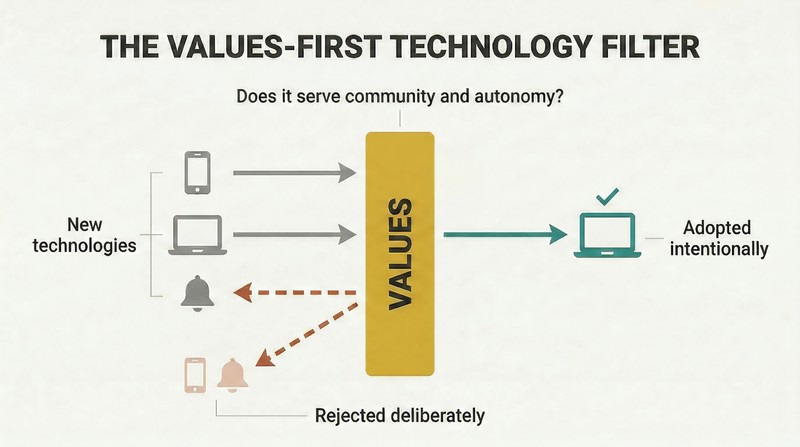
The Amish aren't Luddites — they use rollerblades, solar panels, and $400,000 computer-controlled milling machines. But they evaluate each new technology by asking whether it will bolster community life or erode it. An "alpha geek" tests new tools while everyone observes the impact. Cars are banned because they pulled people away from community, but riding in someone else's car is fine. The power grid is forbidden, but generators and solar panels are acceptable.
This framework works. After Rumspringa — when Amish teens leave to experience modern life — 80 to 90 percent choose to return. A liberal Mennonite named Laura applies similar principles independently: she has never owned a smartphone and describes feeling "a sense of autonomy" from the choice. The act of being selective about technology is itself a deep source of satisfaction.
Analysis
Newport's Digital Minimalism succeeds where most tech-detox advice fails because it correctly diagnoses the problem as philosophical rather than behavioral. Typical prescriptions — turn off notifications, observe a digital Sabbath — treat symptoms while leaving the disease untouched. Newport argues that without a coherent values-based framework, individual tactics inevitably erode under the pressure of attention-engineering. This philosophical depth distinguishes the book from lighter genre entries.
The Thoreau economic framing is the book's most intellectually ambitious move. By converting digital tool costs from abstract unease into concrete life-minutes, Newport provides a decision-making calculus that transcends personal opinion — mirroring how environmentalism gained traction by quantifying externalities. The Amish analysis is equally subversive: by demonstrating that one of America's most enduring communities employs a sophisticated technology evaluation framework, Newport neutralizes the 'Luddite' accusation that typically derails these conversations.
The weakest section is arguably the social media paradox discussion, which synthesizes genuinely contradictory research without fully resolving the tension — though Newport's displacement insight (online interaction crowding out offline) has been increasingly supported by subsequent research. His claim linking solitude deprivation to the iGen mental health crisis, while plausible, relies on correlational data that has faced methodological challenges from researchers like Andrew Przybylski at Oxford.
What elevates the book above contemporaries is the leisure chapter — arguably its most important yet least discussed contribution. By recognizing that screen addiction often masks a poverty of meaningful leisure, Newport identifies why most digital detoxes fail: they create a vacuum without filling it. The sequence matters — build the life first, then remove distractions. This insight, drawing from Aristotle through Arnold Bennett to CrossFit, is more psychologically sophisticated than it appears and represents the book's most enduring contribution to the genre.
Review Summary
Digital Minimalism receives mixed reviews, with many praising its practical advice on reducing technology use and reclaiming focus. Readers appreciate Newport's balanced approach, acknowledging technology's benefits while critiquing its addictive nature. Some find the book life-changing, implementing digital detoxes and reevaluating their relationship with social media. Critics argue it lacks nuance, overlooks certain demographics, and doesn't fully address modern work realities. The writing style and structure receive both praise and criticism. Overall, most readers find value in the book's core message of intentional technology use.
People Also Read






Glossary
Digital minimalism
Values-based philosophy of technology useA philosophy of technology use in which you focus your online time on a small number of carefully selected and optimized activities that strongly support things you value, and then happily miss out on everything else. It contrasts with the default maximalist approach where any potential benefit justifies adopting a new tool.
Digital declutter
30-day technology reset processA three-step process for adopting digital minimalism: (1) take a 30-day break from optional technologies, (2) use that period to rediscover satisfying analog activities, and (3) reintroduce technologies selectively using the Minimalist Technology Screen. Newport tested this with over 1,600 volunteers who reported significant clarity and lifestyle improvements.
Solitude deprivation
Near-zero time alone with thoughtsA state in which you spend close to zero time alone with your own thoughts and free from input from other minds. Newport argues this condition has become widespread for the first time in human history due to smartphones and ubiquitous connectivity, and is linked to rising anxiety, especially among teens raised on these devices.
Minimalist Technology Screen
Three-question technology reintroduction filterA screening process applied when reintroducing optional technologies after a digital declutter. Each technology must (1) serve something you deeply value, (2) be the best way to use technology for that value, and (3) have a defined operating procedure specifying when and how you use it.
Conversation-centric communication
Only real conversation maintains relationshipsA philosophy holding that only rich, analog conversation—face-to-face meetings, phone calls, or video chats involving nuanced cues like tone and facial expressions—counts toward maintaining a relationship. Text-based communication (social media, texting, email) is downgraded to a logistical support role for arranging real conversations.
Bennett Principle
Strenuous leisure generates more energyNamed by Newport after Arnold Bennett's 1910 guide How to Live on 24 Hours a Day. The principle holds that the value received from leisure is proportional to the energy invested—expending more effort on demanding activities during free time actually leaves you more energized than passive consumption like screen browsing.
Thoreau's new economics
Measure cost in life-minutesA framework drawn from Thoreau's Walden, attributed to philosopher Frédéric Gros, that redefines cost: the price of a thing is the amount of life required to be exchanged for it. Applied to technology, it asks users to weigh the total life-minutes consumed by a digital tool against its actual benefits, rather than evaluating benefits in isolation.
Attention resistance
Movement against attention economy exploitationA loosely organized movement of individuals who combine high-tech tools with disciplined operating procedures to extract value from attention economy services while avoiding compulsive use. Tactics include blocking software like Freedom, using social media only on desktop browsers, embracing Slow Media consumption, and replacing smartphones with simpler devices.
FAQ
What's "Digital Minimalism: Choosing a Focused Life in a Noisy World" about?
- Philosophy of Intentional Use: "Digital Minimalism" by Cal Newport advocates for using technology intentionally to enhance life rather than detract from it.
- Focus on Values: The book emphasizes focusing online time on a small number of carefully selected activities that support your values.
- Reclaiming Attention: It argues against mindless adoption of digital tools and stresses reclaiming attention from the digital attention economy.
Why should I read "Digital Minimalism"?
- Regain Control: The book offers insights into regaining control over your digital life by reducing time spent on low-value activities.
- Improve Well-being: Newport discusses how excessive technology use negatively impacts mental health and well-being, offering strategies to counteract this.
- Actionable Strategies: It provides practical advice and real-life examples to help implement digital minimalism effectively.
What is the "Digital Declutter" process in "Digital Minimalism"?
- 30-Day Break: The process involves a 30-day break from optional technologies to reset digital habits and gain clarity.
- Rediscover Meaningful Activities: During this period, you explore activities that bring satisfaction and meaning to your life.
- Selective Reintroduction: After the break, reintroduce only technologies that serve your deeply held values, using them intentionally.
What are the key takeaways of "Digital Minimalism"?
- Intentional Technology Use: Focus on tools that provide significant value and eliminate those that do not.
- Digital Declutter: A structured process to reset your relationship with technology and identify essentials.
- High-Quality Leisure: Replace low-value digital distractions with activities that offer deeper satisfaction and fulfillment.
How does "Digital Minimalism" suggest handling social media?
- Intentional Use: Use social media only if it supports something you deeply value, avoiding mindless scrolling.
- Set Procedures: Establish strict rules for when and how you use these platforms to maximize benefits.
- Prioritize Real Interactions: Emphasize real-world interactions over digital connections for more substantial social fulfillment.
What is the role of solitude in "Digital Minimalism"?
- Crucial for Reflection: Solitude is essential for self-reflection, emotional balance, and generating new ideas.
- Combat Solitude Deprivation: Constant connectivity leads to anxiety and lack of clarity; solitude helps counteract this.
- Practical Practices: Newport suggests practices like leaving your phone at home and taking long walks to cultivate solitude.
How does "Digital Minimalism" address technology addiction?
- Designed to be Addictive: Many digital tools use psychological hooks like intermittent reinforcement to keep users engaged.
- Understanding Mechanisms: Recognizing these mechanisms helps resist compulsive use and regain autonomy over attention.
- Breaking Free: The book provides strategies to break free from addictive patterns and focus on meaningful activities.
What are some practical steps to implement digital minimalism according to Cal Newport?
- Conduct a Digital Declutter: Start with a 30-day break from optional technologies to reset habits.
- Set Clear Rules: Establish clear rules for technology use to align with your values and goals.
- Engage in High-Quality Leisure: Replace mindless digital consumption with activities that require skill and effort.
What is the conversation-centric communication philosophy in "Digital Minimalism"?
- Focus on Real Conversations: Prioritizes real conversation over digital connection, emphasizing analog cues like tone and expressions.
- Supportive Digital Connection: Digital tools should support arranging conversations, not replace them.
- Deeper Interactions: Reduces digital interactions to focus on deeper, more meaningful relationships.
How does "Digital Minimalism" address the attention economy?
- Attention Economy Explained: Describes a business model that profits from capturing consumer attention through digital distractions.
- Resistance Movement: Introduces an attention resistance movement to extract value from digital services without falling into traps.
- Strategies for Resistance: Offers strategies like deleting social media apps and using tools to block distractions.
What are some memorable quotes from "Digital Minimalism" and their meanings?
- "The cost of a thing...": Highlights that time and attention are valuable resources not to be wasted on low-value activities.
- "We didn’t sign up...": Emphasizes the unintended consequences of current digital habits and the need for intentional change.
- "Digital minimalists see new technologies...": Encapsulates the core philosophy of using technology to support deeply held values.
How does "Digital Minimalism" suggest handling social media like a professional?
- Curated Use: Focus on extracting value rather than mindlessly scrolling for entertainment.
- Selective Engagement: Follow high-quality accounts and use tools to filter out noise for intentional use.
- Time Management: Limit use to specific times and durations to prevent constant distraction and focus on meaningful activities.
About the Author
Other books by Cal Newport






Download PDF
Download EPUB
.epub digital book format is ideal for reading ebooks on phones, tablets, and e-readers.








































