
Key Takeaways
1. Industrial Design's Moral Bankruptcy
There are professions more harmful than industrial design, but only a very few of them.
A scathing indictment. Victor Papanek opens with a fierce critique, asserting that industrial design, by creating "tawdry idiocies" and "criminally unsafe automobiles," has put "murder on a mass-production basis." He argues that designers, by concocting products people don't need with money they don't have to impress others who don't care, are complicit in societal and environmental harm. This profession, he contends, is second only to advertising in its phoniness.
Mass-produced harm. Designers have historically created objects that clutter landscapes, pollute the air, and endanger lives, from electric hairbrushes to unsafe cars that kill nearly a million people annually. The skills for these destructive activities are carefully taught to young people, perpetuating a cycle of irresponsibility. Papanek challenges the very existence of industrial design if it continues to focus on trivial "toys for adults" and "killing machines with gleaming tailfins."
A call for change. In an age where design is the most powerful tool shaping our environment and society, it demands high social and moral responsibility. Papanek laments the lack of literature addressing the designer's public responsibility, signaling a profound disconnect between the profession's practice and its potential for positive impact. He believes it's time for industrial design, as we know it, to cease and transform into an innovative, cross-disciplinary tool responsive to true human needs.
2. Redefining Design's True Purpose
Design is the conscious effort to impose meaningful order.
Beyond superficiality. Papanek argues that design is fundamental to all human activity, from composing a poem to baking a pie, representing the "planning and patterning of any act towards a desired, foreseeable end." He distinguishes true design from natural order (like a honeycomb's perfection), emphasizing that design requires conscious intention. The aesthetic appeal of nature, like a trout's streamlining, is merely a byproduct of efficiency, not design itself.
Function's six facets. To evaluate design meaningfully, Papanek introduces the "function complex," a holistic framework that moves beyond the simplistic "form follows function" mantra. This complex includes:
- Method: Honest and optimal use of tools, processes, and materials.
- Use: How effectively a product fulfills its purpose (e.g., a vitamin bottle dispensing pills singly).
- Need: Addressing genuine human requirements—economic, psychological, spiritual, technological, intellectual—rather than manipulated "wants."
- Telesis: Reflecting the times and socio-economic context.
- Association: Psychological conditioning and universal values.
- Aesthetics: The tool that shapes forms and colors into meaningful, delightful entities.
Meaningful order. True design must be meaningful, replacing vague labels like "beautiful" or "ugly" with a deeper understanding of purpose. Aesthetic value is an inherent part of function, not a separate consideration. Papanek criticizes "le style international" for its sterile, operating-room-like aesthetic, which prioritized a narrow view of function over human value and delight.
3. The Peril of Self-Indulgent Art & Design
Good taste is the most obvious resource of the insecure.
Ego over utility. Papanek criticizes the "cancerous growth of the creative individual expressing himself egocentrically at the expense of spectator and/or consumer." He argues that many artists and designers have become detached, creating "auto-therapeutic little comments" rather than serving the consumer. Examples like uncomfortable De Stijl chairs or impractical plastic pillows illustrate how novelty and visual statements often override genuine function and comfort.
Tyranny of choice. With endless new materials and processes, designers face the "tyranny of absolute choice," leading to a "never-ending search for novelty" where "newness-for-the-sake-of-newness becomes the only measure." This results in esoteric cliques and alienation from the functional complex. Papanek draws parallels to Hermann Hesse's "Bead Game," where intellectual elites lose touch with a world convulsed by real problems, exchanging esoterica among themselves.
Art's escape mechanisms. Modern artists, unable to cope with a machine-dominated world, have created various escape mechanisms:
- Satire: Dadaist ridicule of machines (Duchamp, Tinguely).
- Becoming a machine: Mondrian's precise, geometric paintings.
- Avoiding the machine: Surrealist exploration of the unconscious (Dali, Tanning).
- Tiny universes: Joseph Cornell's boxed assemblages.
- Glorifying accidents: Arp's "Forms Arranged According to the Laws of Chance."
These approaches, Papanek argues, often fail to communicate universally or address real-world relevance, becoming "art games" that offer little delight or catharsis to a needy society.
4. Designers' Profound Social Responsibility
His social and moral judgement must be brought into play long before he begins to design, since he has to make a judgement, an a priori judgement at that, as to whether the products he is asked to design or redesign merit his attention at all.
Beyond market success. Papanek asserts that a designer's responsibility extends far beyond market reception or stockholder interests. It begins with an ethical judgment: does the product serve the "social good"? He criticizes the narrow focus on the "tiny top portion" of design problems (e.g., styling rural mailboxes) while neglecting the vast "real needs" at the base of the societal pyramid.
The "kymmenykset" concept. Inspired by a medieval Finnish word for "tithe," Papanek proposes that designers dedicate 10% of their "crop of ideas and talents" to the 75% of mankind in need. This could mean:
- Four hours out of every forty
- One working day out of every ten
- Every tenth year as a sabbatical for socially conscious design
This commitment, he argues, is crucial for addressing global disparities and neglected needs, moving beyond corporate charcoal grey security to meaningful engagement.
Designing for the majority. Papanek challenges the notion of "designing for the minority" when addressing needs like teaching aids for the handicapped, medical devices, or basic shelters. He argues that by "lumping together" all these seemingly small minorities (children, elderly, sick, poor, disabled), designers are, in fact, addressing the global majority. The current focus on trivial gadgets for abundant societies, he concludes, is what truly constitutes designing for a minority.
5. Evaluating Value: The Triad of Limitations
The end to which man studies himself cannot be other than to realize the full potentiality of his being, and to conquer the triad of limitations fate or God, or destiny, or sheer accident, has imposed on him.
Humanity's prison cell. Papanek introduces Dr. Robert Lindner's "Triad of Limitations" as a primary filter for establishing the social value of any design act. This "iron triangle" imprisons humanity with:
- The medium: The environment in which we live.
- The equipment: Our biological capabilities and the tools we fashion.
- Mortality: The finite nature of our lives.
All human effort, Papanek argues, should be directed at overcoming these limitations, and progress is measured by victories against them.
The automobile's perversion. Early automobiles helped overcome the "medium" limitation by extending human mobility. However, modern cars, overloaded with "false values" like status and sex appeal, have become dangerous, polluting, and inefficient. They now "shore up the wall of mortality," killing thousands and contributing to environmental degradation, thus failing the triad's test.
A universal filter. Every human-designed object can be evaluated through this filter. Does it genuinely extend human capabilities, improve our environment, or enhance longevity? Or does it, through superficiality, waste, or danger, reinforce our limitations? This framework provides a powerful ethical compass for designers, urging them to prioritize true human advancement over fleeting market trends.
6. The "Kleenex Culture" of Obsolescence
That which we throw away, we fail to value.
Disposable values. Papanek critiques the "Kleenex Culture" of disposability, where everything from cars to clothes to even human relationships is treated as a throw-away item. This mindset, fueled by planned obsolescence (technological, material, artificial), leads to sloppy workmanship, non-existent quality control, and a devaluation of permanence. The post-WWII era saw a major commitment to stylistic and artificial obsolescence, often making products obsolete before their natural lifespan.
The cost of disposability. This culture has dire consequences:
- Safety hazards: Untested football helmets, unsafe car designs, faulty appliances causing injuries and deaths.
- Environmental pollution: Permanent garbage from non-biodegradable plastics and aluminum, cluttering landscapes and disrupting ecosystems.
- Economic waste: Consumers constantly replacing functional items, often at inflated prices.
Papanek cites the example of color TV sets emitting harmful X-rays and the lack of kinetic energy testing for safety helmets, highlighting the criminal negligence embedded in design for disposability.
Towards rational alternatives. Papanek advocates for:
- Biodegradable materials: Plastics that decompose naturally, like Tetra-Pak's self-destructive packaging.
- Leasing over owning: Shifting from "purchasing-owning" to "leasing-using" for appliances and cars, reflecting rapid technological change and reducing consumer burden.
- Restructured pricing: Inexpensive, semi-disposable products (e.g., 50-cent inflatable chairs) that genuinely reflect their ephemeral nature, freeing consumer money for investment in quality craft objects.
These strategies aim to align design with ecological responsibility and genuine consumer value.
7. Designing for the Global Majority's Real Needs
Isn't it too bad that so little design, so few products are really relevant to the needs of mankind ?
Neglected populations. Papanek argues that designers overwhelmingly cater to the "minority" of affluent societies, neglecting the vast needs of the world's poor, sick, handicapped, and disadvantaged. He challenges designers to address fundamental problems rather than concocting "trivia for the market-places." He provides a long list of desperately needed designs:
- Health care: Low-cost fever thermometers, pulse-takers, urinalysis devices, improved crutches, braces, and exercising vehicles for disabled children.
- Safety: Child-proof medicine safes, efficient smog masks, safe industrial equipment, and improved school buses.
- Education: Low-cost Braille writers, sensory stimulation walls for children, and educational TV sets for developing nations.
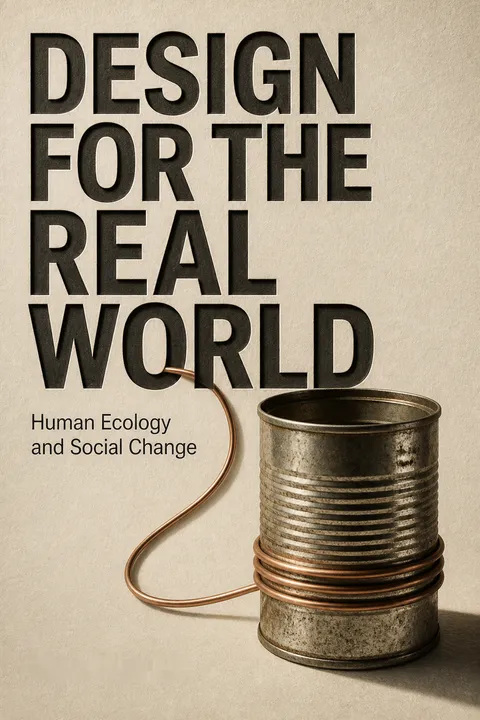
The 9-cent radio. Papanek recounts designing a 9-cent, one-transistor, cow-dung-powered radio for Indonesia, made from a used tin can. This device, designed for pre-literate areas with no electricity, converts heat into energy for an ear-plug speaker. Its "ugliness" was intentional, allowing local people to decorate it and make it their own, fostering participation and cultural relevance. This project exemplifies design for true need, bypassing corporate profit and neo-colonial exploitation.
Seed projects for change. Papanek advocates for "seed projects" where designers work directly in underdeveloped countries, training local populations to design and manufacture for their own needs. Examples include:
- Village-built pipe-making machines for irrigation and sanitation.
- Hand-cranked, modular produce coolers for food preservation.
- Muscle-powered vehicles for transport and exercise.
These initiatives aim to create self-sustaining design capabilities rooted in local culture and resources, rather than imposing Western solutions.
8. Bionics: Nature's Blueprint for Sustainable Design
A bird is an instrument working according to mathematical law, which instrument it is within the capacity of man to reproduce with all its movements.
Nature's optimal solutions. Papanek champions bionics – "the use of biological prototypes for the design of man-made synthetic systems" – as the ultimate design handbook. Nature has already solved many problems optimally, achieving "the mostest with the leastest." Unlike past attempts to merely copy natural forms, modern bionics seeks to understand underlying principles and systems.
Examples of bionic inspiration:
- Beetle eyes: Inspired accurate aircraft speed indicators.
- Rattlesnake pits: Led to heat-seeking sidewinder missiles.
- Dolphin skin: Rippling surface for navigation and speed.
- Maple seeds: Inspired fire-extinguishing modules and reforestation techniques for inaccessible areas, utilizing their spiral descent patterns.
- Lichen: Proposed as self-improving, self-maintaining "paint" for buildings and ground cover for highways, leveraging its growth patterns and temperature resilience.
Systems thinking from biology. Papanek emphasizes an "ethological and ecological approach to systems." He envisions "Total Design" not just as product branding, but as understanding a product's entire "biomorphic phylogenetic chain," from its origins to its eventual obsolescence. This means seeing design as an evolving technology permissive of imitations, where insights from nature's efficient systems can guide human innovation.
9. Confronting Environmental Catastrophe
Nature has let us down, God seems to have left the receiver off the hook, and time is running out...
Design's complicity in destruction. Papanek asserts that if design is ecologically responsive, it must be revolutionary, independent of GDP concerns. He argues that designers are heavily implicated in pollution, crowding, and starvation. The "garbage explosion" has outpaced population growth, and chemical strength has reached catastrophic levels, as seen in the Rhine pesticide spill that killed 75,000 tons of fish.
Man-made deserts and climate change. Human actions, often driven by design choices, have created deserts globally and are now altering the planet's climate. Jet aircraft pollute the upper atmosphere, potentially leading to a "hothouse effect" that could melt icecaps and spin the earth off its axis. Even seemingly benign projects like the Aswan Dam have had disastrous ecological consequences, destroying fisheries and breeding disease vectors.
Rethinking transportation and urban sprawl. Papanek critiques the automobile's inefficiency and pollution, advocating for a complete rethinking of transportation systems. He proposes:
- Monorails: Fast, clean, minimal intrusion.
- Mini-scooters: Foldable, electric, personal mobility for urban areas.
- Mini-taxis: Battery-driven, credit-card billed fleets for downtown, freeing up space for parks.
He also condemns urban planning that creates "vertical black slums" and monotonous suburbs, destroying community and human dignity, urging designers to refuse participation in such "insane and destructive acts."
10. Transforming Design Education
The main trouble with design schools seems to be that they teach too much design and not enough about the social, economic, and political environment in which design takes place.
Outdated pedagogy. Papanek criticizes design education for being stuck in a "half a century old" Bauhaus model, focusing on skills and philosophies (self-expressive individualism, commercialism) that are irrelevant to contemporary challenges. Students are taught processes of a bygone age, ignoring modern advancements like computer technology, cybernetics, and space research. This mis-education creates "massive blocks against new ways of thinking."
Education for generalists. Instead of narrow specialization, Papanek advocates for educating "broad, 'horizontal' generalists or synthesists." His proposed curriculum for industrial and environmental design emphasizes:
- Interdisciplinary mix: Sociology, anthropology, psychology, behavioral sciences.
- Life sciences: Structural biology, ecology, ethology, bionics, biomechanics.
- Modern tools: Computer sciences, photography, kinetics, film-making.
- Free electives: Allowing students to pursue minors in areas like political science.
This approach aims to equip designers to understand the complex, interrelated factors of real-world problems.
Interactive learning and responsibility. Papanek advocates for an ecstatic, interactive learning environment where students are active participants, not passive recipients. He encourages:
- Refusal rights: Students can refuse projects deemed socially irrelevant.
- Team teaching: Students teach each other, leveraging diverse backgrounds.
- Real-world engagement: Working with underserved communities, traveling, and taking non-design jobs to understand true needs.
This radical shift aims to instill a deep sense of social and moral responsibility, ensuring designers are "changed by their environment, and in turn, changes it."
11. Integrated Design for Human Survival
Integrated, comprehensive, anticipatory design is the act of planning and shaping carried on across all the various disciplines, an act continuously carried on at interfaces.
A holistic vision. Papanek defines "integrated design" as a comprehensive, anticipatory process that considers all factors and modulations necessary for decision-making. It views man, his tools, and his environment as a "non-linear, simultaneous, integrated, comprehensive whole." This approach seeks to unify disparate design fields—from city planning to product design—into a single, evolving system responsive to human needs.
The power of interfaces. New discoveries and actions, Papanek argues, occur at the "interfaces" between different techniques or disciplines. The design team, by its very nature, thrives on these confrontations, bringing diverse expertise to bear on complex problems. In a future dominated by automation and computers, the work of the design team—research, social planning, creative innovation—will be the most meaningful and crucial human activity, helping to set goals for society.
Redefining human potential. Integrated design aims to reshape tools, products, shelters, and settlements into an environment capable of growth, change, and regeneration, in response to man's psychophysical wholeness. It recognizes that man is a generalist, and his tools are extensions that enable specialization. By designing these extensions wisely, we can avoid turning humans into permanent specialists and instead foster general adaptability, crucial for survival in a rapidly changing world.
People Also Read




Download PDF
Download EPUB
.epub digital book format is ideal for reading ebooks on phones, tablets, and e-readers.








































