
Key Takeaways
1. The Genesis of a Counterrevolution: A Quiet Deal in Dixie
For what becomes clear as the story moves forward decade by decade is that a quest that began as a quiet attempt to prevent the state of Virginia from having to meet national democratic standards of fair treatment and equal protection under the law would, some sixty years later, become the veritable opposite of itself: a stealth bid to reverse-engineer all of America, at both the state and the national levels, back to the political economy and oligarchic governance of midcentury Virginia, minus the segregation.
A personal crusade. In 1956, James McGill Buchanan, a University of Virginia economics chair, proposed a new center to combat "perverted liberalism" and defend "individual liberty." This seemingly academic endeavor was, in fact, a covert response to the Brown v. Board of Education ruling, which mandated school desegregation. Buchanan, a white southerner, viewed federal intervention as "coercion" and "gangsterism" against property owners, fearing higher taxes to fund improvements for black citizens.
The Virginia Way. Buchanan's vision aligned with Virginia's ruling elite, led by Senator Harry F. Byrd Sr., who maintained power through:
- Poll taxes that suppressed voter turnout.
- Malapportionment of legislative districts favoring conservative rural areas.
- Anti-union "right-to-work" laws.
This system ensured low taxes and minimal government interference, preserving a rigid social order and economic hierarchy. Buchanan's center aimed to intellectually buttress this "Virginia Way."
Stealth as strategy. Buchanan understood that his radical ideas would not gain popular support. He insisted on a discreet name for his center, avoiding terms like "economic liberty" to prevent criticism of establishing a "propagandizing agency." This early embrace of stealth became a hallmark of the movement, recognizing that open declaration of their true goals would be met with public rejection.
2. Calhoun's Enduring Legacy: Protecting Elite Property from Democracy
Both thinkers sought ways to restrict what voters could achieve together in a democracy to what the wealthiest among them would agree to.
An ancient lineage. The intellectual roots of this movement trace back to John C. Calhoun, a 19th-century South Carolina statesman. Calhoun, dubbed "the Marx of the master class," devised constitutional mechanisms to protect the wealthy planter class (slave owners) from majority rule and taxation, advocating for a minority veto power. He saw a fundamental conflict between "tax producers and tax consumers," portraying politics as exploitation and the economy as free exchange.
Slavery's influence. Calhoun's theories were a direct defense of chattel slavery, which generated immense wealth for southern elites. He argued that states had the right to "interpose" their authority against federal laws they deemed "odious," such as those challenging slavery. This stance inverted the traditional view of power, casting wealthy slave owners as victims of government tax collectors and poorer voters as "exploiters."
Anti-democratic principles. Calhoun's ideas were a radical departure from the nation's founders, who, despite their own property interests, aimed for a lasting self-government with protections for minorities, not domination by them. Calhoun's vision, however, sought to empower a "private governing elite" freed from public accountability, a blueprint for restricting democracy to serve the propertied class.
3. Public Choice Theory: Unmasking Government as Self-Interest
The Calculus of Consent claimed to show that simple majority voting thus “tend[ed] to result in overinvestment in the public sector.”
A new economic lens. James Buchanan and Gordon Tullock developed "public choice economics," a field that applied economic principles to analyze government behavior. Their seminal work, The Calculus of Consent, argued that politicians, like other economic actors, are primarily driven by self-interest (e.g., re-election), not the "common good." They recast concepts like "the common good" as mere "smoke screens" for individual gain.
The "rent-seeking" problem. Buchanan and Tullock contended that majority decision-making in government led to "overinvestment in the public sector" because:
- Voters form "special interests" or "pressure groups" to pursue "profits" (later called "rent-seeking") from government programs.
- Politicians promise gains to multiple constituencies to win elections.
- "Logrolling" (vote-trading) among elected officials leads to profligate spending.
- Bureaucrats have incentives to expand their "fiefdoms" by keeping money flowing.
Constitutional constraints. The solution, they argued, was to impose "constitutional constraints" on government. They advocated for "unanimity" in decision-making, giving each individual the power to veto collective schemes, thereby preventing the "exploitation of man by man." This approach aimed to revive constitutional rules akin to those of 1900, an era of extreme economic liberty and limited government intervention.
4. The Unpopular Truth: Democracy vs. Economic Liberty
There seemed no way to reconcile robust individual property rights with universal voting rights.
A fundamental conflict. Buchanan's later work, The Limits of Liberty, concluded that democracy, especially with universal voting rights, was inherently inimical to economic liberty. He argued that an inclusive electorate would inevitably lead to "fiscal exploitation of minorities" (the wealthy) through "discriminatory taxation" and "redistribution." He questioned the legitimacy of government action that lacked unanimous consent, equating taxation without such consent to "criminal" acts.
The "Samaritan's Dilemma." Buchanan introduced the "Samaritan's Dilemma," arguing that compassion (e.g., providing welfare) could lead to "exploitation" by "parasitic" recipients who would become dependent rather than self-reliant. This theory provided a moral justification for cutting social programs, framing assistance as a perverse incentive that undermined individual responsibility and an "orderly and productive free society."
Despair and radical solutions. Faced with the reality that a majority would never willingly agree to rules that disadvantaged them, Buchanan despaired of conventional political change. He called for a "generalized rewriting of the social contract" and "changes that are sufficiently dramatic to warrant the label 'revolutionary.'" He even mused that "despotism may be the only organizational alternative" to the current political structure, revealing a profound anti-democratic inclination.
5. Chile: A Blueprint for Binding Democracy
Whereas the U.S. Constitution famously enshrined “checks and balances” to prevent majorities from abusing their power over minorities, this one, a Chilean critic later complained, bound democracy with “locks and bolts.”
A laboratory for radical change. In 1973, General Augusto Pinochet's coup in Chile overthrew the elected socialist government. Buchanan provided direct guidance to Pinochet's team on how to draft a new constitution that would permanently entrench the power of the capitalist class. This involved:
- "Seven modernizations": privatization of social security, healthcare, and education (vouchers), deregulation, and fragmentation of labor unions.
- Constitutional "locks and bolts": balanced budget requirements, an independent central bank, and supermajority rules for any substantive changes.
Insulating power. Buchanan's advice aimed to create a "virtually unamendable charter" that would make public dissatisfaction irrelevant and prevent future popular pressure for change. The new constitution guaranteed the power of the armed forces and curtailed the influence of non-elite citizens, ensuring a "system frozen by elite interests." This was a stark example of using constitutional design to bind democracy and protect economic liberty from popular will.
A troubling legacy. Despite widespread human rights abuses and economic hardship, Chile's constitution was lauded by the Cato Institute and Heritage Foundation as an "economic miracle." However, it led to surging inequality, making higher education the most expensive on the planet relative to income, and fostering widespread corruption. This "sinister constitution" continues to make urgently needed reforms difficult, leading to public disengagement and a crisis of democratic legitimacy.
6. The Reagan Era's Lessons: Stealth Over Persuasion
“The democracy had defeated the doctrine.”
The limits of direct assault. Ronald Reagan's presidency, despite high hopes from libertarians, failed to deliver the radical transformation promised. Budget director David Stockman admitted that a "true economic policy revolution" would require "risky and mortal political combat" with mass constituencies dependent on government programs like Social Security and Medicare. When the public realized the drastic cuts intended, "the democracy had defeated the doctrine."
A new path: the "crab walk." This defeat taught libertarians a crucial lesson: direct, open advocacy for dismantling popular programs was "political suicide." Buchanan devised a "crab walk" strategy for Social Security privatization:
- Soften public support: Make the system seem unreliable and on the verge of bankruptcy.
- Divide and conquer: Reassure current beneficiaries, suggest higher taxes for high earners (to make it seem like "welfare"), and remind younger workers of their "subsidy" to the aged.
- Target short-term changes: Increase retirement age and payroll taxes to irritate recipients.
Strategic deception. This approach involved a "patchwork pattern of 'reforms'" designed to fracture public support and make "abandonment of the system look more attractive," even if the true goal was its destruction. The ends justified the means, as long as they remained technically within the law, marking a shift towards deliberate deception to achieve unpopular goals.
7. The Koch Network: Funding the Cadre and the "Technology" of Revolution
Since we are greatly outnumbered, the failure to use our superior technology ensures failure.
A "Leninist" strategy. Charles Koch, frustrated by the slow pace of change, embraced a "Leninist" strategy: building a disciplined "cadre" of libertarian thinkers and operatives. He believed that "ideas" were the "greatest power" and that a "vast network of political power" could become the new "Establishment." This required:
- Cultivating talent: Funding organizations like the Institute for Humane Studies (IHS) to identify and train "freedom-friendly professors."
- Creating think tanks: Establishing the Cato Institute (mission: "annihilation of statism") and the Reason Foundation (advocating "dismantling the state step by step" through privatization).
- Demanding radicalism: Koch insisted on an "uncompromisingly radical" approach, dismissing moderates as "sellouts."
Buchanan's "technology." Koch saw Buchanan's theories as the "technology" needed to "create winning strategies." He pledged $10 million to an enlarged James Buchanan Center at George Mason University (GMU), aiming to transform it into a "Pentagon of conservative academia." This base camp, strategically located near Washington D.C., would train a pipeline of "professional libertarians" to staff think tanks and influence policymakers.
The "Kochtopus." Koch's immense wealth and systematic approach created a "Kochtopus" – a sprawling network of ostensibly separate organizations, all funded and guided by his vision. This network aimed to:
- Occupy the Republican Party through primary challenges.
- Push radical legislation via the American Legislative Exchange Council (ALEC).
- Leverage grassroots anger (e.g., Tea Party) through groups like Americans for Prosperity.
- Influence media and public opinion through a "counter-intelligentsia."
8. Dismantling the Public Sphere: Privatization as a Weapon
Privatization was a key element of the crab walk to the final, albeit gradual, revolution—the ends-justify-the-means approach that allowed for using disingenuous claims to take terrain that would make the ultimate project possible.
The "education industry." Public education, a long-standing target, is systematically undermined. The movement, through Koch-funded State Policy Network (SPN) affiliates, pushes laws to:
- Debilitate teachers' unions.
- Slash public school budgets.
- Divert funds to private schools and for-profit virtual charter schools, often with no accountability.
This creates a new "education industry" that profits from public funds while often delivering inferior outcomes, as seen in North Carolina's plummeting per-pupil spending.
Corporate prisons. The push for corporate prisons, advocated by GMU economists like Alexander Tabarrok, is another facet of privatization. Private prison corporations become powerful lobbyists for tougher sentencing and increased incarceration, ensuring a steady "cash stream" from detained individuals. This creates perverse incentives, as exemplified by judges receiving kickbacks for sentencing children to private facilities.
Public health at risk. Libertarians oppose government involvement in public health, viewing it as "rent-seeking" by officials. This ideology has tangible consequences:
- Systematic cuts to public health budgets (e.g., for Zika, Ebola).
- Advocacy for allowing restaurants to "opt out" of handwashing laws, trusting "the market" to regulate.
- Climate change denial, spread through "junk pseudoscience" campaigns, to prevent regulatory restrictions on economic liberty.
The Flint water crisis, directly linked to austerity measures pushed by Koch-funded groups, tragically illustrates the human cost of this approach.
9. Enchaining Democracy: Suppressing the Vote and Local Power
Without the protection of a fairly drawn district, the citizen is a pawn of billionaires who use the map of the country to get what they want.
Voter suppression. The movement systematically works to reduce voter turnout, particularly among low-income and young voters who tend to lean left. After the 2010 midterm elections, ALEC-backed legislators in 41 states introduced over 180 bills to restrict voting, often fueled by the "big lie" of widespread voter "fraud." This effort mirrors the mass disenfranchisement tactics used in the Jim Crow South a century ago.
Gerrymandering for control. The "Redistricting Majority Project" (REDMAP) of 2010 was a cunning plan to use decennial redistricting to:
- Systematically underrepresent "troublesome" voters.
- Overrepresent "manageable" voters.
- Ensure Republican majorities even where Democrats held popular support.
This audacious gerrymander aims to create a "veto-proof supermajority operating without majority support," effectively making citizens "pawns of billionaires" who manipulate electoral maps.
Curbing local democracy. State governments, influenced by the Koch network, are increasingly denying municipal governments the right to make their own policies. "Preemption laws" prevent cities from:
- Raising local minimum wages.
- Enacting environmental protections.
- Implementing anti-discrimination measures.
This strategy of "competitive federalism" (a "race to the bottom" by design) ensures that corporate and conservative interests can exert their will most easily at the state level, where public oversight is often weaker.
10. The Constitutional Endgame: Rewriting the Rules for Oligarchy
The project has multiple prongs. One is a vast legal shift, also anchored at GMU; it illuminates how quietly executed changes in legal rules can bind citizens as never before.
A "privatization of the justice system." The movement seeks to fundamentally alter the U.S. Constitution, not through direct amendment, but through:
- Judicial activism: Koch grantees advocate for an "activist judiciary" to strike down measures desired by voters, returning to a pre-1937 jurisprudence that favored corporate interests over social welfare.
- Arbitration clauses: Corporations embed fine print in contracts that strip citizens of their constitutional right to sue in court, forcing them into mandatory arbitration systems controlled by corporations. This "far-reaching power play" effectively privatizes justice.
Reverting to 1900. The ultimate goal is to restore a constitutional order akin to 1900, an era of "plutocracy" characterized by:
- Unmatched corporate dominance.
- Mass disenfranchisement and suppression of working-class voting.
- Minimal regulation of labor and the environment.
- Judicial decisions (like Lochner and Plessy) that protected property rights at the expense of social justice and civil rights.
A strong government, for their ends. Despite rhetoric about "shrinking big government," the cadre actually desires a very strong government—one that acts only in ways they deem appropriate. This means:
- Federal courts with vast new powers to strike down popular legislation.
- Expanded police powers to control public anger resulting from these changes.
- A nation "cosmetically updated" from midcentury Virginia, where wealth accumulation is prioritized above all else, and the "political we" is extinguished.
Review Summary
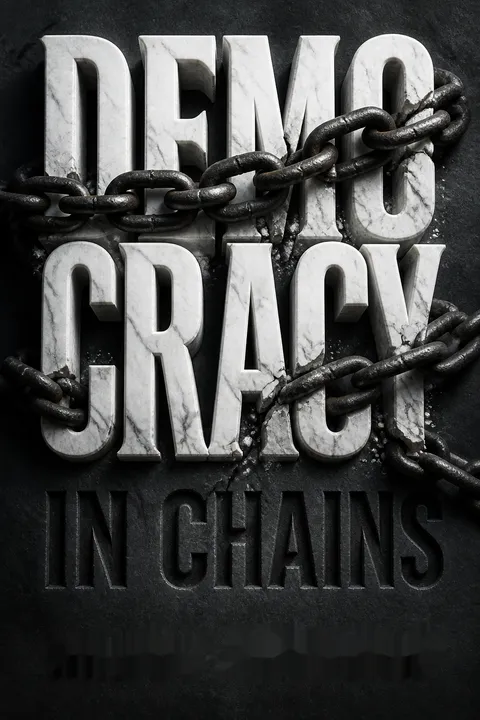
Democracy in Chains receives polarized reviews on Goodreads with a 4.29/5 rating. Supporters praise it as an essential exposé revealing the libertarian right's secret agenda to undermine democracy, tracing influence from economist James Buchanan to the Koch brothers. They commend MacLean's research using Buchanan's archived papers and call it enlightening about conservative strategy. Critics dismiss it as conspiracy theory filled with misrepresentations, inaccuracies, and distortions of Buchanan's work. They accuse MacLean of intellectual dishonesty and creating false connections between historical figures and modern libertarianism, comparing it to partisan clickbait.
People Also Read






Download PDF
Download EPUB
.epub digital book format is ideal for reading ebooks on phones, tablets, and e-readers.








































