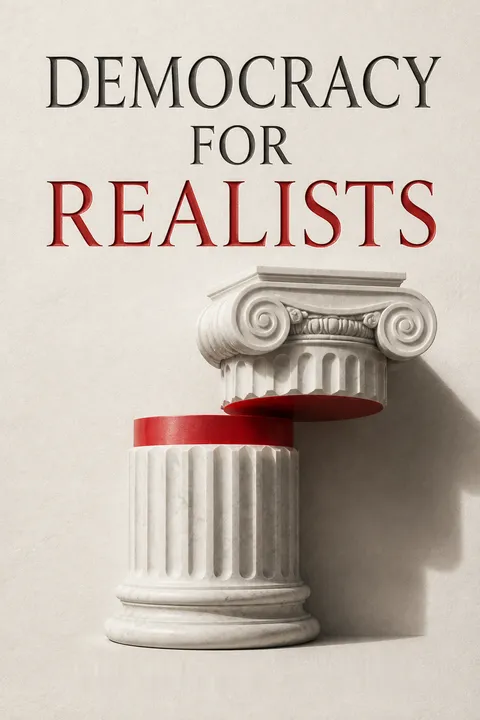

Key Takeaways
1. The "Folk Theory" of Democracy is a Pervasive, Unrealistic Myth.
Unfortunately, while the folk theory of democracy has flourished as an ideal, its credibility has been severely undercut by a growing body of scientific evidence presenting a different and considerably darker view of democratic politics.
Ideal vs. Reality. The conventional understanding of democracy, or "folk theory," posits that ordinary citizens possess clear policy preferences, choose leaders who enact those preferences, and thus govern themselves. This appealing ideal, celebrated in rhetoric like Lincoln's "government of the people, by the people, and for the people," assures people they live under an ethically defensible system. However, empirical social science reveals a starkly different picture.
Citizen Incapacity. The vast majority of citizens pay little attention to politics, are poorly informed, and struggle to articulate coherent policy preferences. They are swayed by superficial factors like "the nature of the times" and political loyalties acquired early in life, rather than detailed policy knowledge. This widespread inattention and lack of information make it impossible for citizens to fulfill the demanding role envisioned by the folk theory.
Logical Incoherence. Even sophisticated theoretical models, like the "spatial model" of voting, which attempts to formalize the populist ideal, encounter severe logical difficulties. When multiple policy dimensions are considered, there is often no single policy platform that represents "the will of the majority," leading to a fundamental incoherence in the very notion of popular sovereignty. This theoretical challenge, highlighted by Arrow's theorem, demonstrates that a reliable democratic procedure for aggregating coherent individual preferences into a coherent collective choice is simply unattainable.
2. Elections Fail to Produce Responsive Government or Policy Mandates.
The populist ideal of electoral democracy, for all its elegance and attractiveness, is largely irrelevant in practice, leaving elected officials mostly free to pursue their own notions of the public good or to respond to party and interest group pressures.
Issue Voting Illusion. The idea that voters choose candidates based on their policy positions ("issue voting") is a cornerstone of the folk theory. However, research shows that observed correlations between voters' issue positions and their choices are often misleading. Voters frequently adjust their own policy views to align with the candidates or parties they already favor, rather than the other way around. This "persuasion" and "projection" means that issue proximity is often a consequence of preference, not its cause.
Limited Elite Responsiveness. Even when voters express clear preferences, elected officials are not strongly constrained by them. Studies of Congress, for instance, reveal that representatives' roll call votes are only modestly correlated with their constituents' preferences. Instead, partisan affiliation strongly dictates voting behavior, with Republican and Democratic members from ideologically similar districts often voting in starkly different ways. This suggests that elections do not compel successful candidates to reflect the policy preferences of the median voter as the spatial theory implies.
Policy Outcomes Unaffected. The overall impact of elections on public policy is less about a popular mandate and more about which partisan team gains power. Policy outcomes shift significantly when control of the White House or Congress changes hands, but this is not necessarily a reflection of the public's "policy mood" or specific issue preferences. Instead, it often reflects the agenda of the winning party's elites, who are then largely free to pursue their own policy goals, knowing that voters' policy views are too thin and incoherent to provide a clear directive.
3. "Blind Retrospection" Undermines Electoral Accountability.
We find that voters punish incumbent politicians for changes in their welfare that are clearly acts of God or nature.
Punishing the Blameless. The retrospective theory of voting suggests that citizens can hold leaders accountable by rewarding good performance and punishing bad. However, this theory assumes voters can accurately attribute responsibility. Our research demonstrates "blind retrospection," where voters punish incumbents for misfortunes clearly beyond governmental control.
- Shark Attacks (1916): New Jersey voters punished President Woodrow Wilson for a series of deadly shark attacks, reducing his vote share by about ten percentage points in affected communities, despite the attacks being random natural events with no governmental solution.
- Droughts and Floods (20th Century): Across the 20th century, incumbent parties consistently lost votes in states experiencing severe droughts or floods. These natural disasters, which presidents cannot cause or prevent, led to electoral punishment, suggesting a general tendency to "kick the government" when in pain.
Irrational Punishment. This pattern of punishment is not rational from a selection or sanctioning perspective. If some incumbents were punished for poor responses to disasters, others should have been rewarded for good responses. Yet, the average effect of natural disasters on incumbent vote shares is preponderantly negative, indicating a one-sided tendency to punish rather than reward. This behavior neither relieves distress nor reliably produces more competent leaders.
Social Construction of Blame. Voters' attributions of blame are often crucial, even if far-fetched. When collective misfortune strikes, political entrepreneurs and the media can construct explanations, often self-serving, that resonate with public frustration. The Spanish Influenza pandemic of 1918, which killed half a million Americans, had no discernible electoral impact because no one successfully constructed a narrative blaming the government, illustrating that pain alone is not enough; a plausible (or implausible) causal story is needed.
4. Voters Are Myopic, Focusing Only on the "Specious Present."
If the economy is flourishing in the final weeks of a campaign, when the music stops, the incumbent is likely to be re- elected.
Short-Term Focus. Even when voters respond to objective economic conditions, their time horizon is remarkably short. Our analysis of U.S. presidential elections since 1952 shows that voters focus almost entirely on real income growth in the six months leading up to Election Day, largely ignoring economic performance earlier in the president's term. This "myopic" voting behavior is a significant deviation from what would be expected if voters were rationally assessing an incumbent's overall economic stewardship.
Ineffective Selection and Sanctioning. This myopia severely limits the effectiveness of retrospective voting.
- Selection: Short-term economic fluctuations are poor indicators of an administration's long-term economic competence. Voters judging on brief, uninformative slices of economic experience are unlikely to reliably select more competent leaders. We found no evidence that factors affecting post-election economic performance also affect voters' decisions to retain or replace the incumbent party.
- Sanctioning: Since only election-year performance matters, incumbents have little incentive to promote sustained economic growth outside of the immediate pre-election window. This creates a "political business cycle," where economic growth tends to peak in election years and fall afterward, as incumbents manipulate policy for short-term electoral gain.
"Musical Chairs" of Elections. The consequence of myopic voting is that election outcomes become, from the standpoint of democratic accountability, essentially arbitrary. The choice between competing governing teams often hinges on the accident of whether "the economy is flourishing in the final weeks of a campaign." This makes elections akin to a game of musical chairs, where the winner is determined by chance rather than a considered judgment of long-term performance or policy.
5. Social Identities, Not Policy, Are the True Drivers of Political Loyalty.
For most voters in these groups, the lapses of judgment in office that infuriated Clinton’s opponents and her stiffness on the campaign trail seemed minor or irrelevant considerations. Identity mattered far more.
Group Attachments are Fundamental. Political preferences and voting behavior are primarily rooted in social identities and group attachments, not rational policy calculations. People align with parties because "their kind" of person belongs to that party, or due to inherited loyalties, rather than a careful assessment of policy platforms. This explains why partisan loyalties are often durable and passed down through generations, even when policy positions are inconsistent.
Identity-Driven Realignments: Major shifts in party systems, or "realignments," are often triggered by changes in the political resonance of group identities.
- New Deal Era: Boston's ethnic groups (Jews, Italian-Americans, African-Americans, Irish-Americans) realigned with the Democratic Party at different times and for different reasons, primarily driven by social status and acceptance within the party, rather than specific New Deal policies or economic recovery.
- Catholic Vote (1960): John F. Kennedy's Catholic identity activated powerful cultural loyalties among Catholics and antipathies among Protestants, significantly altering voting patterns. This was a matter of religious identity, not policy.
- Southern Realignment: The shift of white southerners to the Republican Party was driven more by a changing sense of white southern identity, as the Democratic Party became associated with civil rights for African Americans, rather than specific racial policy issues. This shift occurred even among racial moderates, suggesting identity trumped policy.
Identity Conflicts and Policy Shifts. When identities conflict, individuals may prioritize one over another. In the case of abortion, women's gender identity often made their pro-choice or pro-life views deeply significant, leading pro-choice Republican women to leave the party. Conversely, men, for whom abortion was less central to their gender identity, were more susceptible to partisan persuasion, often changing their abortion views to align with their party. This demonstrates how identities can both drive partisan change and shape policy attitudes.
6. Partisanship Shapes Perceptions, Even of "Objective" Facts.
It will feel like she’s thinking.
Rationalizing Beliefs. Voters, even well-informed ones, often rationalize their political beliefs and perceptions to align with their partisan loyalties. This process, driven by a desire to minimize "cognitive dissonance," means that people tend to perceive their preferred party as closer to their own issue positions than it actually is, and sometimes even construct "objective" facts to support their partisan views. This is not necessarily irrational in a technical sense, but it leads to a "pseudo-environment" loosely connected to reality.
Partisan Distortion of Facts. This partisan bias extends to factual matters, not just policy preferences.
- Inflation (1988): Despite a dramatic drop in inflation under President Reagan, over half of "strong" Democrats claimed inflation had gotten worse, while nearly half of "strong" Republicans correctly identified it as "much better."
- Iraq War (2003-2005): Years after the invasion, a significant portion of Republicans (but far fewer Democrats) continued to believe Iraq possessed WMDs or was linked to 9/11, despite evidence to the contrary.
- Budget Deficit (1996): Most Republicans, and even many Democrats, were oblivious to the fact that the federal budget deficit had decreased by more than half under President Clinton. Moderately informed Republicans were less accurate than the least informed, as a modicum of information was enough to discern what they should want to be true, but not what was true.
Watergate's Ripple Effect. The Watergate scandal, largely unrelated to policy, demonstrated how a partisan shock can alter a wide range of seemingly unrelated political views. Well-informed individuals who became critical of Nixon shifted their positions on issues like government jobs, school busing, and criminal rights to align with their new anti-Republican sentiment. This "ricochet effect" shows how deeply partisanship structures an individual's entire political worldview.
7. "More Democracy" Reforms Often Lead to Counterproductive Outcomes.
Hopelessly naive theories are a poor guide to policy, often distracting reformers from attainable incremental improvements along entirely different lines.
Flawed Reforms. The folk theory's simplistic belief that "the cure for the ills of democracy is more democracy" has driven many reforms, often with counterproductive results. These reforms typically aim to increase direct popular control and reduce the influence of "professional politicians," but they often overestimate citizen capacity and commitment.
Pitfalls of Direct Democracy:
- Referendums and Initiatives: While intended to empower citizens, these mechanisms often empower "millionaires and interest groups that use their wealth to achieve their own policy goals." Voters, lacking detailed information, can make self-defeating choices.
- Fluoridation: Many cities that put fluoridation to a popular vote rejected it, despite scientific evidence of its benefits, leading to worse dental health and higher costs.
- Fire Protection: In Illinois, voter-approved tax limits led to reduced fire district budgets, dangerously degrading fire protection and increasing response times, potentially costing more in insurance than saved in taxes.
- Property Tax Assessments: In New York, electing property assessors led to less frequent assessments, disproportionately benefiting affluent homeowners at the expense of others.
Weakening Party Nominations. The "democratization" of party nominations through direct primaries, while seemingly empowering voters, has diluted the influence of experienced political professionals. This can lead to the selection of less qualified or more extreme candidates, as seen in the instability of Democratic presidential nominations in the 1970s and the Republican nomination in 2016. The historical record suggests that the quality of winning candidates has not improved, and has likely declined, with more "open" systems.
8. Elections Are Often "Musical Chairs," Not Rational Choices.
The result is that, from the viewpoint of governmental representativeness and accountability, election outcomes are essentially random choices among the available parties— musical chairs.
Randomness in Outcomes. Given the limitations of voters – their lack of information, myopic retrospection, and identity-driven loyalties – election outcomes are not the product of a rational, policy-driven collective will. Instead, they are often "essentially random choices" among the available parties. When the partisan balance is close, outcomes can hinge on arbitrary factors like the short-term economy, akin to a game of musical chairs where the winner is determined by chance.
No Genuine Mandates. Elections that "throw the bums out" typically do not produce genuine policy mandates. They simply replace one elite coalition with another. While the new party in power will pursue its own policy agenda, this is not because the electorate has consciously endorsed that agenda, but because the winning party's elites are now in a position to implement their preferred policies, often rationalized by their partisan base.
Hitler's Rise: A Sobering Example. The most appalling failure of 20th-century democracy, Adolf Hitler's rise to power, starkly illustrates this point. German voters were drawn to Nazism not primarily for its anti-Semitic policies, but because Hitler spoke to their nationalistic identity in a period of post-war humiliation and economic desperation. His "catchall" appeal, fueled by blind retrospection during the Depression, swept in protest voters who abandoned traditional parties for the promise of strong leadership, regardless of the specific, often horrific, policy implications.
Identity Trumps Ideology. Hitler's success was a story of identity groups – Protestant nationalists who recognized him as one of their own – rather than a rational endorsement of his ideology. Other identity groups, like Socialists and Catholics, largely resisted his appeal. This demonstrates that economic retrospection, while a factor, is sharply channeled by existing political identity groups, leading to outcomes that are far from a rational, policy-based choice.
9. Democracy's Real Value Lies Beyond Idealized Popular Control.
Getting a clearer picture of why democracy is a good political system—what it does or doesn’t accomplish, which features and processes are essential to its success, which are not, and how it could be made to work more fairly—seems important as an intellectual challenge, as a practical guide, and as an ethical imperative.
Beyond the Folk Theory. While the folk theory of democracy is empirically flawed, democracy still possesses real, pragmatic virtues that distinguish it from authoritarian alternatives. These benefits are often overlooked because they don't align with the idealized vision of popular control.
Pragmatic Benefits of Elections:
- Peaceful Transfer of Power: Elections provide an authoritative and widely accepted mechanism for determining who shall rule, ensuring peaceful transitions even after bitterly contested outcomes.
- Preventing Entrenchment: Regular turnover in power, often driven by random factors or a "law of the pendulum," prevents any single group or coalition from becoming permanently entrenched, fostering stability and discouraging revolution.
- Tolerating Opposition: Electoral competition incentivizes rulers to tolerate opposition, as losing parties can reasonably expect to regain power in the future, fostering a crucial norm of "His Majesty's Loyal Opposition."
- Ethical Constraints: Reelection-seeking politicians are incentivized to avoid violating consensual ethical norms and to address easily managed governmental tasks, as public outrage can lead to electoral punishment.
The Need for a Realist Theory. A truly "more democratic" system requires abandoning the unrealistic assumptions of the folk theory and building a new framework based on a realistic understanding of human nature and group power. This means acknowledging that policy is primarily made by elites, and that power imbalances (wealth, education, organization) routinely distort the democratic process.
Toward a More Egalitarian Democracy. Real political reform must focus on mitigating these power imbalances. Reducing the influence of money in elections and striving for greater economic and social equality would increase the political power of currently under-represented groups. This would lead to a more genuinely democratic system, not by empowering an idealized "people," but by ensuring that the diverse interests of real social groups are more equitably represented in the policy-making process.
People Also Read




Download PDF
Download EPUB
.epub digital book format is ideal for reading ebooks on phones, tablets, and e-readers.








































