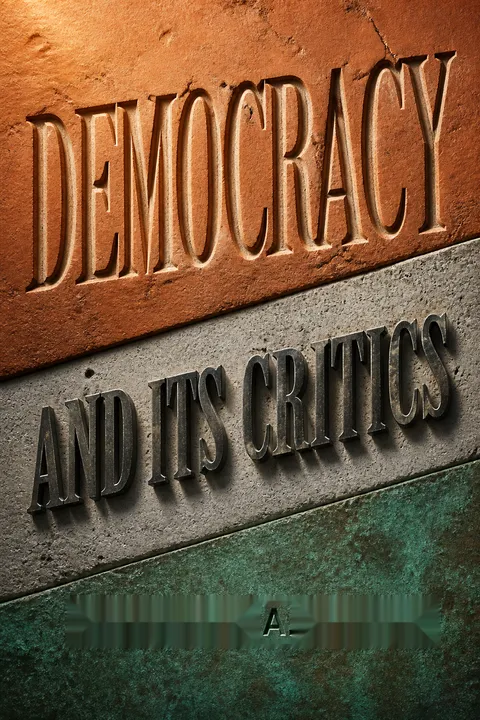

Key Takeaways
1. Democracy's Dual Nature: Ideal and Imperfect Reality
At the outset we confront the fact that in both ordinary and philosophical language democracy may properly be used to refer both to an ideal and to actual regimes that fall considerably short of the ideal.
A timeless vision. From ancient Greece, the idea of a political system where members are political equals, collectively sovereign, and self-governing has captivated the human imagination. This vision, first realized in city-states like Athens, represents a profound shift from rule by the few to rule by the many, inspiring hopes for an ideal yet attainable polity.
Historical inconsistencies. Despite its enduring appeal, the concept of "democracy" has become vague due to its long, varied history and inconsistent interpretations across different eras and cultures. What an Athenian understood by demokratia differs significantly from modern conceptions, leading to a jumble of often contradictory theories and practices.
Critics' insights. Democracy has always faced critics, categorized as adversarial (fundamentally opposed) or sympathetic (supportive but critical). These critics often expose the "shadow theory" of democracy—half-hidden premises and unexplored assumptions—forcing advocates to scrutinize foundational issues like who constitutes "the people," the appropriate scale of governance, and the balance between process and substance.
2. The Two Transformations: From City-State to Nation-State
The city-state was made obsolete by the nation-state, and in a second democratic transformation the idea of democracy was transferred from the city-state to the much larger scale of the nation-state.
Ancient origins. The first democratic transformation occurred in ancient Greece and Rome, establishing the city-state as the primary locus of popular government. This model emphasized small size, direct citizen participation, and a relatively homogeneous citizenry united by shared values, language, and history.
Limits of the polis. However, the city-state model had inherent limitations:
- Exclusivity: Citizenship was restricted, excluding women, resident aliens, and slaves.
- Lack of universal rights: Freedom was tied to city membership, not universal human claims.
- Vulnerability: Small scale made city-states susceptible to conquest by larger empires.
These limitations meant the Greek vision, while inspiring, was not universally applicable or sustainable.
Modern adaptation. The rise of the nation-state necessitated a second democratic transformation, transferring the democratic idea to a vastly larger scale. This shift led to radically new institutions, most notably representative government, which allowed democracy to become relevant to modern, large-scale societies, despite altering the nature of citizenship and participation.
3. Anarchism and Guardianship: Democracy's Fundamental Adversaries
A perennial alternative to democracy is government by guardians.
Anarchist challenge. Anarchism fundamentally opposes the state, arguing that all states are inherently coercive and therefore evil. It posits that a society without a state, based purely on voluntary associations, is feasible and desirable. This critique forces democrats to justify coercion within a democratic framework.
- Core assumptions: No obligation to obey a bad state, all states are coercive, coercion is intrinsically bad, a stateless society is feasible.
- Critique: Coercion is likely even without a state, and a state can be justified to regulate coercion and achieve greater good.
Guardianship's appeal. Guardianship, championed by Plato, argues that ordinary people are unqualified to govern. Rule should be entrusted to a minority with superior knowledge and virtue, ensuring the common good. This vision has appeared in various forms, from Confucianism to Leninism and Skinner's Walden Two.
- Core assumptions: Need for a state, equal consideration of interests, governance by the qualified.
- Critique: Guardians lack objective moral and instrumental knowledge, specialization can impair judgment, power corrupts, and historical examples of guardianship often lead to blunder and oppression.
Democracy's defense. While acknowledging the intrinsic undesirability of coercion, democracy argues that a democratic state is the best feasible option for minimizing coercion and maximizing consent. Against guardianship, democracy asserts that ordinary people are generally competent to govern themselves, and that denying them this right stunts their moral development.
4. The Democratic Process: Justified by Equality and Autonomy
The democratic process is justified not only by its own end-values, then, but also as a necessary means to distributive justice.
Intrinsic equality. The justification for democracy ultimately rests on the idea of intrinsic equality: that all persons are of equal intrinsic worth and their interests deserve equal consideration. This principle, deeply rooted in Western thought, implies that no one is naturally entitled to subject another to their will.
Personal autonomy. Complementing intrinsic equality is the presumption of personal autonomy, which states that, absent compelling evidence to the contrary, every adult is the best judge of their own good or interests. This prudential rule rejects paternalistic authority among adults, asserting that individuals should have the right to judge policies affecting them.
- Justification for autonomy: Others are disadvantaged in knowing one's interests, historical record shows paternalism fails (e.g., slavery, women's suffrage, workers' rights).
- Consequences: Personal autonomy is necessary for self-determination and moral development.
Strong Principle of Equality. Combining these principles leads to the Strong Principle of Equality: every adult member of an association is sufficiently qualified to participate in making binding collective decisions that affect their interests. This principle forms the bedrock of the democratic process, asserting that citizens' claims regarding laws should be counted as equally valid.
5. Inclusion and Majority Rule: Persistent Challenges to Democratic Theory
The problem is, in fact, twofold: 1. The problem of inclusion: What persons have a rightful claim to be included in the demos? 2. The scope of its authority: What rightful limits are there on the control of a demos?
Defining the demos. The question of who rightfully belongs to the demos (the citizen body) is a fundamental and historically contentious issue. Early democratic theorists like Locke and Rousseau, despite universalistic language, implicitly accepted exclusions based on competence (e.g., children, women, slaves), demonstrating that citizenship was often contingent rather than a categorical right.
- Schumpeter's flaw: Allowing "every people to define itself" leads to absurdities, making "democracy" indistinguishable from autocracy if a tiny elite defines itself as the demos.
- Competence criterion: The exclusion of children proves that competence is an unavoidable criterion for inclusion, but this opens the door to arbitrary exclusions if not carefully justified.
Majority rule's dilemmas. While majority rule is often seen as synonymous with democracy, it faces significant theoretical and practical challenges:
- Cyclic majorities: With three or more alternatives, majority preferences can cycle, leading to indecisive or arbitrary outcomes.
- Agenda control: The sequence of voting can be manipulated to favor a specific outcome, undermining fair decision-making.
- Attenuation in practice: In large representative systems, the translation of majority preferences into law is often weakened by low voter turnout, electoral system biases, and coalition governments.
- Minority tyranny: Supermajority rules, while protecting minorities, can allow a small minority to block policies favored by a large majority, effectively imposing minority rule.
No perfect solution. No single decision rule, including strict majority rule or supermajorities, is universally superior or free from flaws. The choice of a decision rule often depends on specific circumstances and a balance of competing values, reflecting the inherent imperfections of any collective decision-making process.
6. Process vs. Substance: Balancing Democratic Means and Just Outcomes
The democratic process is packed to the hilt with substantive values.
Beyond mere procedures. It is a mistake to view democratic procedures as "merely formal" or devoid of moral significance. The democratic process itself embodies substantive values, including:
- Distributive justice: It determines the distribution of power and authority, influencing the allocation of other crucial resources.
- Primary political rights: Rights like free speech, assembly, and fair elections are integral to the process; their absence means democracy itself does not exist.
Inherent limits. While the democratic process is a form of justice, it cannot guarantee perfectly just substantive outcomes in all cases. No feasible political procedure can ensure that unjust legislation will never be enacted. The best we can hope for is "imperfect procedural justice," where the process is fair, even if outcomes are sometimes flawed.
Process versus process. When the democratic process appears to yield undesirable outcomes, the solution is not necessarily to abandon it for a non-democratic alternative. Instead, the conflict is often between the values embedded in the democratic process and those of an alternative process. Solutions may involve:
- Improving polyarchy: Strengthening democratic institutions and practices.
- Judicial quasi-guardianship: An independent judiciary can protect fundamental rights, but its authority must be carefully limited to avoid undermining democratic control.
- Evolution of public opinion: Over time, democratic cultures tend to rectify injustices as beliefs about equality and rights deepen.
7. The Problem of the Unit: Defining "A People" for Self-Governance
To say that a decision should be made by majority rule simply does not—and cannot—answer the question: a majority of what democratic unit?
The unaddressed question. Democratic theory often assumes the existence of a legitimate political unit ("a people") without adequately explaining why that particular aggregation of persons, with its specific boundaries, is appropriate for democratic self-governance. This "problem of the unit" is one of the most intractable in democratic thought.
Illusory solutions. Attempts to resolve this by asserting that "every people defines itself" are arbitrary and offer no normative guidance, effectively legitimizing coercion. Similarly, an absolute right to political autonomy for any group would lead to anarchism, undermining the very possibility of a state and its capacity to prevent harm to non-members.
Federalism's complexities. Federal systems, which divide authority between national and sub-national units, offer a partial solution but also highlight the problem. While federalism can accommodate diverse groups and decentralize decisions, it creates inherent tensions with the democratic ideal of a single demos exercising final control over the entire political agenda.
- Agenda control: In a robust federal system, a national majority may be constitutionally barred from acting on matters exclusively reserved for local units, even if those matters significantly affect the national good.
- Majority rule: Federalism can allow a local minority to prevail against a national majority on certain issues, challenging the principle of majority rule.
Practical judgments. Ultimately, determining the proper scope and domain of a democratic unit requires complex practical judgments, not just theoretical reasoning. These judgments must weigh various criteria, including:
- Desire for autonomy: The extent to which people in a proposed domain desire self-governance.
- Justifiable scope: Ensuring the unit's decisions do not violate fundamental rights or inflict serious harm.
- Affected interests: Including all persons significantly affected by decisions.
- Consensus and efficiency: Seeking boundaries that foster higher consensus and outweigh costs.
8. Conditions for Polyarchy: Why Democracy Flourishes (or Fails)
What conditions favor the development, consolidation, and stability of polyarchy in a country or, on the other hand, limit the prospects for polyarchy?
Historical rarity. Democracy, especially in its modern form (polyarchy), is historically aberrant, not a "natural" condition. Its emergence and stability depend on a confluence of specific, often fragile, conditions.
Key enabling conditions:
- Civilian control of coercion: Military and police forces must be subject to popularly chosen civilian leaders, preventing their use to establish or maintain non-democratic rule. Historically, this was favored by military technologies requiring mass mobilization (e.g., hoplites, mass infantry).
- Modern Dynamic Pluralist (MDP) society: Characterized by high income, urbanization, occupational diversity, literacy, and autonomous firms. MDP societies disperse power and foster democratic beliefs, making it harder for any single group to monopolize power and easier for excluded groups to demand inclusion.
- Low subcultural pluralism (or consociationalism): Strong ethnic, religious, or linguistic cleavages can destabilize polyarchy. Consociational arrangements (grand coalitions, mutual vetoes, proportionality, segmental autonomy) can mitigate these conflicts, but require specific elite beliefs and skills.
- Supportive political culture: A system of beliefs, particularly among political activists, that values democracy and its institutions is crucial for resilience during crises.
- Favorable foreign influence: External powers can either hinder or foster polyarchy, depending on their own regime type and strategic interests.
Fragile foundations. The absence or weakness of these conditions makes polyarchy unlikely or unstable, leading to breakdowns or oscillations between democratic and non-democratic regimes. While an MDP society is not strictly necessary (e.g., early US, India), its core features—dispersed power and democratic attitudes—are vital for long-term stability.
9. Minority Domination: An Enduring Challenge to Democratic Ideals
In all societies—from societies that are very meagerly developed and have barely attained the dawnings of civilization, down to the most advanced and powerful societies—two classes of people appear—a class that rules and a class that is ruled.
The inevitability thesis. Theories of minority domination (e.g., Marx, Mosca, Pareto, Michels) argue that democracy is an illusion, a facade for the inevitable rule of a privileged minority. They contend that significant inequalities in power are universal and inescapable, rendering true majority rule impossible.
Mechanisms of control. Dominant minorities maintain power through:
- Structural advantages: Enduring social, economic, and political structures that concentrate resources.
- Personal qualities: Cunning, ambition, intelligence, ruthlessness among leaders.
- Socially determined resources: Education, wealth, information.
- Coercion and persuasion: Force, inducements, and ideological/cultural hegemony (e.g., "political formulas," "false consciousness") that secure the acquiescence or consent of the ruled.
Critique of inevitability. While acknowledging pervasive political inequality in polyarchies, the claim of inevitable minority domination is problematic:
- Vagueness: Theories are often too general and conceptually ambiguous (e.g., defining "power," "domination," "anticipated reactions") to be rigorously verified or disproved.
- Oversimplification: They often underestimate the importance of organized competition (e.g., party competition) as a mechanism for non-elites to influence elites. Michels's "iron law of oligarchy" misapplies observations from internal party dynamics to entire political systems.
- Chain of control: They fail to provide sufficient evidence for the detailed, indirect chains of control they posit between a dominant minority and policy outcomes.
Distorted truth. Theories of minority domination reflect the truth of persistent inequality but distort it into an inescapable fate. They divert attention from the possibility of reducing inequalities and improving democracy, offering either utopian revolutionary promises or bleak pessimism that undermines efforts toward a more democratic future.
10. The Elusive Common Good in a Pluralist World
All political societies are composed of other, smaller societies of different types, each of which has its interests and maxims . . . The will of these particular societies always has two relations: for the members of the association, it is a general will; for the large society, it is a private will, which is very often found to be upright in the first respect and vicious in the latter.
Philosophical quandaries. The concept of a "common good" faces profound philosophical difficulties. Attempts to define it are either too limited (leading to unacceptable outcomes in some cases) or too general (lacking practical guidance). Even reasonable criteria for judging the common good can conflict, leading to decision cycles.
Historical skepticism. Historical evidence for a "Golden Age" of civic virtue where citizens consistently pursued a universally agreed-upon common good is scant. Political life has always been marked by conflict, with individuals and groups often prioritizing their own interests over a broader, unified good.
- Rousseau's antinomy: In large, diverse societies, the "general will" of a smaller group (e.g., a local community) can become a "private will" when viewed from the perspective of the larger society, creating inherent conflicts of interest.
- Expanded demos: A truly inclusive demos (e.g., including women, freedmen, foreigners) would inevitably face greater heterogeneity and conflicting interests, making a singular "common good" even more elusive.
Pluralism's challenge. Modern polyarchies are characterized by extensive social and organizational pluralism, with numerous autonomous groups and diverse interests. This pluralism complicates the pursuit of a common good:
- Whose good? The domain of the common good is hard to define—should it include only citizens, all residents, or all persons significantly affected by decisions (including foreigners and future generations)?
- Unequal influence: In a pluralist system, organized interests often exert more influence than unorganized ones, leading to unequal consideration of interests.
- Organizational vs. individual equality: Ensuring equal influence among organizations can contradict the principle of equal voting among individual citizens.
Cultural relativism. Some approaches, like Walzer's "spheres of justice," argue that justice (and thus the common good) is culturally relative, derived from "social meanings" within a political community. However, this struggles to resolve conflicts between different social meanings within a diverse society or to justify overriding local injustices.
11. Toward a Third Transformation: Democratizing Tomorrow's World
The vision of the democratic process that has guided the argument of this book stretches human possibilities to their limits and perhaps beyond.
Enduring democratic values. Democracy, justified by its promotion of freedom, human development, and the protection of shared interests, is a requirement of distributive justice. Its historical transformations (city-state to nation-state) show its adaptability, but also its persistent imperfections.
Future prospects for polyarchy. The number of polyarchies in the world is likely to stabilize, with stable democracies remaining resilient and new ones emerging in countries where favorable conditions strengthen. However, many countries will remain non-democratic, requiring nuanced appraisal and long-term support for democratic evolution rather than short-term intervention.
New scale, new challenges. The increasing transnationalization of critical decisions (economy, environment, security) means national governments are becoming "local governments" in a global context. This erodes national autonomy and challenges the capacity of a national demos to control vital matters.
- Adaptive strategies:
- Transnational democracy: The European Community offers a nascent model, but widespread transnational polyarchy is unlikely soon.
- Strengthening national polyarchies: Improving internal democratic institutions to better control delegated authority and maintain vigorous political life.
- Enhancing local democracy: Empowering citizens with significant control over local decisions to offset powerlessness at larger scales.
Polyarchy III: Bridging the knowledge gap. The most formidable challenge is the growing gap between the specialized knowledge of policy elites and the understanding of ordinary citizens, threatening a drift towards de facto quasi-guardianship. An "advanced democratic country" (Polyarchy III) would actively seek to reduce inequalities in economic resources and, crucially, in knowledge and cognitive skills.
- Technological solutions: Telecommunications can provide universal access to information, facilitate agenda influence, and enable widespread political discussion.
- Minipopulus: Randomly selected citizen groups (e.g., 1,000 citizens) could deliberate on issues, representing the informed judgment of the demos and serving as a complement to legislative bodies.
An ongoing quest. The future of democracy will not replicate the past. It requires continuous adaptation to evolving structures and consciousness. The vision of people governing themselves as political equals, with the necessary resources and institutions, remains a compelling, albeit demanding, guide for a just and peaceful society.
Review Summary
Reviews of Democracy and Its Critics are generally positive, averaging 3.84 out of 5. Many readers, particularly those in political science, consider it essential reading for understanding democratic theory. Praised for its logical structure, historical depth, and accessible style, the book examines democracy's foundations, critics, and future possibilities. Some readers found it dry or overly academic, while others criticized Dahl's uncharitable treatment of opposing viewpoints and weak arguments against elite dominance. Overall, most agree it is a thought-provoking, influential work worth reading despite its occasional shortcomings.
People Also Read






About the Author
Other books by Robert A. Dahl
Download PDF
Download EPUB
.epub digital book format is ideal for reading ebooks on phones, tablets, and e-readers.








































