


Plot Summary
Prologue
The book opens with a woman wading into the black waters of Elegushi beach at night. No DJ, no crowds — just the thrashing surf and cold wrapping her body. She is Monife Falodun,2 twenty-five years old, and she has left a brief note for her family.
She thinks of her mother, of her cousin who might explain the why of it. She thinks of Golden Boy,4 and hopes his heart shatters into glittering, self-pitying pieces. She reminds herself that the worst has already happened. The water is at her neck now. All she has to do is stop fighting.
Buried and Born
Every photograph of Monife2 has been stripped from the walls — Mo's mother Bunmi6 ordered it, on a spiritual adviser's word. Ebun3 discovers the gaps like wounds as she returns from Ikoyi Cemetery, where her cousin's coffin now lies under soil. She is seven months pregnant and barely upright.
Tolu,10 Mo's2 brother, hasn't spoken to her since the death — his silence reads as blame. Ebun3 storms toward the west wing to confront Bunmi,6 but before she can speak, liquid hits the terrazzo floor. Five weeks early, her water has broken.
At the hospital, she delivers a daughter whose face is unmistakably Mo's2 — the same wide-set eyes, the same long forehead, impossibly thick hair. Bunmi6 lifts the newborn and declares that Monife2 has come back. Ebun3 names the child Eniiyi1 and refuses to let anyone call her by a dead girl's name.
The Candle and the Curse
Built for six daughters — each room a refuge from the men who would fail them — the Falodun house was a museum of heartbreak and clutter. Eleven-year-old Ebun3 lived there with her flamboyant mother Kemi,7 lonely and friendless, until fifteen-year-old Monife2 arrived from London with her mother Bunmi6 and brother Tolu,10 all three discarded by a philandering father.
Mo2 was incandescent — inventing games, rolling her eyes at their mothers, listening to Ebun3 with her chin cupped in her hands. But she carried darkness too: episodes of crushing depression that flattened her for days, and knowledge of the Falodun family curse.
An ancestor named Feranmi15 had been cursed by her husband's first wife, who swore no man would ever stay in their line. When Ebun3 said she didn't believe in curses, Mo2 asked what would happen if the curse believed in her.
Golden Boy on the Pitch
Mo2 was twenty, studying law with no intention of becoming a lawyer, when she spotted him at a casual football match — a player whose footwork was weightless and whose golden skin made the sun look dull. His name was Kalu Kenosi:4 top grades, head boy, a first-class degree. She called him Golden Boy4 and broke up with her current boyfriend that same week.
At a house party, she walked straight up to Kalu4 and pulled him outside into the shadows. He tasted of peppermint. When he asked her to be his girlfriend, she said yes before he finished speaking. He gave her an ankle bracelet from London and told her he loved her. She said it back, meaning it with every cell. For the first time, she believed the curse might not apply to someone like them.
Mrs. K's Café Demolition
The first time Mo2 visited the Kenosi house, Kalu's mother9 looked her up and down and told her never to return. The second encounter was worse — an invitation disguised as warmth.
Over milkshake and coffee at an Ikoyi café, Mrs. Kenosi9 catalogued Mo's2 shortcomings: average grades, no career plans, divorced parents, a family curse, and skin that was — in her assessment — too dark. She presented an alternative: Amara,8 the polished daughter of a neighboring family, light-skinned and top of her class.
When Mo2 finally met Amara8 at a restaurant Kalu4 arranged, the girl was small, deferential, and bright-eyed with admiration for him. Mo2 drank four mojitos and watched Kalu4 drive Amara8 home after dropping her off first. The distance between who she was and who the Kenosis wanted was becoming unbridgeable.
The Name on the Pad
Terrified of losing Kalu4 to his mother's machinations, Mo2 surrendered to the superstition she had always mocked. She visited Mama G12 — the same spiritual adviser she and Ebun3 had once tried to shake down for a refund — and purchased a powder to dissolve in Kalu's drink and a grimy paper on which to write his name and pin to her menstrual pad.
She slipped the powder into his malt. She wore the pad during her heaviest flow. She hated herself, but generations of Falodun women had lost their men, and she refused to be next.
Then Kalu4 knocked her bag to the floor — and there was the fabric, his full name in capitals pinned to it. Trust shattered in a single look. He told her she had gone too low, that perhaps his mother9 was right. Weeks later, he ended the relationship. Eight months after that, he married Amara.8
The Staircase Affair
No job, no photography, no love — Mo2 had stalled completely. Then she bumped into Kalu4 at a supermarket, him polished as a magazine cover, her in a faded T-shirt and bandana. He drove her home and placed a Haribo gummy heart in her palm.
Two weeks later he appeared at the Falodun gate, confessing she was not just his ex but the friend he missed most. She let him inside. They barely cleared the hallway before years of longing collapsed into urgency. Ebun3 walked in on the aftermath and coolly informed Mo2 that Kalu4 had a daughter with Amara.8
The affair continued — eleven visits over two months — but guilt was corroding Kalu.4 He kept saying they should stop. Mo2 kept pulling him back. Then she discovered she was pregnant. So was Amara.8 Kalu4 offered financial support but not himself.
Two Pills, One Scream
Kalu's mother9 and Amara8 arrived at the Falodun house to demand Mo2 abort the child. Amara,8 one hand resting on her own pregnant belly, promised the baby would never be acknowledged. Ebun3 threw them out. But Ebun3 — secretly pregnant herself and refusing to name her baby's father — had decided to terminate.
She invited Mo2 to come with her. At night, they went to an illegal provider and each received pills. Mo2 took hers alone in the bathroom. She heard something leave her body and wept until dawn. When she called Kalu,4 he said they were finished.
Weeks of near-comatose grief followed — and then Mo2 noticed Ebun's3 belly, still growing. Her cousin had never swallowed the pill. The sound that tore from Mo2 traveled through every room in the Falodun house. Days later, she walked into the ocean.
The Child Who Mirrors
Eniiyi's1 thick hair, left-handedness, and knowing eyes made looking at her feel like time travel. At three, she drew two figures and identified them both as versions of herself. Ebun3 tore the drawing to pieces. At four, the sleepwalking began.
Ebun3 followed her one night through the dark house to the courtyard, where Eniiyi1 sat on the iroko tree's roots, eyes closed, facing nothing. After Eniiyi1 nearly drowned at a family pool party, Ebun3 enrolled her in brutal swimming lessons — a hundred and fifty sessions that transformed the child into a formidable swimmer.
At twelve, Ebun3 caught her dancing in Mo's2 bedroom wearing Mo's2 yellow sundress and beat her until Grandma East7 seized her wrist. Eniiyi1 asked to go to boarding school. Ebun,3 understanding the house was poisoning them both, said yes.
Rescue at Elegushi
Years later, Eniiyi1 returned to the Falodun house with a master's in human genetics — a grown woman still wearing her aunt's face. Grandma East,7 Ebun's mother Kemi,7 was ruby-nailed and wrestling-obsessed as ever. Grandma West6 — Mo's mother Bunmi6 — had dissolved into dementia, calling Eniiyi1 by her dead daughter's name.
The ancient dog Sango,14 impossibly, was still alive. At Elegushi beach with friends, Eniiyi1 spotted a hand vanishing beneath the waves. She dove in and hauled a half-conscious man to shore. He coughed back to life and opened umber eyes that locked on hers.
His name was Zubby.5 Weeks later, he found her at a club and touched her wrist. She gave him her number. At the Falodun gate, meanwhile, a persistent air force pilot named Osagie11 kept appearing with flowers for Ebun.3 Eniiyi1 gave him her mother's phone numbers.
Swimming Lessons Turn to Love
Their first call lasted two hours. She agreed to teach him to swim, and their lessons became excuses for proximity — his arms beside hers in the water, their first kiss while treading the deep end. He introduced her to comics and anime; she taught him bilateral breathing.
But the dreams of Monife2 were worsening. From her aunt's old notebook, Eniiyi1 read the cursed history of every Falodun woman who loved and lost. From Uncle Tolu,10 she extracted the truth her family had hidden for twenty-four years: Monife2 had not drowned by accident.
She had walked into the sea on purpose. Still, Zubby5 made Eniiyi1 feel like herself — not Mo's2 shadow but her own person. He took her to a tattoo parlor: his was Latin script behind his ear; hers, a black kite in mid-flight inked beneath her breast, a mark no ghost could claim.
The Pink Room
The Kenosi family home was all marble and massive windows — the same grand house Mo2 had visited decades before. Eniiyi1 entered a cream-and-blush reception room and waited. A handsome older man appeared in the doorway, golden-skinned with amber eyes. He froze.
He whispered her dead aunt's name. Zubby's5 father was Kalu Kenosi4 — Golden Boy4 — the man Monife2 had loved and lost. Then Amara8 entered. Twenty-five years of buried fury erupted: she called Eniiyi1 a haunting spirit, accused her of destroying their marriage, and attacked — slapping, scratching, pulling hair — until both men dragged her apart.
Eniiyi1 touched her cheek and felt blood. She finally understood her mother's panic upon learning Zubby's5 name. The curse had looped back. Her love story and Monife's2 were threaded through the same family.
Grandma West's Last Morning
Eniiyi1 shaved her head to shed every trace of Monife,2 then dug beneath the iroko tree to bury Zubby's5 leather bracelet — a gesture she recognized as exactly the kind of thing Mo2 would do. Her trowel struck metal.
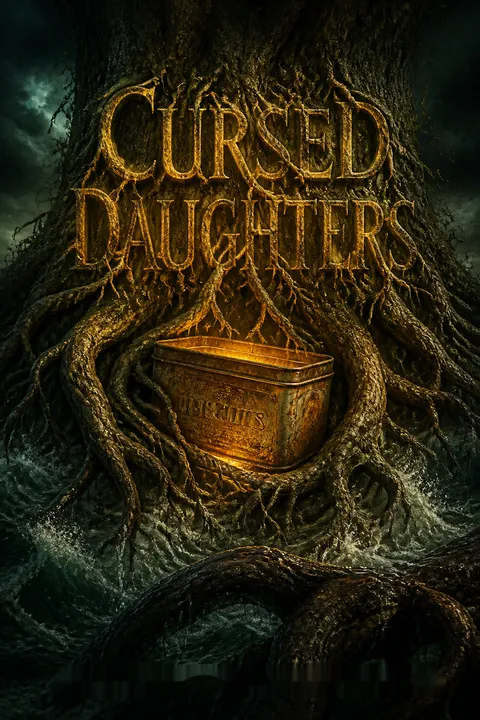
Inside a Royal Dansk tin were Mo's2 buried love tokens: Golden Boy's4 handkerchief, his watch, a Haribo gummy sweet preserved across decades. That night, Grandma West6 died in her sleep, still calling for a daughter who would never return.
At the funeral gathering, Osagie11 — the pilot courting Ebun3 — noticed Eniiyi's pale birthmark and recognized it as vitiligo, the same genetic condition mottling his own arms. He confronted Ebun3 behind a closed door. Eniiyi1 heard him declare what she had waited her whole life to hear: that she was his child.
The Voicemail That Never Played
Kalu4 arrived at the Falodun house red-eyed and contrite, prostrating flat on the floor. But it was Tolu10 who detonated the room. He turned on Ebun:3 she had convinced Mo2 to terminate the pregnancy, then kept her own baby.
He turned on Grandma East:7 the older women had pushed Mo2 toward superstition and juju. Then he confessed his own sin — the day before Mo2 walked into the sea, Kalu4 had left a voicemail saying he wanted the child, that he was sorry. Tolu10 had deleted it, certain it would only deepen her pain.
But by then, the baby was already gone. Ebun3 fell to her knees. Grandma East7 wept. Eniiyi1 handed Kalu4 the tin of buried tokens and Zubby's5 bracelet, asking him to return it to his son. The families' tangled grief had finally been spoken aloud.
Eniiyi Takes Flight
Before leaving Lagos, Eniiyi1 slept with Funsho13 — her loyal, pining friend — not from desire but from a need to prove she could choose outside the pattern linking her to Monife.2 When she told Zubby,5 he punched her bedroom wall and asked why. She said she needed to know her love for him was not a dead woman's puppet show. He left, defeated.
Osagie11 offered his empty London flat and promised to visit — the father she never knew, arriving just as she prepared to go. At the gate, Ebun3 took her hand and said she was sorry, that she hoped this next chapter would be Eniiyi's1 own. Sango14 licked her face. She looked back at the Falodun house one last time, the place where every woman she descended from had loved and lost, and walked through the gate.
Epilogue
In the novel's final vision, Eniiyi1 wrestles the curse itself beneath the ocean — beast against black body, neither tiring — until it expires in her arms. Above the waterline, she boards a plane and soars away from Lagos, from the Falodun house, from every shadow Monife2 cast.
Sango the Immortal14 dies the day after she leaves. Osagie11 proposes to Ebun,3 who says yes. The house empties of its living women, left to ghosts. And seven years later, Eniiyi1 walks into a Lagos restaurant and meets Zubby's5 eyes across the room. Neither of them can look away.
Analysis
Cursed Daughters interrogates whether the stories families tell about themselves become the architecture of their fate. The Falodun curse — spoken into existence by a wounded first wife generations ago — functions less as supernatural decree than as inherited cognitive framework. Each generation enters relationships pre-armed with the conviction that men will leave, generating precisely the anxiety and self-sabotage that drives them away. Monife's2 recourse to juju is not evidence the curse is real; it is evidence that believing in the curse produces real consequences.
Braithwaite's non-linear structure mirrors how intergenerational trauma actually works: effects precede known causes, consequences arrive before explanations. Eniiyi1 is born into a mystery — why does she look like a dead woman? — and spends her life assembling fragments of truth that her family actively conceals. The triptych form — Monife's2 pursuit, Ebun's3 guardianship, Eniiyi's1 reckoning — shows how trauma mutates across generations. Mo's2 love was genuine but warped by abandonment anxiety inherited from her mother. Ebun,3 traumatized by loss, responds with suffocating control: hiding fathers, enforcing swimming lessons, beating her daughter for wearing a dead woman's dress. Her protection is real, but so is its damage.
The novel's most radical argument emerges through Eniiyi's1 training in genetics. She wonders whether epigenetic markers — chemical tags altered by trauma and passed to offspring — explain what her grandmothers call a curse. This reframing does not diminish the suffering; it relocates its cause from the spiritual to the biological, from punishment to pathology, opening a door to intervention. Genetic counselling becomes Eniiyi's1 metaphor: inherited conditions can be understood and managed rather than merely endured. To leave the Falodun house is to reject the premise that destiny is fixed.
The novel also probes the violence of maternal love — Bunmi's6 incense rituals, Kemi's7 pragmatic dating, Ebun's3 raised hand, Mrs. Kenosi's9 café ambush. Each mother believes she is protecting her child; each inflicts damage proportional to her fear. Braithwaite refuses to rank these women's failures, presenting them instead as variations on a single theme: love distorted by powerlessness.
Review Summary
Cursed Daughters by Oyinkan Braithwaite receives mostly positive reviews (4.08/5), praised for its compelling exploration of generational trauma through the Falodun women's curse affecting their romantic relationships. Readers appreciate the multiple perspectives, short chapters, dark humor, and lyrical prose set in Lagos. Many note it's vastly different from her debut My Sister, the Serial Killer—more melancholic and literary. The audiobook narration receives high marks. Criticisms include repetitive narrative, underdeveloped characters, predictable plots, and rushed endings. Some reviewers struggled with the non-linear timeline and found the women's obsession with men frustrating, though this appears intentional to the curse's metaphor.
Characters
Eniiyi
The living doubleBorn the day her aunt Monife2 died, Eniiyi is the youngest protagonist and the axis around which the novel's generational trauma orbits. She is Monife's2 physical twin down to the curve of her smile, yet she fights fiercely to exist as her own person—studying genetics, shaving her head, getting a tattoo of a black kite. Psychologically, she oscillates between accommodation and rebellion: she plays along when Grandma West6 calls her Monife2, then punishes herself for the compliance. Her pursuit of genetic counselling reveals a deeper obsession—she wants to understand why inheritance feels like destiny. Eniiyi is wary of romance, having been raised by women who suffered for it; but when love finds her, she discovers that running from it and running toward it produce equally complicated results.
Monife (Mo)
The incandescent, lost cousinCharismatic, impulsive, and hungry for love, Mo is the family's brightest flame and its most devastating loss. Raised between London and Lagos after her father's abandonment, she masks deep depression with sharp humor, bold fashion, and fierce loyalty to her younger cousin Ebun3. Mo's psychology is defined by a paradox: she dismisses the Falodun curse openly yet is terrified it will claim her. She loves with an intensity that borders on self-destruction—burying her boyfriend's belongings under trees, eating ants to make him laugh, crossing moral lines she once swore she would respect. Her depressive episodes hint at something clinical beneath the family mythology, but no one in her world distinguishes between spiritual affliction and mental illness, leaving her trapped between two inadequate frameworks.
Ebun
The secretive, guarded motherPractical, secretive, and constitutionally incapable of vulnerability, Ebun is the fortress of the Falodun household—always fixing the car, balancing the books, holding the line. The daughter of a serial-marrying mother, she learned early that love is transactional and men are temporary. She guards her emotions with an intensity that makes her an excellent accountant and a complicated parent. Her deepest fear is that her daughter will repeat Monife's2 fate, and this fear manifests as control: tearing up drawings, enforcing swimming lessons, withholding truths about the past. Ebun loves fiercely but expresses it through protection rather than warmth, building walls she tells herself are shelters. The tension between what she knows and what she refuses to say defines every relationship in her life.
Kalu (Golden Boy)
The passive golden loveGolden-skinned, artistically gifted, and genuinely decent, Kalu is the love of Monife's2 life and the hinge upon which the novel's tragedy turns. He sketches Mo2 in quiet moments, tells her he loves her without reservation, and means every word—but he is also his mother's9 son. Raised in extraordinary privilege, Kalu has never had to fight for anything, which means he does not know how to fight for Mo2 when it counts. His tragedy is passivity: he lets his mother9 steer, lets social expectation override his heart, and defaults to the path of least resistance. He is not a villain but something more painful—a good man who lacks the courage to be great when it matters most.
Zubby
The earnest son of historyKalu's4 son, a lanky programmer and comic book devotee whose near-drowning at Elegushi beach brings Eniiyi1 into his life. Zubby is earnest, emotionally articulate, and unafraid of commitment—qualities that terrify Eniiyi1 precisely because they mirror the doomed intensity of Mo2 and Kalu's4 bond. He wears Spider-Man T-shirts and double glasses, and loves with a directness that refuses to accommodate the ghosts haunting his girlfriend's family.
Bunmi (Grandma West)
The grief-consumed headmistressMo's2 mother and a respected headmistress who, behind closed doors, chews tobacco and communes with spirits to win back her ex-husband. After losing her daughter, she fixates on Eniiyi1 as Monife2 reborn, calling her by her dead child's name until dementia makes the confusion permanent. Her grief never resolves—it simply changes form, from denial to spiritual obsession to cognitive dissolution.
Kemi (Grandma East)
The vivacious serial daterEbun's3 mother, a pint-sized woman with ruby-red nails and a passion for televised wrestling. Kemi is the household's comic relief and emotional glue—flirtatious, pragmatic, and unashamed of her strategies for survival. She mediates fights, funds groceries through wealthy suitors, and loves freely, though she has never found lasting romantic happiness herself.
Amara
The approved wifeKalu's4 wife, initially presented as gentle and deferential—round-faced, soft-spoken, ordering water with cucumber slices. But she is more complex than her placid surface suggests, capable of fierce protectiveness when she perceives a threat to her family. She represents the life Kalu4 chose: polished, socially approved, and built on foundations the novel gradually reveals to be unstable.
Mrs. Kenosi
The elegant, ruthless matriarchKalu's4 mother, beautiful and surgically cruel. She weaponizes class, tribal prejudice, and colorism to separate Mo2 from her son. Her café ambush—cataloguing Mo's2 shortcomings with clinical precision—is the novel's most devastating act of social violence. She represents the institutional forces that reinforce the curse: family expectation, hierarchy, and the ruthless economics of marriage.
Tolu
The silent, guilty brotherMo's2 older brother, who retreats from the Falodun household after personal tragedy and carries unspoken guilt for decades. Married to a British woman named Ashley, he got a vasectomy to ensure no daughter of his would ever be subjected to the family's dysfunction. His rare appearances are tense, obligatory, and freighted with things left unsaid.
Osagie (Oba)
The patient father at the gateAn air force officer who appears at the Falodun gate with flowers, courting Ebun3 with a patience that borders on devotion. Warm, large, and given to booming laughter, he is the antithesis of every man the Falodun women have known. He wears long sleeves habitually, and his quiet persistence suggests he is accustomed to playing the long game. His connection to the family runs deeper than anyone initially realizes.
Mama G
The dubious spiritual adviserA nomadic practitioner with enormous breasts and a gold tooth, who sells remedies and exploits Bunmi's6 desperation. The juju products she provides become catalysts for irreversible consequences in the Falodun family.
Funsho
The pining loyal friendEniiyi's1 nervous, gazelle-like friend who loves her openly. He serves as both a steadying presence in her social life and, ultimately, the instrument of a desperate decision she makes to reclaim her autonomy.
Sango
The immortal guardian dogMo's2 dog, purchased as a puppy from a Lagos street hawker and living impossibly long—nearly thirty years. He is the only male presence in the Falodun house who never leaves, a living thread connecting all three generations.
Feranmi Falodun
The cursed ancestorThe beautiful, bold progenitor whose seduction of a city man provoked a blood-sealed curse from his first wife, condemning all Falodun women to lose their men across every subsequent generation.
Plot Devices
The Falodun Family Curse
Generational psychological prisonPronounced in blood by the first wife of Feranmi Falodun's15 husband, the curse declares that no man will stay with any woman in the Falodun line. Across generations, it manifests as abandoned wives, broken engagements, and women sent back to their family home. The novel leaves deliberately ambiguous whether the curse is supernatural or self-fulfilling—a psychological inheritance passed through stories and fear rather than through blood. Each generation of women cites it to explain romantic failure, which may itself perpetuate the pattern. Monife's2 notebook documents every instance; Eniiyi1 later wonders if epigenetic markers and generational trauma might explain what her grandmothers attributed to spirits. The curse functions as both villain and mirror, reflecting whatever the believer most fears.
The Iroko Tree
Burial ground for love tokensThe massive tree at the center of the Falodun courtyard serves as the novel's axis—the still point around which the family's chaos revolves. Mo2 buries Golden Boy's4 handkerchief beneath its roots as a homemade antidote to the curse. Eniiyi1 sleepwalks to its roots as a child, sitting in a trance on the exposed wood. Decades later, when Eniiyi1 tries to bury Zubby's5 leather bracelet in the same soil, her trowel strikes a biscuit tin containing Mo's2 preserved tokens—physical proof that her aunt's love story and her own have converged in the same earth. The tree holds the family's secrets in its roots, returning them only when someone digs deep enough.
Mama G's Juju Products
Catalyst for the lovers' breakupThe brown powder Mo2 slips into Kalu's4 drink and the paper she pins to her menstrual pad with his name represent her surrender to the superstition she once ridiculed. The products serve a dual function: they are objectively useless as magic, but their discovery destroys Kalu's4 trust in Mo2 entirely. The juju does not work as a spell, but it works as plot—giving Kalu4 the excuse he needs to leave and confirming his mother's9 narrative that Mo2 is unsuitable. The irony is devastating: the curse-breaking remedy becomes the curse's most effective weapon, proving that the real damage comes not from spiritual forces but from the desperation they engender.
Sango the Dog
Living thread across generationsPurchased by Mo2 from a Lagos street hawker as a puppy, Sango lives for nearly thirty years—a biological impossibility the novel treats with quiet wonder. He follows Eniiyi1 from birth, sleeping at her feet, barking when she sleepwalks, absorbing the perfume Grandma East7 sprays to mask his smell. He is the only male creature in the Falodun household who stays. Ebun3 resents him; the grandmothers tolerate him; Eniiyi1 adores him. His death the day after Eniiyi1 leaves Nigeria signals the end of an era—when the last woman walks through the gate, the guardian's vigil is finally complete.
Eniiyi's Birthmark (Vitiligo)
Proof of separate identityA trail of pale skin on the back of Eniiyi's1 neck, initially used by Ebun3 to reassure herself that her daughter is not simply Monife2 reborn. The birthmark becomes Eniiyi's1 talisman of individuality—she points to it whenever someone insists she is her aunt's carbon copy. Mama G12 dismisses it; Grandma West6 ignores it; but the mark persists as stubborn biological evidence that Eniiyi1 has her own genetic signature. In the novel's final act, the mark transforms from a symbol of difference into something far more specific—a genetic connection to a person Eniiyi1 never knew was part of her story, rewriting the meaning of inheritance itself.
Download PDF
Download EPUB
.epub digital book format is ideal for reading ebooks on phones, tablets, and e-readers.








































