


Plot Summary
Prologue
The narrator opens with a question that haunts the entire story: are people truly equal? He references Fukuzawa Yukichi's famous declaration that heaven places no one above another — but notes the passage continues with a harder truth, that education creates the divide between those who rise and those who stay. Equality, the narrator concludes, is a complete fiction.
Yet raw inequality cannot simply be accepted, either. Somewhere between these poles lies an answer worth pursuing. This philosophical restlessness propels a student toward the Tokyo Metropolitan Advanced Nurturing High School — a government institution that promises to develop Japan's future leaders by measuring human worth through standards no one fully understands.
Nobody Gives Up Their Seat
On the bus to the Advanced Nurturing High School, a blond student named Kouenji7 refuses to yield his priority seat to an elderly woman, debating an offended office worker with smug logic about rights versus obligations.
A girl in school uniform — Kushida3 — appeals to all passengers, and eventually a stranger yields. Ayanokouji Kiyotaka,1 the narrator, doesn't move either, and notices the girl beside him shares his indifference: Horikita Suzune.2 After disembarking, Horikita2 confronts Ayanokouji1 for staring at her.
She calls giving up one's seat pointless; he calls himself trouble-averse. Their exchange is frosty but honest — the first of many reluctant connections. They walk through the school gates together, mirrors of each other's detachment.
Paradise with a Price Tag
Ayanokouji1 enters Class D and immediately fails at making friends — paralyzed by overthinking, he watches a classmate befriend someone else before he can speak. Horikita2 takes the seat beside him and reluctantly shares her name.
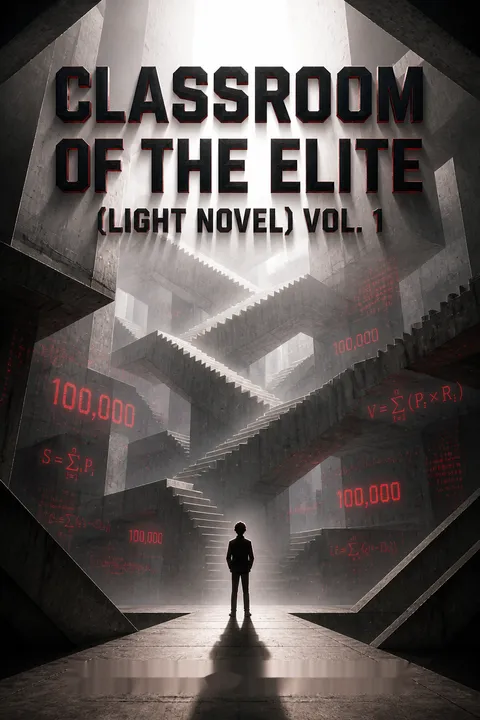
Their homeroom teacher, Chiyabashira-sensei,6 distributes student ID cards loaded with 100,000 points — each equivalent to one yen — usable at any campus facility. The school is a sealed world: dormitories, shops, cafés, even karaoke, but no outside contact permitted. Students erupt in celebration.
Ayanokouji1 privately chose this school precisely because its isolation means no one from his past can reach him. The generosity seems impossible. Horikita2 alone voices what nags at him: receiving this much preferential treatment is frightening.
The President Shares Her Name
At the club fair, representatives from dozens of organizations pitch their groups to restless first-year students. The final speaker steps to the microphone and says nothing. Laughter ripples through the gymnasium, then dies.
Without uttering a word, the boy at the podium stills over a hundred voices through sheer presence — a silence so total it feels physical. He introduces himself as student council president Horikita Manabu8 and recruits only those who understand the council's true weight. Ayanokouji1 glances at Suzune2 beside him.
She stands frozen, face drained of color, staring at the stage with an intensity she will not explain. Meanwhile, Ayanokouji1 finally exchanges contact information with classmates Ike9 and Sudou,4 cracking open his social isolation for the first time.
Class D Gets Nothing
On May 1, Chiyabashira-sensei6 announces that Class D received zero points. Ninety-eight absences and late arrivals, three hundred ninety-one incidents of talking or phone use — every infraction deducted from their allowance until nothing remained.
She reveals the school's hidden architecture: classes are ranked by ability, A at the summit, D for the defective. A recent pop quiz exposed seven students near failure; anyone scoring below the midterm's passing threshold faces immediate expulsion.
The class that spent a month in reckless luxury now owns nothing. Sudou4 storms out when Hirata,5 Class D's natural leader, urges cooperation. Horikita,2 who scored third-highest on the entrance exam, stiffens at being labeled defective and privately resolves to discover why she was placed here.
Fifty in Every Subject
Chiyabashira-sensei6 summons Ayanokouji1 to the guidance room but hides him in the kitchenette to overhear Horikita's2 protest about her Class D placement. The teacher acknowledges Horikita's2 superb entrance scores but insists academics alone do not determine class rank — the school evaluates something beyond intelligence, though she refuses to specify what.
Then she calls Ayanokouji1 out. His results show fifty points in every subject across both the entrance exam and the recent quiz — a statistical impossibility unless deliberate.
He solved the hardest math problem flawlessly yet missed elementary ones. Ayanokouji1 insists it was coincidence. Neither woman believes him. Walking home, Horikita2 asks him to serve as her pawn in the campaign to reach Class A. He refuses. She pretends not to hear.
Horikita Insults Sudou's Dream
Horikita2 conscripts Ayanokouji1 to recruit Sudou,4 Ike,9 and Yamauchi10 into a study group she will tutor. He fails to persuade any of them, so he secretly enlists Kushida,3 whose popularity convinces all three boys to attend. Kushida3 even outmaneuvers Horikita2 into allowing her to participate.
But in the library, Horikita's2 teaching turns contemptuous. When Sudou4 cannot solve basic simultaneous equations, she calls his professional basketball dreams childish — a simpleton who quits at the first obstacle could never go pro.
Sudou4 grabs her collar. Kushida3 barely restrains him. One by one, all three quit. Horikita2 concludes that expelling failures would raise the class average and spare everyone future grief. The group that took days to assemble dissolves in minutes.
Kushida's Other Face
Ayanokouji1 follows Kushida3 to the school rooftop after the study group collapses. Through a cracked door, he hears a voice nothing like the girl he knows — low, venomous, wishing Horikita2 dead, cursing her as the absolute worst. He tries to slip away but kicks the door.
Kushida3 catches him. Her warmth vanishes. She pins his forearm against the wall, forces his palm against her chest, and warns that his fingerprints on her uniform now serve as evidence for a sexual assault accusation should he ever speak.
Ayanokouji1 deduces from subtle clues — Kushida3 knew Horikita's2 name before any introduction occurred — that the two likely share a hidden past. He swears silence. Kushida's3 smile snaps back into place as if the last five minutes never happened.
Dodging the President's Fist
Late at night, Ayanokouji1 spots Horikita2 leaving the dormitory and follows her to a confrontation with her older brother, the student council president.8 Manabu8 coldly declares she will never reach Class A, that her fixation on following him blinds her to her own flaws, and demands she withdraw.
When he pins her against the concrete wall, Ayanokouji1 grabs his arm. Manabu8 retaliates with a backhand and a sharp kick — both dodged, revealing combat instincts Ayanokouji1 deflects with jokes about calligraphy lessons.
Later, alone with Horikita,2 Ayanokouji1 argues passionately that every student possesses different strengths and the school may penalize expulsions in ways they cannot foresee. Horikita2 relents. She will help the failing students — but only as strategic calculation, never kindness.
A Date as Study Incentive
Horikita2 approaches Kushida3 at café Palate, honestly confessing her motives are selfish — she wants Class A, not friendship. Kushida3 agrees and asks to join their campaign permanently. With everyone reassembled, Horikita2 unveils a revised strategy: study during class hours and review material in ten-minute breaks between periods, eliminating after-school sacrifice.
She compiles condensed answers, and the three tutors teach one-on-one. When Sudou4 still resists, Ayanokouji1 improvises by asking Kushida3 on a date if he scores fifty.
Ike9 and Yamauchi10 scramble to outbid each other. Kushida3 plays along, offering a date to whoever scores highest. Sudou4 quietly agrees without turning around. The study group reforms on terms that finally accommodate basketball practice, and the Idiot Trio begins genuinely wrestling with their lessons.
Buying Last Year's Answers
A Class C student mocking them in the library inadvertently reveals the midterm material has changed — and Class D was never notified. Chiyabashira-sensei6 casually admits she forgot, handing over revised topics one week before the exam. Two weeks of study are partly wasted.
Ayanokouji,1 suspecting deliberate sabotage, acts on a hunch that the school reuses questions. He locates a broke third-year student eating free meals in the cafeteria and purchases old midterm papers for 15,000 points. The questions match word for word.
Kushida3 distributes copies the day before the test, earning Horikita's2 genuine praise — and then a blunt question: does Kushida3 hate her? Kushida3 confirms it plainly. Both agree to keep working together anyway, their partnership forged from usefulness rather than affection.
One Point Short
Exam day proceeds smoothly for most — old test questions match, and students excel. But Sudou4 fell asleep before memorizing the English section, leaving him only ten minutes to cram. After the final test, Horikita2 surprises everyone by apologizing to Sudou4 for dismissing his basketball dreams, praising the effort he invested in studying.
Then results post. Sudou4 scored thirty-nine in English. Chiyabashira6 draws a red line at forty — the passing grade, calculated by dividing the class average by two and rounding up.
The class notices Horikita2 scored just fifty-one in English while earning perfect marks elsewhere: she deliberately tanked her own grade to lower the average and reduce the threshold. Her calculation was precisely right — except the rounding went the wrong direction. She is one mathematical rule away from having saved him.
100,000 Points for One Answer
Ayanokouji1 intercepts Chiyabashira6 in the hallway and argues the school created unfair conditions — the delayed notification about changed test material was negligence or sabotage. He invokes her own enrollment-day words: students can buy anything with their points.
He offers to purchase one test point for Sudou's4 English score. She names the price: 100,000 points. Horikita2 appears behind him, offering her remaining balance. Together they cover the cost, and Chiyabashira6 accepts — overturning Sudou's4 expulsion. She admits she is impressed by strategies she never anticipated from Class D.
That evening, the group gathers in Ayanokouji's1 spartan dorm room to celebrate. Kushida3 proposes they all pursue Class A together. Even Horikita,2 attending her first social gathering, does not object. The alliance is fragile, the gap enormous — but Class D survives intact.
Analysis
Classroom of the Elite operates as a philosophical thought experiment housed within a competitive school drama. Its opening question — are people truly equal? — recurs through every institutional mechanism the story constructs. The S Point System literalizes human value: behavior carries a monetary price, compliance generates currency, recklessness costs material comfort. When Class D loses everything in month one, the novel reveals that freedom without accountability produces exactly the inequality the narrator warns about in the prologue.
The school's class ranking system mirrors social stratification, but the novel's sharpest insight is that labels become self-fulfilling. Once branded defective, students internalize failure — Sudou4 stops trying, Ike9 defaults to cramming, Yamauchi10 spends himself into poverty. The system measures not just ability but response to adversity, which is why Horikita's2 placement in Class D despite top-three entrance scores makes philosophical sense: intelligence that refuses to cooperate is, by the school's holistic metric, deficient.
Horikita's2 arc embodies the central critique of narrow meritocracy. Her gradual recognition that Sudou's4 athletic dedication constitutes genuine ability — not lesser ability wearing different clothes — mirrors Japan's ongoing tension between standardized testing culture and the diversity of human talent. Her deliberate sabotage of her own English score represents the mathematical expression of a moral shift: for the first time, she sacrifices personal excellence for collective survival.
Kushida3 introduces a darker thread about performative identity. If appearing kind produces the same social results as genuine kindness, does authenticity matter? The novel refuses to answer, instead presenting her dual nature as evidence that every ranking system — academic, social, moral — contains dimensions it cannot measure.
Ayanokouji's1 deliberate mediocrity poses the book's most unsettling question: what happens when someone with the ability to change everything chooses passivity? His late, reluctant interventions — acquiring old tests, purchasing the decisive point — suggest that unused potential is its own form of deficiency. The school may have placed him in Class D not as punishment but as provocation, waiting to see if opening the cage door would finally draw out the bird.
Review Summary
Classroom of the Elite receives mixed reviews, with an average rating of 4.12/5. Readers praise its psychological depth, intriguing premise, and complex characters, particularly the protagonist Ayanokouji. Many find the school's merit-based system fascinating. However, some criticize the slow pacing, especially in the first half, and the occasional fan service. Comparisons to the anime adaptation are frequent, with opinions divided on which version is superior. Despite its flaws, many readers express eagerness to continue the series and uncover more about the mysterious main character.
Characters
Ayanokouji Kiyotaka
Class D's Disguised GeniusThe first-person narrator who presents himself as an unremarkable, trouble-averse teenager — yet whose every test score lands at exactly fifty points, whose reflexes dodge a martial arts master's strikes, and whose strategic thinking outpaces everyone around him. He chose this school specifically because it severs all outside contact, hinting at a past he refuses to discuss. His self-deprecation reads as performance rather than genuine modesty. He forms an unlikely partnership with Horikita2 while maintaining emotional distance from everyone, including himself. Psychologically, he operates from radical non-attachment — observing, calculating, occasionally intervening, but retreating before others can truly see him. His deepest tension lies between the desire for normalcy and an inability to stop being exceptional.
Horikita Suzune
Brilliant Loner of Class DA fiercely intelligent student who scored third-highest on the entrance exam yet was placed in Class D — a classification she considers an insult to her abilities. Her aloof demeanor is not shyness but deliberate rejection of human connection, rooted in nine years of choosing solitude. She is driven by an obsessive need to prove herself to her older brother, the student council president8, who regards her with cold indifference. Her arc traces a shift from treating classmates as expendable baggage to grudgingly acknowledging their individual value. She struggles with the gap between intellectual superiority and emotional blindness — capable of predicting test questions but incapable of understanding why insulting someone's dream destroys cooperation. Her pride makes every concession feel like a wound being reopened.
Kushida Kikyou
Everyone's Favorite ClassmateThe most popular girl in Class D, radiating warmth and eagerness to befriend every classmate without exception. Her self-appointed mission to connect with everyone — including the resistant Horikita2 — drives much of the class's social dynamics. Her cheerfulness appears effortless, yet the intensity with which she pursues universal approval suggests deeper psychological needs: her identity seems anchored to others' affection in ways that could prove fragile under pressure. She likely shares an undisclosed history with Horikita2, evidenced by subtle inconsistencies in how she first learned Horikita's2 name before any introduction. Her role as the group's social catalyst makes her indispensable, but the gap between her public warmth and private motivations raises unsettling questions about what she might become if her carefully maintained image were ever threatened.
Sudou Ken
Fiery Basketball DreamerA hot-tempered basketball player with the worst academic scores in Class D and the shortest fuse in any room he enters. His dream of going professional is his single anchor of purpose, and insulting it guarantees his violence. Beneath the aggression lies genuine vulnerability — when Horikita2 finally acknowledges his effort, he is deeply moved. His growth from adversarial dropout risk to cooperative team member forms the emotional core of the midterm crisis, and his willingness to sacrifice basketball practice for studying marks his most significant act of self-discipline.
Hirata Yousuke
Class D's Natural LeaderHandsome, empathetic, and dating Karuizawa11, he organizes self-introductions on the first day, forms study groups during the crisis, and mediates conflicts without ego. His genuine concern for every classmate extends even to those who antagonize him. He functions as the moral center the class gravitates toward publicly, while Ayanokouji1 and Horikita2 operate more strategically in the shadows. His popularity makes him simultaneously indispensable and insufficient — warmth alone cannot solve Class D's structural problems.
Chiyabashira Sae
Class D's Cryptic TeacherClass D's homeroom teacher, whose stern exterior conceals a deliberate testing methodology. She withholds critical information — the point deduction rules, the changed test material — with seeming negligence that may be calculated provocation designed to force resourcefulness. Her role oscillates between adversary and guide: she punishes carelessness mercilessly but drops hints for those sharp enough to listen. Her acceptance of Ayanokouji's1 unconventional gambit suggests she wanted the class to fight back all along.
Kouenji Rokusuke
Narcissistic Conglomerate HeirHeir to a business empire, physically dominant and academically gifted, yet utterly uncooperative. He scores ninety on tests while polishing his nails, swims faster than dedicated athletes, and socializes exclusively with upperclassmen women. His narcissism is genuine rather than performative — he considers himself above every institutional metric. Class D's ranking means nothing to him because his future is guaranteed by birth. He represents the privilege that renders the school's meritocratic ideals absurd.
Horikita Manabu
Student Council PresidentSuzune's2 older brother, whose silent authority can paralyze a gymnasium full of students before he speaks a word. He views his sister's pursuit of him as pathological fixation rather than admiration and coldly demands she leave the school. His martial arts expertise — fifth dan in karate, fourth dan in aikido — and intellectual dominance set the ceiling against which both Suzune2 and Ayanokouji1 measure themselves. He represents the standard Suzune2 fears she can never reach.
Ike Kanji
Girl-Obsessed Class ClownLoud, socially enthusiastic member of the so-called Idiot Trio whose academic weakness is matched only by his infatuation with Kushida3. His crush drives much of his motivation, making him an easy target for incentive-based manipulation during the study group's revival.
Yamauchi Haruki
Compulsive Liar of Class DA boastful fabricator who claims professional gaming scouts and baseball stardom in equal measure. The most financially reckless student in Class D, he burns through his points within weeks on a gaming console and serves as comic relief tinged with genuine desperation.
Karuizawa Kei
Hirata's Flashy GirlfriendA gyaru-type girl dating Hirata5 who spends extravagantly and borrows points from classmates once hers run out. She occupies a central position in Class D's female social hierarchy.
Hoshinomiya Chie
Flirty Class B TeacherChiyabashira's6 high school friend and Class B's homeroom teacher. Her playful, boundary-pushing demeanor with students contrasts sharply with Chiyabashira's6 severity, hinting that different classes operate under very different philosophies.
Ichinose
Composed Class B StudentA poised Class B student who defuses a library confrontation between Class D and Class C with calm authority. Her brief appearances establish her as a figure of quiet competence beyond Class D's orbit.
Plot Devices
The S Point System
Currency doubles as evaluationEvery student receives monthly points equivalent to yen, loaded onto student ID cards for all campus purchases. Points are simultaneously deducted for class infractions — tardiness, talking, phone use — though the exact deduction formulas remain hidden. The system creates an elegant trap: students who spend freely in month one discover their deposit arrives as zero in month two. The dual function of currency and performance metric forces Class D to confront the link between behavior and consequence. The teacher's enrollment-day statement that points can purchase anything on campus proves literally true when a student1 uses accumulated points to buy an additional test point for a failing classmate4 — revealing the system's ultimate, radical flexibility.
Class Ranking System (A-D)
Social hierarchy as motivationStudents are sorted into four classes by an undefined measure of overall ability. Class A receives guaranteed access to elite universities and employers; Class D is labeled defective — the repository for students the school deems least capable. Rankings are not permanent: if a lower class earns more points than a higher one, promotion is theoretically possible, making every month a potential shift in hierarchy. The system breeds both despair and ambition — despair because the gap between D and A seems insurmountable, ambition because the school explicitly states movement is achievable. The criteria for initial placement remain opaque, as students with top entrance scores sit alongside those who barely passed, suggesting the school measures something beyond academics.
Old Test Papers
Hidden backdoor to survivalThe school administers midterm exams using questions identical to previous years' tests — a pattern never announced. Students must discover it through resourcefulness, social networking, or purchasing materials from upperclassmen who retained them. The device rewards initiative over pure study: a student who cannot solve simultaneous equations can still pass by memorizing last year's answers. It suggests the school's real curriculum involves collective problem-solving rather than textbook mastery. The papers function as decisive insurance for struggling students, but their power depends on timing — distributed too early, they destroy study motivation; distributed too late, they cannot be absorbed. The protagonist1 discovers and deploys them as a calculated gambit the night before the exam.
Midterm Expulsion Rule
Collective survival stakesAny student scoring below the passing threshold on a midterm or final exam faces immediate expulsion — no second chances, no remediation. The threshold is calculated per class by dividing the class average by two, then rounding, which means every student's performance affects everyone else's survival. A class of high scorers paradoxically creates a higher bar to clear, punishing strong classes that contain even one weak member. This formula transforms academic performance from personal responsibility into communal obligation and generates the novel's central dramatic tension: will the class invest energy in protecting its weakest members, or sacrifice them to simplify future competition? The school reinforces the pressure by dangling a dream vacation as reward for classes with zero failures.
Ayanokouji's Hidden Abilities
Unreliable narrator mysteryThroughout the novel, the protagonist claims average ability while evidence accumulates against him: entrance exam scores of exactly fifty in every subject suggest deliberate calibration, not mediocrity. He solves the hardest quiz problem flawlessly yet misses elementary ones. His muscular build draws notice despite claims of no exercise. When confronted by a martial arts expert8, he dodges every attack with instinctive precision attributed to piano and calligraphy training. His homeroom teacher6 openly declares he may be the most intelligent student in Class D. These contradictions function as the novel's sustaining mystery: why would someone this capable engineer his own invisibility, and what in his sealed-off past demands it?
FAQ
Synopsis & Basic Details
What is Classroom of the Elite (Light Novel) Vol. 1 about?
- Elite school, hidden system: The story follows Kiyotaka Ayanokouji as he navigates Tokyo Metropolitan Advanced Nurturing High School, a prestigious institution promising a bright future, but concealing a merit-based system where students are divided into classes A through D based on their abilities.
- Class D's struggle: Ayanokouji finds himself in Class D, the class for "defective" students, and they quickly learn that their behavior directly impacts their monthly allowance of points, a currency used for everything on campus.
- Unveiling the truth: The volume explores the initial challenges faced by Class D as they grapple with the school's hidden rules, the true nature of their classmates, and the realization that their path to success will be far from easy.
- Keywords: Classroom of the Elite synopsis, Classroom of the Elite summary, Classroom of the Elite plot
Why should I read Classroom of the Elite (Light Novel) Vol. 1?
- Intriguing psychological elements: The novel delves into the characters' inner thoughts and motivations, creating a suspenseful atmosphere and prompting readers to question their own values and beliefs.
- Strategic mind games: The story features intricate strategies and manipulations as characters try to outwit each other, making it a compelling read for those who enjoy intellectual challenges and plot twists.
- Social commentary: The novel offers a critical look at meritocracy, equality, and the pressures of modern society, prompting readers to reflect on the values and systems that shape their own lives.
- Keywords: Classroom of the Elite review, Classroom of the Elite recommendation, Classroom of the Elite why read
What is the background of Classroom of the Elite (Light Novel) Vol. 1?
- Japanese education system critique: The novel subtly critiques the Japanese education system's emphasis on academic achievement and conformity, highlighting the potential for talented individuals to be overlooked or stifled.
- Social hierarchy commentary: The class divisions within the school reflect the rigid social hierarchies present in Japanese society, where status and reputation play a significant role in determining one's opportunities and success.
- Dystopian undertones: The school's isolated environment and strict rules create a sense of unease and control, hinting at a dystopian society where individual freedom is sacrificed for the sake of order and efficiency.
- Keywords: Classroom of the Elite background, Classroom of the Elite context, Classroom of the Elite themes
What are the most memorable quotes in Classroom of the Elite (Light Novel) Vol. 1?
- "Are people equal or not?": This opening question sets the stage for the novel's exploration of equality and meritocracy, challenging readers to question their own assumptions about fairness and justice.
- "To be human is to be unequal. Equality does not exist.": This stark statement encapsulates the novel's cynical view of human nature and the inherent inequalities that exist in society, highlighting the challenges faced by those who are deemed "defective."
- "I will employ violence to rehabilitate you, Ayanokouji-kun, and purge you of those impure thoughts.": This quote, spoken by Horikita, reveals her pragmatic and sometimes ruthless approach to achieving her goals, showcasing her willingness to use any means necessary to succeed.
- Keywords: Classroom of the Elite quotes, Classroom of the Elite best quotes, Classroom of the Elite memorable quotes
What writing style, narrative choices, and literary techniques does Syougo Kinugasa use?
- First-person perspective: The story is told from Ayanokouji's point of view, providing readers with intimate access to his thoughts and strategies, while also creating a sense of mystery and intrigue as his true motives remain hidden.
- Ironic tone: The narrative employs a dry and sarcastic tone, often contrasting Ayanokouji's detached observations with the emotional turmoil of those around him, creating a darkly humorous effect.
- Strategic foreshadowing: Kinugasa subtly hints at future events and character developments, leaving clues and breadcrumbs for readers to piece together, enhancing the suspense and anticipation.
- Keywords: Classroom of the Elite writing style, Classroom of the Elite literary techniques, Classroom of the Elite narrative
Hidden Details & Subtle Connections
What are some minor details that add significant meaning?
- Horikita's cheap shampoo: Horikita's choice of the cheapest shampoo in the store hints at her hidden financial prudence and a possible backstory of economic hardship, contrasting with the privileged environment of the school.
- Kouenji's nail filing: Kouenji's constant nail filing, even in inappropriate settings, emphasizes his self-absorbed nature and disregard for social norms, highlighting his privileged background and lack of concern for others' opinions.
- The "Free" toiletries: The availability of free toiletries and food in the convenience store, limited to three items per month, foreshadows the potential for students to fall into poverty and rely on the school's meager support system, highlighting the dark side of the point-based economy.
- Keywords: Classroom of the Elite details, Classroom of the Elite hidden meaning, Classroom of the Elite symbolism
What are some subtle foreshadowing and callbacks?
- The bus incident foreshadows class divisions: The initial bus scene, where Kouenji refuses to give up his seat, foreshadows the later class divisions and the egotistical attitudes that will plague Class D.
- Horikita's book choice: Horikita reading "Crime and Punishment" foreshadows her own internal struggles with morality and justice, as she grapples with the school's harsh system and her own desire to reach Class A.
- Ayanokouji's hidden abilities: Ayanokouji's seemingly average performance on the entrance exam, with perfectly balanced scores, foreshadows his hidden intelligence and strategic mind, which he deliberately conceals from others.
- Keywords: Classroom of the Elite foreshadowing, Classroom of the Elite callbacks, Classroom of the Elite analysis
What are some unexpected character connections?
- Horikita and her brother: The revelation that the student council president is Horikita's brother adds a layer of complexity to her character, suggesting a strained family dynamic and a desire to prove herself to him.
- Kushida and Horikita's past: The subtle hints that Kushida and Horikita may have a shared history, possibly attending the same school before, create a sense of mystery and intrigue, suggesting a deeper conflict between them.
- Ayanokouji and Chiyabashira-sensei: The teacher's unusual interest in Ayanokouji, and her knowledge of his hidden abilities, hints at a possible connection between them, suggesting that she may have a specific purpose for him in Class D.
- Keywords: Classroom of the Elite character connections, Classroom of the Elite relationships, Classroom of the Elite character analysis
Who are the most significant supporting characters?
- Kikyou Kushida: Her popularity and manipulative nature make her a key player in Class D's social dynamics, influencing the relationships between students and driving the plot forward.
- Yousuke Hirata: His leadership skills and desire for unity make him a central figure in Class D's efforts to improve, highlighting the importance of cooperation and empathy in overcoming challenges.
- Ken Sudou: His athletic abilities and volatile personality create conflict and tension within Class D, while his struggles with academics highlight the challenges faced by those who are deemed "defective."
- Keywords: Classroom of the Elite supporting characters, Classroom of the Elite character analysis, Classroom of the Elite character list
Psychological, Emotional, & Relational Analysis
What are some unspoken motivations of the characters?
- Ayanokouji's desire for freedom: Ayanokouji's primary motivation is to escape his past and live a life free from external control, which is why he values the school's restrictions on outside contact.
- Horikita's need for validation: Horikita's relentless pursuit of Class A stems from a deep-seated need to prove herself to her brother and overcome her perceived shortcomings.
- Kushida's fear of exposure: Kushida's desire to befriend everyone is driven by a fear that her true nature will be revealed, leading her to manipulate and control those around her.
- Keywords: Classroom of the Elite character motivations, Classroom of the Elite psychological analysis, Classroom of the Elite character analysis
What psychological complexities do the characters exhibit?
- Ayanokouji's apathy vs. hidden empathy: Ayanokouji presents a facade of apathy and detachment, but his actions often reveal a hidden empathy for others, suggesting a conflict between his desire for freedom and his innate human connection.
- Horikita's intelligence vs. social ineptitude: Horikita's high intelligence is contrasted with her social ineptitude, highlighting the limitations of academic ability and the importance of emotional intelligence in navigating social situations.
- Kushida's duality: Kushida's dual nature, as both a charming friend and a manipulative schemer, creates a complex and intriguing character, raising questions about the true nature of her personality and motivations.
- Keywords: Classroom of the Elite character psychology, Classroom of the Elite psychological analysis, Classroom of the Elite character analysis
What are the major emotional turning points?
- Class D receiving zero points: The realization that their behavior has consequences and that they are truly considered "defective" marks a turning point for Class D, forcing them to confront their shortcomings and consider the need for change.
- Horikita apologizing to Sudou: Horikita's awkward but sincere apology to Sudou represents a significant emotional turning point for her, as she begins to acknowledge the value of empathy and connection.
- Ayanokouji revealing his past: Ayanokouji's brief mention of his isolated past in junior high hints at a deeper emotional history, suggesting a reason for his detached personality and desire for freedom.
- Keywords: Classroom of the Elite emotional analysis, Classroom of the Elite character development, Classroom of the Elite plot analysis
How do relationship dynamics evolve?
- Ayanokouji and Horikita's reluctant partnership: Their initial relationship is characterized by mutual distrust and manipulation, but they gradually develop a grudging respect for each other, forming a tentative partnership based on shared goals.
- Kushida's attempts to befriend Horikita: Kushida's persistent attempts to befriend Horikita, despite the latter's rejection, create a complex and intriguing dynamic, highlighting the power of social influence and the challenges of overcoming personal biases.
- The formation of the Idiot Trio: The bond between Sudou, Ike, and Yamauchi, despite their academic struggles, showcases the importance of friendship and loyalty in navigating difficult situations.
- Keywords: Classroom of the Elite relationship analysis, Classroom of the Elite character dynamics, Classroom of the Elite social dynamics
Interpretation & Debate
Which parts of the story remain ambiguous or open-ended?
- Ayanokouji's true abilities: The extent of Ayanokouji's intelligence and strategic abilities remains ambiguous, leaving readers to wonder about his true potential and the reasons for his deliberate mediocrity.
- Kushida's ultimate goal: Kushida's true motivations and the reasons for her hatred of Horikita remain a mystery, leaving readers to speculate about her long-term plans and the role she will play in the story.
- The school's true purpose: The school's ultimate goal in sorting students into classes based on ability remains unclear, raising questions about the ethics of such a system and the potential for manipulation and control.
- Keywords: Classroom of the Elite ambiguity, Classroom of the Elite open-ended, Classroom of the Elite unanswered questions
What are some debatable, controversial scenes or moments in Classroom of the Elite (Light Novel) Vol. 1?
- Horikita's use of violence: Horikita's willingness to use violence to achieve her goals, such as stabbing Ayanokouji with a compass, raises questions about the morality of her actions and the extent to which she is willing to go to succeed.
- The objectification of female characters: The boys' ranking of female classmates based on their breast sizes is a controversial scene that raises questions about sexism and objectification in the story.
- The school's harsh expulsion policy: The school's willingness to expel students for failing grades, despite their potential in other areas, raises ethical concerns about the value of human potential and the fairness of the system.
- Keywords: Classroom of the Elite controversial, Classroom of the Elite debatable, Classroom of the Elite ethics
Classroom of the Elite (Light Novel) Vol. 1 Ending Explained: How It Ends & What It Means
- Sudou avoids expulsion: The primary conflict of the volume is resolved with Sudou narrowly avoiding expulsion, thanks to Horikita and Ayanokouji's combined efforts. This highlights the potential for Class D to overcome their challenges through cooperation and strategic thinking.
- Ayanokouji and Horikita's alliance: The ending solidifies the tentative alliance between Ayanokouji and Horikita, setting the stage for their future collaboration and the challenges they will face together in their quest to reach Class A.
- Uncertain future: Despite the victory, the ending leaves the future of Class D uncertain, as they still face significant challenges and the school's manipulative system remains a constant threat.
- Keywords: Classroom of the Elite ending explained, Classroom of the Elite ending meaning, Classroom of the Elite analysis

Download PDF
Download EPUB
.epub digital book format is ideal for reading ebooks on phones, tablets, and e-readers.








































