
Plot Summary
City of Lost Children
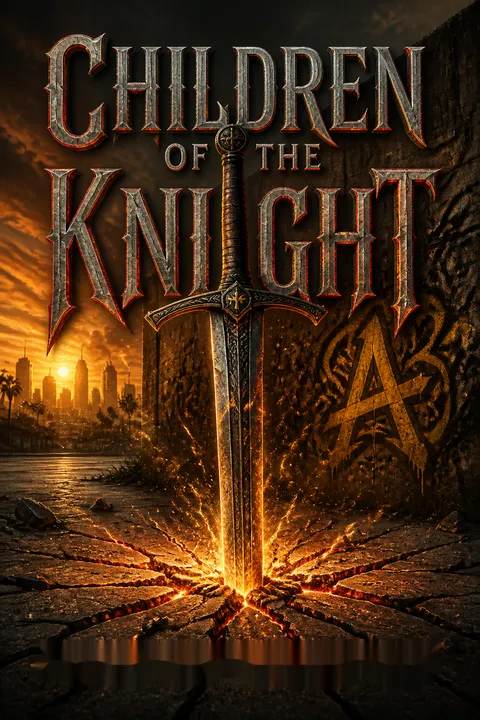
In a fractured Los Angeles, children and teens are abandoned by the systems meant to protect them. Gangs, poverty, and neglect shape their lives, leaving them with few choices and little hope. The city is a battleground, with violence and corruption rampant, and the youngest are its most frequent casualties. Amidst this chaos, a mysterious symbol begins to appear, erasing gang tags and igniting both curiosity and conflict. The city's adults—cops, politicians, and media—are either burned out or self-serving, unable or unwilling to help. The children, forced to survive on their own, are desperate for meaning, belonging, and a future. Into this void, a legend is about to step, promising change.
The Knight's Arrival
A strange, armored knight on horseback appears in the city's darkest alleys, saving a vulnerable boy, Lance, from violence. Speaking in archaic language and wielding a sword, the knight—Arthur—offers Lance food, shelter, and a purpose. Lance, hardened by the streets and wary of adults, is drawn to Arthur's sincerity and strength. Arthur reveals his identity as the legendary King Arthur, returned to a world in need, and names Lance his First Knight. Together, they retreat to an underground lair, a forgotten storm drain transformed into a new Camelot. Here, Arthur shares his vision: to gather the lost children and build a new Round Table, one that will fight for justice and hope in a city that has forgotten both.
Underground Sanctuary Formed
Lance, now Arthur's apprentice and guide to the modern world, helps the king navigate Los Angeles and its dangers. They gather supplies, sell Arthur's jewels for money, and begin recruiting other outcasts—runaways, gang members, and street kids—offering them food, training, and a sense of belonging. The underground lair becomes a sanctuary, echoing with the sounds of swordplay and laughter. Arthur's code of chivalry is introduced, and the children, hungry for purpose, begin to transform. Lance, still haunted by his past, finds strength in Arthur's faith in him. Together, they lay the foundation for a revolution, one that will challenge the city's power structures and offer the children a new identity.
Gathering the Outcasts
Word spreads of Arthur's crusade, and the ranks of his knights swell. Boys and girls from every background—gangsters, hustlers, addicts, and the abused—find their way to the underground Camelot. Among them are Mark and Jack, two boys bound by love and survival, and Reyna, a fierce archer with a privileged past. Old rivalries and prejudices flare, but Arthur insists on unity and respect. The children share their stories, revealing wounds inflicted by parents, society, and themselves. Through training and shared hardship, they begin to see each other as found family. Lance, now a leader, struggles with his own trauma and the burden of responsibility, while Arthur's vision grows ever more ambitious.
Trials of Brotherhood
As the knights train, old habits and fears resurface. Lance's past abuse and confusion about his identity haunt him, while Mark and Jack wrestle with love, jealousy, and addiction. Reyna challenges Lance's authority, forcing him to prove himself. Arthur, both mentor and father figure, listens to the children's pain and offers compassion, but even he cannot heal every wound. The children learn that brotherhood—and sisterhood—requires forgiveness, honesty, and sacrifice. When Mark's addiction nearly kills him, the group rallies to save him, deepening their bonds. The underground Camelot becomes a place of both struggle and hope, where the children begin to believe in their own worth.
The Code of Chivalry
Arthur formally introduces the code of chivalry, demanding honor, truth, and protection of the weak. The children swear fealty, but living by these ideals proves difficult. Prejudices, rivalries, and the lure of violence threaten to tear them apart. Arthur insists that every child, regardless of background or orientation, deserves respect and a place at the table. Lance, as First Knight, must mediate conflicts and set an example, even as he doubts himself. The group's unity is tested by external threats—gang retaliation, police suspicion, and the city's indifference—but their shared commitment to Arthur's vision holds them together. The code becomes both shield and sword, guiding them through darkness.
The First Crusade
Arthur's knights, now trained and united, embark on their first major challenge: confronting the city's gangs. Through a combination of courage, strategy, and restraint, they disarm gang leaders and offer them a choice—join the Round Table or continue the cycle of violence. The confrontation is tense and nearly turns deadly, but Arthur's insistence on "might for right" prevails. Some gang members, impressed by the knights' skill and honor, join the cause. The children's victory is celebrated, but not without cost. The city takes notice, and the knights' actions inspire both admiration and fear. Lance, having proven himself in battle, earns the respect of even his fiercest critics.
The Banner and the Sword
With their numbers and confidence growing, Arthur and his knights take their crusade public. They march through neighborhoods, cleaning up graffiti, repairing homes, and helping the poor. The media, led by reporter Helen, begins to follow their exploits, turning Lance into a reluctant celebrity. Donations pour in, and the city's residents—long ignored by politicians—rally to support the knights. The children's sense of purpose deepens, but so does the scrutiny. The mayor and police, threatened by Arthur's popularity, plot to undermine him. Meanwhile, Lance struggles with the pressures of leadership and the pain of being seen as a symbol rather than a person.
The City Awakens
Arthur's movement spreads, transforming neighborhoods and inspiring hope among the city's forgotten. Parents, teachers, and even some police begin to question their own roles and failures. The mayor, desperate to regain control, tries to co-opt the knights' success with a public mural project, but the children see through the gesture. Arthur and Jenny, a compassionate teacher, join forces to provide education and guidance. The children's victories are hard-won, and the cost of leadership—especially for Lance—becomes clear. As the city awakens to the power of its youth, enemies gather in the shadows, determined to crush the new Camelot before it can change the world.
Enemies in the Shadows
The knights' success threatens powerful interests—drug lords, corrupt officials, and those who profit from the city's misery. Mr. Ramirez, a ruthless crime boss, targets Arthur and his children, using violence and manipulation to protect his empire. Betrayals and setbacks test the knights' resolve. Mark, struggling with addiction and unrequited love, disappears, and Lance and Jack risk everything to find him. The city's adults, from police to politicians, must choose sides. As the knights prepare for their most dangerous crusade—taking on the drug trade—they realize that the greatest threats come not just from outside, but from within their own hearts.
The Price of Hope
Tragedy strikes when Mark is found dead, a victim of overdose and despair. The loss devastates the knights, especially Jack and Lance, who blame themselves. Arthur, wracked with guilt, questions his mission and his ability to protect the children he loves. The group is fractured by grief, and Lance, overwhelmed by shame and self-doubt, runs away. As the knights prepare for a citywide assault on the drug trade, they must confront the reality that hope comes at a price. The children's courage and unity are tested as never before, and the line between victory and defeat grows thin.
Betrayal and Sacrifice
Lance and Jack are kidnapped by Ramirez, who uses them as bait to destroy Arthur. As the knights launch their assault on the city's drug houses, Ramirez sets a deadly trap. A sniper targets Arthur during a public rally, and Lance, in a final act of courage, sacrifices himself to save his king. Shot and dying, Lance is cradled by Arthur, Jack, and Reyna, surrounded by the children he inspired. The city watches in shock and sorrow as the boy who became a symbol of hope breathes his last. Arthur, devastated but resolute, vows to continue the crusade in Lance's name.
The Final Stand
With Lance gone, Arthur must rally his knights and the city for one last stand. The children, united in grief and purpose, confront the mayor and demand justice, rights, and recognition. The city's adults, moved by the children's sacrifice and courage, begin to change. The corrupt are exposed, the powerless empowered. Arthur, wounded but unbroken, leads the children in a final act of defiance—burning the city's confiscated drugs and unveiling a mural honoring Lance. The city, once lost, is transformed by the children's example. The Round Table endures, not as a place, but as a living ideal.
The Future's Gilded Dawn
In the aftermath, Arthur mourns Lance but finds solace in the children's resilience and the city's awakening. The mural of Lance becomes a beacon of hope, and the code of chivalry lives on in the hearts of the knights. Jenny, Jack, Reyna, and the others carry forward Arthur's vision, guiding the next generation. The city, forever changed, remembers the boy who gave everything for a better world. Arthur, once and future king, knows that the true power of Camelot lies not in swords or banners, but in the courage to love, forgive, and hope. The children lead, and the people follow, into a future bright with possibility.
Analysis
Children of the Knight reimagines the Arthurian myth as a radical, youth-led movement for justice in a city broken by neglect and violence. At its core, the novel is a meditation on the power of found family, the necessity of hope, and the cost of change. By centering the story on children—abused, abandoned, and criminalized—the book indicts the failures of adult society while celebrating the resilience and potential of the young. Arthur's code of chivalry becomes both a shield against cynicism and a challenge to the status quo, demanding that power serve the vulnerable. The narrative does not shy away from the realities of trauma, addiction, and loss; instead, it insists that healing is possible through love, honesty, and collective action. The story's tragic arc—culminating in Lance's sacrifice—underscores the truth that hope is always hard-won and that progress is built on both triumph and grief. In a world obsessed with spectacle and celebrity, the novel asks what it means to be truly seen, to be worthy, and to lead. Ultimately, Children of the Knight is a call to arms for compassion, courage, and the belief that even the most broken can become heroes.
Review Summary
Children of the Knight receives overwhelmingly positive reviews (4.01/5) for its unique modern retelling of King Arthur in Los Angeles. Readers praise how the story addresses serious issues—child abandonment, abuse, homelessness, gang violence, and LGBTQ+ youth struggles—while maintaining hope and adventure. Many found it emotionally powerful, moving them to tears. The diverse cast of street children who become Arthur's knights resonated deeply. Some criticism focused on Arthur's inconsistent archaic speech and occasionally heavy-handed messaging. Reviewers appreciated the blend of fantasy and social commentary, with many calling it life-changing and recommending it for both teens and adults.
Characters
Lance Sepulveda
Lance is a fourteen-year-old Latino boy hardened by years of abandonment, abuse, and life on the streets. Gifted, sensitive, and fiercely independent, he hides his pain behind bravado and a skater's swagger. Lance's long hair and striking looks make him both a target and an object of fascination. Chosen by Arthur as his First Knight, Lance becomes the heart of the new Round Table, guiding and training the other children. His journey is one of self-discovery, as he confronts his trauma, questions his identity, and learns to trust and love. Lance's greatest strength is his compassion, but it is also his vulnerability. His ultimate sacrifice cements his legacy as a symbol of hope and change.
Arthur Pendragon
Arthur, the once and future king, awakens in modern Los Angeles with a mission to save its lost children. Wise, compassionate, and unwavering in his ideals, he brings the code of chivalry to a world that has forgotten honor. Arthur is both mentor and surrogate father to the children, especially Lance, whom he loves as a son. He struggles to adapt to the modern world, relying on Lance as his guide. Arthur's greatest challenge is not external enemies, but the pain and brokenness of the children he leads. His journey is one of humility, as he learns that leadership requires not just strength, but vulnerability and love.
Mark
Mark is a sensitive, blue-eyed boy cast out by his family for being gay. Forced into prostitution and addiction, he finds solace and purpose in Arthur's Camelot. Mark's love for Jack is deep but complicated by shame and self-doubt. His friendship with Lance is a source of healing for both, but his inner demons prove too strong. Mark's relapse and death are a devastating blow to the group, exposing the limits of hope and the reality of trauma. His story is a reminder of the cost of neglect and the need for compassion.
Jack
Jack is a strong, athletic boy who hides his pain behind bravado and humor. Rejected by his adoptive family for being gay, he survives on the streets through strength and resilience. Jack's love for Mark is unwavering, and his friendship with Lance becomes a lifeline after Mark's death. Jack is haunted by guilt and the fear of losing those he loves. His journey is one of acceptance, as he learns to forgive himself and embrace vulnerability. Jack's loyalty and courage make him a pillar of the Round Table, and his grief is both a wound and a source of strength.
Reyna
Reyna is a beautiful, skilled archer from a wealthy family, but she feels alienated by her parents' neglect. Drawn to Arthur's cause, she challenges the boys and asserts her place as an equal. Reyna's confidence masks insecurity and a longing for connection. Her relationship with Esteban is both competitive and tender, and her friendship with Lance is transformative. Reyna's journey is one of humility and growth, as she learns to value others and herself. She becomes a leader among the girls and a symbol of the new Camelot's inclusivity.
Esteban
Esteban is a tough, intelligent gang leader who commands respect through strength and cunning. Scarred by violence and betrayal, he is initially skeptical of Arthur's ideals but is won over by the promise of purpose and brotherhood. Esteban's rivalry with Lance turns to respect, and his relationship with Reyna softens his edges. He becomes a key strategist and leader, guiding the knights through dangerous missions. Esteban's journey is one of redemption, as he learns that true power lies in service, not domination.
Chris
Chris is a small, vulnerable boy rescued by Lance and Arthur. His innocence and trust are a stark contrast to the hardened teens around him. Chris quickly bonds with Lance, seeing him as a hero and big brother. His presence reminds the group of what they are fighting for—the right of every child to be safe and loved. Chris's growth and resilience inspire the others, and his role in the story's climax cements his place as the future of Camelot.
Jenny
Jenny is a dedicated English teacher disillusioned by the failures of the education system. She becomes an ally to Arthur and the children, offering guidance, love, and practical support. Jenny's relationship with Arthur is both romantic and collaborative, and she serves as a bridge between the children and the adult world. Her insights into trauma, learning, and the need for individualized care shape the group's approach. Jenny's journey is one of renewed purpose, as she rediscovers her passion for teaching and advocacy.
Mr. Ramirez
Ramirez is a ruthless drug lord who profits from the city's misery. Charismatic and cunning, he manipulates both the criminal underworld and the political elite. Ramirez sees Arthur and the children as a threat to his power and orchestrates violence and betrayal to destroy them. His cruelty and lack of conscience make him a formidable enemy. Ramirez's downfall is brought about not by force, but by the unity and courage of the children he underestimated.
Justin
Justin is a streetwise teen caught between the world of gangs and the expectations of his police officer father, Gibson. Initially involved in drug dealing, Justin is drawn to Arthur's cause and finds a new sense of belonging. His journey is one of reconciliation, as he and his father confront their failures and begin to heal. Justin's transformation is emblematic of the possibility of change, even for those most at risk.
Plot Devices
Modern Arthurian Legend
The novel's central device is the transplantation of King Arthur and his code of chivalry into contemporary Los Angeles. This mythic framework provides both structure and inspiration, allowing the story to explore timeless themes—leadership, honor, sacrifice—within a modern context. Arthur's Round Table becomes a metaphor for inclusive, youth-led community, and the quest motif drives the narrative through escalating challenges. The legend's resonance is heightened by the children's longing for meaning and the city's desperate need for hope.
Found Family and Chosen Brotherhood
The children's formation of a new family—bound not by blood, but by choice and shared struggle—is a key device. This found family offers what the adult world has denied: acceptance, love, and purpose. The bonds between Lance, Jack, Mark, Reyna, and the others are tested by conflict, loss, and betrayal, but ultimately endure. The group's rituals—swearing the code, training, sharing stories—create a sense of belonging that is both healing and empowering.
Duality of Might and Right
Arthur's insistence on "might for right" is both a guiding principle and a source of tension. The children, shaped by violence, must learn to wield power responsibly, resisting the temptation to become what they oppose. The narrative structure uses escalating confrontations—gang battles, public crusades, the assault on the drug trade—to test the group's commitment to non-lethal force and justice. The device of restraint, even in the face of betrayal and loss, distinguishes the knights from their enemies and defines their legacy.
Trauma, Healing, and Confession
The story foregrounds the psychological wounds of its characters—abuse, addiction, abandonment—and uses confession and mutual support as mechanisms for healing. Key scenes involve characters sharing their stories, confronting their fears, and seeking forgiveness. The device of confession, often in moments of crisis, allows for catharsis and growth. The narrative structure interweaves personal and collective trauma, showing how healing is both individual and communal.
Media and Public Perception
The rise of Arthur's movement is mediated by news coverage, social media, and public spectacle. The children's actions are amplified—and sometimes distorted—by the gaze of the city. Lance's reluctant celebrity, the mural project, and the televised confrontations all serve to heighten stakes and complicate the group's mission. The device of media attention explores the power and peril of visibility, as well as the tension between authenticity and performance.
Foreshadowing and Tragic Irony
From the outset, the narrative foreshadows the cost of hope—through references to Arthur's past, the children's vulnerability, and the city's resistance to change. The structure echoes the tragic arc of the original Arthurian legend, with betrayals, misunderstandings, and the ultimate sacrifice of the hero. The device of tragic irony—where the audience senses the coming loss even as the characters strive for victory—deepens the emotional impact and underscores the story's themes.
Download PDF
Download EPUB
.epub digital book format is ideal for reading ebooks on phones, tablets, and e-readers.








































