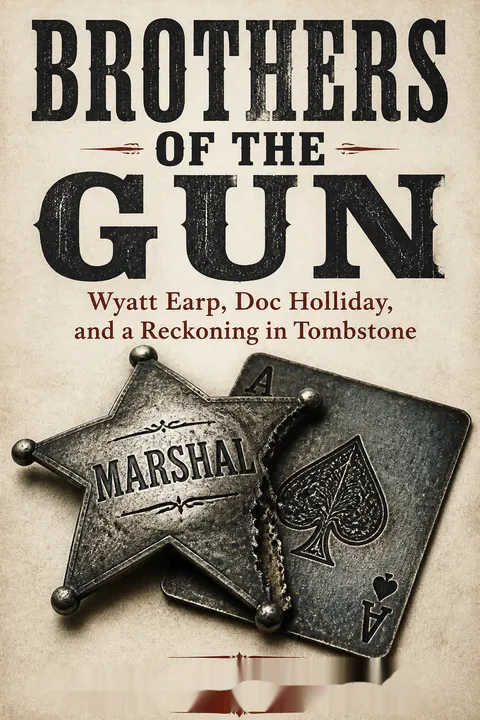

Key Takeaways
1. Wyatt Earp's Complex Path to Lawman Status
“It does beat the band how the truth will be warped and misstated over a period of years.”
Early life challenges. Wyatt Earp's early life was marked by a series of personal and legal troubles, often obscured in later accounts. Born in Illinois, his family frequently relocated, with his father, Nicholas Earp, facing legal issues for selling liquor and accumulating debt. Wyatt himself was involved in horse theft in Indian Territory and arrested multiple times in Peoria, Illinois, for "keeping and being found at a house of ill-fame," suggesting a less-than-sterling early reputation.
Transition to law enforcement. Despite these early missteps, Wyatt found his calling as a peace officer in the booming cattle towns of Kansas. Starting as an "extra policeman" in Wichita, he quickly gained a reputation for fearlessness and effectiveness in disarming rowdy cowboys. His appointment as assistant city marshal in Dodge City further solidified his image as a capable lawman, often working alongside his brothers, Jim and Virgil, who also sought opportunities in these frontier towns.
Ambition and personal loss. Wyatt's career in law enforcement was intertwined with personal ambition and tragedy. The sudden death of his first wife, Arella Sutherland, in Lamar, Missouri, left him heartbroken and led to his initial departure from the town, leaving behind unpaid taxes. His later move to Tombstone, Arizona, was driven by the lure of silver fortunes and a desire to establish himself, but also by a weariness of the constant demands of a peace officer's life, seeking a new path beyond the badge.
2. Doc Holliday: A Cultured Dentist Turned Reckless Gambler
“He was hot-headed and impetuous and very much given to both drinking and quarreling, and, among men who did not fear him, was very much disliked.”
Southern gentleman's decline. John Henry "Doc" Holliday, born into a respected Georgia family, initially pursued a career in dentistry, graduating from the Pennsylvania College of Dental Surgery. However, a diagnosis of tuberculosis, likely contracted from his mother, prompted his move West for the "prairie cure." This move coincided with a rapid descent into gambling, which quickly became his obsession, overshadowing his dental practice.
Gambling and violence. Doc's life in Dallas, Denison, and Fort Griffin, Texas, was characterized by frequent arrests for gambling and violent altercations. He was known for his "mean disposition and ungovernable temper," especially when under the influence of alcohol, which he often consumed to cope with his illness. A notable incident involved him shooting a saloon owner in Breckenridge, Texas, after a cane beating, further cementing his reputation for recklessness.
Complex character. Despite his volatile nature and gambling addiction, Doc was described as cultured, well-educated, and a sharp dresser. His relationship with the prostitute "Big Nose Kate" Elder was tumultuous, marked by jealousy and frequent quarrels. While many disliked him, he also possessed a certain charm and loyalty, particularly to those he considered friends, a trait that would become central to his bond with Wyatt Earp.
3. A Friendship Forged in Frontier Chaos
“It was because of this episode that I became the friend of Doc Holliday ever after.”
Initial encounter. Wyatt Earp and Doc Holliday first met in Fort Griffin, Texas, in 1877, when Wyatt was working as a bounty hunter for the Atchison, Topeka & Santa Fe Railway. Wyatt was seeking information on outlaws, and Doc, a local gambler, was suggested as a potential source. Though their initial interaction was transactional, Doc's interest in Dodge City's opportunities and Wyatt's observations of Doc's character laid the groundwork for a future connection.
Life-saving act in Dodge City. Their bond solidified in Dodge City in 1878 during a tense standoff. When a group of rowdy cowboys threatened Wyatt, who was alone and outnumbered, Doc Holliday, witnessing the scene from inside the Long Branch saloon, rushed out with two revolvers, shouting at the cowboys to surrender. This decisive intervention saved Wyatt's life, creating an unshakeable loyalty between the two men.
Mutual respect and contrasting personalities. Their friendship deepened despite their stark differences:
- Wyatt: Ambitious, disciplined, driven by a desire for respectability and order.
- Doc: Cultured but reckless, consumed by gambling and illness, seemingly without future plans.
Yet, Wyatt saw Doc as family, and Doc, in turn, was fiercely loyal to Wyatt, always ready to defend him, even at great personal risk.
4. Tombstone: A Boomtown Ripe for Conflict
“Good women didn’t go anyplace.”
The lure of silver. Wyatt Earp's decision to leave Dodge City was driven by the promise of immense silver fortunes in Tombstone, Arizona, a booming mining camp attracting thousands. He envisioned establishing a stage line and investing in mines, seeking to carve out a prosperous future beyond law enforcement. His brothers, Jim and Virgil, along with their wives, joined him, drawn by the same intoxicating stories of easy riches.
A town of contrasts. Tombstone was a chaotic mix of opportunity and vice. Its rapid growth led to a scarcity of housing and high prices, but also a thriving economy fueled by miners, gamblers, and prostitutes. The town's "godless hole" reputation, with numerous saloons and dance halls, made it a magnet for "sporting men" like Wyatt and Doc, but also created a volatile environment where lawlessness was rampant.
Earp family's establishment. Upon arrival, the Earps quickly integrated into Tombstone's burgeoning society. They acquired mining claims and town lots, and Wyatt, despite his earlier weariness of law enforcement, accepted a position as deputy sheriff, recognizing the prestige and influence it offered. Jim became a saloonkeeper, and Morgan later joined them, further solidifying the family's presence and interests in the rapidly developing town.
5. The Escalating Feud with the Cowboys
“The Cowboys as a class are not over brave, though there are some among them who have gone through so much difficulty that they have become desperate and will take desperate chances.”
Outlaw element. Tombstone's prosperity attracted a lawless element known as the "Cowboys," a semiorganized band of cattle thieves and stage robbers operating across the US-Mexican border. These outlaws, often with Southern roots, terrorized the region, stealing livestock and engaging in violent acts, yet found allies among merchants and politicians who benefited from their patronage and votes.
Earp-Cowboy friction. The Earps, particularly Virgil and Wyatt, frequently clashed with the Cowboys. Early encounters included tracking stolen army mules to the McLaury brothers' ranch and confronting Billy Clanton over a stolen horse. These incidents, coupled with the Earps' roles as lawmen, positioned them as direct adversaries to the Cowboys, who viewed the Earps as interlopers disrupting their illicit operations.
Failed truce and rising tension. Wyatt attempted a risky deal with Ike Clanton to capture the Benson stage robbers, hoping to gain glory and exonerate Doc Holliday from false accusations. However, the plan unraveled, leading to Ike's paranoia and a deep-seated animosity towards the Earps. This failed alliance, combined with public accusations against Doc and the Earps, intensified the feud, setting the stage for an inevitable confrontation.
6. The O.K. Corral: A Thirty-Second Defining Moment
“All was confusion.”
Morning of threats. The morning of October 26, 1881, began with Ike Clanton, armed and intoxicated, openly threatening the Earps and Doc Holliday throughout Tombstone. Despite the warnings, Wyatt and Virgil initially dismissed the threats, but as the day progressed and the Cowboys, including Frank and Tom McLaury and Billy Clanton, gathered and rearmed, the tension became unbearable. Virgil, as Chief of Police, felt compelled to act.
Confrontation on Fremont Street. Around 2:45 p.m., Virgil, Wyatt, Morgan Earp, and Doc Holliday confronted the Cowboys in a vacant lot near the O.K. Corral. Sheriff Johnny Behan, who had falsely claimed to have disarmed the Cowboys, was present but ineffective. Virgil ordered the Cowboys to surrender their weapons, but Billy Clanton and Frank McLaury drew their revolvers, initiating a chaotic and deadly gunfight.
A blur of violence. The shootout lasted no more than thirty seconds, with twenty-five to thirty shots fired.
- Wyatt fired first at Frank McLaury, hitting him in the stomach.
- Morgan was shot in the back but continued to fight.
- Doc Holliday, wielding a shotgun, delivered a fatal blast to Tom McLaury.
- Billy Clanton was riddled with bullets.
- Ike Clanton and Billy Claiborne fled.
When the smoke cleared, three Cowboys lay dead, and Virgil and Morgan Earp were wounded. Wyatt and Doc emerged largely unscathed, though Doc had a superficial hip wound.
7. Wyatt's Vendetta: An Eye for an Eye
“I there and then made a vow that I would kill each and every one of those bandits, that they would prove no more alibis on me.”
Morgan's assassination. The street fight at the O.K. Corral did not end the feud. On March 18, 1882, Morgan Earp was assassinated in a billiard parlor, shot through a back door. The bullet severed his spinal column, and he died in Wyatt's arms, urging his brother to "get even." This act of vengeance, coupled with Virgil's maiming in an earlier ambush, ignited Wyatt's personal vendetta.
Stilwell's demise. Wyatt, now a deputy US marshal with authority to appoint deputies, immediately began his hunt for Morgan's killers. Frank Stilwell, a Cowboy and former deputy of Sheriff Behan, was identified as one of the assassins. Wyatt and his posse tracked Stilwell to Tucson, where they ambushed him at a train depot, riddling his body with bullets. Wyatt shouted to Virgil, "We got one! One for Morg!"
The "Earp Vendetta Ride." Wyatt's posse, including Doc Holliday, Warren Earp, and other loyal gunhands, continued their relentless pursuit of the remaining Cowboys. They tracked and killed "Indian Charley" (Florentino Sáiz) in the Dragoon Mountains. In a dramatic confrontation at a spring, Wyatt single-handedly killed Curly Bill Brocius, a prominent Cowboy leader, despite his own men initially fleeing. This period, dubbed the "Earp Vendetta," saw Wyatt operating outside conventional legal boundaries, driven by a fierce desire for retribution.
8. Legal Battles and Public Opinion Divide
“You may meet one man who will support the Earps and declare that no other course was possible to save their own lives, and the next man is just as likely to assert that there was no occasion whatever for bloodshed.”
Murder charges and Spicer hearing. Following the O.K. Corral shootout, Ike Clanton filed murder charges against the Earps and Doc Holliday. Justice of the Peace Wells Spicer presided over a month-long preliminary hearing, during which thirty witnesses testified. The defense, led by attorney Thomas Fitch, presented compelling evidence, including Wyatt's prepared statement and letters of endorsement from Kansas officials, arguing the Earps acted in self-defense and official duty.
Conflicting testimonies and Behan's role. The hearing was marked by contradictory eyewitness accounts and the questionable testimony of Sheriff Johnny Behan, who had personal and political motives to discredit the Earps. Behan's lies and his failure to disarm the Cowboys before the fight undermined the prosecution's case. Ultimately, Judge Spicer ruled that there was insufficient evidence for a murder trial, exonerating Wyatt and Doc, though he criticized Virgil's judgment in recruiting his brother and Doc.
Public's divided sentiment. The street fight and subsequent legal proceedings deeply divided Tombstone's citizens. While some lauded the Earps as heroes who brought order, others viewed them as cold-blooded murderers. The local newspapers, the Republican-leaning Epitaph and the Democratic-leaning Nugget, fueled this division with biased reporting. This polarized public opinion reflected a broader struggle between those who desired law and order and those who sympathized with the outlaw element.
9. The Earp Party's Escape and Powerful Allies
“If the truth were known, [Paul] would be glad to see the Earp party get away with all of these murderous outfits.”
Flight from Arizona. After Morgan's murder and Virgil's maiming, Wyatt understood that remaining in Tombstone meant continued danger. He arranged for Virgil and their wives to leave for California, then, with his posse, embarked on a "vendetta ride" to eliminate Morgan's killers. Facing arrest warrants for Stilwell's murder, Wyatt and his men eventually fled Arizona, seeking refuge in New Mexico and Colorado.
Strategic alliances. During their flight, the Earp party relied on a network of powerful allies. Wells Fargo, grateful for their efforts against stage robbers, provided financial support and public endorsements, denying any Earp involvement in robberies. Cattle baron Henry C. Hooker, a victim of Cowboy rustling, also supported Wyatt, offering horses and money, and openly defying Sheriff Behan's attempts to track the Earps on his ranch.
Political maneuvering. Wyatt's friends, including Bat Masterson and influential figures like George W. Crummey, worked to prevent his extradition back to Arizona. Despite "flawless" requisitions from Arizona's governor, Colorado's Governor Pitkin, influenced by Crummey and concerns about the Earps' safety in Arizona, repeatedly refused to honor the warrants. This political protection allowed Wyatt and his men to evade justice for the Stilwell killing, effectively ending the "Earp vendetta ride."
10. Enduring Legends and Conflicting Narratives
“The real story of the Old West can never be told unless Wyatt Earp will tell what he knows; and Wyatt will not talk.”
Shaping the narrative. Wyatt Earp, outliving Doc Holliday by over forty years, became increasingly concerned with how his story was told. He gave interviews and collaborated on an autobiography, aiming for "truth, correctness, and vindication." However, he found many journalists took liberties, creating sensationalized and often defamatory accounts that painted him as a "man-killing" outlaw.
Biographers and myth-making. Stuart Lake's 1931 biography, Wyatt Earp: Frontier Marshal, significantly shaped Wyatt's public image, portraying him as a heroic lawman. Lake, despite Wyatt's laconic nature, crafted a compelling narrative, often embellishing details and omitting inconvenient truths, such as Wyatt's early legal troubles and his relationship with Mattie Earp. This book cemented Wyatt's status as an Old West icon, though critics like Frank Waters later blasted it as "a piece of fiction."
Contrasting accounts. Other narratives, like William Breakenridge's Helldorado, presented a starkly different view, portraying the Earps as no better than the Cowboys. Doc Holliday's lover, Big Nose Kate, also attempted to publish her own "truth," though her recollections were often unreliable and filled with animosity towards the Earps. These conflicting accounts highlight the difficulty of separating fact from legend in the Wild West, where personal biases and sensationalism often overshadowed historical accuracy.
11. The Unbreakable Bond of Brothers in Arms
“Damon did no more for Pythias than Holliday did for Wyatt Earp.”
Loyalty in action. The friendship between Wyatt Earp and Doc Holliday was a defining aspect of their lives, characterized by unwavering loyalty and mutual support in the face of extreme danger. From Doc saving Wyatt's life in Dodge City to Doc joining Wyatt's vendetta ride after Morgan's murder, their actions consistently demonstrated a bond akin to brotherhood, transcending their contrasting personalities and Doc's declining health.
Beyond words. Neither Wyatt nor Doc extensively articulated the depth of their friendship, preferring to let their actions speak. Wyatt considered Doc family, and Doc, despite his volatile nature and frequent quarrels with others, remained steadfastly by Wyatt's side. This loyalty was so profound that Bat Masterson, a mutual friend, famously compared their bond to the legendary Greek friendship of Damon and Pythias.
A final farewell. Their last recorded meeting in Denver in 1886, just over a year before Doc's death, was deeply emotional. Doc, frail and visibly dying from tuberculosis, sought out Wyatt for one final conversation. Wyatt, deeply affected, watched his friend walk away, knowing it was their last goodbye. This poignant parting underscored the profound impact their unique friendship had on both men, a bond that endured through the chaos and violence of the frontier.
Review Summary
Brothers of the Gun receives strong praise across most reviews, with readers appreciating Gardner's thorough research, engaging prose, and balanced portrayal of Wyatt Earp and Doc Holliday. Many highlight his ability to humanize both figures, presenting them as complex, flawed individuals rather than legends. Reviewers frequently note the book reads more like fiction than dry history. Some criticism centers on Doc Holliday feeling secondary to Earp's narrative, occasional abrupt transitions, and the book being less comprehensive than other works on the subject. Overall, it's considered a rewarding read for Old West enthusiasts.
People Also Read
Download PDF
Download EPUB
.epub digital book format is ideal for reading ebooks on phones, tablets, and e-readers.








































