
Plot Summary
Cold Stone, Bleeding Honor
Gjorg Berisha waits, rifle in hand, on a cold Albanian hillside. He is hunting Zef Kryeqyqe, enacting revenge to balance blood, as dictated by the Kanun—Albania's ancient code of honor. When his moment comes, Gjorg kills his brother's murderer, feeling both relief and emptiness. Custom demands he attend the victim's funeral and dine with the bereaved, grimly binding killer and kin. The ritual maintains order but leaves Gjorg emotionally adrift. This act isn't personal hatred but relentless obligation; his life, and his family's future, is now hopelessly tangled in the legacy of violence, relentless as winter on the mountains.
The Debt of Blood
Gjorg's act opens a cycle of formal truce and tension. News of the killing spreads, awakening the village to gather—some to mourn, others to defend or retaliate. The blood feud's rules mete out periods of safety, "bessa," for killer and kin. First, a 24-hour truce, then, after negotiation, a thirty-day respite, allowing normal life to resume until the next vendetta. Each stage is intricate, public, and emotionally charged. Gjorg receives the blood-tax payment—a grim purse of family savings—obliging him to travel to the Kulla of Orosh to render formal tribute for the act. The mechanisms of tradition carry him along, never allowing true peace.
In the Shadow of the Kanun
Traversing the High Plateau, Gjorg reflects on the omnipresence of the Kanun. Its rules define property, hospitality, marriage, and especially the spilling of blood. Even the story of his family's feud—fifty years of reprisals, a death for a wavering word or a directional fall—feels dictated by external laws rather than fate or enmity. This code makes normal joys and sorrows indistinguishable from threats and duties. Gjorg wonders what life would be like unpunctuated by vengeance, foreign as the airplanes that sometimes pass overhead. The eternal cycle offers safety in predictability, but desperation in its inescapability.
Truce: Thirty Days of Life
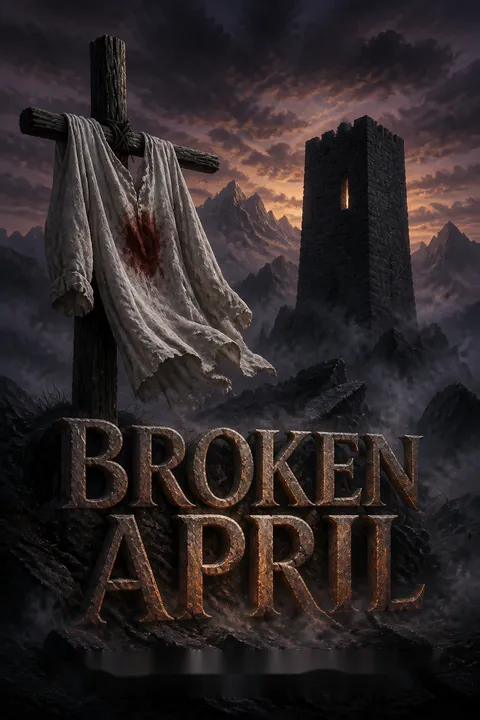
Granted a temporary peace, Gjorg's family urges him to settle affairs, spend his days usefully, or even marry. But Gjorg's engagement ended with his beloved girl's death, and the truce feels hollow. The shirt of his slain brother, hung as a bloodstained flag, is only now washed and removed. Yet already the shirt of the new victim is raised elsewhere—a barometer of unresolved blood. Thirty days loom ahead, blending the promise of spring with a creeping sense of doom. Gjorg seeks purpose but meets only the dull ache of a condemned month: April, a month forever unfinished.
Seeking the Kulla of Orosh
Gjorg treks across moor and village to Orosh, stronghold of the Kanun. Fog and rain, deserted settlements, and endless references to the code oppress him. In the Kulla's shadow, he meets other killers—dry of words, sharing only the locked-jaw silence of burden. They gather to pay the "death tax," trading stories not as confession, but as a fellow chewing of destiny's cud. The Kulla itself, half castle, half market of blood, processes their fates in bureaucratic darkness. Gjorg is both relieved and mortified at this impersonal reckoning. The machine turns, unmoved by grief.
Guests and Legends
Writer Bessian and his new wife Diana, on their honeymoon, venture by carriage into the highlands, seeking "legend, not life." They romanticize the savage grandeur even as cities disapprove their journey. Diana is both enthralled and unsettled, watching villagers with black ribbons—living "marks of death"—and listening to her husband's philosophical praise of the Kanun's structure. Their privileged vantage blends awe with mounting unease. Bessian's narration captures tradition's majesty but evades its brutality. In their seclusion, guests are revered like deities—yet are also fated to brush tragedy, as ancient custom shadows hospitality.
The Velvet-Lined Carriage
Bessian and Diana's journey becomes a crossing: their carriage glides through roads of ritual and danger, hospitality and offense, watched by villagers and killers alike. Their presence disturbs, attracts—and eventually collides with—the brooding realities beneath tradition. At the inn, Diana first glimpses Gjorg, pale and haunted. Their fleeting exchange—her gaze, his yearning—marks a disruptive moment for both. In public, all are restrained by formality; in private, tension roils beneath brushstrokes of courtesy or admiration. The city's insular warmth is replaced by the chill of the plateau, where each encounter is loaded with the threat of inexorable fate.
Judgments and Boundaries
Bessian, Diana, and itinerant judges like Ali Binak attend a ritual settlement of boundary disputes, which under the Kanun can spur killings as quickly as land changes hands. Boundaries are marked not only by stone but by graves—the dead serve as lasting witness. Ali Binak's cryptic wisdom dispenses justice using riddles and analogies that blend law and myth. For the townsfolk, the rituals seem at once farcical and tragic; for the mountain people, they are the only possible order. Diana, watching the resolution and its reliance on calculated compensation for wounds and lives, is torn between respect and revulsion.
Pale Eyes in Passing
Encounters are wordless but weighted. Diana and Gjorg cross paths: his black ribbon signaling imminent extinction, her city beauty sparking in him a forbidden longing. Both are shaken—she by compassion and illicit attraction, he by a glimpse of another life, distant as a dream. Their mutual fascination is amplified by rarity and circumstance, never to be spoken or fulfilled. Bessian ponders Hamlet; his wife sees something tragic and sublime in Gjorg's fatal dignity. These peripheral connections hint at lives ruled not by choice but by overlapping patterns of duty, and the costly consequences of mere gazes.
The Steward of Blood
At Orosh, Mark Ukacierra, the steward of the blood-tax, reflects on his fading world. The records of murders, feuds, and compensations fill shelves—an industry of violence reduced to accountancy. He feels both responsibility and impotence as killings decline, threatening the legitimacy of the Kulla and his own role. Mark's anguish over the erosion of tradition wars with his secret fear of change, and a strange "blood-sickness" eats at him. He is anxious about urban influences, outsider guests (especially Diana), and the waning power of the Kanun. In its bureaucracy, the code is both maintained and subverted.
Gjorg's Restless Wanderings
With his truce soon to expire, Gjorg drifts from inn to crossroads, haunted by the knowledge that he cannot escape destiny. Stories of violence, love, and betrayal swirl in tavern air. His hope of seeing Diana's carriage again grows into obsession, but their paths only nearly intersect. Encounters with travelers—selling oxen, telling tales, living always at a margin of survival—blur Gjorg's sense of self and purpose. He learns, too late, that he has sought meaning not in vengeance but in impossible connection, only to find the walls of tradition implacable and unyielding.
April's Imminent Eclipse
April passes with relentless speed. Gjorg marks his dwindling protection, measuring sun and shadow, now stalked by enemies and memories alike. As the date of his fate approaches, his world contracts to a stark present tense—every day a negotiation with death, every horizon a snare. He is less actor than observer, his agency eaten away by the mechanics of custom. Yet even this slow narrowing brings moments of acute, even hopeful, awareness: the possibility of another meeting, a reprieve, an unlooked-for mercy lingering at the road's edge.
Diana's Crossing
Diana, exhausted and disturbed by all she has witnessed, reaches a moment of crisis. drawn to the tower of refuge—a space forbidden, male, and sacred to vengeance—she enters, breaching the boundary between observer and participant. Her act cannot be explained even to herself; it is a crossing brought about by intangible longing, perhaps for Gjorg, certainly for release from the iron rules governing both the mountains and her marriage. Her return from the tower is marked not by violence, but by a void—a sudden absence in her eyes that signals an irreversible transformation, affecting her and Bessian alike.
The Tower of Refuge
The towers where killers take shelter become symbols of the paradox at the heart of the Kanun: safety purchased at the price of self-exile, honor maintained by self-immurement. Within, men wait for the slow turning of vengeance; without, families keep watch and fields go fallow. Diana's entry into one such tower becomes the focal point of legend and scandal, exposing the tensions between tradition, gender, and the lure of death. Towers, meant to protect, also perpetuate the prison of endless feud, trapping all who come near in shadowed silence.
The Failures of Return
Bessian and Diana try, and fail, to recover normalcy after their ordeal. The vivid mountain world recedes as their carriage approaches the city, but its shadows linger inside them. Bessian is filled with remorse, questioning his motives and his writing, unable to reach his wife. Diana, changed beyond words, seems both present and forever absent. Neither can quite articulate the losses sustained. The Kanun's logic has not simply ruled over the villagers, but has quietly colonized their own souls, leaving them haunted by things unsaid and impossible distances.
Dusk Over the High Plateau
Gjorg, aware his truce has ended, tries to reach home, but must avoid open roads. The world is bathed in a melancholy glow: traditions, feuds, and personal histories overlap, creating a sense of fatal convergence. Gjorg longs still for Diana, for escape, for something beyond the mechanics of blood and ritual. But choices have narrowed to a mere vector: move, hide, wait. The world's indifferent beauty—spring's promise, April's softness—mock the hard realities beneath.
The Final Hour
As dusk settles, Gjorg hears his enemy's voice and is struck down in the very manner prescribed by tradition. Even in dying, the rules are observed: he is turned on his back, his weapon placed by his head. His killer vanishes, footsteps echoing the distance between individuality and obligation. Gjorg's last thoughts blend confusion and clarity: he has both fulfilled his duty and been betrayed by it. The cycle continues, seemingly unchanged, yet something in the infinite repetition is beginning to fray.
Afterimages in Mist
As the Vorpsis' carriage descends to the lowlands, the mountains fade into myth, shrouded by mist. Gjorg's death feeds another cairn of stones—another chapter in the never-ending feud. Diana and Bessian, looking back, see only absence and the curtain's fall. The world outside changes, but inside, all involved carry away a piece of the high plateau—the code, the wound, the secret longing for what lies just beyond reach. The Kanun endures, but the spell it casts is tinged with doubt, sorrow, and the faintest glimmer of change.
Analysis
Kadare's Broken April
is a ruthless diagnosis of the persistence and devastation of collective violence, made all the more horrifying by its ritual normalization. Through interwoven stories—a doomed avenger, a couple seeking meaning, and the apparatus that measures loss—the novel exposes how tradition, when codified into law, colonizes not only action but thought and feeling. The Kanun, while offering stability, becomes a force that subordinates agency, joy, and love to the demands of vengeance and honor. Yet Kadare resists cheap condemnation: he shows the beauty and comfort embedded in ritual, the allure of certainty, the existential thrill of belonging to myth. His critique is acute but ambivalent, staging a dialogue between those inside (Gjorg, the villagers) and those outside (Diana, Bessian, even the weary officials), revealing the limits of both. The final impression is of lives wasted, loves sundered, possibilities denied. But against this darkness, there glimmers a faint, problematic hope—the possibility of seeing, understanding, or, at the least, yearning for another way. It is a modern tragedy, as much about our longing for meaning as our entrapment by it.
Review Summary
Broken April receives predominantly positive reviews, with readers praising Kadare's atmospheric, restrained prose and his vivid portrayal of Albania's ancient blood feud tradition, the Kanun. Many appreciate the novel's dual narrative — following young Gjorg toward his inevitable fate and a honeymooning couple navigating the highlands — as an effective lens for examining blind adherence to inherited customs. Some critics note the thin plot and documentary-like pacing as weaknesses, while others find the novel's haunting, doom-laden atmosphere more than compensates for limited characterization.
Characters
Gjorg Berisha
Gjorg is a young mountaineer drawn inexorably into the cycle of blood feud by the murder of his brother. Driven not by personal hate, but by the crushing weight of custom and family obligation, Gjorg enacts vengeance even as he outwardly resists and internally questions its necessity. His psyche is marked by numb obedience, melancholy, and an underlying yearning for escape or connection—best symbolized by his fixation on Diana, the outsider. Through his final thirty days of truce, Gjorg is transformed from reluctant participant into existential wanderer, searching for meaning beyond the cold arithmetic of the Kanun. His eventual death is at once an act of completion and surrender—a life claimed, and claimed by, the code.
Diana Vorpsi
Diana, the cultured wife of Bessian, is initially beguiled by the mountaintop romance of the north but quickly finds herself unsettled by the reality beneath. Her compassion and curiosity lead her to trespass, emotionally and literally, into spaces forbidden to women and strangers. Her gaze upon Gjorg is both empathetic and subtly erotic; in him, she glimpses a raw humanity suppressed by law—a kindred longing. The tower's shadow transforms Diana, instilling an irremediable absence or wound. She becomes an emblem of the way even outsiders, seemingly immune, are irrevocably marked by the world they only meant to observe.
Bessian Vorpsi
Bessian is a prominent intellectual and writer, whose fascination with the Kanun is part scholarly, part romantic, part escapist. He brings Diana to the highlands in pursuit of authenticity, but remains blinkered to the suffering beneath ritual. As the code devastates both his marriage and his self-image, Bessian descends into remorse and impotence, unable to bridge the growing chasm inside his wife or himself. His journey is a cautionary tale about the hazards of intellectualizing violence, or seeking to turn living tragedy into mere literature.
Mark Ukacierra
Steward of the blood-tax, Mark represents the administrative side of ritualized violence. Plagued by anxiety over the decline of killings (and thus income and purpose), he is a relic of a fading order, at once complicit in the perpetuation of suffering and personally afflicted by it ("blood-sickness"). Mark's internal contradictions—resentful of outsiders, fearful of change, dependent on the machine of feud—mirror the Kanun's own paradoxes. His record-keeping is an act of both devotion and despair.
Ali Binak
Ali is the legendary judge of the Kanun, called to arbitrate the thorniest disputes. His pronouncements are cryptic, authoritative, and deeply rooted in the mountain mentality: blending logic, myth, and fatalism. Ali is respected by all—the embodiment of tradition's wisdom and intransigence. Yet his calm masks the exhaustion of practicing law in a world where every solution is temporary and every boundary (literal or metaphorical) is bound to be crossed. He is both guardian and prisoner of the rules he reads.
The Doctor
Once a surgeon, now demoted to counting wounds for legal compensation, the doctor trails Ali Binak, his medical knowledge reduced to bureaucratic utility. Disillusioned, cynical, and unable to practice healing, he embodies the loss of meaning in a society where blood, wounding, and compensation are the core currencies. His bitterness is existential, his role both necessary and tragic, serving a system that turns human flesh into arithmetic.
The Surveyor
The surveyor is a figure of comic disgust and tragedy; trained for scientific measurement, his skills are irrelevant in a world that values bloodlines, testimony, and ritual over logic or progress. Frequently drunk, often inappropriate, he is both a witness and a casualty of the collision between old and new ways. His perspective is jaundiced: he recoils from the Kanun but is unable to escape its orbit.
Gjorg's Father
He is the inflexible spine of Gjorg's fate: insistent on upholding honor, pushing for vengeance. Yet he exhibits little hatred for the Kryeqyqe; his attitude is one of mechanical compliance. He represents the inertia of patriarchal duty, valuing code over feeling, unable to offer comfort or alternative paths to his son. His world is cold, static, sorrowful.
Kryeqyqe Family
The Kryeqyqe are not villains, but a clan woven into the same net of obligation, suffering, and ritual as Gjorg's. Their grief and retaliation are as formal as their rivals', their pain as real. They serve as foils to the Berisha, highlighting the arbitrary destructive force of the feud: enemies only because the Kanun has made them so.
The Kanun
Although not a character in the flesh, the Kanun shapes every thought, action, and feeling in the novel. Its logic colonizes the psyche, blurs the boundary between justice and cruelty, kinship and enmity, meaning and futility. The characters are its children, custodians, and casualties. Its presence is unwavering, suffocating, indestructible—and yet, tremors of change begin to pass beneath its ancient stones.
Plot Devices
The Kanun as Structuring Force
The Kanun is not merely background—it is the engine that propels both the plot and interior worlds of the characters. Decisions are not spontaneous but referential: every act is a citation of custom. This deterministic structure creates irony, tension, and fatalism, stripping individual agency and exposing how tradition, even when senseless, becomes self-perpetuating.
The Ritual of Bessa (Truce)
The thirty-day bessa is a literal deadline: its ticking-away structures Gjorg's aimless days, defines his opportunities, and signals the approach of doom. Through repetition—ritual meals, funerals, payments—it both comforts and terrorizes. Truce is temporary, life provisional.
Parallel Narratives and Intersections
The juxtaposition between Bessian/Diana's urban consciousness and Gjorg's mountain fatalism allows readers to interrogate both. Their eventual crossing—Diana's gaze on Gjorg; their passage through the same territory—exposes the limitations and impacts of each worldview. The device destabilizes both the "inside" authority of tradition and the "outside" pretense of objectivity or escape.
Recurring Symbols: Blood, Shirt, Tower
The bloodstained shirt is a visual index of unresolved vendetta. Towers of refuge are both sanctuaries and prisons—a metaphor for self-protecting systems that destroy those within. Stones (cairns, boundaries) turn deaths into enduring physical marks on the landscape. Each symbol reiterates the way the past is cemented into daily life, and how escape is nearly impossible.
Foreshadowing and Doubling
Kadare uses recurring motifs, ominous weather, and narrative echoes to signal the inescapability of fate—the fate of Gjorg mirrors that of his ancestors, while Diana's intrusion into the tower is at once a breaking and a mirroring of taboo. Characters' stories are told in advance or referenced in ballads, lending events a déjà vu inevitability.
Narrative Irony and Modernity
The text is laced with critical reflection: the doctor debunks romanticism, the steward laments legal decline, Bessian self-consciously interrogates his own aestheticizing. The Kanun is both glorified and anatomized, promoted as myth and denounced as commodity. This dialogic device allows the narrative to both immerse and question, preventing naïve celebration or total condemnation.
Download PDF
Download EPUB
.epub digital book format is ideal for reading ebooks on phones, tablets, and e-readers.








































