Key Takeaways
1. America's "Leviathan by Proxy" is a hidden, dysfunctional big government.
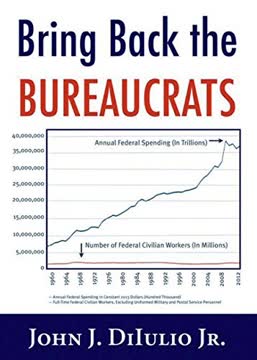
The really big story about big government in America can be glimpsed by eyeballing the figure that appears on this book’s cover.
Hidden growth. Despite public perception, the U.S. federal government has grown fivefold in spending since 1960, reaching over $3.5 trillion annually, yet the number of full-time federal bureaucrats has remained largely stagnant. This paradox is explained by "Leviathan by Proxy" (Lev-Pro), a system where Washington leverages state and local governments, for-profit businesses, and nonprofit organizations to administer federal policies, programs, and regulations. This creates a massive, debt-financed, and often invisible "intergovernment" that touches every aspect of American life.
Proxy layers. This proxy system involves multiple layers of delegation, making government functions opaque and accountability elusive. For example:
- Federal grants to states and localities have increased tenfold since 1960, with state and local government employees tripling to over 18 million.
- The federal government spends over $500 billion annually on contracts with for-profit firms, with the Department of Defense alone obligating $350 billion and employing the equivalent of 710,000 full-time contract employees.
- Nonprofit organizations, many heavily reliant on government grants and fees, employ nearly 11 million people, often lobbying for policies they then administer.
Systemic dysfunction. Lev-Pro guarantees bad government, leading to widespread inefficiency, duplication, and administrative meltdowns. Examples include the flawed response to Hurricane Katrina, the problematic launch of Obamacare health exchanges, and billions in improper Medicare and Medicaid payments. This complex web frustrates performance reforms and undercuts democratic accountability, as the true administrators are often far removed from direct federal oversight.
2. Politicians leverage outsourcing to mask government growth and avoid accountability.
Post-1960 leaders in both parties have won and kept office by behaving as if Washington can “do something” or “do more” about nearly everything... without requiring their constituents to pay more (or pay at all) for the new or expanded government services and without hiring more full-time federal bureaucrats to administer them.
Political calculus. American voters are philosophically conservative, desiring smaller government and lower taxes, yet behaviorally liberal, demanding extensive federal benefits. This paradox has driven politicians in both parties to adopt debt financing and proxy administration. By outsourcing, they can expand government services without visibly increasing the federal payroll or directly raising taxes, thus placating voters and securing re-election.
Congress's role. The incumbent-dominated Congress is the primary architect of Lev-Pro, using it to cloak big government. They delegate broad authority to federal bureaucrats, who then redelegate to proxies. This system allows Congress to claim credit for new programs while deflecting blame for administrative failures onto the proxies or the "bureaucracy." Martha Derthick noted that Congress chooses grants not out of love for states, but because "it loves the federal bureaucracy less."
Judicial complicity. The federal judiciary has largely enabled this delegation, abandoning traditional constitutional prohibitions against delegating lawmaking powers to administrative agencies. This has led to an "unlimited Leviathan by Proxy," where federal bureaucrats delegate to state/local agencies, for-profit contractors, and nonprofits, who then delegate further to subcontractors and subgrantees. This intricate web makes accountability nearly impossible, as each layer finds refuge in red tape and blames others for inefficiencies.
3. The federal workforce is critically understaffed, not bloated, leading to administrative failures.
The inconvenient truth is that the federal workforce has shrunk, not only relative to how much money rushes through it, but also relative to the number and complexity of the tasks that it is supposed to execute, the interagency partnerships it is supposed to maintain, and the proxies that it is supposed to manage and monitor.
Workload explosion. While federal spending has soared, the number of federal civil servants has remained largely flat since the 1960s. This means each federal bureaucrat is responsible for managing vastly more money, more complex tasks, and a larger number of proxies. This "leverage index" of federal spending per federal bureaucrat has reached unprecedented peaks, indicating an overloaded, not bloated, workforce.
Consequences of understaffing. This chronic understaffing leads to severe administrative dysfunctions across various agencies:
- FEMA: Before Hurricane Katrina, FEMA's responsibilities grew significantly, but it lost a quarter of its senior management and faced a hiring freeze, leading to its widely criticized response.
- Social Security Administration (SSA): Facing a projected loss of nearly one-third of its workforce by 2020, the SSA struggles with increasing workloads and risks significant backlogs, wait times, and improper payments for its 62 million (soon to be 85 million) beneficiaries.
- IRS: Decades of understaffing have exacerbated the "tax gap," with billions of dollars in owed taxes going uncollected annually. Despite the high cost-effectiveness of IRS enforcement, calls to bolster its "human capital" have been ignored.
Systemic vulnerability. The federal government lacks complete and reliable information on its own programs and how they are administered, let alone the performance of its myriad proxies. This absence of comprehensive data and adequate staffing means that even well-intentioned reforms like the Government Performance and Results Act are poorly implemented, leaving federal managers unable to effectively coordinate or measure program efforts.
4. Outsourcing to contractors and grantees fuels inefficiency and fraud, not true privatization.
But Leviathan by Proxy’s contracting out is not privatizing—it is privatization’s antithesis.
Flawed market. Unlike true privatization, which aims for efficiency through free-market competition, Lev-Pro's contracting process often features poorly trained federal "acquisition workforce" bureaucrats purchasing goods and services for others, subject to political constraints rather than consumer preferences. This "government market" is often closer to being closed than competitive, with two-thirds of federal contracts and half of all federal contract dollars awarded without "full and open competition" in 2008.
Persistent problems. The contracting process is plagued by systemic issues:
- Cost overruns: The Department of Defense's F-35 weapons program, for example, suffered years of huge cost overruns and engineering changes due to breakdowns in the contracting process.
- Inadequate oversight: The Department of Energy, spending 90% of its budget on contracts, has "numerous, long-standing, and systemic security issues" and "inadequate oversight" of its contractors, particularly in high-risk areas like plutonium disposition.
- Fraud: Medicare alone made an estimated $32.4 billion in "improper payments" in 2012, including contractors billing for undelivered services or at inflated rates, despite significant anti-fraud efforts.
Proxy dependence. Many for-profit firms and nonprofit organizations become excessively dependent on federal funding, effectively functioning as de facto federal agencies. These "awardees" often dominate the process year after year, creating a powerful lobby that resists reforms. The Project On Government Oversight (POGO) estimated that federal contractors are paid roughly twice as much as federal employees for comparable services, yet the government lacks a system to determine cost-effectiveness.
5. A half-century of proxy government has eroded constitutional principles and civic responsibility.
Leviathan by Proxy reflects a derangement of our constitutional system, a loss of responsible republican representation, a decline in responsible democratic citizenship, a plague of poor public administration, and an insidious, almost irresistible, force for government growth.
Constitutional derangement. Lev-Pro subverts the separation of powers, with Congress and federal courts often dictating how federal laws are "faithfully executed," rather than the executive branch. Federalism traditions are trivialized as state and local governments increasingly function as Washington's administrative appendages, rather than sovereign civic authorities. This system deviates sharply from the Founders' vision of a strong yet limited government.
Erosion of representation. Congresspersons, focused on re-election, engage in "phony ideological wars" while lavishing debt-financed benefits on constituents and taking campaign cash from groups that receive government grants or contracts. Proxy administration shrouds government's true size and attenuates accountability, allowing elected officials to avoid responsibility for poor performance. This undermines James Madison's hope for "proper guardians of the public weal."
Decline in citizenship. "We the People" demand ever-greater public benefits, casually handing the bill to future generations, while pretending not to touch "Leviathan's hand." This fosters a culture of passive dependence and petty supplicants, rather than active, liberty-loving citizens. The "daddy state" cultivates individuals who resent but ultimately rely on government for their health, housing, and daily bread, eroding the civic character essential for a healthy republic.
6. Reviving the administrative presidency is crucial for effective governance.
But, if the decades-old dilemmas wrought by Leviathan by Proxy are going to be addressed in ways that really make a long and lasting difference, then the “someone in charge” now and in the decades ahead, the person at the highest level who pays attention to public administration, must be none other, and none below, the president of the United States.
Leadership vacuum. For the last half-century, presidents have increasingly functioned as chief legislators, agenda-setters, or communicators, and less as chief administrators. This shift has led to a "Katrina syndrome," where administrations stumble into major management problems and fail to solve them, as seen with the Hurricane Katrina response and the Obamacare website rollout. The White House's focus on the "rhetorical presidency" means senior staff often shield the president from administrative details.
Hamiltonian energy. The Constitution distinctly vests "the executive Power" in the President, making them the chief executive responsible for "faithfully execut[ing]" federal laws. Alexander Hamilton, in Federalist Paper No. 70, emphasized that "Energy in the executive is a leading character in the definition of good government." This energy is essential for the "steady administration of the laws" and protection against "ambition, of faction, and of anarchy" – precisely the issues exacerbated by Lev-Pro.
Reorganizing the White House. To revive the administrative presidency, the White House and the Executive Office of the President must be reorganized to prioritize public administration. This means senior staff must focus on implementation details, not just political messaging. While challenging, a president who genuinely commits to being a chief administrator, holding their team accountable for what "the federal bureaucracy" does, can begin to address the systemic dysfunctions of Lev-Pro.
7. Hiring more federal civil servants can lead to smaller, better government.
Maybe hiring more federal bureaucrats while pruning proxies would result not only in less big government overall, but also in a federal government that is less beset by grant-seeking and contract-mongering special interests, more faithful to the original Constitution... more likely to work better and cost less, and less difficult for responsible democratic citizens to hold accountable.
Counterintuitive solution. The core proposal is to hire 1 million more full-time federal civilian workers by 2035, increasing the federal workforce from 2.1 million to 3.1 million. This would bring the ratio of federal bureaucrats to citizens closer to 1965 levels (1:125 vs. 1:150 today). This expansion is not about growing government, but about deleveraging Lev-Pro by reducing reliance on non-essential proxies.
Benefits of direct administration. A larger, well-trained federal workforce could:
- Improve oversight: More effectively manage and monitor the remaining necessary proxies.
- Enhance performance: Directly administer programs, reducing administrative layers and improving efficiency.
- Curb growth: Reduce the political pressure from proxy lobbies that incessantly advocate for federal policies they administer.
- Increase accountability: Make government operations more transparent and easier for citizens to hold accountable.
Strategic hiring. The expansion should be front-loaded, with immediate hires for critically understaffed agencies like the Social Security Administration and units specializing in contract planning, awarding, and oversight. Government employee unions would need to make concessions to ensure flexibility and efficiency. This shift aims to replace the "imbecility of noncompetitive contracting" with the "nobility of public administration."
8. Reforming federal contracting and grant systems is essential to curb proxy influence.
If your business, whether it is a small company or a multinational megacorporation, gets government money to do the people’s business, then, during the entire period that the work is being performed, your business should not be allowed to lobby Congress in any way that relates to renewing its federal contracts, enriching its federal contracts, or being awarded additional federal contracts—period.
Curbing lobbying. A fundamental reform is to prohibit businesses receiving federal contracts from lobbying Congress on matters related to those contracts. This would directly address the "implementation-group liberalism" where proxies influence policy for their own financial gain, rather than the public interest. This measure aims to drain the "for-profit federal contracting swamps."
Contracting reforms. Several specific changes are needed to clean up the contracting process:
- Award caps: Implement caps on federal contract awards as a percentage of a company's annual revenues to prevent excessive dependence on government funding.
- End single-bid contracts: Require a separate act of Congress for sole-source deals above a certain dollar value (e.g., $25 million) to increase transparency and competition.
- Enforce performance: Strictly discipline and displace contractors who violate federal laws or fail to perform, moving beyond trivial fines.
- Data collection: Create a new federal office to systematically gather and disseminate data on contractor personnel, productivity, and compliance, as the OPM currently excludes contractors from its purview.
Nonprofit scrutiny. Federal grants to tax-exempt organizations, especially for "human services," need routine and systematic scrutiny to ensure they measurably benefit nonmembers, not just their own staff or unrelated activities. This would address concerns about nonprofit organizations using tax dollars to subsidize activities not plainly related to their core missions or lobbying for self-serving policies.
9. Reinventing federal grants-in-aid can restore accountability and federalism.
Most federal grants to states go, in the end, to individual citizens as payments for unemployment benefits, health insurance supplied via Medicaid, supplemental nutrition programs including so-called food stamps, and more. Growth in those federal funds need not be restricted in order to freeze at 2014 levels most other federal grants-in-aid, starting with federal dollars that are used to expand state corrections departments, city commercial development corporations, and so on.
Grant proliferation. Since 1960, federal grants to state and local governments have increased tenfold, with significant shifts in purpose. Medicaid, which didn't exist in 1960, now accounts for 46% of all federal grants-in-aid. This dramatic increase was driven by federal politicians defining national needs, leading state and local officials to become part of an "intergovernmental lobby" seeking more federal money with fewer strings attached.
Freezing non-essential grants. To contain Lev-Pro, most federal grants-in-aid, excluding those directly benefiting individual citizens (like unemployment or Medicaid), should be frozen at 2014 levels. This would target federal dollars used for purposes like expanding state corrections departments or city commercial development corporations, which often serve local priorities rather than clear national needs.
Functional swaps. The next president should sponsor a bipartisan commission to reinvent federal grants-in-aid by "swapping" functions between different levels of government. For example, the federal government could take full responsibility for Medicaid in exchange for states foregoing federal education funding. This would clarify accountability, as citizens currently struggle to know "which level of government to hold accountable for results" when funds are commingled.
10. Citizens must confront the true nature of big government and demand better.
It is past time for We the People to understand it—and to accept responsibility for it.
Wake-up call. The current state of American government, characterized by Lev-Pro, is "hyperactive and anemic, overgrown and understaffed." It is a debt-financed, proxy-administered system that is deeply dysfunctional and anathema to the nation's constitutional and democratic traditions. This reality demands a public epiphany that transcends ideological and partisan divides.
Civic responsibility. The health of the republic ultimately depends on citizens' civic character – their discernment in choosing leaders and their self-discipline in deciding what government should do. While Americans mistrust government, they simultaneously demand ever-increasing benefits without paying for them or acknowledging the hidden bureaucracy. This passive dependence fuels Lev-Pro's growth and dysfunction.
Demanding change. To move forward, citizens must:
- Understand how Lev-Pro truly works, beyond political rhetoric.
- Accept responsibility for the government they have enabled through their demands and voting patterns.
- Demand that leaders prioritize effective administration and accountability over political expediency.
By understanding the true nature of Lev-Pro and accepting collective responsibility, "We the People" can begin the battle of ideas and wills necessary to make America's big government less big, less bad, and more likely to be a blessing than a burden to future generations.
Review Summary
Bring Back the Bureaucrats receives mixed reviews with a 3.22 rating. Readers appreciate DiIulio's argument that federal programs rely too heavily on contractors rather than civil servants, creating inefficiency and accountability issues. One reviewer praises it as essential reading for citizens and leaders. However, critics note that while additional bureaucrats may improve government administration, they won't solve all problems. One reviewer controversially criticizes both DiIulio and someone named Murray for "libertarian brain rot" and other political concerns.