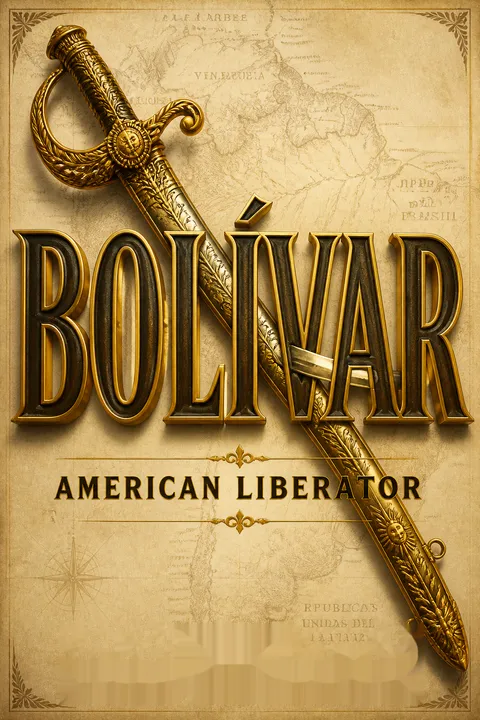

Key Takeaways
1. Bolívar's Formative Years: A Crucible of Privilege and Loss
"Had I not become a widower, my life might have been very different. I would never have become General Bolívar, nor the Liberator, although I have to admit that my temperament would hardly have predisposed me to become mayor of San Mateo."
Early life's paradox. Simón Bolívar was born into immense wealth and aristocratic privilege in Caracas in 1783, inheriting vast estates, mines, and hundreds of slaves. Yet, his early life was marked by profound personal loss, including the deaths of his father, mother, and grandparents by age ten, leaving him an unruly orphan. This tumultuous upbringing, coupled with an unconventional education under figures like Simón Rodríguez, exposed him to Enlightenment ideals and fostered an adventurous spirit, shaping a man destined for a path far removed from a comfortable landowner's life.
European influences. His travels to Europe, particularly Spain and France, further refined his intellect and ignited his revolutionary fervor. In Madrid, he witnessed the decadence of the Spanish court and the fragility of monarchy, while in Paris, he absorbed the radical ideas of Rousseau, Locke, and Voltaire. These experiences, combined with the tragic loss of his young wife, María Teresa, within a year of their marriage, profoundly altered his life's trajectory, pushing him towards a destiny of political action and military leadership.
Seeds of rebellion. Bolívar's early exposure to the injustices of Spanish colonialism, from the strict racial hierarchies to the economic exploitation of the colonies, fueled a deep-seated animosity towards the crown. He saw firsthand the "divide and subjugate" tactics that kept the diverse populations of Spanish America in ignorance and subservience. This blend of personal tragedy, intellectual awakening, and direct observation of colonial oppression laid the groundwork for his later commitment to liberating his homeland, transforming a privileged youth into a fervent revolutionary.
2. The Spark of Independence: Napoleon's Catalyst and Creole Ambition
"The people are calling you, Señor," he said. He motioned the governor to go back and finish the conversation.
Napoleon's unintended gift. The catalyst for South American independence arrived with Napoleon Bonaparte's invasion of Spain in 1807, which deposed King Ferdinand VII and plunged the Iberian Peninsula into chaos. This power vacuum emboldened Creole elites across the Americas, who, long resentful of Spanish rule and economic restrictions, saw an unprecedented opportunity to assert self-governance. In Caracas, this led to the formation of local juntas that, while initially professing loyalty to the imprisoned king, harbored deep aspirations for true autonomy.
Creole discontent. Bolívar, already a radical proponent of absolute independence, initially viewed these early, cautious movements with skepticism, refusing to compromise his vision for total liberty. However, the growing discontent among wealthy Creoles, who felt increasingly marginalized by Spain's anti-Creole laws and the appointment of often-inferior peninsulares to high office, created a fertile ground for rebellion. The "first grito" of independence in Quito in 1809, though short-lived, signaled a continent-wide awakening.
The Caracas coup. The decisive moment came on April 19, 1810, when Caracas's Creoles, including Bolívar's family and friends, orchestrated a bloodless coup against Captain-General Emparán. This audacious act, fueled by news of Spain's capitulation to France and the perceived illegitimacy of the Spanish Regency, resulted in the establishment of the Supreme Junta of Caracas. This new government, while still nominally loyal to Ferdinand VII, immediately declared free trade, abolished Indian tributes, and suspended the slave trade, marking the dawn of Venezuela's first republic and setting the stage for Bolívar's active involvement.
3. The Brutality of Liberation: "War to the Death" and Racial Conflict
"SPANIARDS AND CANARY ISLANDERS: COUNT ON DEATH, EVEN IF YOU HAVE BEEN INDIFFERENT. AMERICANS: COUNT ON LIFE, EVEN IF YOU HAVE BEEN GUILTY."
A desperate decree. Bolívar's "War to the Death" decree, issued in Trujillo in 1813, was a brutal and controversial measure born from the savage realities of the independence wars. Intended to unite Americans against a foreign invader and retaliate against Spanish atrocities, it instead plunged Venezuela into a horrifying civil war, turning Americans against Americans. This policy, which called for the extermination of all Spaniards who did not actively support the patriot cause, marked a dark turn in the revolution, escalating violence to unprecedented levels.
Racialized warfare. The conflict quickly devolved into a racial war, exacerbated by figures like José Tomás Boves and his "Legions of Hell"—a formidable army of black, pardo, and mestizo plainsmen. Boves, a Spanish sailor turned warlord, rallied the marginalized masses by promising plunder and the extermination of the Creole elite, effectively inverting the colonial racial hierarchy. This strategy, which Spain ironically exploited, highlighted the deep-seated racial tensions and class resentments that the Creole-led revolution had initially failed to address, forcing Bolívar to confront the complex social fabric of his America.
Devastating consequences. The "War to the Death" and the ensuing racial conflict led to catastrophic losses, with entire cities razed, populations decimated, and the countryside strewn with unburied corpses. Bolívar himself, though initially believing the decree would unify patriots, later admitted its tragic outcome, recognizing that the revolution had become a "bloody conflict that wiped whole cities from the map, reduced civilian populations by a third, and virtually obliterated Spain’s expeditionary forces." This period profoundly shaped his understanding of the challenges inherent in building a truly inclusive and stable republic.
4. Military Brilliance: Audacious Campaigns and Unprecedented Victories
"A weak man requires a long fight in order to win. A strong one delivers a single blow and an empire vanishes."
Strategic audacity. Bolívar's military genius lay in his audacious, often improvised, campaigns that defied conventional warfare and consistently surprised his enemies. His "Admirable Campaign" in 1813, where he marched a small force from New Granada to liberate Caracas, and his subsequent crossing of the Andes before the Battle of Boyacá in 1819, are prime examples. These feats, comparable to Hannibal's crossing of the Alps, showcased his ability to leverage terrain, speed, and the element of surprise against numerically superior and better-equipped Spanish forces.
Uniting disparate forces. A key to his success was his ability to forge a cohesive fighting force from diverse and often unruly elements, including:
- Untrained peasants and runaway slaves
- Hard-bitten plainsmen (llaneros) under leaders like José Antonio Páez
- European mercenaries, particularly the British Legion, veterans of the Napoleonic Wars
Bolívar's charisma and unwavering commitment to liberty inspired loyalty and transformed these disparate groups into a formidable army, capable of enduring immense hardships and achieving seemingly impossible victories.
Decisive battles. The Battle of Boyacá (1819) in New Granada and the Battle of Carabobo (1821) in Venezuela were pivotal, securing independence for these regions and paving the way for Gran Colombia. His final, crowning achievement was the Battle of Ayacucho (1824) in Peru, led by his trusted general Antonio José de Sucre. This decisive victory, achieved against overwhelming odds, effectively ended Spanish rule in South America, demonstrating Bolívar's strategic vision and the enduring power of a unified, determined liberation army.
5. The Grand Vision of Gran Colombia: Unity Against Fragmentation
"Unity, unity, unity must be our motto!"
A continental dream. Bolívar's most ambitious political project was the creation of Gran Colombia, a vast republic encompassing Venezuela, New Granada (Colombia), Ecuador, and Panama. This vision, articulated in his eloquent Angostura Address of 1819, stemmed from his conviction that only a strong, unified nation could withstand external threats and overcome the internal divisions inherited from three centuries of Spanish colonialism. He believed that a fragmented South America would be perpetually vulnerable to anarchy and foreign interference.
Challenges to unity. Despite his fervent appeals, the dream of Gran Colombia was constantly undermined by:
- Regionalism: Local caudillos and elites, like Páez in Venezuela and Santander in New Granada, prioritized their provincial interests over national unity.
- Federalism vs. Centralism: Debates over governmental structure, with many advocating for a loose federation of states, clashed with Bolívar's insistence on a strong, centralized authority to manage a diverse and often unruly populace.
- Racial tensions: Deep-seated prejudices and mistrust among different racial groups (whites, pardos, indigenous, blacks) made true social cohesion difficult, despite Bolívar's efforts to promote equality and abolish slavery.
The Bolivian Constitution. In an attempt to solidify his vision, Bolívar drafted the Bolivian Constitution, which proposed a president for life and a hereditary senate, reflecting his growing belief that South America needed a firm, benevolent hand to guide it towards stability. While controversial, this document underscored his profound concern for the long-term viability of the new republics, which he felt were ill-prepared for the full responsibilities of democracy without strong leadership and moral education.
6. Personal Passions and Public Scrutiny: Love, Loss, and Scandal
"I loved my wife very much and at her death I took an oath never again to marry. As you can see, I have kept my word."
Enduring grief and fleeting affections. The premature death of his young wife, María Teresa, left an indelible mark on Bolívar, shaping his personal life and public persona. He vowed never to remarry, a promise he kept, yet he was an "insatiable womanizer" throughout his life. His numerous romantic entanglements, from the Parisian socialite Fanny du Villars to the spirited Manuela Sáenz, often intertwined with his political and military campaigns, drawing both fascination and scandal.
Manuela Sáenz: The Liberatrix. Manuela Sáenz, a wealthy, married Ecuadorian revolutionary, became Bolívar's most enduring and influential lover. Their passionate affair, openly conducted and defiantly unconventional, scandalized conservative society but provided Bolívar with intellectual companionship, emotional support, and a fierce defender. Manuela, a skilled horsewoman and patriot, often accompanied him on campaigns, served as his archivist, and famously saved his life during an assassination attempt, earning her the title "Liberatrix of the Liberator."
The cost of public romance. Bolívar's romantic life, particularly his relationship with Manuela, was a constant source of gossip and criticism, exploited by his enemies to undermine his reputation. While he found solace and strength in these relationships, they also exposed him to accusations of impropriety and distraction, highlighting the tension between his personal desires and the immense public expectations placed upon him as the leader of a continent-wide revolution. His personal life, much like his political career, was lived under intense scrutiny and often became a battleground for his ideals and his flaws.
7. The Guayaquil Conundrum: Clash of Liberators, Divergent Visions
"There is no room in all of Peru for General Bolívar and me."
A pivotal encounter. The meeting between Simón Bolívar and José de San Martín in Guayaquil in 1822 was a pivotal, yet ultimately fraught, moment in South American history. Both revered as liberators, they represented distinct approaches to achieving and consolidating independence. San Martín, having liberated Argentina and Chile, and then Lima, sought Bolívar's aid to complete the liberation of Peru, which remained largely under Spanish control in the highlands. However, their meeting quickly revealed irreconcilable differences in their political visions and personal ambitions.
Conflicting strategies and ambitions. Their private discussions, shrouded in mystery, likely centered on:
- Guayaquil's fate: Bolívar had preemptively annexed the strategic port city of Guayaquil for Gran Colombia, despite San Martín's belief that it should choose its own destiny or join Peru.
- Military aid for Peru: San Martín desperately needed Bolívar's seasoned Colombian troops but was offered only a fraction of what he expected, leading him to suspect Bolívar's desire for sole glory.
- Political systems: San Martín advocated for a European-style monarchy in Peru, believing the populace unready for democracy, a concept Bolívar vehemently rejected as a relic of the old world.
San Martín's withdrawal. Faced with Bolívar's unwavering ambition, his refusal to serve under Bolívar, and the political chaos in Lima (including the ousting of his trusted advisor Monteagudo), San Martín made the momentous decision to withdraw from Peru. He left Lima leaderless, clearing the path for Bolívar to complete the liberation. This act, though seen by some as a noble sacrifice, was also a bitter admission of defeat and a testament to the clash of two colossal egos and their fundamentally different visions for the future of South America.
8. The Weight of Dictatorship: Power, Betrayal, and Disillusionment
"Pity the nation that obeys one man as we should pity the man who holds all power."
The necessity of absolute rule. Following the collapse of Gran Colombia's constitutional government and repeated internal insurrections, Bolívar reluctantly assumed dictatorial powers in 1828. He believed this was a temporary, necessary evil to restore order and prevent the nascent republics from descending into anarchy, arguing that his people, infantilized by centuries of colonial rule, were not yet ready for full democracy. This decision, however, fueled accusations of megalomania and monarchical ambitions, particularly from his former vice president, Francisco Santander.
Assassination attempts and betrayals. Bolívar's assumption of absolute power made him a target. The most infamous was the September 25, 1828, assassination attempt in Bogotá, where he narrowly escaped death thanks to Manuela Sáenz's quick thinking. This event, which he believed Santander orchestrated, shattered his spirit and deepened his disillusionment with his countrymen. The constant betrayals by former allies and generals—Páez, Padilla, Córdova—who prioritized regional power or personal ambition over national unity, weighed heavily on him, transforming his initial optimism into profound weariness.
The unraveling of Gran Colombia. Despite his efforts, Gran Colombia began to unravel. Regional leaders, emboldened by Santander's anti-Bolívar rhetoric and their own separatist desires, pushed for greater autonomy. Venezuela, under Páez, declared secession, followed by Ecuador. Bolívar, once the unifying force, found himself increasingly isolated and reviled, accused of tyranny and corruption. The very nation he had fought so hard to create was tearing itself apart, leaving him to lament the "era of blunders" and the seemingly insurmountable challenges of governing a continent unprepared for the responsibilities of freedom.
9. Plowing the Sea: A Legacy of Unfulfilled Dreams and Enduring Symbolism
"America is ungovernable; he who serves a revolution ploughs the sea; all one can do in America is leave it; the country is bound to fall into unimaginable chaos, after which it will pass into the hands of an undistinguishable string of tyrants of every color."
A bitter farewell. In his final years, ravaged by tuberculosis and profound disillusionment, Bolívar famously declared that "he who serves a revolution ploughs the sea," expressing his despair over the fragmentation and ingratitude of the newly independent nations. He resigned the presidency of Gran Colombia in 1830, hoping his departure would heal the fractured union, but his dream of a unified continent had already crumbled. He died reviled and impoverished in Santa Marta, Colombia, forbidden even to return to his native Venezuela, a stark contrast to the immense wealth and power he had once commanded.
The posthumous legend. Despite his tragic end, Bolívar's legend grew exponentially after his death. His failures as a politician receded, while his unparalleled successes as a liberator took center stage. He became a powerful symbol of Latin American greatness, a figure invoked by politicians across the ideological spectrum, and a source of national pride. His vision of a united, free, and racially egalitarian America, though unrealized in his lifetime, continued to inspire future generations, transforming him from a flawed man into an enduring myth.
An enduring, complex legacy. Bolívar's life embodies the paradoxes of revolution:
- He fought for liberty but resorted to dictatorship.
- He championed racial equality but struggled with the prejudices of his time.
- He dreamed of unity but witnessed fragmentation.
His legacy is a testament to the immense challenges of nation-building in a continent scarred by colonialism and deep internal divisions. Yet, his unwavering will, strategic genius, and profound commitment to freedom continue to resonate, making him one of the most celebrated and complex figures in world history, a "colossus" whose shadow still looms large over Latin America.
Review Summary
Bolívar: American Liberator is widely praised as an engaging, well-researched biography of Simón Bolívar, the Venezuelan liberator who freed six South American nations from Spanish rule. Reviewers appreciate Marie Arana's accessible prose, historical context, and balanced portrayal of Bolívar's brilliance alongside his flaws, including brutality and dictatorial tendencies. Common criticisms include insufficient tactical military detail, limited treatment of indigenous peoples, and occasional inconsistencies in writing style. Most readers recommend it as an excellent introduction to Latin American history, particularly for those unfamiliar with the subject.
People Also Read






About the Author
Other books by Marie Arana
Download PDF
Download EPUB
.epub digital book format is ideal for reading ebooks on phones, tablets, and e-readers.








































