
Key Takeaways
1. The AI Shift: From Coder to Intent-Driven Orchestrator
AI is transforming software development, shifting programmers from writing code to collaborating with AI in an intent-driven workflow.
A profound transformation. The era of AI is fundamentally reshaping the developer's role, moving from meticulous line-by-line coding to a more strategic, intent-driven collaboration with artificial intelligence. This "vibe coding" approach, as coined by Andrej Karpathy, involves describing desired outcomes in natural language and letting large language models (LLMs) fill in the implementation details. It's a radical shift from being a code artisan to an orchestrator of AI-generated solutions.
Spectrum of AI integration. This new paradigm exists on a spectrum, ranging from exploratory "vibe coding" to disciplined "AI-assisted engineering." Vibe coding prioritizes speed and rapid prototyping, treating AI as a conversational partner to quickly materialize ideas. AI-assisted engineering, conversely, is a more structured approach, where developers maintain control, using AI as a copilot across the traditional software development lifecycle—from design and testing to code generation under clear constraints. Both leverage AI's power, but with different goals and levels of human oversight.
Programming with intent. At its core, this shift means focusing on what the program should accomplish rather than how it should be coded. The prompt becomes the new unit of thought, a high-level instruction that the AI translates into functional code. This iterative process involves describing, generating, reviewing, and refining, allowing developers to operate at a higher level of abstraction and significantly boost productivity, potentially turning a "10x engineer" into a "100x reality."
2. The 70% Problem: AI Accelerates, Humans Perfect
AI can get you 70% of the way there, but that last 30% is frustrating.
The magic and the wall. AI coding tools excel at generating boilerplate, routine functions, and getting projects most of the way to completion, often covering about 70% of requirements with impressive speed. This initial progress feels magical, allowing rapid prototyping and feature implementation. However, developers frequently hit a "70% problem" wall, where the final 30%—addressing edge cases, refining architecture, ensuring maintainability, and handling complex, novel problems—becomes a significant challenge.
Beyond accidental complexity. AI is superb at handling the "accidental complexity" of software, such as repetitive, mechanical tasks, but struggles with "essential complexity"—the inherent difficulty of understanding and managing a problem. It won't invent novel algorithms or innovative architectures, nor will it take responsibility for decisions. AI-generated code, while plausible, can hide a "minefield of bugs or poor design decisions," leading to "house of cards code" that appears solid but collapses under real-world pressure.
Human expertise is irreplaceable. The crucial last 30% demands deep human expertise, critical thinking, and foresight. This includes:
- Edge case handling: Anticipating unusual inputs, race conditions, and future requirements.
- Architectural refinement: Ensuring sound, maintainable system structures.
- Security hardening: Identifying and mitigating vulnerabilities.
- Performance optimization: Diagnosing and resolving bottlenecks.
- User-centric design: Infusing empathy and understanding into the product.
This means AI is a powerful force multiplier, but human judgment remains paramount for delivering robust, production-ready software.
3. Mastering Prompts: Your New Programming Language
In vibe coding, prompts are the new source code.
The art and science of communication. Prompt engineering is the critical skill for effectively communicating with AI coding assistants, essentially becoming the new programming literacy. A well-crafted prompt is the difference between irrelevant or buggy code and a spot-on solution, as LLMs respond only to the input they're given. Developers must think like spec writers, providing precise and logical instructions to guide the AI, much like writing documentation for a literal junior developer.
Specificity and clarity are paramount. To get the best results, prompts must be specific and clear, including relevant details such as:
- Language and environment: "Write a Python function..." or "Using React Hooks..."
- Scope of output: "Provide only the function implementation" or "Provide a complete runnable script."
- Requirements and constraints: "Handle the case of missing last names by treating them as empty strings" or "using O(n) time and O(1) space."
- Desired output format: "Give only the code, no explanation" or "Format the output as JSON."
Vague prompts force the AI to guess, leading to generic or incorrect outputs, while detailed prompts set the AI up for success.
Iterative refinement is the feedback loop. Even with clear prompts, perfection is rare on the first try. Interacting with AI is an iterative process, a feedback loop where developers critically review AI output, identify what's missing or wrong, and provide refined prompts. This back-and-forth allows for gradual evolution from a vague idea to polished code, much like a pair-programming session. Techniques like chain-of-thought prompting (asking the AI to think step-by-step) or role prompting (asking it to act as a "security analyst") further enhance communication, ensuring the AI's output aligns with specific needs and quality standards.
4. Beyond Code Generation: AI's Role Across the SDLC
AI’s role extends to testing, debugging, design, project management, and more.
Holistic development acceleration. AI's influence is rapidly expanding beyond mere code generation to encompass nearly every phase of the software development lifecycle (SDLC). This holistic integration means the entire process, from initial concept to deployment and maintenance, can be accelerated and enhanced. Developers can leverage AI as a comprehensive partner, not just a coding assistant, to streamline workflows and improve overall software quality.
Enhanced quality assurance and maintenance. AI is poised to revolutionize testing and debugging. Future AI tools could:
- Automate test generation: Creating unit, integration, and even fuzz tests to ensure robust coverage and catch corner-case bugs.
- Intelligently debug: Analyzing stack traces and variable states in real-time to pinpoint error causes and suggest fixes, even predicting issues before they occur.
- Predictive maintenance: Identifying code smells, suggesting refactorings, automatically updating dependencies, and optimizing performance by analyzing code paths and usage patterns.
This proactive approach minimizes manual effort in quality assurance, leading to more reliable and maintainable codebases.
AI-driven design and project management. Beyond code, AI is set to transform how we design software and manage projects. Generative design tools can produce UI mockups from natural language descriptions, accelerating design iteration and even personalizing user experiences in real-time. In project management, AI can assist with:
- Task allocation: Recommending developers for tasks based on expertise and workload.
- Scheduling and planning: Breaking down goals into subtasks and suggesting sprint plans.
- Risk analysis: Identifying potential delays or technical hurdles from historical data.
- Decision support: Providing data-driven insights for strategic choices.
This allows human managers to focus on leadership, vision, and the human elements of collaboration, while AI handles heavy analysis and routine suggestions.
5. Autonomous Agents: Delegating Entire Development Tasks
Unlike familiar “copilot” assistants that suggest code while you type, these agents operate more like background junior developers you can dispatch to handle entire tasks asynchronously.
The next evolution of AI coding. Autonomous background coding agents represent a significant leap beyond traditional in-IDE copilots. Instead of interactive suggestions, these agents receive high-level tasks and work independently in isolated cloud environments, planning, executing, verifying, and reporting results—often as fully formed pull requests. This asynchronous workflow allows developers to delegate entire development tasks, effectively expanding their cognitive bandwidth by having AI work in parallel.
How agents operate. Autonomous agents follow a structured process:
- Plan: Interpret the request and formulate a multi-step plan, often visible for human review.
- Execute: Launch a dedicated sandbox environment, read/modify code across multiple files, and even create new ones.
- Verify: Compile code and run tests iteratively, self-correcting errors until tests pass.
- Report: Deliver results as a pull request with diffs, commit messages, and explanations for human review and merge.
This end-to-end capability transforms AI from a reactive helper to a proactive, self-directed developer, capable of tackling larger-scope tasks like refactoring cross-cutting concerns or upgrading dependencies.
Challenges and the amplified review bottleneck. While powerful, autonomous agents introduce unique challenges. Their sequential decision-making can compound initial misinterpretations, leading to "coherent incorrectness" that is internally consistent but fundamentally flawed. Environmental brittleness, where slight variations in sandbox setups cause subtle bugs, and the "async coordination paradox," where multiple agents create conflicts, are new complexities. Most significantly, agents amplify the code review bottleneck by delivering large volumes of code simultaneously, requiring humans to reverse-engineer the agent's "reasoning." This demands a higher degree of trust and sophisticated oversight, treating agent-produced code like that of an "overeager junior developer" requiring thorough verification.
6. Security, Maintainability, Reliability: The Human Imperative
Speed and productivity mean little if the resulting software is riddled with vulnerabilities or prone to crashing.
The critical pillars of quality. While AI accelerates code generation, the fundamental dependability of software—its security, maintainability, and reliability—remains a human responsibility. AI-generated code, learned from vast public datasets, can inadvertently reproduce insecure patterns or introduce subtle flaws. Therefore, developers must act as the ultimate security safety net, ensuring that rapid development does not compromise the robustness of the final product.
Common vulnerabilities and auditing strategies. AI-generated code is susceptible to various security pitfalls, including:
- Hard-coded secrets: API keys or passwords directly in code.
- SQL injection: Queries concatenating user input without parameterization.
- Cross-site scripting (XSS): Unescaped user input in web outputs.
- Improper authentication/authorization: Weak password handling or missing access checks.
- Insecure defaults: Using HTTP instead of HTTPS, or outdated cryptography.
Effective auditing involves: - Automated scanners: SAST tools like ESLint, Bandit, or GitHub CodeQL.
- AI as reviewer: Using a separate AI to audit the generated code.
- Human code review: Employing a security checklist and critical thinking.
- Penetration testing and fuzzing: Feeding crafted inputs to find vulnerabilities.
- Security-focused unit tests: Asserting security properties for critical code.
Developers must actively supplement AI's knowledge with current security best practices to compensate for training cutoffs.
Building robust testing and maintainability frameworks. Comprehensive testing is paramount to validate reliability and catch issues early. This includes:
- Automated testing: Unit, integration, and end-to-end tests, often AI-generated and integrated into CI/CD pipelines.
- Property-based testing and fuzzing: Defining high-level properties to generate diverse inputs and catch edge cases.
- Load and performance testing: Identifying bottlenecks and optimizing AI-generated code for efficiency.
For maintainability, developers must enforce consistent coding standards, continuously refactor AI-generated code, provide thorough documentation, and track technical debt. Deployment best practices, such as automated CI/CD, staged rollouts, comprehensive observability, and regular audits, close the loop, ensuring that AI-accelerated development results in trustworthy software.
7. Ethical AI: Navigating IP, Bias, and Responsibility
Responsible AI-assisted dev means you, the developer, are reviewing every line and making decisions, not deploying raw AI output without human validation.
Intellectual property complexities. The use of AI in code generation raises significant intellectual property (IP) questions. AI models trained on vast datasets, including open-source code with various licenses, can produce outputs that are substantially similar to existing copyrighted material. While AI tool terms of service often grant users rights to the output, this doesn't automatically mean the output is free from third-party IP claims or eligible for copyright protection. Lawsuits like Doe v. GitHub, Inc. highlight the risk of AI regurgitating licensed code without proper attribution. Developers must:
- Review outputs: Check for verbatim or near-verbatim copies of known code.
- Attribute sources: Cite known algorithms or open-source snippets.
- Understand licenses: Ensure compliance with open-source obligations, especially for restrictive licenses like GPL.
- Avoid sensitive input: Do not feed large chunks of copyrighted or proprietary code into AI tools without appropriate licenses.
Transparency, attribution, and bias mitigation. Ethical AI use demands transparency about AI's involvement and proper attribution. Disclosing AI assistance in code comments or documentation fosters accountability and trust among teams and stakeholders. Furthermore, AI models can perpetuate biases present in their training data, leading to outputs that are discriminatory or unfair. This can manifest as:
- Cultural biases: User-facing text reflecting insensitive language or North American-centric assumptions.
- Exclusionary design: Overlooking internationalization needs or diverse user demographics.
- Algorithmic bias: Incorporating discriminatory variables in decision-making code (e.g., credit scoring).
Developers must proactively work to avoid bias by: - Testing with diverse examples: Ensuring code functions fairly across varied inputs.
- Prompting for inclusivity: Explicitly instructing AI to use neutral language and diverse examples.
- Hiring diverse teams: Leveraging varied perspectives to catch subtle biases.
Golden rules for responsible AI use. A framework for ethical AI-assisted development includes:
- Human in the loop: Never let AI work unsupervised; human validation is essential.
- Take responsibility: The development team is accountable for all code, regardless of its origin.
- Protect privacy: Avoid exposing sensitive data in prompts and obtain user consent for AI features.
- Comply with laws: Stay informed about evolving AI regulations (e.g., GDPR, EU AI Act).
- Foster an ethical culture: Encourage discussions, provide training, and designate ethics champions.
- Create guardrails: Build systems that fail safely and allow user override for AI recommendations.
- Document decisions: Log why certain AI suggestions were used or rejected.
- Proactively avoid discrimination: Ensure AI usage leads to fair outcomes for all users.
This balanced approach ensures that the speed of AI does not compromise fundamental values or societal well-being.
8. Future-Proofing Your Career: Embrace New Skills, Deepen Fundamentals
AI won’t replace developers, but developers who can use AI effectively may well replace those who can’t.
Evolving roles, not obsolescence. The rise of AI coding tools signals not the end of programming, but "the end of programming as we know it today." Developers' roles are evolving, with AI shouldering much of the "70% problem" of boilerplate and routine tasks. This shift means engineers at all levels must adapt, focusing on durable skills that AI cannot (yet) replicate, thereby maximizing their irreplaceable human contribution and future-proofing their careers.
Maximizing human contribution at every level.
- Senior Engineers: Become architects and editor-in-chiefs, leveraging AI as a force multiplier for big initiatives, mentoring less-experienced team members, cultivating domain mastery and foresight, and honing soft skills and leadership. Their judgment, strategic thinking, and mentorship are more critical than ever.
- Midlevel Engineers: Adapt by learning to manage systems integration and boundaries, deepening computer science fundamentals, building domain expertise, mastering performance optimization and DevOps, focusing on rigorous code review and quality assurance, and developing strong systems thinking and cross-functional communication skills.
- Junior Developers: Thrive by learning the "why" behind the code, practicing problem-solving and debugging without AI's safety net, focusing on testing and verification, developing an eye for maintainability, wisely building prompting and tooling skills, seeking feedback and mentorship, and shifting their mindset from consuming solutions to creating understanding.
The enduring human advantage. The core problem-solving mindset remains crucial, but the day-to-day tasks look different. The "human 30%" will concentrate on higher-level critical thinking, quality control, and the nuanced aspects of software development. This includes:
- System design and architecture: Crafting robust, scalable, and secure systems.
- Critical thinking and foresight: Anticipating issues and making informed trade-offs.
- Domain expertise: Understanding business context and user needs.
- Quality assurance: Rigorously reviewing, testing, and debugging all code.
- Communication and collaboration: Effectively interacting with both humans and AI.
AI is a powerful tool for the skilled; those who combine these enduring human strengths with effective AI utilization will outperform those who rely solely on one or the other, actively shaping the future of software engineering.
Review Summary
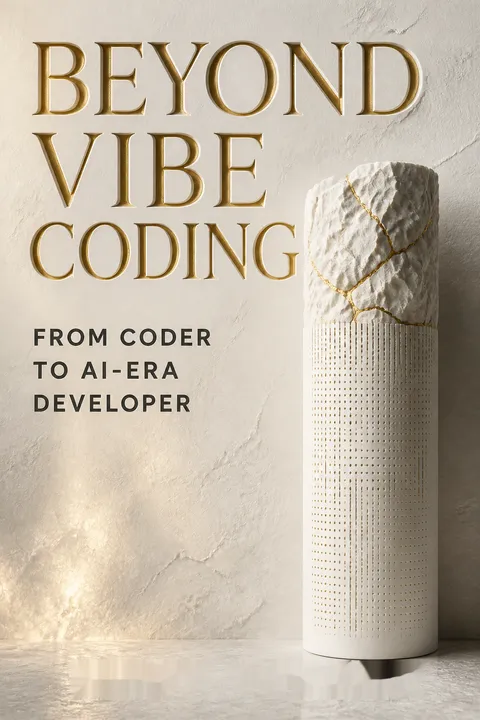
Beyond Vibe Coding receives mixed reviews averaging 3.33/5 stars. Critics note the book largely recycles the author's blog posts with excessive repetition of concepts like distinguishing vibe coding from AI-assisted programming. Reviewers find it contains too much filler, web-specific content, and tool-specific details that may quickly become outdated. The target audience is unclear—too basic for experienced developers, potentially confusing for juniors. While the core advice is solid, readers suggest consulting Osmani's blog posts and online discussions instead for more practical value.
People Also Read







Download PDF
Download EPUB
.epub digital book format is ideal for reading ebooks on phones, tablets, and e-readers.








































