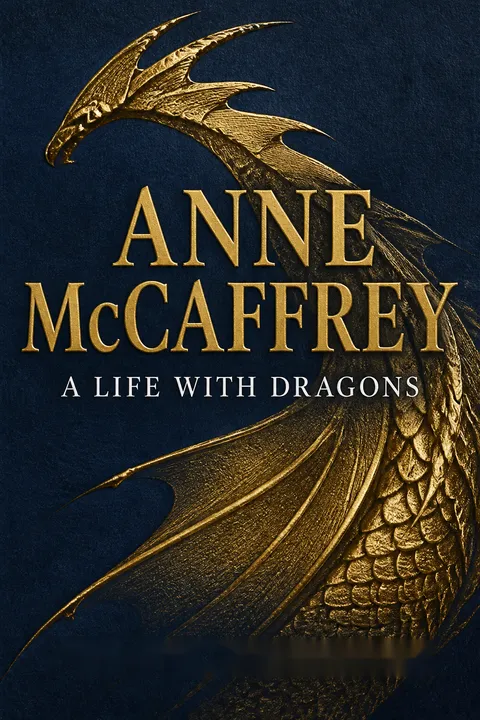

Key Takeaways
1. Irish Roots & Rebellious Spirit Shaped Her Core Values
“a family trait— bucking the system,” she says.
Family legacy. Anne McCaffrey's Irish American heritage, particularly from her paternal grandfather, instilled in her a deep-seated sense of integrity and a willingness to challenge authority. Her grandfather, a Boston policeman, famously arrested an influential politician for electioneering and refused to discriminate against Jewish merchants, actions that cost him career advancement but earned him lasting family respect. This tradition of standing up for justice, even at personal cost, became a cornerstone of Anne's character and later, her fictional worlds.
Education's value. The McCaffrey and McElroy families, despite facing anti-Irish prejudice and financial struggles, highly valued education as a means of upward mobility. Her maternal great-grandfather, a "hedgerow teacher," risked imprisonment to educate Catholics in Ireland, and Jewish merchants, grateful for her grandfather's fairness, funded her father's elite schooling. This emphasis on learning and intellectual pursuit, often against societal odds, profoundly influenced Anne's own academic drive and her later portrayal of knowledge as power in her novels.
Psychic leanings. Both sides of Anne's family embraced a belief in "second sight" or precognition, a common thread in Irish folklore. Her paternal grandfather's uncanny foreknowledge of his own death and her mother's prescient stock market withdrawal before the Great Depression reinforced this family trait. These personal experiences later inspired Anne's creation of "psionic powers" and "Talents" in her science fiction, transforming mystical intuition into scientifically plausible abilities that empower her characters.
2. Adolescence as a Crucible for Her Empathetic Fiction
Anne’s ability to give life to such characters derives from her own adolescence.
Outsider feelings. Anne's teenage years were marked by a profound sense of being an outsider, a feeling exacerbated by her unconventional family and the societal pressures on girls in the 1940s. She struggled with self-image, feeling unattractive and often uninvited by peers, leading her to seek solace in books and solitary activities like climbing. This personal experience of alienation became a wellspring for her later fiction, allowing her to craft deeply empathetic protagonists who feel different and struggle to find their place.
Wartime impact. World War II profoundly shaped Anne's adolescence, bringing both separation from her father and older brother who served overseas, and intense worry over her younger brother Kevin's life-threatening illness. While she felt excluded from direct combat, her experiences of loss, fear, and the supportive roles women played during the war informed her later creation of strong female characters who are active combatants and strategists in her novels, often as a fictional compensation for her real-life exclusion.
Literary escapes. Reading provided Anne with a vital escape from adolescent anxieties, immersing her in worlds where unusual people had exciting adventures. Authors like Caroline Dale Snedeker and Zane Grey, with their strong female characters and emphasis on animal bonds, resonated deeply. Austin Tappan Wright's "Islandia," a thousand-page fantasy of an isolated, pre-industrial society with sexual freedom and environmentalism, was particularly influential, offering a radical alternative to her own flawed world and foreshadowing her own utopian creations.
3. Radcliffe Cultivated Her Intellect and Nonconformist Path
“She is gifted musically and writes very well. Like most embryo writers, she undertakes very ambitious sorts of literary work, and loses interest before she completes them."
Intellectual awakening. Radcliffe College, during and after WWII, offered Anne a stimulating environment where her intelligence and nonconformist spirit were appreciated. Despite being described by advisors as "too boisterous and self-assertive," she thrived academically, making the dean's list and pursuing an unconventional major in Slavic languages. This period solidified her intellectual confidence and provided the rigorous research skills that would later underpin the detailed world-building in her science fiction.
Artistic expression. Beyond academics, Radcliffe provided crucial outlets for Anne's performative talents. She excelled in the Radcliffe Entertainment Unit, singing for troops, and participated in theatrical productions, honing her stage presence and vocal skills. This love for performance, particularly musical theater, would remain a significant part of her life until her writing career fully blossomed, and it profoundly influenced the central role of music and "Talents" in her fictional universes.
Broadened horizons. Her studies in diverse subjects like Chinese philosophy, cartography, and government, coupled with interactions with returning GI Bill students from varied backgrounds, expanded Anne's worldview. This exposure to different cultures and perspectives, alongside her thesis on Russian utopian literature, laid the groundwork for her ability to create believable alien societies and complex political systems in her science fiction, far beyond the conventional literary paths of her peers.
4. An Unsupportive Marriage Forged Her Resolve to Write
“He didn’t believe what I wrote had any merit: I had to prove it all to him. Often that sort of negative response is even more instrumental to success than positive support.”
Early romance and domesticity. Anne married Wright Johnson in 1950, drawn by their shared love for music, theater, and literature. The early years in New York City were vibrant, filled with cultural experiences. However, with the arrival of children and a move to the New Jersey suburbs, Anne's life shifted towards traditional domesticity, a role she found increasingly confining. This period, mirroring the "feminine mystique" described by Betty Friedan, sparked a "strange stirring, a sense of dissatisfaction" that propelled her towards writing.
Husband's criticism. Despite Wright's own professional writing background, he was unsupportive and often dismissive of Anne's science fiction, viewing it as unserious. His verbal abuse and constant criticism of her housekeeping, coupled with his increasing absence and heavy drinking, created a hostile environment. Anne's letters to her agent, Virginia Kidd, reveal her deep frustration and anger, but also her fierce determination to prove him wrong, transforming his negativity into a powerful motivator for her burgeoning career.
Writing as defiance. Writing became Anne's primary outlet and a defiant act against her husband's attempts to control her. She carved out precious moments to write amidst childcare and household duties, seeing it as a way to maintain her identity beyond "just mommy." Her early stories, like "The Ship Who Sang," featuring a protagonist who escapes a confining life, directly reflect Anne's own yearning for freedom and validation, demonstrating how her personal struggles fueled her creative output.
5. Emigration to Ireland Ignited Her Creative and Personal Freedom
Now we were back! Reverse immigration. . . . And thus began the Irish adventure.
A bold new chapter. Following her divorce in 1970, Anne made the audacious decision to move to Ireland with her two youngest children, a "reverse immigration" to her ancestral homeland. This move, though financially precarious and thousands of miles from her established support network, was a deliberate act of self-liberation. It allowed her to shed the constraints of her marriage and American societal expectations, embracing a new identity as an independent woman and full-time writer.
Cultural and financial hurdles. Adapting to Ireland presented numerous challenges, from navigating a new cultural system (like needing to own property for a library card) to coping with the relatively backward position of women. Anne faced prejudice as a divorced, independent woman, even struggling to get a bank card in her own name. Financially, she relied on the Haughey's Artists Exemption Act, which exempted writers from taxes, but still faced constant anxiety over bills and her ex-husband's unreliable child support.
Creative surge. Despite the adversities, Ireland proved to be a powerful catalyst for Anne's writing. The move "deepened" her work, making Pern feel like a "real country," and her frustrations often found creative expression in her fiction. This decade saw her publish thirteen books, including the acclaimed Harper Hall Trilogy and "The White Dragon," which made her the first science fiction writer on the New York Times Bestseller List, solidifying her financial independence and global reputation.
6. Writing Became Her Refuge, Outlet, and Path to Self-Discovery
“I shall continue to write— I can’t not write anyhow— until I am too frail to touch the keys of my word-processor.”
Therapeutic escape. From childhood, writing served as a therapeutic outlet for Anne, a way to process emotions and escape difficult realities. Whether it was her teenage novel "Eleutheria, the Dancing Slave Girl" or later, "The Ship Who Sang" written to cope with her father's death, writing allowed her to transmute personal pain into art. This deep, almost compulsive need to write remained a constant throughout her life, providing solace and a means of self-expression.
Creating better worlds. Anne's fiction consistently offered alternatives to the flaws she perceived in the real world. Disappointed by limited opportunities for women and the harsh realities of war, she crafted utopian societies where:
- Women held positions of power and leadership.
- Egalitarian relationships between humans and animals flourished.
- Psychic "Talents" were valued over conventional beauty or social status.
- Conflict, though present, was often overcome through cooperation and ingenuity.
Emotional resonance. A hallmark of Anne's writing is its profound emotional depth, often making readers cry. Her ability to evoke intense longing, loss, and the triumph of connection stems directly from her own life experiences:
- The abandonment felt during adolescence.
- The pain of her mother's death and her daughter's chronic illness.
- The struggles of her unhappy marriage.
- The joy of deep friendships and animal companionship.
This raw emotional honesty is what made her characters so relatable and her worlds so compelling.
7. Success Brought New Burdens, Forging Her "Fairy Godmother" Role
“By playing fairy godmother.” Then she said with a sigh, “It’s very expensive.”
New challenges of fame. Achieving bestseller status and signing a million-dollar contract brought Anne financial freedom but also new pressures. Her fame meant constant demands from fans at conventions, leading to exhaustion and a sense of being overwhelmed. She worried about fans living too much in her fictional worlds and struggled with the emotional toll of intense interactions, often feeling the need to "put on her persona" despite her inner anxieties.
Generosity as a defining trait. Freed from her own financial struggles, Anne embraced a "fairy godmother" role, generously supporting a wide circle of family, friends, and even strangers. This included:
- Paying for friends' medical treatments and travel.
- Hosting numerous guests at Dragonhold-Underhill.
- Providing financial assistance for her children's education and housing.
- Paying for a six-thousand-dollar dinner bill at a convention when the hotel threatened to stop service.
Her immense generosity, though often costly, was a core part of her identity and a way she found joy in her success.
Building her "queendom." Anne's new home, Dragonhold-Underhill, was a tangible manifestation of her success and her desire to create a supportive community. Designed with ample space for guests and a commodious study, it became a bustling hub for her extended family and friends. This "queendom," as she sometimes called it, mirrored the communal "Holds" in her Pern novels, providing a physical space where she could nurture relationships and continue her creative work amidst a lively, supportive environment.
8. Her Deep Connection to Animals Transformed into Iconic Fictional Bonds
“Ed [her first horse] and I had a terrific rapport. . . . [H]e used to let me cry on his broad shoulders when things went wrong— that is, if he didn’t step on my toes.”
Lifelong animal affinity. Anne's profound love for animals was a constant throughout her life, from dressing up her cat Thomas as a child to her deep bond with her horse, Mr. Ed. She believed in the empathetic and even telepathic connections between humans and animals, finding solace and unconditional acceptance in their presence. This personal philosophy formed the bedrock of her most iconic creations, particularly the dragons of Pern.
Dragons as companions. In the "Dragonriders of Pern" series, dragons are not merely beasts but genetically engineered, telepathic companions who share an unbreakable bond with their human riders. These relationships are egalitarian, offering unconditional love and mutual respect, a stark contrast to the often-flawed human relationships Anne experienced. The dragons serve multiple roles:
- Providing transportation and defense against the life-threatening Thread.
- Offering emotional support and telepathic communication.
- Enabling women to assume positions of leadership as queen dragon riders.
This reimagining of dragons from feared monsters to intimate friends became one of Anne's most enduring and popular contributions to fantasy literature.
Ecofeminist themes. Anne's realistic Gothic novels, like "Ring of Fear," explicitly explored her ecofeminist perspective, criticizing the exploitation of animals and paralleling it with the exploitation of women. The heroine's special relationship with her horse and her recovery from sexual trauma highlight the importance of respecting both animals and women as sentient beings, not property. This theme, implicit in her science fiction, became explicit in her realistic works, showcasing her consistent advocacy for compassionate treatment of all living creatures.
9. Collaborations and Mentorship Defined Her Later Career
“It’s flattering when people want to write in your universe.”
Expanding her universe. In the 1990s, Anne embraced co-authorship, a new phase in her career that allowed her to expand her fictional worlds and mentor other writers. These "shared universe" books, often based on her established settings like Pern or the Brain Ship series, provided a fresh outlet for her creativity and a way to engage with other authors. This collaborative approach, reminiscent of the Milford conferences she attended as a novice, brought intellectual stimulation and companionship.
Nurturing new talent. Anne, remembering her own struggles as a mid-list writer, generously offered her famous name to help lesser-known authors gain wider readership. While her agents sometimes viewed these collaborations as "share-cropping" that diluted her brand, Anne saw it as a way to give back and foster new talent. Her most successful collaborations, particularly with Elizabeth Ann Scarborough and Elizabeth Moon, were characterized by mutual respect and a shared creative vision, leading to popular series like "Powers That Be" and "Acorna."
Passing the torch. As Anne aged and faced health challenges, she began to consciously prepare for the continuation of her literary legacy. She entrusted the future of Pern, her most beloved world, to her children, particularly her son Todd. Their co-authored novels, "Dragon's Kin" and "Dragon's Fire," and Todd's solo Pern novels, represent a public "passing of the torch," ensuring that the rich history and intricate world of Pern would continue to evolve through new voices within her family.
10. Grand Master Status Crowned a Life of Groundbreaking Feminist Contributions
“What I have achieved for women in science fiction is science fiction that is women-oriented, that they can read with a great deal of enjoyment because my viewpoint characters are women, strong women–role models.”
Pioneering achievements. Anne McCaffrey's career was marked by a series of groundbreaking "firsts" that reshaped the science fiction genre. She was:
- The first woman to win both the Hugo and Nebula Awards (1968).
- The first science fiction writer to appear on the New York Times bestseller list (1978).
- The first science fiction writer to receive the Margaret A. Edwards Award for Lifetime Literary Achievement (1999).
- Only the third woman to be named a Grand Master by the Science Fiction and Fantasy Writers of America (2005).
These accolades cemented her status as a literary icon and a trailblazer for women in a male-dominated field.
Humanizing science fiction. Anne consciously challenged the prevailing "thud and blunder" narratives of 1950s science fiction, which often featured passive or screaming female characters. She injected "emotional content and personal involvement" into her stories, focusing on women's issues like child-rearing, relationships, and self-discovery. Her strong, active female protagonists, who were "victims— strong people— who become survivors," provided vital role models and helped "feminize" the genre, making it more accessible and appealing to a broader readership, especially women.
A lasting legacy. Anne's impact extended beyond her literary contributions; she nurtured the careers of many writers and inspired countless readers, including pilot-astronaut Pamela Melroy, who carried Anne's books into space. Her ability to create worlds that "speak to people's hearts" and offer "limitless possibilities" ensured her enduring influence. Even in her eighties, Anne remained engaged and active, knowing that her hopes, fears, and dreams, and her powerful model of self-creation, would live on through her books and the generations of writers and readers she inspired.
People Also Read



Download PDF
Download EPUB
.epub digital book format is ideal for reading ebooks on phones, tablets, and e-readers.








































