


Plot Summary
The Gravedigger Wakes
Private Cyril Bagger1 crawls out of a mass grave in the Argonne Forest, October 1918, miraculously unscathed from a mortar that shredded every man near him. A con artist drafted into the 43rd Division, Bagger1 has spent the entire war dodging combat — rigging card games so indebted soldiers fight in his place, cultivating burial-duty assignments behind the front lines.
He carries his dead father's red leather Bible not for faith but for the smell of childhood comfort. As he scrapes other men's blood from his face and peels a human ear from his jaw, an unearthly shriek rolls unbroken across the battlefield — organic, agonized, drilling into every skull.
Beneath it, a voice he cannot place whispers his name. His fourteen-year-old companion Lewis Arno2 arrives with alarming news: Major General Reis4 wants him.
Reis's Five Expendables
In a shell crater painted with blood, the 43rd's youngest division commander inspects his five most disposable soldiers. Reis4 — vain, withered of right arm, desperate for a Medal of Honor — has learned he is being replaced. The entire division is marching out, but the shrieker remains.
He assigns Bagger,1 young Arno,2 obsessively clean scavenger Goodspeed,7 brutish Popkin,6 and shell-shocked Black flamethrower operator Veck5 to stay behind and help the screaming man — a euphemism everyone understands as mercy killing.
Reis4 strikes Bagger1 with his golden walking stick, dubs him Private Gravedigger, and promises him a solitary death. His parting word is élan — sprint with unsnuffable zeal. The moment Reis4 exits the crater, panic threads between the five men like chemical gas. They know what help really means.
Rochambeau's Loaded Dice
Veck5 suggests Rochambeau — rock, paper, scissors — and Bagger1 suppresses a flare of excitement. He mastered this game as a boy in his father's8 church pews, mapping opponents' psychological tells inside a hymnal. Each player faces every other once.
Bagger1 reads Veck's5 intimidation to predict rock, catches Popkin's6 overthinking for scissors, exploits Goodspeed's7 rattled nerves for paper. He wins every match. Arno2 loses them all. Their final duel should decide everything, but the kid chokes, throwing a meaningless C-shape instead of a real symbol.
Bagger's1 own fist melts open, unchosen. Arno2 is declared the loser. The fourteen-year-old strips his pack and climbs the trench ladder while the others make false small talk. Bagger1 watches from below, hearing a voice inside him plead — save me — and recognizes it cannot be ignored.
A Tower of Blinding Light
Moved by thoughts of Tarzan rescuing his son Korak — characters from the novel he reads aloud to Arno2 each night — Bagger1 strips his gear and follows the kid over the top. They drag themselves through flooded craters and severed limbs, Bagger1 chanting élan as a survival mantra.
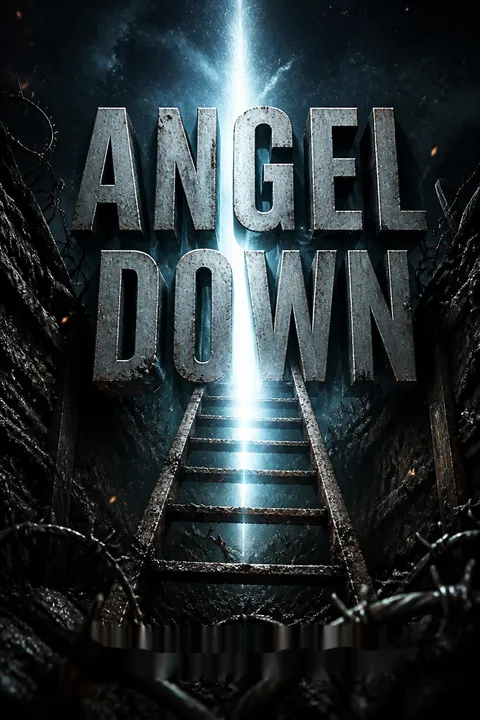
Fifty yards out, a column of white light six feet wide pierces the smoke and rises endlessly from the ground. At its base, tangled in concertina wire, lies a woman in a red dress and blue cape,3 her skin cascading with radiance. She is the shrieker.
Bagger1 and Arno2 hack the wire while machine guns rake the thorns around them. When Bagger1 lifts her, the light tilts with her body. The October chill softens to warmth. The slaughterhouse reek turns to a bakery sweetness. Arno2 weeps. Something like gallantry ignites in Bagger's1 chest.
The Vulture Halved
Arno2 throws the blue cape's hood over the angel's3 face, dousing her glow just as German bullets saw through the wire. Bagger1 runs for the trench while Arno2 fires covering shots.
A mortar drops directly on them — but instead of obliteration, Bagger1 feels himself pinched by the scruff and lifted ten feet into the air, dangled alongside the angel,3 then tossed safely into the trench as the shell detonates behind them. The miracle stuns the remaining men. Veck5 identifies the woman as an angel, citing the legend of the Angel of Mons.
Goodspeed7 sees profit. Before anyone can agree on a plan, the scavenger snatches the angel,3 climbs the only ladder, pulls it up behind him, and peels back her hood — exposing her halo to the German gunners. The shell that follows cuts Vincent Goodspeed7 cleanly in half.
Lucky Strikes and Raised Kittens
The four survivors flee through the trench system into the Argonne timber, taking turns carrying the angel3 as they search for their division. Each man holds her differently — Popkin6 with lascivious hunger, Veck5 protectively beneath his severed horse-head mask, Arno2 curled against her side like a child — and each grows possessive with every impossible gift she produces.
When Popkin6 craves tobacco, a pristine pack of Lucky Strikes materializes on a rock. When a nail pierces Arno's2 boot, the wound beneath vanishes. When Veck5 finds a litter of dead kittens, one wobbles back to life.
But when Popkin6 kills a field mouse for food, silent tears roll down the angel's3 face. They camp under an abandoned French howitzer. Bagger1 reads The Son of Tarzan by the angel's light until Arno2 falls asleep against her side — then realizes his father's Bible is lost, left behind in the trench.
Popkin's Bayonet, Bagger's Fists
Bagger1 wakes to Arno2 bleeding from the throat — Popkin6 has bayoneted the boy, stolen the angel,3 and fled. Bagger1 presses a gunnysack to the wound, leaves Veck5 applying pressure, and sprints after bootprints through the mud.
He tracks Popkin6 to a destroyed village where the brute has stripped the angel3 naked inside a wrecked ambulance, convinced she is Effie,9 the girl whose teasing letters have driven him to obsession. When a starving old villager runs toward the angel's glow, Popkin6 shoots him without hesitation. Bagger1 tackles Popkin.6
The brawl is savage — bitten scalps, gouged eyes, cracked ribs. Bagger1 sees rainbows formed by the angel's light through rain, and fights with the feral precision of a gaffed gamecock, luring Popkin6 against a freestanding jail wall. The brute batters the masonry until it tips forward and buries him in brick.
Nine Words Destroy Veck
Bagger1 wakes behind a wrecked German tank to find Veck5 eating a charred pigeon. Arno2 is dead — Veck5 confirms with only a stare. Then he produces a field message found in the boy's clothing: Reis's4 handwritten addendum in elegant cursive, nine words revealing the major general never valued Veck,5 only resented being sent a Black soldier.
The pride that sustained him through weeks of hostility in the white division evaporates. He strips naked, smears chemical-protection paste on his body, handcuffs Bagger1 to the tank with the key just out of reach, and carries the angel3 into a gas-poisoned field.
Dissolving from exposure, he demands the angel3 end the world. She responds by raising two hundred corpses into the air like marionettes — showing Veck5 his apocalypse has already arrived. His flamethrower punctures and detonates.
The Wager for Arno's Life
The angel3 appears to Bagger1 in her true form — a monstrous shape with saucer-wide eyes and an aardvark trunk, mimicking his gas mask. When he tears the mask off, she peels away the monster face and reshapes into the familiar woman.
For the first time she speaks, delivering the ancient angelic greeting: do not be afraid. She explains that each man saw the person he most needed — Veck5 his daughter Naomi, Popkin6 his Effie,9 Goodspeed7 the movie star Theda Bara, Arno2 a mother. Each wish became the instrument of its maker's death.
Bagger,1 she notes, is the only one who asked nothing of her. She offers a wager: Arno's2 life in exchange for a vow never to take another human life. If Bagger1 breaks this promise, a catastrophe beyond imagination will consume the world. He accepts. She kisses his blighted lips.
Arno Returns Whistling
Lewis Arno2 sits on the wrecked tank twirling a handcuff key and whistling a marching tune. The angel3 rests against his legs with a conspiratorial look. The wound on Arno's2 neck is ugly but sealed with fresh skin — a fatal gash reduced to nothing.
The kid complains that Bagger's1 made-up ending to The Son of Tarzan makes no sense; Tarzan would sacrifice himself for Korak, not fight his own son. Arno2 has somehow recovered both the novel and the red leather Bible from the wreckage.
Bagger1 opens the Bible and discovers three bullet holes drilled through its back cover — rounds that would have killed him in No Man's Land, stopped by his dead father's book.8 He turns away fast to hide tears, the con man undone by a grace he cannot swindle or explain.
Reis Waltzes with Minerva
Bagger1 carries the angel3 into Reis's4 dugout, certain that military leadership will use her to end the conflict. Reis4 sees not a celestial being but Minerva — the goddess of war embossed on the Medal of Honor he craves. He exposes his withered arm and begs for it to be made whole.
Bagger1 pleads with the angel,3 who complies in a grotesque surgical miracle: bones unsheathe, muscles reweave, skin fuses smooth. With two working arms for the first time in his life, Reis4 waltzes the angel3 across the dugout, declaring her his wonder weapon.
His plan is not to end the war but to prolong it — years more of slaughter until he alone deploys the angel,3 saves the world, and claims his medal. He locks her in a trunk and dismisses Bagger.1 The gravedigger realizes he has delivered a miracle to a tyrant.
Rochambeau's True Body Count
Germans attack at dawn. Bagger1 gets swept into the bloodlust, seizes a Browning automatic rifle, and nearly opens fire — but Arno2 tackles him in the trench and slaps sense back into him, screaming about the promise to the angel.3
The reminder detonates a deeper revelation: the Rochambeau game was not just a contest. Bagger1 beat Goodspeed7 with scissors — and Goodspeed7 was scissored by shrapnel. He beat Popkin6 with rock — and Popkin6 was crushed beneath a falling wall. He beat Veck5 with paper — and Veck5 perished after finding Reis's4 paper note.
The angel3 had interpreted each winning symbol as a direct order to execute the loser in kind. Bagger1 was the hand holding the sword all along. Arno2 screams that they must rescue the angel3 from Reis4 before she becomes a weapon aimed at the world.
The Bullet in the Temple
They fight through shellfire to Reis's4 collapsing dugout. Bagger1 kicks open the trunk holding the angel.3 Reis4 attacks with his walking stick, smashing Bagger's1 cheekbone, breaking three fingers, destroying his left eye. As Arno2 takes brutal blows defending the angel,3 time freezes.
The angel3 carries Bagger1 into a vision — his father's8 church, where he recognizes her face: the Virgin Mary from Raphael's Solly Madonna, the painting he stared at as a boy in the Bishop's Bible. She reveals Earth's core as an infernal engine recycling corpses into ammunition.
When time resumes, Bagger1 shoots Reis4 through the skull with the man's own pistol, shattering his vow. He presses the barrel to his own temple — but the bullet hangs motionless a hair from his eye. The angel3 plucks it from the air and cradles it like a newborn.
Old Man Bagger's Tree
The angel3 strides through battle and plants the bullet in No Man's Land's yellow clay. Bagger1 glimpses the future: decades of regrowth, the Argonne restored to forest, a magnificent tree spreading where the round took root.
An old one-eyed man — himself — touches the bark, whispers the angel3 was right about everything, and smiles across a face mapped by a long life. He regrets nothing. In the present, the angel's3 body ruptures its garments. Dark scuted skin, twin spines splitting into vast bat wings of black bone and red-leather membrane, obsidian horns crowning the skull where a halo once glowed.
She ascends and vanishes. In a crater, Bagger1 holds Arno's2 hand and feels his dead father's8 invisible grip close around his ruined one. The shamefly buzzes free through the hole in his cheek. The story's final word loops back to its first — and Cyril Bagger1 considers himself lucky.
Analysis
Angel Down operates as a sustained interrogation of the relationship between violence and devotion, deploying the Western Front not as a setting for conventional war fiction but as a laboratory for testing what happens when the sacred is discovered in the most profane landscape on Earth. Daniel Kraus structures the entire novel as essentially one breathless sentence — almost no periods, only commas and conjunctions — creating a rhythm that mimics both the relentlessness of trench warfare and the unbroken chain of human violence the angel3 ultimately reveals.
Each soldier's encounter with the angel3 functions as a projective test: Goodspeed7 sees a commodity to exploit, Popkin6 sees a body to possess, Veck5 sees a mechanism for racial justice, Arno2 sees the maternal love he was denied. Only Bagger,1 who has spent his life wanting nothing he could not steal, discovers that his deepest need is the most fundamentally human — to protect something beyond himself, as his father8 once protected him through a Bible he never bothered to read.
The Rochambeau revelation is the novel's most devastating structural achievement: what reads initially as a tension-building game sequence is retroactively exposed as the mechanism by which Bagger1 unknowingly ordered three executions, each death matching the symbol that defeated the victim. This transforms a children's game into a parable about how seemingly insignificant choices — a hand gesture, a political vote, a draft card signed under duress — propagate lethal consequences through systems designed to convert human agency into mechanical slaughter.
The circular ending — the final line looping back to the first — constitutes Kraus's deepest argument. The story rejects the linear narrative of progress that war propaganda requires. The angel's3 vision of Earth's core as an engine converting corpses into bullets indicts not any particular war but the industrial logic that makes each conflict feedstock for the next. Bagger's1 only available resistance is not the coward's refusal to fight but the far costlier refusal to kill — a distinction the novel insists is the difference between selfishness and sacrifice.
Review Summary
Angel Down by Daniel Kraus receives overwhelmingly positive reviews (4/5 overall) for its ambitious structure—written as one continuous sentence with paragraphs beginning with "and." Readers praise the visceral, atmospheric WWI setting where soldiers discover a fallen angel on the battlefield. The experimental format effectively conveys war's relentless horror. Many call it a literary masterpiece comparable to All Quiet on the Western Front, highlighting Kraus's exceptional prose and character development of protagonist Cyril Bagger. However, some readers found the run-on sentence style exhausting or gimmicky, and the graphic violence overwhelming.
Characters
Cyril Bagger
Con man turned gravediggerA Mississippi riverboat con man drafted into the U.S. Army, Bagger has spent the war avoiding combat through elaborate schemes—rigging card games so indebted soldiers fight in his place, cultivating burial-duty assignments where bullets cannot reach. His father8, a preacher who drowned on the Lusitania, haunts him as a shamefly trapped in his chest—a guilt he cannot silence. Bagger's cynicism masks a man terrified of connection: he reads adventure novels aloud to a boy2 he pretends not to love, carries a Bible he refuses to open, and guards his selfishness like a second religion. What sets him apart is not courage but a gambler's talent for reading people—a skill honed in card dens that becomes, against every instinct, a gateway to empathy.
Lewis Arno
The boy who joined for familyA fourteen-year-old who lied about his age to enlist, Arno is an illiterate orphan who sought in the Army what orphanages never provided: adventure, belonging, and family. He attaches himself to Bagger1 with a stray puppy's persistence, badgering the con man to read dime novels aloud each night—a ritual that becomes both men's lifeline. His smallness makes him nearly impossible for German guns to hit, but his emotional openness leaves him vulnerable to everything else. Arno's instinct for devotion—curling into the angel3 like a child reaching for a mother, defending Bagger's1 promises when Bagger1 himself forgets—functions as the story's moral compass, a simplicity that consistently outmaneuvers the adults' sophistication.
The Angel
The being each man needsFound tangled in barbed wire over No Man's Land, radiating a tower of white light from her skin, the angel appears as a beautiful woman in a red dress and blue cape. She does not walk or speak for most of the story and reveals no personal will. Yet she is far from passive: she reflects back to each soldier the face of whoever he most desperately needs—a daughter, a lover, a mother, a celebrity. Her miracles are real but double-edged, for she operates not on her own judgment but as an instrument wielded by whoever claims her. Neither benevolent guardian nor malevolent destroyer in any conventional sense, she is an Adversary whose apparent helplessness makes her the most dangerous presence in the story—capable of wonders or devastation depending on the hand that holds her.
Major General Lyon Reis
The butcher seeking his medalThe youngest division commander in the American Expeditionary Force, Reis compensates for a withered right arm with a manicured Van Dyke beard, an ivory trench coat, and a refusal to rotate his men from the front line. His uniform bears three medals arranged with a deliberate gap—space reserved for the Medal of Honor he considers his birthright. He forces the 43rd into suicidal frontal assaults and has chosen their nickname: the Butcher Birds, after the shrike that impales prey on thorns. His favorite word is élan. Beneath the martinet posture lies a man whose entire identity has been constructed to overcome his physical deficiency, making him psychologically transparent yet utterly unpredictable—a leader whose ambition has been sharpened by a lifetime of compensating for the body that betrayed him at birth.
Ben Veck
Shell-shocked flame operatorA Black soldier from the all-Negro 368th Regiment, reassigned to the white 43rd Division as a solo flamethrower operator. Veck's perpetual trembling marks severe shell shock from his regiment's betrayal, when they were pushed into unshelled woods without maps or wire cutters. His sustaining belief—that Reis4 specifically chose him—provides the fragile pride holding his fractured psyche together. Beneath the shakes lies quiet dignity and surprising moral clarity.
Hugh Popkin
The brute who craves loveA massive, slow soldier whose imposing body conceals a child's emotional architecture. His chemical-scarred scalp and rotting teeth mask an aching romantic desperation—his letters to Effie Inez Barbeau9 reveal a man whose only experience of love is humiliation. Violence is his sole fluency, directed without discrimination at anyone between him and what he wants. His obsessiveness makes him dangerous in ways his low intellect cannot predict.
Vincent Goodspeed
The battlefield scavengerA meticulous opportunist who stops mid-charge to clean his boots while comrades die. Behind steel-rimmed pince-nez gleams the cold calculus of a man who sees every object, living or dead, as merchandise. He robs battlefields and trades with Germans for profit. His cleanliness amid universal filth is his most unsettling quality—a vulture who preens between meals.
Bishop Bernard Bagger
The drowned preacher fatherBagger's1 father, a preacher who lost his congregation by pursuing theological truth over comfortable fellowship. After his wife died giving birth to Cyril1, the Bishop retreated into Hebrew scholarship and apocalyptic sermons. He drowned on the Lusitania in 1915, having booked passage to minister to soldiers in hopes of restoring his wavering faith. His red leather Bible—pressed into his reluctant son's hands before departure—becomes the story's most enduring talisman.
Effie Inez Barbeau
Popkin's tormenting sweetheartPopkin's6 obsession back home, whose playful letters about dating other boys drive the brute to jealous madness from four thousand miles away. She demanded a fighting man yet refuses to say she loves one.
Marie-Louise
Bagger's Vosges comfortA French prostitute whose rosewater perfume and red hair represent Bagger's1 sole experience of wartime tenderness—comfort he held at arm's length to avoid anything resembling love.
Father Muensterman
Company P's cursing chaplainCompany P's chaplain, who vomits into his own cupped hands and warns Bagger1 he will find the devil in No Man's Land—a prophecy that proves far more literal than anyone expects.
Plot Devices
The Red Leather Bible
Paternal talisman of protectionBishop Bagger's8 personal Bible, pressed into Cyril's1 reluctant hands before the Lusitania's final voyage. Bagger1 carries it not for scripture but for the aromatic comfort of its red leather and onionskin pages—the smell of childhood safety. It functions as a physical embodiment of his father's8 protection: the book literally absorbs three German bullets in No Man's Land, its pages stopping rounds that would have killed Bagger1 while he carried the angel3. Its loss midway through the story triggers Bagger's1 deepest despair; its miraculous recovery signals grace. The paintings inside—particularly Raphael's Solly Madonna—provide the visual template the angel3 uses when appearing to Bagger1, connecting father, mother, and divine intermediary in a single sacred object.
Uncle Sam the Shamefly
Embodied guilt and conscienceA housefly that literally flew into Bagger's1 mouth at training camp, inspired by an Uncle Sam recruitment poster resembling his drowned father8. The fly takes permanent residence in Bagger's1 chest as a physical manifestation of inherited shame—guilt over his mother's death in childbirth, his father's8 drowning, and his own refusal to fight or care. Bagger1 has tried to drown it with moonshine, incinerate it with cigarettes, and dope it with opium. The shamefly activates whenever Bagger1 confronts his cowardice, its wings buzzing against his ribs like a conscience he cannot silence. Its eventual departure from his body signals his final release from the shame that has governed his entire adult life.
Rochambeau
Death dressed as child's playThe children's game of rock-paper-scissors that Bagger1 mastered in his father's8 church pews, using psychological profiling to predict opponents' choices. In Bois de Fays, the five soldiers use it to determine who must crawl into No Man's Land alone. Bagger1 rigs his victories through expertise, but the game operates on a level he cannot foresee: the angel3 interprets each winning symbol as an execution order matched to method. Goodspeed7, defeated by scissors, is scissored by shrapnel. Popkin6, defeated by rock, is crushed by a falling wall. Veck5, defeated by paper, is destroyed after finding a paper note. The game transforms from a con man's trick into the story's most devastating mechanism—a child's amusement channeling divine violence through the hand of an unwitting executioner.
The Son of Tarzan
Fatherhood parable in pulp formEdgar Rice Burroughs' novel about Tarzan's civilized son who follows his father into the jungle to become Korak the Killer. Bagger1 reads it aloud to the illiterate Arno2 each night, inserting crude fabrications to amuse himself. The book functions as an allegory for Bagger1 and Arno's2 relationship—Tarzan the reluctant protector, Korak the fearless child—and its central question of whether a father must sacrifice himself for his son echoes through every turning point. When Bagger1 invents a false ending in which Tarzan kills Korak, Arno2 later rejects it, intuiting that Tarzan would give his own life instead. The novel's physical survival—burned, bloodied, passed between soldiers—mirrors the persistence of storytelling as a survival mechanism amid annihilation.
The Angel's Light and Halo
Beacon and target at onceThe angel's3 exposed skin emits blinding white light capable of illuminating trenches, rendering flesh translucent, and forming a pillar visible for miles. A golden halo floats above her uncovered head. This radiance functions as both miracle and weapon: it warms and heals those nearby but serves simultaneously as a beacon for German artillery, making the angel3 the most precious and most dangerous object on the battlefield. The blue cape and red dress conceal the light when the hood is raised, creating a dynamic of revelation and concealment that mirrors the story's theological questions about whether divine presence helps or harms humanity. The fatal error of uncovering the light at the wrong moment drives the first major death7 in the story.
Download PDF
Download EPUB
.epub digital book format is ideal for reading ebooks on phones, tablets, and e-readers.








































