
Key Takeaways
1. The Claude Neal Lynching: A "Classic" American Tragedy
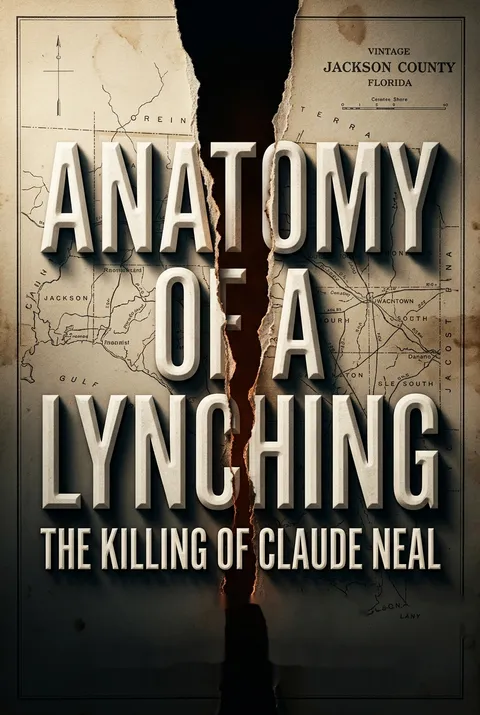
In Anatomy of a Lynching, first published in 1982, historian James R. McGovern (1928-2012) called the killing of Neal “one of America’s last ‘classic lynchings’” (15).
A defining event. The brutal lynching of Claude Neal in October 1934, in Jackson County, Florida, was a pivotal moment in American history, shocking the nation with its unfathomable cruelty and challenging the widespread belief that mob justice was fading from the Deep South. Neal, a 23-year-old black farm laborer, was accused of raping and murdering Lola Cannidy, a young white woman, an accusation that ignited a firestorm of racial hatred and vigilante action.
Elements of classic lynching. The Neal case embodied nearly every horrific element associated with the practice of lynching in the first half of the twentieth century. These included:
- A black male victim accused of a sexual crime against a white female.
- Abduction from jail with minimal resistance from law enforcement.
- Prolonged torture before death.
- Broad approval from the white community.
- Impunity for the murderers.
- Public display and mutilation of the corpse, with photographs sold as souvenirs.
Catalyst for change. While the actual murder wasn't a "spectacle lynching" in the literal sense, the widespread advance notice through newspapers and radio, coupled with the collective mutilation of Neal's body, made it a profoundly public event. This incident, condemned by NAACP spokesman Walter White as "one of the most bestial crimes ever committed by a mob," served as a powerful catalyst, accelerating the demise of lynching as a public ritual in the United States.
2. Roots of Lynch Law: Caste, Poverty, and Fear
The American practice of lynching blacks, while sometimes employed in the antebellum South, became a systematic feature of race relations after 1865.
Reassertion of authority. Lynching became a systematic tool for southern whites to reassert dominance over blacks after Reconstruction, particularly between 1865 and 1900. This period saw a desperate need to "teach blacks their place," ensuring obedience to white employers and suppressing any perceived sexual impulses toward white women, often reinforced by literature depicting blacks as bestial.
Socioeconomic drivers. Lynchings were more prevalent in impoverished, rural southern counties, especially those with tenuous social relations where blacks constituted less than a quarter of the population. These areas, often adhering to frontier ethics, favored vigilante justice over formal legal procedures, a tendency exacerbated by:
- Understaffed and inadequate law enforcement.
- Poor communications and roads.
- Economic depressions, particularly in the cotton market.
Caste and gender gains. Lynching served to maintain white supremacy by conferring significant caste advantages. It ensured cheap black labor, sexual access to black women, and enforced deference, while preventing miscegenation between black men and white women. The "rape mythology"—portraying white women as pure and black men as depraved—justified brutal reprisals, even though the actual threat of black-on-white rape was disproportionately exaggerated compared to the white male's obsessive vigilance.
3. Jackson County: A Microcosm of Southern Violence
Jackson County, Florida, where Claude Neal grew up and lived, was prone to the lynching of blacks.
A history of racial turbulence. Jackson County, Florida, Claude Neal's home, was a region steeped in racial conflict, boasting one of the highest lynching rates in Florida, a state already leading the nation in lynchings relative to its black population. This history was deeply rooted in its antebellum past as a cotton plantation area and further inflamed by the trauma of a Civil War battle where black Union soldiers defeated local Confederates.
Frontier justice and lawlessness. The county's slow economic development and rural isolation perpetuated a frontier mentality, where citizens felt a moral right to take justice into their own hands. This individualism often manifested as contempt for formal laws, widespread gun ownership, and frequent acts of violence for trivial reasons. The inadequate number of county police officers further invited lawlessness and vigilante action, creating an environment where personal strength or social connections were paramount for survival.
Depression-era tensions. The Great Depression intensified social tensions, leading to devastating farm income losses and widespread unemployment. New Deal policies, while offering relief, also created resentment among poor whites who felt federal programs undermined their social standing or competed with them for jobs. This volatile mix of economic hardship, racial prejudice, and a tradition of lawlessness created an ominous backdrop, making the county ripe for mob violence against blacks.
4. The Suspect and the Mob: A Swift, Unjust Pursuit
The evidence against Neal was not fully convincing, though it was sufficient to make him a prime suspect.
Flimsy evidence, swift accusation. Following the discovery of Lola Cannidy's mutilated body, Claude Neal was quickly arrested based on circumstantial evidence: a piece of cloth found near the body, alleged bloody clothes, and unexplained cuts on his hands. Despite the lack of conclusive proof—no fingerprints on the murder weapon, and conflicting accounts of his injuries—the coroner's jury swiftly charged Neal, his mother, and aunt, fueled by the community's outrage and preconceived notions of black guilt.
Doubts and alternative theories. The official narrative was immediately questioned by the black community and later by an NAACP investigator, Howard Kester. Kester's report suggested a possible illicit sexual relationship between Neal and Cannidy, with Neal killing her in a fit of rage after she threatened to expose him. Rumors also circulated among blacks that a white man was the true murderer, who then paid Neal's mother to wash his bloodied clothes, a theory dismissed by authorities but persistent in black oral history.
Mob's relentless pursuit. Even before Neal's confession, a furious mob formed, relentlessly pursuing him through multiple jails across northwest Florida and into Alabama. Despite efforts by some sheriffs to protect him, the mob's determination, combined with leaked information and apparent sympathy from some law enforcement officials, led them to Brewton, Alabama. Neal's eventual confession, possibly coerced and later recanted, sealed his fate, as he resigned himself to death, whether by electric chair or mob.
5. The Spectacle of Vengeance: Torture, Mutilation, and Public Display
“After taking the nigger to the woods about four miles from Greenwood, they cut off his penis. He was made to eat it. Then they cut off his testicles and made him eat them and say he liked it.”
A pre-announced horror. The lynch mob, confident in community approval, publicly announced their intentions through local newspapers and radio, inviting thousands to witness Neal's "extra-legal vengeance." A carnival-like atmosphere enveloped the Cannidy farm, with bonfires, armed spectators, and demands for souvenirs from Neal's body. Despite the leaders' fears of losing control of the unruly crowd, the promise of brutal retribution was clear.
Unspeakable torture. Neal was subjected to hours of unimaginable torture in the woods:
- Castration, with his genitals forced into his mouth.
- Slicing of his sides and stomach with knives.
- Severing of fingers and toes.
- Burning with red-hot irons.
- Repeated near-choking by hanging him from a tree limb.
Remarkably, Neal maintained composure, even asking for a cigarette, dying without remorse or protest.
Post-mortem desecration. After Neal's death, his body was dragged to the Cannidy home, where the family and crowd further mutilated it with knives and bullets. Children, some mere tots, reportedly waited with sharpened sticks to drive into his flesh. His nude, disfigured corpse was then dragged to the Jackson County courthouse square and hanged from a tree for public display, with photographers capturing hundreds of images that were later sold as souvenirs.
6. Local Acquiescence vs. National Outcry
“Nobody stood up and said it should not have happened.”
Local justification and denial. In the immediate aftermath, Jackson County officials and many residents preferred to gloss over the lynching, accepting it as a "righteous act" or an inevitable consequence of Neal's alleged crime. Mayor Burton blamed "out-of-town agitators" for the subsequent riots, while State's Attorney John H. Carter, though deploring the manner of death, conceded that "civil institutions must be greatly strengthened before they will supplant the lynching evil." The local grand jury, in a shocking move, exonerated the lynchers and affirmed Neal's guilt.
Silence and fear. The pervasive fear among local blacks, coupled with their desire to maintain peace, led them to publicly disavow Neal and plead for mercy for the "good colored people." Ministers, churches, and local newspapers largely remained silent or actively supported the mob's actions, reflecting a community where the will to prosecute lynchers was absent, and social unrest was a greater concern than justice for a black man.
National condemnation. In stark contrast, national newspapers and organizations erupted in outrage. Editorials across the country condemned Florida's lax laws and ineffectual response, with some sarcastically suggesting Florida exploit lynchings as a tourist attraction. Governor David Sholtz was deluged with over a hundred telegrams and letters, mostly from small organizations and distinguished figures, demanding prosecution and denouncing the state's failure to prevent the advertised lynching.
7. Federal Inaction and Political Calculation
“If I come out for the anti-lynching bill now, they will block every bill I ask Congress to pass to keep America from collapsing. I just can’t take that risk.”
A missed federal opportunity. The Claude Neal lynching occurred just after the failure of the Wagner-Costigan Bill of 1934, a proposed federal anti-lynching law. Walter White of the NAACP immediately pressed Attorney General Homer Cummings to apply the Lindbergh Act (kidnapping) to Neal's interstate abduction. However, Cummings, prioritizing the New Deal's broader anti-crime program and fearing a collision with the powerful Southern bloc in Congress, refused, interpreting the act's "or otherwise" clause narrowly to exclude lynching.
Roosevelt's political tightrope. President Franklin D. Roosevelt, while personally abhorring lynching and supporting anti-lynching legislation, faced a critical political dilemma. The "First Hundred Days" of New Deal unity had passed, and he needed Southern Democratic support to pass his ambitious legislative agenda, including crucial social and economic reforms. Direct intervention on the anti-lynching bill risked alienating powerful Southern committee chairs and derailing his entire program.
Eleanor Roosevelt's limited influence. Walter White extensively lobbied Eleanor Roosevelt, who was sympathetic to the cause and acted as an intermediary with the President. While she conveyed White's concerns and expressed hope for the bill's passage, FDR ultimately prioritized his legislative agenda. His famous quote to White—"If I come out for the anti-lynching bill now, they will block every bill I ask Congress to pass to keep America from collapsing. I just can’t take that risk"—underscored the political calculations that prevented federal intervention.
8. The NAACP's Strategic Campaign: Exposing the Horror
This explains why the editor of the Jackson County Floridan found it necessary to justify the action taken against Neal as his locale came under attack by the national press and why Mayor Burton, who sought the economic development of Marianna, was forced to implore Pathe News not to show films of the riot.
Mobilizing public outrage. Walter White, deeply affected by the Neal lynching, saw it as a potential "Dreyfus case" for the anti-lynching movement. He swiftly mobilized the NAACP, telegramming news services, radio commentators, and NAACP branches to publicize the gruesome details. His immediate goal was to pressure the Justice Department and Congress, and to secure the Wagner-Costigan Bill's inclusion in FDR's "Must Program."
The Kester Report's impact. White commissioned Howard "Buck" Kester, a courageous white social reformer, to investigate the lynching. Kester's detailed, sixteen-page report, describing the "sheer sadism and abnormal cruelty," became a powerful propaganda tool. The NAACP distributed thousands of copies nationwide, sending them to congressmen, ministers, and editors, aiming to "stir thoughtful Americans to action" and expose the horrors to a broad audience.
Art as activism. White also organized the "Art Commentary on Lynching" exhibit in New York, featuring works by prominent artists like George Bellows and Reginald Marsh, with some directly inspired by Neal's fate. This exhibit, though politically sensitive for figures like Eleanor Roosevelt, aimed to visually shock the public. Despite the Wagner-Costigan Bill ultimately failing due to a Southern filibuster, the NAACP's relentless campaign, fueled by the Neal case, significantly raised national awareness and laid crucial groundwork for future civil rights efforts.
9. The Decline of Public Lynching: A Shift in National Conscience
After 1935, the era of lynchings in the form of public murder of blacks with attendant rituals came rapidly to an end in America.
A rapid demise. Following 1935, the practice of public lynchings, characterized by mob participation and gruesome rituals, rapidly declined. While acts of terror against blacks continued, they largely shifted to clandestine murders, lacking the public spectacle that defined earlier lynchings. This swift change, after decades of entrenched practice, was a striking development, with the Claude Neal case serving as a significant catalyst.
Modernity and exposure. Modern technology, including news services, photography, and improved travel for reporters, stripped lynchers of their anonymity. The national media's extensive coverage and condemnation of the Neal lynching created a powerful deterrent, forcing local communities like Jackson County to outwardly comply with national norms due to fear of embarrassment and negative economic impact, particularly on tourism.
Shifting Southern attitudes and federal action. A growing number of Southerners, including state officials, became increasingly sensitive to the moral evil of public lynchings, leading to increased editorial condemnation and support for federal anti-lynching laws. The federal government, under the New Deal, also began to exert its influence, with presidential support, repeated legislative attempts, and the establishment of the Civil Rights Section in the Justice Department. These combined forces, alongside urbanization, the logic of fighting fascism, and the eventual rise of black political power, ultimately led to the passage of the Civil Rights Act of 1968, outlawing mob violence.
10. The Psychology of Violence: Power Without Opposition
Men become violent when they feel justified to do so and when they do not meet effective opposition to their pretensions.
Dehumanization as justification. The dehumanization of Claude Neal, from his denial of legal rights to his brutal death, was rooted in centuries of white supremacy and debasing stereotypes of blacks as inferior, ignorant, and sexually predatory. These negative images served to justify violence, particularly the "call to arms" against alleged black male sexual aggression toward white women, which was often a projection of white anxieties and a tool for caste control.
The impunity of power. The persistence of lynching, even after white dominance was firmly re-established, stemmed not merely from fear but from the "fearlessness" of whites who knew they could act with impunity. This unlimited power, unchecked by effective opposition from blacks or civil authority, emboldened lynchers. This dynamic parallels other forms of human destructiveness:
- Holocaust: Eichmann's "banality of evil" and the lack of external opposition to Nazi atrocities.
- Rape: Perpetrators emboldened by the victim's perceived helplessness and low conviction rates.
- Child Abuse: Abusers, often victims themselves, displace aggression on defenseless children with little fear of punishment.
The will to resist. The core hypothesis is that violence flourishes when perpetrators feel justified and face no effective opposition. The decline of lynching, therefore, offers a powerful lesson: when victims or their allies become aware of their plight and actively organize defense through self-defense, exposure of injustice, and governmental intervention, the "will to power" of the aggressor can be effectively challenged and ultimately curtailed.
People Also Read

Download PDF
Download EPUB
.epub digital book format is ideal for reading ebooks on phones, tablets, and e-readers.








































