
Key Takeaways
1. Understand the "Craziness": People's irrationality is predictable.
The secret to preserving your sanity lies in how well you understand the craziness going on around you.
Deciphering behavior. Many workplace frustrations stem from people acting irrationally. Instead of being confused, recognize that these "crazy" behaviors, like all human actions, follow predictable patterns. These patterns are often not rational in terms of efficiency but make sense from the individual's internal perspective.
Unconscious drivers. People's motivations are layered, from primal instincts (fight/flight, dominance) to learned habits and filtered perceptions. They often act on these unconscious drivers without realizing it. Your goal isn't to control their behavior, but to understand its source to choose your response wisely.
Strategic response. By understanding these underlying patterns, you gain power. You can choose not to participate in destructive "dances" and prevent situations from escalating. This conscious choice in your internal thoughts and external actions is crucial for maintaining your sanity and effectiveness.
2. Navigate Deception: Lies and bullshit are workplace constants.
AT WORK, people who say what they mean and mean what they say are almost as rare as spotted owls.
Varieties of untruths. The workplace is rife with various forms of dishonesty, from Chris's blatant sales "bullshit" to Joey's "dog-ate-my-homework" excuses, Byron's pathological lying, Janelle's self-deception, and even high-power motivational "bullshit." Each type requires a different approach.
Protect yourself. Confronting liars rarely works; it often backfires. Instead, focus on minimizing damage to yourself. Strategies include: knowing your goal, "backfilling" to correct misinformation, identifying patterns, getting out of the middle of conflicts, and using the "Jewish Mother" strategy (guilt with food, telling everyone, gentle nagging).
Spotting deception. Trust your gut feeling when something seems off. Liars often focus on big events, slipping on details, and their non-verbal cues might be incongruent. For pathological liars, suspect everything they say, and if harm is being done, use firsthand evidence to inform those in power, never accusing directly.
3. Master Emotional Self-Control: Override your "autopilot" in conflicts.
The secret to staying sane in a dysfunctional workplace is to make rational choices about your own thoughts and actions even when the people around you are not making rational choices about theirs.
Recognize arousal. In emotional situations, your brain's "autopilot" (oldest, best-learned responses) tends to take over, often leading to poor choices like fighting or fleeing. Recognize physiological arousal (thumping heart, tight muscles) or repetitive thinking as cues to disengage autopilot.
Strategic delay. When confronted, slow down. Ask for time to think. Your immediate response is usually wrong. Define a realistic goal (e.g., calming the person for rational discussion, not "winning"). Never try to reason with someone who is yelling; wait for them to stop.
Defuse anger. Avoid explanations, as they often sound like counterattacks. Instead, ask, "What would you like me to do?" This forces the angry person to think and shifts focus to problem-solving. Staying calm while others are agitated makes you appear in control and often leads them to self-sabotage.
4. Decipher Unwritten Rules: They dictate success more than formal policies.
In every business, there are unwritten rules that are that are more important than anything you will find on paper or on your computer screen.
Invisible guidelines. Every company operates by unwritten rules, often more powerful than official policies. These rules are rarely articulated but are learned by observing what gets rewarded, punished, or ignored. "Please your boss" is often the foundational unwritten rule.
Observing success. To understand these rules, watch successful people's actions, not just their words. Corporate myths and stories shared around the watercooler also reveal deep-seated beliefs about how things "really are" in the company.
Strategic compliance. Unwritten rules can cover everything from work-life balance and quality standards to acceptable demeanor and political engagement. Your success and sanity depend on discerning these rules and deciding whether to follow them. If they conflict with your ethics, it might be time to seek a different environment.
5. Cultivate "People Skills": They are a competitive sport, not optional.
The grim fact of it is: people skills is a competitive sport, and we’re losing. To girls.
Beyond competence. Many professionals, especially men, undervalue "people skills," dismissing them as "horseshit" or "sugar-coating." However, these skills—making others feel heard, understood, and valued—are crucial for success in any field beyond mere technical competence.
Essential workout. Developing people skills requires conscious effort. Key exercises include: active listening (repeating back what's said), making small talk (showing interest), using praise (four compliments for every criticism), remembering names and conversations, being tactful (thinking before speaking), validating problems before offering advice, and showing empathy.
Competitive advantage. Mastering these skills allows you to influence customers and coworkers effectively. It's about building rapport and demonstrating value beyond your job description. Neglecting them means losing out to those who prioritize interpersonal effectiveness.
6. Embrace Self-Promotion: It's a necessary skill, not conceit.
The first step in promoting yourself well is realizing that it isn’t a bad thing to do, only difficult.
Overcoming reluctance. Many people, especially those who pride themselves on humility, struggle with self-promotion, viewing it as conceited or "sucking up." This internal conflict can hinder career advancement, as opportunities rarely come to those who wait silently.
Strategic self-advocacy. Effective self-promotion isn't about boasting or putting others down. It's about strategically communicating your value. This involves: asking for what you want, being positive and enthusiastic, complimenting others to show interest, and telling concise stories that highlight your past successes and lessons learned.
Practice makes perfect. These skills don't come naturally; they require practice and rehearsal, much like acting. Overcome self-doubt by preparing your "legend" and practicing how to present yourself and your accomplishments in a compelling, yet not arrogant, manner.
7. Seek Challenge, Avoid Boredom: Growth happens outside your comfort zone.
If we don’t take the scary road once in a while by choosing to do things that are frightening or challenging, our minds become dull, sluggish, and prone to depression.
The crossroads of life. We constantly face a choice between the "scary" path of growth and the "boring" road of stagnation. Opting for comfort, even if it leads to misery, prevents personal and professional development.
Mind's vitality. Your mind, like a high-performance engine, needs challenges to stay sharp. If you only do easy, repetitive tasks, it will become sluggish. Seek out what is difficult or frightening, whether in your job, hobbies, or relationships, to stimulate growth and prevent depression.
Proactive engagement. Don't wait for challenges to be handed to you. Look for opportunities in the very things you complain about. If you avoid "politics" or "difficult conversations," those are precisely the areas where you can develop new skills and influence your environment positively.
8. Abandon Blame: Learn from mistakes, don't punish them.
If blame is the answer, you’re asking the wrong question.
The blame game. When problems arise, the default human response is often to seek someone to blame. This primitive instinct, equating punishment with problem-solving, is counterproductive in the workplace, fostering paranoia and a culture of "covering your ass."
Focus on solutions. Blaming diverts energy from actual problem-solving and prevents learning. Instead of asking "Whose fault is it?", ask "What can be done about it?" This shifts the focus from retribution to constructive action.
Embrace learning. Mistakes are invaluable learning opportunities. Admit your own mistakes, understand the underlying misperceptions that led to them, and create a plan to fix them. By modeling this behavior, you can subtly influence your workplace culture away from blame and towards growth.
9. Recognize Dysfunctional Systems: Identify corporate "elephants" and Theory X.
In a dysfunctional family, therapists say, there’s an elephant—usually a drunken abusive parent—in the parlor, but no one ever mentions it.
Unacknowledged truths. Dysfunctional companies, like families, have "invisible elephants"—problems everyone sees but no one dares to mention, often to protect those in power. Pointing them out directly can be career suicide.
Theory X in disguise. Many organizations, despite espousing modern "Theory Y" principles (trusting workers), still operate under "Theory X" (workers are lazy, need control). This often manifests as closely managed information, tight budgets for bottom-up ideas, and loyalty being valued over ability.
Strategic navigation. To survive, recognize these patterns without openly challenging them. Ask subtle questions to encourage conscious decision-making rather than reflexive secrecy. Understand that managers may be acting out of their own distrust or fear, perpetuating a self-fulfilling prophecy.
10. Manage Career Transitions: Job loss and interviews require strategic action.
Losing a job, even a bad job, is traumatic. Your job is part of your identity; losing it is like losing a piece of yourself. It hurts.
Coping with loss. Job loss is a profound trauma, triggering sadness, fear, and anger. Avoid self-medication (alcohol, mindless distractions) and instead, talk to trusted friends and family. Focus on small, actionable steps rather than feeling overwhelmed by the entire journey.
Effective job searching. Treat finding a job as your new job: set a schedule, dress professionally, and make daily progress reports. Prioritize networking and face-to-face meetings. Write compelling scripts for calls and interviews, highlighting your unique skills and reliability.
Interview mastery. Prepare thoroughly for interviews by researching the company and interviewer, rehearsing answers to common questions, and crafting stories that showcase your strengths. Overdress, arrive early, and project confidence. Ask probing questions and always send a thank-you note.
11. Evolve as a Manager: Balance dilemmas and nurture critical traits.
Managers are people, and as such, they grow, develop, and evolve.
Management Shock Syndrome. New managers often experience isolation and frustration, realizing that their old work buddies now see them as "one of Them." They may feel pressured to adopt old-school, "kick-butt" styles, becoming the authority figures they once resented.
Critical distinctions. Effective management requires understanding key distinctions: problems (solvable) vs. dilemmas (continuously balanced), supervising (organizing tasks) vs. managing (setting priorities), adequacy vs. excellence, product vs. process, sales vs. marketing, hard work vs. important work, delegation vs. task assignment, reverence vs. respect, and cooperating vs. competing.
Nurturing talent. While conformity is easy to manage, truly strong departments need creativity, critical thinking, and initiative. Managers must actively nurture these traits, even if they make things uncomfortable, rather than breeding them out in favor of cheerful compliance.
Review Summary
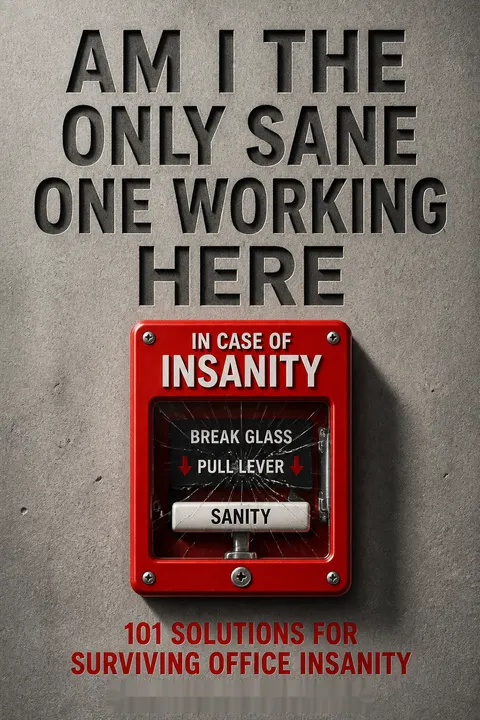
Am I The Only Sane One Working Here receives mixed reviews, averaging 3.66/5. Many praise its practical workplace advice, relatable scenarios, and humorous tone, calling it essential reading for white-collar professionals. Critics, however, find it surface-level, lacking deep research, and relying on platitudes. Several readers noted dated and occasionally offensive remarks — particularly about appearance and gender — as off-putting. Despite these flaws, most agree the book offers useful insights on navigating office dynamics, managing difficult personalities, and understanding workplace behavior.
People Also Read

Download PDF
Download EPUB
.epub digital book format is ideal for reading ebooks on phones, tablets, and e-readers.








































