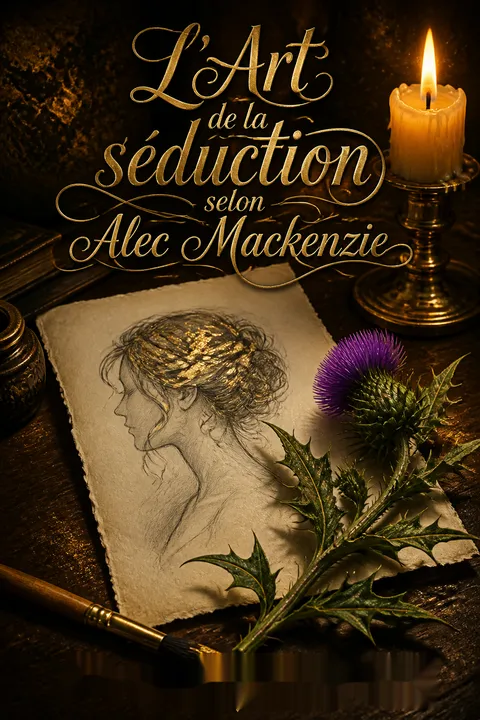

Plot Summary
Secrets in the Attic
In the attic of Kilmorgan Castle, Ian Mackenzie and his wife Beth sift through generations of Mackenzie family papers, journals, and sketches. Their discovery of Alec Mackenzie's sketchbooks and the journals of his wife, Celia, ignites Beth's fascination with their ancestors' dramatic lives. Ian, with his unique memory and perspective, begins to recount the story of Alec and Celia—a tale of love, danger, and survival after the Jacobite defeat at Culloden. The narrative is framed as a story told to family, blending nostalgia, loss, and the enduring power of storytelling to connect generations and heal old wounds.
Exile and Disguise
After the catastrophic defeat at Culloden, Alec Mackenzie, presumed dead, lives in exile in France. When his brother Will disappears in England, Alec risks everything to return, assuming the identity of "Ansel Finn," an Irish drawing master. He brings his infant daughter Jenny with him, seeking refuge in the home of Lady Flora, a powerful and eccentric London hostess. Alec's mission is twofold: find Will and keep his daughter safe, all while hiding his true identity from a city hostile to Highlanders. The tension of living under false pretenses is palpable, as Alec navigates a world where every misstep could mean death.
The Drawing Master's Arrival
Lady Celia Fotheringhay, daughter of the influential Duke of Crenshaw, is sent to Lady Flora's house for drawing lessons as a means of social rehabilitation after a scandal. Expecting a fussy, elderly artist, Celia instead finds the imposing, mysterious Mr. Finn. Their first encounter is charged with awkwardness and curiosity—Celia is both unsettled and intrigued by his raw masculinity and the vulnerability he shows with his daughter. Alec, in turn, is surprised by Celia's intelligence and lack of fear. Their lessons begin, setting the stage for a relationship built on art, secrets, and mutual fascination.
Lessons in Anatomy
Alec's unconventional teaching methods—posing shirtless for Celia to study anatomy—break social norms and spark a simmering attraction. Celia's talent for capturing the essence of her subject surprises both of them, as does her ability to see through Alec's façade. Their sessions are charged with unspoken longing and the thrill of discovery, both artistic and personal. Alec's careful balance between seduction and restraint is tested, while Celia's sheltered world expands with each lesson. The studio becomes a sanctuary where both can be honest, if only in their art.
Portraits and Pretenses
Alec's true purpose in London—finding Will—intertwines with Lady Flora's own schemes. Celia's family history and her recent disgrace make her a pawn in political games she barely understands. Alec and Lady Flora plot to use Celia's access to her father for information, but Alec's growing feelings for her complicate matters. Meanwhile, Celia's mother and Lady Flora maneuver to control her future, pushing her toward unwanted marriage. The tension between duty and desire intensifies, as Alec and Celia's relationship becomes both a risk and a refuge.
Dangerous Connections
Alec's nighttime forays into London's underworld yield clues about Will's fate but also attract deadly attention. A violent encounter leaves Alec battered, and Celia's concern for him deepens their bond. Lady Flora's own grief and bitterness surface, revealing the personal costs of political intrigue. Celia's family, especially her manipulative mother and weak-willed uncle, are implicated in the shadowy imprisonment of Highlanders. The lines between friend and foe blur, and Alec realizes that trust is as dangerous as any weapon.
The Art of Trust
As Alec and Celia grow closer, trust becomes both their greatest strength and their greatest vulnerability. Alec confides his true identity, and Celia promises to keep his secret. Their emotional and physical intimacy blossoms, culminating in stolen kisses and confessions. Yet, the threat of exposure looms—Celia's family's involvement in the imprisonment of Scots, Lady Flora's unpredictable machinations, and Alec's own guilt over using Celia for his mission. The stakes rise as love and loyalty are tested against survival.
Seduction and Strategy
Lady Flora's salon becomes a battleground of wit, prejudice, and hidden agendas. Alec, forced to play the role of the charming but harmless Irish artist, endures the English elite's mockery of Highlanders. Celia intervenes, rescuing Alec from his own rage and drawing them into a clandestine embrace. Their seduction is both a personal awakening and a strategic alliance—each needs the other to navigate the treacherous world of London society and family politics. The salon's glittering surface hides currents of danger and desire.
Unmasking the Past
Celia's mother destroys her artwork and arranges a marriage to a man she despises, pushing Celia to the brink. Alec's investigation reveals that Celia's uncle and Lord Chesfield are running secret prisons for Highlanders, using Celia's father's name. Lady Flora's own vendetta against a regimental officer for her daughter's death erupts in violence. The past's wounds—personal and political—drive the characters toward confrontation and reckoning. Alec and Celia must decide whether to flee, fight, or trust each other with the truth.
A Ball and a Betrayal
The Duchess of Crenshaw's ball is both a social triumph and a cover for Alec's rescue mission. Disguises, diversions, and alliances converge as Alec slips away to free the imprisoned Scots. Celia, tasked with distracting guests and family, faces her own tests of loyalty and courage. Lady Flora's attempt at vengeance nearly ends in tragedy, exposing the rot at the heart of the English elite. The ball's glitter gives way to chaos, as love, honor, and justice collide in a night of revelations and reversals.
Prisoners and Promises
Alec, aided by allies old and new, frees Will and the other prisoners in a daring nighttime escape. Will's own schemes and stubbornness complicate the rescue, but brotherly love prevails. Celia's father, confronted with the truth, chooses justice over family loyalty, breaking the cycle of complicity. Uncle Perry and the corrupt colonel are exposed and punished. Alec and Celia, reunited in the aftermath, reaffirm their promises to each other, choosing love and freedom over fear and submission.
Rescue in the Night
Alec, Celia, Will, and the rescued Scots flee England, pursued by enemies and haunted by the past. Their journey is fraught with peril but also moments of tenderness and hope. On the ship to France, Alec and Celia's love deepens, and Will's survival brings relief and new beginnings. Letters to and from family across the Channel begin to heal old wounds, as forgiveness and understanding replace suspicion and resentment. The promise of a new life beckons, even as the scars of exile remain.
Flight to Freedom
In Paris, Alec and Celia find sanctuary among the Mackenzie clan. Their marriage, once a desperate alliance, becomes a true partnership of equals. Celia's artistic talents flourish under Alec's guidance, and Jenny finds a loving family. Letters from England bring news of reconciliation and change—Celia's father asserts his authority, her mother is subdued, and Uncle Perry is disgraced. The Mackenzies, though exiled, build a home filled with laughter, art, and resilience, proving that love can outlast even the darkest times.
Parisian Homecoming
The Mackenzie household in Paris is a haven for exiles and dreamers. Alec and Celia's relationship matures, blending passion, friendship, and shared purpose. Will's return brings both relief and the promise of future adventures. The family's wounds begin to heal, and the next generation is born into a world shaped by courage and compassion. The past is honored but does not dictate the future—each character finds a measure of peace and belonging, even far from their ancestral home.
Letters Across the Channel
Letters between Celia and her father, Edward, and friends in England bridge the gap of exile. News of justice, forgiveness, and changing fortunes arrives, softening the pain of separation. The family's story becomes one of resilience and adaptation, as old enemies are vanquished and new alliances formed. The written word becomes a lifeline, connecting hearts and minds across distance and difference. The promise of return and reunion lingers, as hope triumphs over loss.
Family, Forgiveness, and Futures
The story returns to the attic at Kilmorgan, where Ian and Beth reflect on the enduring power of family, storytelling, and love. The lessons of Alec and Celia's journey—courage, forgiveness, and the refusal to be defined by the past—echo through the generations. The Mackenzie legacy is not one of titles or lands, but of hearts healed and futures reclaimed. The art of seduction, in the end, is the art of living fully, loving deeply, and daring to hope.
Analysis
Alec Mackenzie's Art of Seduction is a sweeping historical romance that deftly intertwines personal and political liberation. At its heart, the novel explores the transformative power of love, art, and trust in the face of trauma, exile, and societal constraint. Alec and Celia's journey—from wary strangers to passionate partners—mirrors the broader struggle of the Mackenzie family to survive, adapt, and reclaim agency after catastrophic loss. The narrative's use of art as both metaphor and method underscores the importance of self-expression and the courage to see and be seen. The story's framing as a family legend, retold and reinterpreted, highlights the enduring relevance of the past and the necessity of storytelling for healing and hope. Ultimately, the novel argues that true seduction is not manipulation, but the invitation to vulnerability, authenticity, and shared creation—a lesson as vital now as it was in the turbulent world of eighteenth-century Britain.
Review Summary
Characters
Alec Mackenzie
Alec is a man forged by loss, loyalty, and the trauma of war. Presumed dead after Culloden, he lives under a false identity, driven by the need to rescue his brother and protect his daughter. Alec's outward bravado masks deep wounds—grief for lost family, guilt over survival, and the constant threat of discovery. His artistry is both a means of survival and a form of self-expression, allowing him to connect with Celia on a profound level. Alec's journey is one of learning to trust, to love again, and to reclaim his place in a world that has tried to erase him.
Celia Fotheringhay
Celia is the intelligent, quietly rebellious daughter of the Duke of Crenshaw. Scarred by scandal and her mother's manipulations, she is thrust into a world of political intrigue and personal danger. Her artistic talent becomes both her refuge and her means of connection with Alec. Celia's psychological arc is one of awakening—she moves from passive obedience to active agency, choosing love and self-determination over fear and submission. Her empathy, courage, and wit make her both a survivor and a catalyst for change.
Lady Flora
Lady Flora is a complex figure—brilliant, brittle, and driven by both personal loss and political ambition. Her salons are centers of power and intrigue, and she is unafraid to use people as pawns in her schemes. Beneath her icy exterior lies a well of grief for her lost daughter, which fuels both her ruthlessness and her moments of vulnerability. Lady Flora's relationship with Celia is fraught, oscillating between mentorship and exploitation. Her arc is one of reckoning with the costs of power and the necessity of forgiveness.
Will Mackenzie
Will is Alec's missing brother, a master of disguise and intrigue. His disappearance sets the plot in motion, and his eventual rescue reveals both his resourcefulness and his recklessness. Will's psychological complexity lies in his willingness to endure suffering for a greater cause, his loyalty to family, and his penchant for risk. He is both a mirror and a foil to Alec—where Alec is direct and passionate, Will is subtle and strategic. His return brings closure and the promise of new adventures.
Jenny Mackenzie
Jenny, Alec's infant daughter, is both a source of vulnerability and a beacon of hope. Her presence humanizes Alec, grounding him in love and responsibility. Jenny's innocence contrasts with the brutality of the world around her, and her bond with Celia cements the new family's unity. She represents the future the Mackenzies fight for—a life beyond exile, fear, and loss.
The Duke of Crenshaw
Celia's father is a man of principle, caught between his ideals and the machinations of those around him. Though he is used as a figurehead for darker schemes, his essential decency and love for his daughter ultimately prevail. The duke's arc is one of awakening—he moves from passive complicity to active justice, breaking the cycle of abuse and restoring honor to his family.
The Duchess of Crenshaw
Celia's mother is a formidable force—ambitious, controlling, and emotionally distant. Her obsession with status and power drives much of Celia's suffering, and her willingness to sacrifice her daughter's happiness for political gain is chilling. Yet, her eventual defeat and retreat into silence suggest the limits of such power. She embodies the dangers of a world where love is subordinate to ambition.
Lady Cynthia (from the epilogue)
Though a minor character, Lady Cynthia's presence in the epilogue hints at the ongoing evolution of women's roles and the persistence of unconventional spirits in the Mackenzie lineage. Her defiance of gender norms and embrace of adventure echo Celia's own journey.
Mrs. Reynolds
Lady Flora's companion is a stabilizing presence—practical, compassionate, and quietly courageous. Her loyalty to Flora and her willingness to intervene in moments of crisis make her an unsung hero. Mrs. Reynolds represents the power of friendship and the importance of standing up for what is right, even in the shadows.
Malcolm Mackenzie
Malcolm, Alec's brother, is a figure of strength and stability. His intelligence, humor, and loyalty provide a counterpoint to Alec's volatility and Will's cunning. Malcolm's presence in Paris anchors the family, offering a vision of what home and belonging can be, even in exile.
Plot Devices
Framing Narrative and Storytelling
The novel is framed as a story told by Ian Mackenzie to his wife Beth, connecting the past to the present and highlighting the enduring power of family narratives. This device allows for reflection, commentary, and the layering of meaning, as the struggles of Alec and Celia resonate through the generations.
Disguise and False Identity
Alec's adoption of the "Ansel Finn" persona is both a shield and a source of tension. The motif of disguise recurs throughout—at salons, balls, and in personal relationships—underscoring themes of deception, vulnerability, and the longing to be truly seen.
Art as Metaphor and Catalyst
Art lessons serve as both literal and metaphorical vehicles for intimacy, self-discovery, and rebellion. The act of drawing, painting, and observing becomes a way for characters to reveal and reshape themselves, challenging societal constraints and forging new identities.
Letters and Communication
Letters between characters—across countries, generations, and emotional divides—serve as lifelines, sources of information, and tools of reconciliation. The motif of coded messages and secret correspondence highlights the dangers and possibilities of communication in a world of surveillance and suspicion.
Political Intrigue and Family Drama
The plot weaves together the aftermath of the Jacobite rebellion, the politics of English society, and the intimate dramas of love, betrayal, and forgiveness. Family members become both allies and adversaries, and the resolution of political conflict is mirrored in the healing of personal relationships.
Rescue and Escape
The recurring motif of rescue—Alec seeking Will, Celia escaping her mother, the freeing of prisoners—serves as both plot engine and thematic core. Escape is not only from physical danger but from the prisons of fear, shame, and the past.
Download PDF
Download EPUB
.epub digital book format is ideal for reading ebooks on phones, tablets, and e-readers.








































