
Key Takeaways
1. Aesthetics of Excess Unmask Neoliberal Class and Racial Politics
To exceed is to trespass.
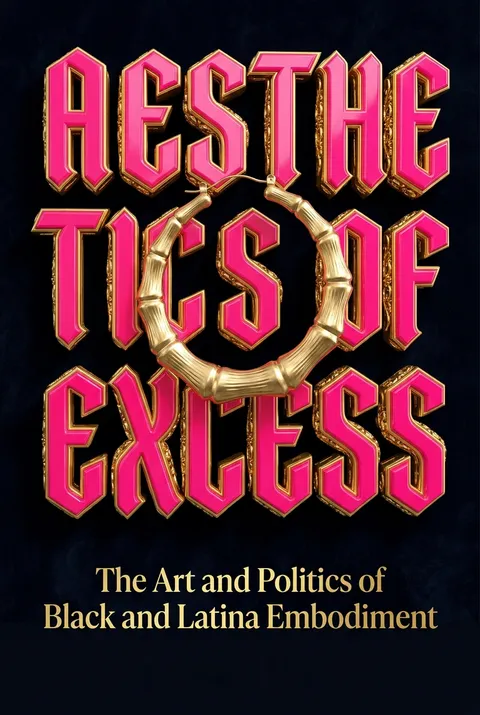
Excess as abundance. The book redefines "aesthetics of excess" not as a negative deviation from modernist European stylistic values, but as an embrace of abundance and a powerful form of cultural capital for Black and Latina women and girls. These styles, often deemed "too much"—too sexy, too ethnic, too loud—are rooted in diasporic creative and spiritual lineages that predate colonization, challenging the austerity imposed on racialized working classes. This visuality of difference flaunts where the social order seeks to erase Black and Latinx bodies through mass incarceration, deportation, and other forms of social death.
Neoliberalism's blind spot. In a neoliberal society that champions meritocracy and individual self-making, class disparities are often obscured, and legitimate personhood is determined by bodily readings. When Black and Latina women and girls embody aesthetics of excess, they refuse to conform to these neoliberal conventions of productivity and respectability. Their styles, therefore, have the power to unmask the realities of class stratification, signaling forms of difference that are intolerable to the contemporary nation-state.
Racialized policing. These bodies are then policed and racialized as sexually and aesthetically excessive, and therefore deviant, often through rhetorics of style rather than explicit class critique. This dynamic creates a double bind: while these styles are appropriated and commodified in mainstream art and media as "ironic" or "edgy," they draw mockery and censure in everyday contexts. The author's own discomfort with being compared to a "Bratz doll" highlights how deeply ingrained these biases are, even within racialized communities.
2. "Chonga" Style: A Defiant Performance of Working-Class Latina Identity
Chongas can’t be tamed, and people feel threatened by their lack of shame.
Chonga as social lightning rod. The "chonga" figure, a colloquial term in Miami for young Latina women perceived as "low-class, slutty, tough, and crass," became a focal point for debates on aesthetic excess. Characterized by tight clothing, heavy makeup, large hoop earrings, and gel-sculpted hair, chongas are often ridiculed for their perceived lack of taste and their "extraness." This mockery, exemplified by the viral "Chongalicious" video, serves to distance mainstream Latinx communities from a hypersexual, hyperethnic, and underclass inscription, particularly as many Latinx individuals seek to align with whiteness for social mobility.
Class and racial anxieties. The chonga's style, often seen as an appropriation of Blackness, triggers anxieties about racial authenticity and class respectability within Latinx communities. While some Black girls in WOTR workshops viewed chonga style as a "worthless" attempt to "be Black," others, like interviewee Q, recognized it as a creative way to "stand out" and assert difference, akin to Black women's own aesthetic practices. This highlights the complex, often antagonistic, racial dynamics at play in Miami's diverse urban landscape.
Branding and exploitation. Despite being denigrated, chonga aesthetics have proven to be a valuable brand in popular culture and the art world. The "Chongalicious" performers attempted to capitalize on the trope, but their association with "real" chongas limited their mainstream crossover success. Conversely, artists like Luis Gispert and Nikki S. Lee have gained critical acclaim by incorporating chonga-esque styles into their work, often flattening the subjects into consumable spectacles. This demonstrates how the art world can profit from racialized aesthetics while the originators remain marginalized.
3. Masculine Aesthetics: Queer Women of Color Claim Power and Pleasure
People would think that I’m a rich-ass dyke [chuckling].
Masculinity as defiance. For masculine-body-presenting Black and Latina young women, often identifying as "studs" or "gay," their aesthetic choices are a powerful assertion of self-worth and a rejection of normative femininity. Styles like low-riding jeans, boxer shorts, designer brands, and tattoos, inspired by hip-hop culture, are not just fashion statements; they are performances of financial power and sexual attractiveness. Interviewee Dimple's desire to be seen as a "rich-ass dyke" encapsulates this fusion of economic aspiration and queer eroticism.
Ego and erotics. These masculine aesthetics are deeply intertwined with a sense of "ego"—a confident, self-possessed subjectivity that attracts sexual partners and signifies self-sufficiency. Interviewee Q, who fluidly embodies both feminine and masculine styles, describes feeling more "confident" and having "swag" when dressed as her masculine alter ego, Kevin. This performance of monied masculinity allows them to subvert traditional gender roles and claim erotic pleasure, challenging the heteropatriarchal order that often demonizes their identities.
Navigating familial and social pressures. The choice to embody masculinity comes with significant social costs, including discrimination, harassment, and violence, as seen in tragic cases like Sakia Gunn. Family members, particularly mothers, often police these styles, fearing the social punishment their daughters might face. However, the book reveals a nuanced reality: while mothers may express disapproval, they often find ways to support their daughters, creating "mother/daughter-style blues" that navigate the tension between protection and self-expression.
4. Nicki Minaj's Rococo Pink: Artifice as Radical Black Femininity
And if I’m fake, I ain’t notice cuz my money ain’t.
Fakery as a political tool. Nicki Minaj's hyperfeminine, plasticized, and often rococo-esque aesthetic, marked by bright pinks, elaborate wigs, and dramatic makeup, is frequently critiqued as "fake" and a capitulation to Eurocentric beauty standards. However, the book reinterprets this artifice as a powerful means to create new racial and gender epistemologies. Minaj's embrace of "fakery" challenges notions of racial authenticity and gendered sexual respectability, disturbing established hierarchies that privilege "natural" white femininity.
Neoliberal Barbie. Minaj strategically deploys the Barbie brand and neoliberal rhetoric to frame her success as a testament to individual work ethic and self-making, despite her marginalized background. Her lyrics, like "I Beez in the trap," celebrate her hustle and financial independence, resonating with young women of color who see her as an inspiration for overcoming economic hardship. This "neoliberal Barbie" performance, while buttressing capitalist ideology, also allows a Black woman to claim wealth and power in a system designed to exclude her.
Rococo rebellion. The book draws parallels between the vilification of rococo art in 18th-century France—associated with frivolous, fake women and aristocratic decadence—and the contemporary critiques of Minaj. Her rococo aesthetics, seen in Francesco Vezzoli's portraits and the "Stupid Hoe" video, trespass into privileged visual fields, infusing white femininity with a hip-hop edge. The "Stupid Hoe" video, with its "Barbie-Baartman" imagery, recalibrates the gaze on Black women's bodies, using grotesque hypersexuality to resist easy consumption and challenge racist/sexist stereotypes.
5. Black Women Artists' Grotesque Bodies Challenge Normative Beauty
What kind of power does the grotesque offer to Black women in relation to their monstrous representation?
Grotesque as critical lens. Artists like Wangechi Mutu, Shoshanna Weinberger, and Kara Walker utilize grotesque aesthetics to expose and subvert dominant constructs of Black women's beauty and sexuality. Mutu's collages of hybrid figures, Weinberger's headless bodies with proliferating breasts and asses, and Walker's monumental "Sugar Baby" sphinx all employ disfiguration and exaggeration to challenge the historical objectification and hypersexualization of Black women's bodies in visual culture. This "ambivalent grotesque" elicits both enticement and disgust, forcing viewers to confront complex issues of pain, pleasure, power, and subjection.
Reclaiming narratives. Weinberger's work, for instance, re-imagines the figure of Saartjie Baartman (the Hottentot Venus) not as a symbol of injury, but as a futuristic, otherworldly grotesque that defies essentialism. Similarly, Walker's "Sugar Baby" fuses the mammy trope with an overtly sexual sphinx, creating an "unexpected and powerful" representation that upsets expectations. These artists reclaim historical narratives of Black female bodies, transforming them into sites of resistance and complex subjectivity, rather than mere victimhood.
Challenging the gaze. The grotesque aesthetics of these artists compel viewers, including WOTR participants, to theorize about heteronormative male gaze and the exploitation of Black women. While some girls expressed shame or disgust at the explicit imagery, others articulated anger, empathy, or even pleasure in crafting their own erotic, grotesque bodies. This demonstrates how the grotesque can disrupt the status quo, forcing a confrontation with uncomfortable truths about racialized gender inequality and inviting a re-evaluation of aesthetic norms.
6. Girls' Art Praxis: A Space for Erotic Self-Determination and Critique
The space of wotr is not safe and may at times be perilous due to the context, content, and power differentials it negotiates, but it is more often affirming once the dust settles and the instructors and the girls let their guards down.
WOTR as transformative space. The Women on the Rise! (WOTR) project provided a crucial, albeit sometimes challenging, space for Black and Latina girls to engage in self-expression and critical dialogue through art. Operating in detention facilities and community centers, WOTR countered deficit-oriented views of these girls by fostering their "Black girl genius" and "creative potential." Through workshops inspired by artists like Mutu, Weinberger, and Walker, girls explored complex issues of race, gender, sexuality, and representation, often producing art that challenged societal norms.
Art as theory and healing. The hands-on art-making process, particularly with three-dimensional sculptures of sexualized bodies, allowed girls to physically manipulate and reclaim narratives of their own embodiment. They would "giddily construct monstrous bodies with multiple, enormous breasts, buttocks overflowing with stuffing," often using cell phones to document their "grotesqueries." This process, akin to Audre Lorde's "erotic as power," provided a sense of control and pleasure, transforming historical defacement into expressions of Black girl pleasure and power.
Confronting discomfort. WOTR workshops often sparked "agitated responses" from participants, revealing their own internalized norms and discomfort with overt sexuality. Yet, these moments of friction were leveraged by instructors to deepen discussions, prompting girls to examine the assumptions embedded in their reactions. Even the author's own panic when a grandmother brought young girls to a lecture on pornography highlighted the need for pedagogies that embrace, rather than avoid, difficult conversations about sexuality, preparing girls to navigate a hypersexualized world.
7. The Art World's Hypocrisy: Commodifying and Erasing Marginalized Art
The truth of the matter is that wotr was always underresourced and undervalued, even during moca’s most successful times.
Appropriation and erasure. The book exposes the inherent hypocrisy of the mainstream art world, which readily commodifies and celebrates racialized aesthetics when presented by elite artists, while simultaneously undervaluing and erasing the contributions of working-class artists of color and community-based projects. The WOTR project itself, despite its success and impact, was copyrighted by the Museum of Contemporary Art (MOCA) and later became a target for appropriation by a departing board seeking to establish a new, more exclusive institution (ICA Miami).
Neoliberal artwashing. The saga of MOCA's board departure, its lawsuit against the city of North Miami, and the subsequent founding of ICA Miami exemplifies "artwashing" and gentrification. The board, composed of wealthy white collectors, abandoned a predominantly Black, working-class neighborhood when residents rejected a museum expansion, taking valuable artworks and programs with them to a more affluent district. This revealed the art world's "classist and racist character," prioritizing flashy new buildings and elite donors over community engagement and social justice.
Silencing dissent. The art world's power structures also dictate who can critique and how. While international artists like Ai Weiwei are celebrated for "reimagining" cultural artifacts, local artist Maximo Caminero was criminalized for smashing a Weiwei vase in protest of local artists' exclusion from Miami's premier art spaces. Similarly, white artists like Kelley Walker have inflicted harm on communities of color through controversial works, often with relative impunity. This stark contrast underscores how race, class, and power determine whose art is valued, whose voice is heard, and whose "trouble" is tolerated.
Review Summary
Aesthetics of Excess receives positive reviews with a 4.21/5 rating. Readers praise the first three chapters, particularly the discussion of lesbianism and masculinity within excess aesthetics. Some found chapter four's language inaccessible. The book is described as a unique art history text exploring excess in style and embodiment among Black and Latinx youth, primarily through Miami-based ethnography of arts education programs. Multiple educators plan to include it in their syllabi, noting its relevance for Black and Brown women throughout the United States.
People Also Read



Download PDF
Download EPUB
.epub digital book format is ideal for reading ebooks on phones, tablets, and e-readers.








































