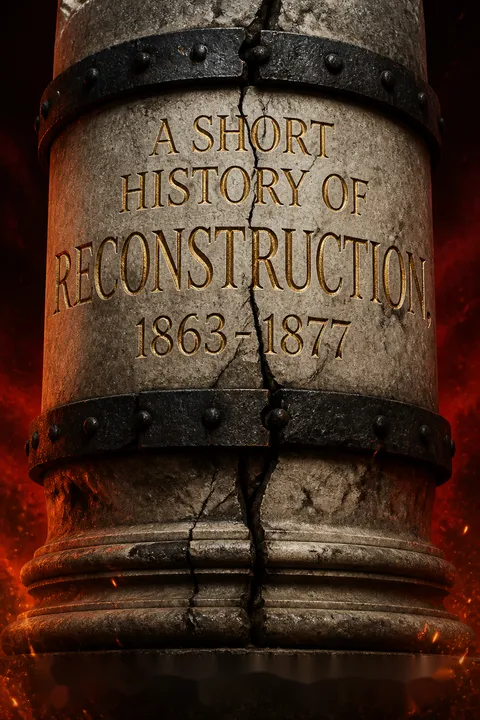

Key Takeaways
1. Emancipation Ignited a Revolution, Redefining Freedom's Core
Begun to preserve the Union, the Civil War now portended a far-reaching transformation in Southern life and a redefinition of the place of blacks in American society and of the very meaning of freedom in the American republic.
Abolition's Genesis. The Emancipation Proclamation on January 1, 1863, marked a pivotal shift, transforming the Civil War from a conflict solely for Union preservation into a revolutionary struggle against slavery. This executive order, while initially excluding loyal border states and Union-occupied territories, declared over three million enslaved people "henceforth shall be free," fundamentally altering the war's character and setting the stage for Reconstruction. The Proclamation was not merely a legal decree but a recognition of an ongoing process, as thousands of slaves had already sought refuge behind Union lines, effectively dismantling the institution from within.
Black Agency's Impact. The actions of enslaved people themselves were crucial, as their mass desertions to Union camps and challenges to plantation authority forced the Lincoln administration's hand. This "contraband of war" policy, initiated by General Benjamin F. Butler, evolved into the widespread enlistment of black soldiers, with some 180,000 serving in the Union Army by war's end. Their military service was not only vital to Union victory but also a powerful claim to equal citizenship, providing a foundation for future political demands.
A New National Purpose. The Proclamation imbued the Union cause with a profound moral purpose, aligning national authority with the ideal of universal freedom. This shift signaled that the Southern states could not simply return to the Union unchanged, but would undergo a "far-reaching transformation." The war, therefore, became a crucible for redefining American liberty, citizenship, and the very structure of the nation, moving towards an unprecedented commitment to equality regardless of race.
2. Freedmen Forged Autonomy Through Family, Church, and Education
Blacks carried out of bondage an understanding of their new condition shaped both by their experience as slaves and by observation of the free society around them.
Reclaiming Family and Identity. Emancipation brought an immediate and profound desire among freedmen to solidify family ties, many of which had been fractured by slavery. Thousands embarked on poignant journeys to reunite with lost relatives, and by 1870, most black families lived in two-parent households. This newfound autonomy also led to a significant, albeit temporary, withdrawal of black women from field labor, as families sought to emulate middle-class norms and women prioritized domestic responsibilities and childcare.
Building Community Institutions. Second only to family, the independent black church became a cornerstone of freedmen's lives, emerging from the "invisible institution" of slavery to become a central hub for social, educational, and political activities. Ministers, often among the few literate blacks, frequently served as community leaders and political figures. This period also saw the proliferation of mutual aid societies, debating clubs, and fraternal organizations, all fostering collective self-improvement and providing vital social safety nets.
The Thirst for Knowledge. Education was paramount to the meaning of freedom for blacks, who, largely illiterate after generations of prohibitive laws, displayed an "avidity for learning." Northern benevolent societies and the Freedmen's Bureau provided crucial support, but the initiative often came from blacks themselves, who pooled resources to build schools, pay teachers, and even teach each other. This collective effort laid the groundwork for Southern public education and produced a new generation of black teachers and politicians.
3. The White South Fractured, Resisting a New Social Order
Like a massive earthquake, the Civil War and the destruction of slavery permanently altered the landscape of Southern life, exposing and widening fault lines that had lain barely visible just beneath the surface.
Deepening Internal Divisions. The Civil War exacerbated long-standing class and regional antagonisms within the white South, particularly between the planter elite and upcountry yeomen. While most upcountry farmers initially rallied to the Confederacy, policies like conscription exemptions for slaveholders and impressment of farm goods fueled resentment, leading to widespread desertion, draft evasion, and an "inner civil war" in mountainous regions. This discontent laid the groundwork for a segment of white Southerners to align with the Republican party during Reconstruction.
Planters' Devastation and Resistance. The planter class emerged from the war economically and psychologically shattered, losing their slaves, savings, and political dominance. Many struggled to adapt to free labor, clinging to paternalistic notions and believing that blacks would not work without coercion. They sought to use state power to re-establish labor discipline, viewing any black assertion of autonomy as "insolence" and a threat to their social order.
The Rise of Unionism (with caveats). Wartime Unionism, particularly in the upcountry, became a significant, albeit complex, force. These Unionists, often small farmers, resented the planter aristocracy and the war's impact but generally shared white supremacist views and were reluctant to extend rights beyond emancipation to blacks. Their loyalty to the Union did not translate into a commitment to racial equality, highlighting the deep-seated racial prejudices that permeated all strata of white Southern society.
4. The North's Industrial Boom Fueled National Power and New Divisions
For the Union too, the Civil War was a time of change.
Economic Transformation. The Civil War spurred unprecedented prosperity and deep structural changes in the North, accelerating the emergence of an American industrial bourgeoisie. Railroads boomed, manufacturing expanded to meet military demand, and agriculture flourished with westward expansion and mechanization. Congressional policies, such as the Homestead Act, Land Grant College Act, and support for transcontinental railroads, further consolidated the national market and tied the fortunes of industrialists to the Republican party and the federal government.
Rise of the Activist State. The exigencies of war led to the birth of a modern American state with vastly expanded authority, income, and bureaucracy. The federal budget soared, and the government became the nation's largest employer. Republicans, especially Radicals, embraced this enhanced national power, viewing the state as the "custodian of freedom" and believing it essential for defining and protecting citizens' rights, particularly for the newly emancipated.
New Social and Political Fault Lines. While the war unified the North against slavery, it also intensified internal divisions. The rapid accumulation of wealth by industrialists contrasted with the struggles of workers facing inflation and regressive taxes, fueling class tensions. The expansion of federal power clashed with traditions of local autonomy, and even modest improvements in the status of Northern blacks provoked violent backlash, as seen in the New York City draft riots. These conflicts foreshadowed future challenges to Reconstruction.
5. President Johnson's Lenient Reconstruction Policy Backfired
When Johnson assumed office on April 15, 1865, his past career led many to expect a Reconstruction policy that envisioned far-reaching change in the defeated South.
A President's Betrayal. Andrew Johnson, Lincoln's successor, initially seemed poised to punish "traitors" and empower loyal white yeomen, but his Reconstruction policy quickly shifted to leniency towards former Confederates. His May 1865 proclamations offered widespread amnesty, excluding only wealthy planters and high-ranking officials, but even these exclusions were often circumvented by individual pardons. Johnson's deep-seated racism and belief in limited federal power led him to oppose black suffrage and prioritize the swift reintegration of Southern states under white control.
Southern Defiance and the Black Codes. Johnson's policies emboldened white Southerners, who, relieved by the mild terms, quickly moved to reassert control over black labor and social life. The newly elected state legislatures, dominated by former Whigs and ex-Confederates, enacted the "Black Codes," which, while granting some rights like property ownership and marriage, severely restricted black mobility, economic options, and legal protections. These codes aimed to "restore all of slavery but its name," provoking outrage in the North.
Alienating Congress and the North. Johnson's actions, including his vetoes of the Freedmen's Bureau Bill and the Civil Rights Bill, alienated moderate Republicans who had initially sought cooperation. His defiant rhetoric, equating Radical Republicans with Confederate leaders, further solidified Congressional opposition. The Black Codes and reports of widespread violence against freedmen convinced many Northerners that Johnson's approach had failed to secure the fruits of Union victory and necessitated a more assertive federal role in the South.
6. Radical Republicans Forged a Bold Experiment in Interracial Democracy
The driving force of Radical ideology was the Utopian vision of a nation whose citizens enjoyed equality of civil and political rights secured by a powerful and beneficent national state.
A New Vision for the Nation. Radical Republicans, a self-conscious political generation shaped by the anti-slavery struggle, viewed the Civil War as a "golden moment" for fundamental change, advocating for a "perfect republic" where all citizens enjoyed equal civil and political rights. Leaders like Thaddeus Stevens and Charles Sumner championed black suffrage and a powerful national state to enforce these rights, believing that federalism and states' rights should not obstruct a sweeping national effort to redefine citizenship.
The Fourteenth Amendment's Promise. The growing split with President Johnson and Southern intransigence propelled Congress to embed the war's results in the Constitution, culminating in the Fourteenth Amendment in 1866. This landmark amendment established national and state citizenship, prohibiting states from abridging "privileges and immunities," denying "due process of law," or "equal protection of the laws." It aimed to guarantee equality before the law for all Americans, fundamentally altering federal-state relations and providing a constitutional basis for future civil rights.
The Reconstruction Acts and Black Suffrage. Despite initial reluctance, the Memphis and New Orleans riots of 1866, coupled with Southern rejection of the Fourteenth Amendment, convinced moderate Republicans that black suffrage was essential. The Reconstruction Act of 1867 divided the former Confederate states (except Tennessee) into military districts, requiring new state constitutions that provided for manhood suffrage and ratification of the Fourteenth Amendment for readmission. This unprecedented legislation launched a bold experiment in interracial democracy, empowering former slaves to participate directly in shaping their states' futures.
7. Southern Republican Governments Championed Progress Amidst Corruption
Unprecedented challenges confronted the Southern Republicans who came to power between 1868 and 1870.
Biracial Governance and Social Progress. Republican governments, formed under the Reconstruction Acts, brought a diverse coalition of blacks, Northern "carpetbaggers," and native white "scalawags" to power. These governments, often facing empty treasuries and widespread opposition, embarked on ambitious programs to rebuild the South and expand public services. They established the South's first state-funded public school systems, created hospitals and asylums, and guaranteed civil and political rights for blacks, including equal treatment in transportation and public accommodations, though full integration remained elusive.
Economic Development and Fiscal Strain. A central tenet of Southern Republicanism was the "gospel of prosperity," aiming to modernize the South through state aid to railroads and other industries. While this led to significant railroad expansion and some industrial growth, it also vastly increased state debts and taxes, draining resources from other programs. This fiscal strain, coupled with the economic devastation of the war and declining land values, made tax increases a major political liability.
Corruption and Factionalism. Corruption, while endemic in American politics of the era, thrived in the Reconstruction South due to expanded budgets and opportunities for state-linked capitalist enterprise. Bribery, fraud, and misuse of public funds became widespread, discrediting Republican regimes in the eyes of many, including Northern public opinion. Internal factionalism, fueled by policy differences and competition for patronage, further weakened the already vulnerable Republican party, which struggled to balance the aspirations of its black and poor white constituents with the desire to attract "respectable" whites and outside capital.
8. The Ku Klux Klan Unleashed Terror, Challenging State Authority
In effect, the Klan was a military force serving the interests of the Democratic party, the planter class, and all those who desired the restoration of white supremacy.
A Campaign of Terror. The advent of Radical Reconstruction spurred the rapid expansion of the Ku Klux Klan and similar white supremacist organizations, which acted as a paramilitary arm of the Democratic party. Their primary goal was to destroy the Republican party's infrastructure, undermine the Reconstruction state, reestablish control over the black labor force, and restore racial subordination. Violence was systematically directed at black and white Republican leaders, teachers, and any freedmen asserting their rights or achieving economic success.
Targeting Black Autonomy. Klan violence extended beyond electoral politics, aiming to suppress black institutions and economic independence. Black schools and churches were attacked, and freedmen who disputed labor contracts or sought landownership were brutally punished. The pervasive nature of this terror, often committed in broad daylight by undisguised men, underscored the impotence of local authorities and the widespread complicity or silence of "respectable citizens."
Federal Intervention and its Limits. Faced with the paralysis of state governments, Congress passed the Enforcement Acts in 1870 and 1871, making certain crimes against civil rights federal offenses and authorizing military intervention. While these acts, particularly the suspension of habeas corpus in nine South Carolina counties, successfully broke the Klan's back and restored a measure of order by 1872, they also highlighted the Reconstruction governments' reliance on "power from without." The need for federal intervention was a humiliating confession of weakness, and its eventual withdrawal would prove fatal.
9. Northern Liberalism and Economic Depression Undermined Reconstruction
The intoxicating postwar economic expansion ended abruptly in 1873.
Economic Crisis and Class Conflict. The Panic of 1873 triggered a severe economic depression that profoundly reshaped Northern politics and ideology. Widespread unemployment, wage cuts, and militant labor strikes exposed deep class divisions, challenging the core tenets of the free labor ideology. This crisis led to a hardening of attitudes among the urban middle and upper classes, who increasingly embraced fiscal conservatism and the defense of property rights, viewing labor and agrarian movements as dangerous "communism."
The Rise of Liberal Reformers. A new intellectual and political movement, "Liberal Republicanism," emerged, advocating for limited government, civil service reform, and an end to "corrupt" machine politics. While many liberals had been early advocates of black rights, they grew increasingly disenchanted with Reconstruction, viewing Southern governments as extravagant and incompetent, and black suffrage as a source of misrule. They argued that the nation had done enough for blacks, who should now "fend for themselves."
Erosion of Northern Resolve. The depression and the rise of liberalism contributed to a significant decline in Northern support for Reconstruction. The 1874 elections saw a massive Democratic landslide, signaling public weariness with "annual autumnal outbreaks in the South" and a desire to shift national focus to economic issues. Supreme Court decisions, particularly Slaughterhouse (1873) and U.S. v. Cruikshank (1876), further emasculated federal power to protect black rights, effectively giving a "green light" to terror where local officials failed to act.
10. The Compromise of 1877 Formally Ended Federal Intervention
"The whole public are tired out with these annual autumnal outbreaks in the South . . . [and] are ready now to condemn any interference on the part of the Government."
The Disputed Election of 1876. The Presidential election of 1876 between Republican Rutherford B. Hayes and Democrat Samuel J. Tilden resulted in a constitutional crisis, with disputed electoral votes from Florida, South Carolina, and Louisiana. These states, still under Republican control, submitted rival returns amidst widespread fraud and intimidation by Democrats. The crisis reflected the deep partisan divisions and the waning commitment to federal intervention in the South.
The Bargain of 1877. To resolve the impasse, Congress created an Electoral Commission, which ultimately awarded all disputed votes to Hayes, securing his victory by a single electoral vote. This outcome was facilitated by a series of informal negotiations, often referred to as the "Bargain of 1877," where Southern Democrats tacitly agreed not to obstruct Hayes's inauguration in exchange for assurances of "home rule" for the South and the withdrawal of federal troops from Louisiana and South Carolina.
The End of Federal Protection. Hayes's subsequent order to remove federal troops from the Southern statehouses marked the formal end of Reconstruction. This action, while not a complete withdrawal of all federal presence, symbolized the nation's decisive retreat from its commitment to protecting black civil and political rights. The "Southern question" was declared "dead," and the federal government's role in safeguarding black freedom was effectively abandoned, ushering in an era of white supremacy.
11. Reconstruction's End Left a Legacy of Unfinished Revolution
For the nation as a whole, the collapse of Reconstruction was a tragedy that deeply affected the course of its development.
A Revolution Unfinished. Reconstruction, despite its ultimate failure to secure lasting political and economic equality for blacks, left an altered landscape. The autonomous black family, church, and educational institutions survived, providing a foundation for future struggles. While blacks did not achieve economic independence, the era prevented a return to the most oppressive forms of labor coercion envisioned by white Southerners, and the constitutional amendments provided a legal framework for future federal intervention.
The Rise of the "New South." The "Redeemers" who came to power after 1877 dismantled the Reconstruction state, drastically cutting public services, especially education, and rewriting laws to reinforce planter control over labor. This led to a regressive tax system, the expansion of the convict lease system, and the progressive erosion of black political rights, culminating in widespread disenfranchisement around the turn of the century. The "New South" emerged as a poverty-stricken, colonial economy with distinctive repressive labor relations.
A Lingering Shadow. The collapse of Reconstruction accelerated the spread of racism throughout the nation, shifting American politics to the right and complicating reform efforts for generations. The "Solid South," ruled by a reactionary elite, became an enduring consequence, stifling dissent and hindering progressive legislation. While the "Dunning School" of historians long legitimized this narrative of Reconstruction as a "tragic era" of "black barbarism," black communities preserved a different memory—a time of hope, possibility, and accomplishment, whose legal and institutional legacies would eventually fuel the modern Civil Rights Movement.
Review Summary
Reviewers broadly praise A Short History of Reconstruction as an informative, important, though occasionally dry read. Many note it as an eye-opening account of a neglected historical period, highlighting Foner's emphasis on Black agency and the ultimate failure of Reconstruction due to racism, political corruption, and economic interests. Several reviewers mention it is an abridged version of a larger work, with some feeling the condensation sacrifices depth. Common criticisms include dense, dissertation-like prose, while praise centers on its relevance to understanding modern American politics and racial inequality.
People Also Read






About the Author

Download PDF
Download EPUB
.epub digital book format is ideal for reading ebooks on phones, tablets, and e-readers.








































