

Key Takeaways
One ordinary morning at eleven, finding your mother dead rewrites everything
The rupture that starts it all. In January 1976, an eleven-year-old San Diego girl nicknamed Cupcake found her mother dead of an epileptic seizure, choked on her own tongue. Within days, a court handed her and her brother to Mr. Burns, a biological father they had never met, who only wanted their mother's life-insurance money. He immediately dumped them with Diane, a foster mother running a house of horrors.
Biology trumped love in court. California law gave custody to the surviving blood parent regardless of eighteen thousand dollars in unpaid child support, regardless that a loving stepfather and uncle begged for the children. A single death detonated a decade of abuse, rape, addiction, and gang life. The memoir traces how one loss can hurl a child straight into hell.
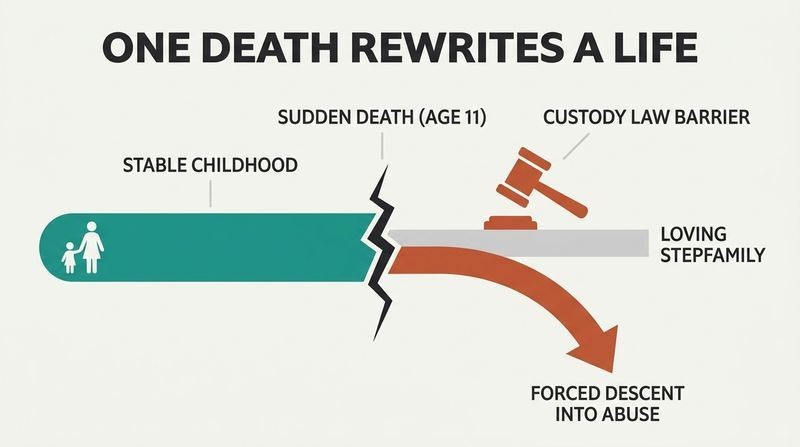
What's striking is how the machinery of child welfare, meant to protect, instead accelerated harm. Research on adverse childhood experiences (the ACE study by Felitti and Anda) shows that a high count of early traumas sharply raises risk of addiction, depression, and early death. Cupcake accumulated nearly every category before age twelve. The memoir functions as a lived case study of what statisticians only tabulate. It also quietly indicts a legal system that privileged genetic parenthood over demonstrated caregiving, a bias family courts still wrestle with when weighing blood ties against a child's actual attachments and safety.
Numbness feels like rescue, which is exactly how addiction recruits you
The first drink arrived as mercy. The night after landing at Diane's, her nephew Pete handed the girl rum and coke, then raped her. The alcohol dulled the terror, and she instantly loved not the taste but the not-feeling. Weed, then prostitution introduced by a runaway named Candy, followed within weeks. Each substance was recruited as medication against unbearable circumstances rather than recreation.
Every drug had an assigned job. She later described her use like a pharmacy: speed for energy, downers for her uncontrollable rage, alcohol for courage, crack for euphoria. The logic was survival, not pleasure. When a child has no protector, chemical oblivion becomes the only available shelter. That framing explains why willpower lectures never touched her: the drugs were solving a real problem before they became the problem.
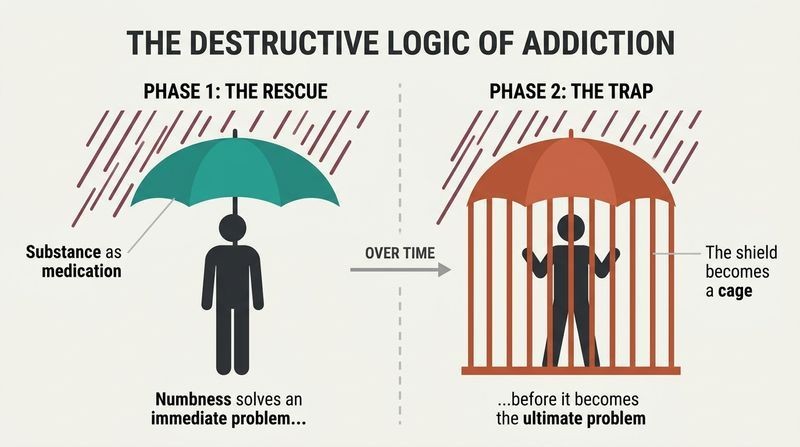
This maps precisely onto the self-medication hypothesis advanced by psychiatrist Edward Khantzian, who argued addicts unconsciously select drugs that soothe their specific emotional wounds. Cupcake's inventory (uppers for numbness, downers for rage) reads like a textbook illustration. The uncomfortable implication is that abstinence-only messaging aimed at traumatized users misses the point: remove the coping tool without addressing the pain, and relapse is nearly guaranteed. Trauma-informed care, now standard in progressive addiction treatment, grew from exactly this recognition. Her story predates the mainstreaming of that model, which makes her intuitive grasp of it all the more remarkable.
A gang offered the belonging that every abandoned kid is starving for
Getting jumped in felt like coming home. At fifteen, living with a great-aunt in South Central Los Angeles, Cupcake joined the Eight-Tray Gangster Crips. Initiation meant a beating by the female members; fighting back proved she had heart and earned her a place. For the first time since her mother died, she belonged to something that fed and protected her.
Loyalty was manufactured on purpose. The gang trained members to love the set more than family or self, teaching that fallen members went to a special Gangsta heaven. She learned to shoot, did drive-bys, robbed buses, and eventually took two bullets in the back at a party. The camaraderie was real, and so was the body count. Belonging and self-destruction arrived in the same package.
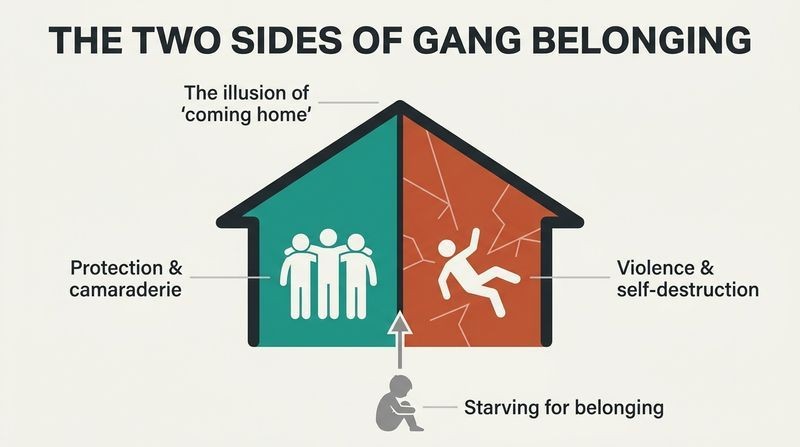
Sociologists studying street gangs, from Frederic Thrasher in the 1920s to Sudhir Venkatesh a century later, consistently find gangs fill voids left by absent families, schools, and economies. Cupcake's account humanizes the data: she names the exact emotional transaction, unconditional acceptance in exchange for total loyalty and expendability. What's easy to miss is how the gang mirrored the abuse she fled, offering love conditioned on violence. The tragedy is that a child correctly identified belonging as her deepest need, then found it in the one place guaranteed to get her killed. The need was healthy; the supply was lethal.
The lie that a job proves you are not an addict
Employment became her alibi. Cupcake clung to a belief that real addicts could not hold jobs, so as long as she worked, she could not have a problem. She rose from alarm monitor to word processor to legal secretary, all while smoking crack, shooting through paychecks, and killing off fake relatives to claim bereavement leave. The job was psychological cover.
The delusion is common and dangerous. Her boyfriend Brett shared the identical belief and it kept him relapsing. Functional addiction lets users postpone reckoning indefinitely because they can point to external proof of normalcy. The spell broke only when she caught her reflection in a gas-station window: shoeless, ninety-eight pounds, ribs showing, living behind a Dumpster. The job had masked collapse, not prevented it.
The functioning addict is one of addiction's most persistent myths, and it delays intervention precisely because it sounds like evidence of control. Clinical researchers note that high-functioning alcoholics often have worse long-term outcomes because employment, income, and social standing shield them from consequences that might otherwise force change. Cupcake weaponized the myth into a whole identity. Her insight, that quitting her job was the price of admitting the disease, inverts the usual logic beautifully: the very thing she used as proof of health had to be surrendered to get healthy. Denial thrives on plausible external metrics.
Rock bottom is a mirror you finally cannot look away from
The window that ended the running. After being thrown out for smoking crack, Cupcake spent days behind a Dumpster, turning tricks and hitting a pipe made from a car antenna. Passing a gas station, she saw her reflection: wild hair, bulging bloodshot eyes, scabbed lips, a filthy green dress, no shoes, a body so thin the ribs showed. The image of a barely-human creature finally pierced her denial.
Surrender, not willpower, opened the door. Standing there, she whispered two words she had resisted for fifteen years: help me. A quiet inner voice answered that she would have to quit her job. Recognizing that willingness to quit meant admitting the disease, she walked sixty blocks to her boss Ken to resign. Instead of firing her, he sent her to rehab.
Bottoming out is central to recovery literature, but the mechanism is often misunderstood as mere suffering. Cupcake's account clarifies that the turning point was not pain (she had endured far worse) but a collapse of self-deception, triggered by seeing herself as others saw her. Psychologists call this a moment of ego deflation, and twelve-step tradition treats it as prerequisite to change. The detail that her boss tore up her termination papers rather than sign them illustrates how recovery, statistically, hinges on someone extending grace at the exact moment of surrender. Bottom plus a hand equals a chance; bottom alone often just equals death.
You never have to use again, even when you desperately want to
Desire is not a command. Cupcake's sponsor Venita taught her a distinction that reorganized her mind: wanting to drink and having to drink are different things. Even overwhelmed by craving, she could choose not to act. The tool was to treat sobriety one day at a time, since it is always today, and to fight urges by praying, leaving slippery places, and phoning someone in recovery before picking up.
Practice asking for help before you need it. Venita forced her to call a woman in recovery every single day, so that when a real crisis hit, lifting the phone would not feel impossibly heavy. She also insisted Cupcake rely on a power greater than herself, arguing that love alone (her father's, her uncle's) had never gotten her clean, because addiction is too powerful for human will.
The separation of craving from action is the cognitive backbone of modern relapse-prevention therapy, echoed in mindfulness-based approaches that teach urges to be surfed rather than obeyed. Neuroscience supports this: cravings peak and subside in roughly fifteen to thirty minutes, so delay tactics genuinely work. Venita's insistence on daily help-seeking practice is quietly brilliant behavioral design, rehearsing a hard skill under low stakes so it fires under high ones. The claim that willpower and even love cannot conquer addiction is contentious among researchers who emphasize agency, yet it usefully removes shame, reframing relapse as disease rather than moral failure.
Family is whoever loves you, not whoever shares your blood
A mismatched puzzle that fit perfectly. In recovery, Cupcake assembled a chosen family of wildly different ages, races, and beliefs: her father and uncle, her sponsor Venita, her boss Ken, three surrogate mothers (Gail, Maria, and Chaney), and two judges who mentored her. Only her uncle was blood. The rest loved her anyway, and that love transcended difference.
Small acts rebuilt a destroyed person. A coworker gave her dishes, another sold a Sony TV for twenty-five dollars, her uncle brought her mother's old mattress, and anonymous law professors pooled 560 dollars so she could buy an interview suit. Cupcake learned that friends who stay only for what you can offer them are not friends, a lesson drawn straight from street life, where no one was glad to see you unless you carried money or dope.
The concept of chosen or fictive kin is well documented in sociology and increasingly validated by longevity research: the Harvard Study of Adult Development found that quality relationships, not wealth or fame, best predict health and happiness across a lifetime. Cupcake's ragtag support network functioned as an external scaffold for a self she could not yet hold up alone. What's notable is the reciprocity clause she articulates, distinguishing transactional street ties from unconditional love. Her framework offers a practical test for anyone auditing their relationships: ask whether the bond survives when you have nothing to give. Most street bonds fail it; real family passes it.
Steal back the dream that drugs and trauma stole from you
A five-year-old's interrogation predicted a lawyer. Cupcake once badgered her father with relentless questions about Santa Claus until he confessed the truth, prompting him to say only lawyers ask endless questions and care about the answers. Her mother's death buried that dream. Years sober, bored and restless, her sponsor asked what dream the streets had stolen, then commanded: steal it back.
She started at one plus one. A college placement test scored her English at the top but her math below a one, meaning she began at literal first-grade arithmetic at age twenty-seven. Over eight and a half years, working full time, she earned an associate's degree, graduated from San Diego State magna cum laude, got into law school despite a dismal LSAT score of 147, and eventually passed the California bar.
The reclaiming of a pre-trauma aspiration is a powerful therapeutic move, aligning with narrative therapy's premise that people heal by re-authoring their life story around buried values rather than around damage. Cupcake's trajectory also rebuts the deficit framing so often applied to survivors: her scattered brain and low test scores reflected disrupted schooling and drug damage, not fixed capacity. Her decomposition of a massive goal into a single present goal (finish community college, not become a lawyer) mirrors evidence-based motivation research on proximal versus distal goals. The Santa anecdote is more than charming; it locates identity in a trait (relentless questioning) that survived everything.
Rewrite the tapes in your head with sticky notes and repetition
Positive reinforcement, one Post-it at a time. When Cupcake could not name a single good thing about herself, Venita had her write affirmations on sticky notes (Cup, you are pretty; Cup, you deserve happiness) and plaster them over every surface of her apartment, even the toilet tank. The goal was to overwrite decades of messages, from bullies and abusers, telling her she was ugly and worthless.
Self-esteem comes from esteemable acts. Venita paired the notes with behavior: practice saying please and thank you, practice not fighting when someone stepped on your foot, do kind things and the feeling follows. Cupcake, taught to hate her dark skin and kinky hair, taped up images of dark-skinned black women she admired until she believed, after roughly five years, that black really was beautiful and that she was enough.
The sticky-note method is folk cognitive-behavioral therapy: interrupt automatic negative thoughts through deliberate, repeated counter-messaging. Skeptics rightly note that affirmations alone can backfire for people with very low self-worth, sometimes worsening mood by highlighting the gap between statement and belief. What rescues Cupcake's version is Venita's pairing of words with esteemable acts, which aligns with research showing behavior change drives self-concept change more reliably than thought alone. You act your way into right feeling, not feel your way into right action. The racialized dimension, actively curating images to decolonize an internalized beauty standard, anticipates contemporary conversations about representation and self-image.
Feel the grief you spent years drinking to avoid
Fifteen years of suppressed mourning. Cupcake had never grieved her mother; she drank and used to avoid the pain and simply refused to look back. Her sponsor sat with her all night as she finally told the true story of that morning, sobbing through memories of lifting her mother's body, singing their song with the head in her lap, being torn from her father in the courtroom. Venita encouraged the tears rather than hushing them.
Negative feelings are where healing lives. The lesson was that suppressing any emotion, happy or sad, would lead her back to drinking. Sober, she experienced raw emotion for the first time, starting with pervasive fear. She learned to let feelings move through her by praying, crying, cussing, and sitting on her hands until an urge passed, doing anything except numbing.
This is grief work as addiction medicine, and it tracks with research on emotional avoidance as a core driver of relapse. Psychologist Steven Hayes's acceptance and commitment therapy holds that the struggle to escape painful feelings, not the feelings themselves, produces most psychological suffering. Cupcake had spent a lifetime proving the point in reverse. The image of a sponsor keeping vigil all night against a possible relapse-triggered breakdown underscores how dangerous reopening old wounds can be without support. Delayed grief is a recognized clinical phenomenon; trauma frozen at eleven does not simply dissolve. It waits, sober, for the day the anesthetic runs out.
Half a man is no man at all, so protect your recovery first
Choosing herself over love. Cupcake's fiance Brett treated her like a queen when clean, sending roses and opening every door, but he kept relapsing on crack. When he showed up loaded and broke at her door one night, she realized his using threatened the sobriety she had fought for. She gave an ultimatum: get treatment tonight and stay clean, or lose her. He said okay, then vanished, choosing the drug.
A woman is ready for a man only when she does not need one. Venita had warned Cupcake not to make a man her god, noting that addicted women often abandon themselves once a partner appears. Losing Brett taught her to accept kindness, to set a standard for how she deserved to be treated, and to trust that the right person arrives when the time is right.
The principle that recovery must outrank romance reflects hard clinical wisdom: shared using among couples is a leading relapse vector, and treatment programs routinely counsel newly sober people to avoid new relationships in year one. Cupcake's ultimatum was not cruelty but boundary-setting, the very skill her chaotic history never taught her. Venita's aphorism, that readiness for partnership requires not needing one, echoes attachment theory's notion of secure autonomy: healthy interdependence grows from a stable self, not a dependent one. The painful truth embedded here is that loving someone with active addiction sometimes means refusing to be dragged down with them, however tender the person is when sober.
Fear is fine, but never let fear be the reason you stop
Two definitions of fear. Cupcake's surrogate mother Chaney drilled an acronym into her: FEAR means either Forget Everything And Run, or Face Everything And Recover. Which one you choose defines your life. Venita added that it is okay to be afraid; it is not okay to let fear stop you. Every milestone, first job interview sober, first day of school, resigning to enter rehab, was walked through eyes closed, teeth clenched, one foot forced in front of the other.
Do the footwork, leave the results to God. She applied to five law schools; four rejected her over a low LSAT. The fifth, University of San Francisco, accepted her through a program that weighed her whole story, not just numbers. Her rule became: you cannot get good at anything you quit, so keep at it no matter what.
The reframe that courage is action despite fear, not the absence of fear, is supported by exposure-based psychology: avoidance shrinks a life while approach expands it, and confidence follows action rather than preceding it. Chaney's acronym is a memory-friendly commitment device, the kind behavioral economists praise for making abstract resolve concrete in the decisive moment. What's quietly radical is Cupcake's separation of effort from outcome (do the footwork, release the results), which lowers the paralyzing stakes of any single attempt. Four rejections would end most dreams; her policy of never quitting meant one acceptance was all she needed. Persistence, not talent, was the variable she controlled.
Analysis
A Piece of Cake is a survival memoir, not a self-help book, yet it smuggles a coherent recovery philosophy inside an almost unbearable story. The structure is strictly chronological and story-driven, moving from a mother's death when Cupcake Brown was eleven, through foster-home abuse, child prostitution, gang life in South Central, and near-fatal crack addiction, to law school, the bar exam, and a career as an attorney. The narrative arc is its argument: transformation is possible from the lowest imaginable starting point.
What makes the book hard to summarize is that its power lives in accumulated horror and specific voice, the code-switching between street vernacular and courtroom polish, rather than in extractable frameworks. The lessons only land because they are earned across two hundred thousand words of lived catastrophe. Stripped of the story, aphorisms like one day at a time sound like fridge magnets. Embedded in it, they read as hard-won technology for staying alive.
The memoir's central and most transferable insight is that trauma, addiction, and self-destruction were rational responses to an irrational world, and that recovery required rebuilding an entire self: emotional regulation, self-worth, speech, relationships, and purpose, not merely quitting drugs. Brown implicitly champions a trauma-informed, community-dependent model of change decades before it became clinical orthodoxy. Her chosen family and twelve-step scaffolding do the work that no individual willpower could.
The book is weakest as a generalizable playbook, since her outcome depended heavily on rare strokes of grace (a boss who paid for rehab, professors who funded a suit, a sponsor who answered every call). Readers should not conclude that grit alone guarantees escape. Its enduring value is testimonial: it expands the reader's sense of what a written-off human being can become, and it renders addiction and foster-system failure legible from the inside. It is a document of grace received and grace passed on.
Review Summary
A Piece of Cake by Cupcake Brown receives mostly high praise (4.25/5 stars) for its raw, gripping portrayal of addiction, abuse, and redemption. Readers find it inspirational and deeply moving, though some criticize the writing quality, calling it repetitive, poorly structured, and overly dramatic. Many appreciate Brown's authentic voice and conversational tone, while others feel it needs better editing or a ghostwriter. The memoir's honesty about foster care failures, gang life, and recovery resonates strongly. Some question the story's believability given its extreme hardships, but most consider it a powerful, life-affirming testament to human resilience.
People Also Read




Glossary
Cheerleading practice
Coded phrase for sexual abuseThe euphemism Cupcake's foster father Mr. Bassinet used for the sexual acts he coerced her into in his van, while pretending they were driving to actual cheerleading practice. She adopts the phrase throughout the memoir as shorthand for later sexual transactions with men, a linguistic defense that let her narrate abuse without naming it directly.
Trash-can junkie
Addict who uses any drugA term from her rehab counselor describing an addict with no single drug of choice who will use whatever is available: crack, cocaine, meth, heroin, PCP, pills, alcohol. Cupcake embraced the label because it accurately captured her indiscriminate use, driven by the logic that whatever was free was her favorite.
The Voice
Her intuitive inner guideA quiet inner voice Cupcake heard throughout her life, often warning her not to get in a certain car or go down a certain street. She initially attributed it to intuition and ignored it at her peril. In recovery she came to understand it as connected to God or a higher power guiding her decisions.
Hoo-ride
Retaliatory gang drive-byGang slang for driving through a rival gang's territory looking for people to shoot or beat, typically as retaliation after the rival gang attacked first. Cupcake did her first hoo-ride within a month of joining the Eight-Tray Gangster Crips, firing a .38 at rival gang members from the back of a car.
Marcia Brady version
Her fabricated wholesome pastThe fictional childhood Cupcake invented to tell employers and acquaintances, modeled on the idyllic television family from The Brady Bunch: five loving brothers, a devoted father, a big house, no abuse. She used it for years to hide her real history of rape, foster abuse, gangs, and prostitution, believing society feared people with pasts like hers.
Come to versus awakening
Blackout waking versus conscious livingCupcake's distinction between her old life and sobriety. Coming to meant regaining consciousness after a blackout with no memory of what she had done. Awakening meant living clean and present, remembering her actions and controlling her body. She promised God she would never come to again, choosing a life of conscious awakening instead.
Download PDF
Download EPUB
.epub digital book format is ideal for reading ebooks on phones, tablets, and e-readers.








































