
Key Takeaways
1. America's Enduring Cycle of Debt and Optimism
A deadbeat, Dad told me, “was a guy whose mouth wrote a check his ass could not cash.”
Optimistic borrowing. Americans have a long history of borrowing with overly optimistic assumptions about their capacity to pay. This national trait, whether among rich or poor, young or old, has consistently fueled economic booms that inevitably lead to busts. The author's father, a repo man in 1970s Florida, intimately understood this cycle, witnessing firsthand how consumer debt, contracted in brighter times, could quickly drown families when economic conditions soured.
Recurring pattern. The story of his father repossessing televisions and stereos from "deadbeats" in central Florida after the 1973 oil shock is, in essence, the story of American history. From the nation's founding, Americans settled the country by borrowing for goods, land, and abstract representations of those assets, always with the most hopeful outlooks. This inherent optimism, coupled with a willingness to take on debt, has been a constant driver of both prosperity and financial disaster.
Historical echoes. Pundits often claim the 2008–2009 financial crisis, built on "junk consumer debt" packaged into "collateralized debt obligations" (CDOs), was unprecedented. However, the author argues that America has experienced numerous similar periods of financial decline, with consumer debt often at their core. The trunk of his father's Dodge Dart, filled with defaulted loan agreements for everyday items, served as a tangible reminder that the narrative of bad debts is far from new in the United States.
2. Transnational Credit Fuels Domestic Crises
Panics are always and everywhere transnational because credit is transnational.
Foreign doubts. American financial stability has historically been deeply intertwined with the confidence of foreign lenders. Doubts from European investors about Americans' capacity to honor their financial promises have repeatedly triggered domestic panics, demonstrating that economic crises are rarely confined within national borders. This transnational nature of credit means that a crisis in one nation can quickly ripple across oceans.
Historical examples. The first panic in 1792, for instance, stemmed from European lenders' skepticism about America's ability to subdue western Indians, which impacted westward expansion. Subsequent crises also had international roots:
- 1819: Failed trade negotiations between America and Britain caused a panic when Americans lost their best trading partners.
- 1837: British banks' speculative bets on American cotton plantations busted when the Bank of England doubted slave owners' ability to pay.
- 1857: English doubts about American railroad land titles and farmers' mortgage payments triggered a crash.
- 1893: A drop in sugar-tax revenues from Cuba and European doubts about gold repayment led to a panic.
- 1929: American doubts about dollar loans to Germany and Latin America seized international bond markets.
Global trust. The question of whether America was "simply a nation of deadbeats" has been crucial to understanding its financial history, often overlooked by observers focused solely on domestic factors. Recovery from these panics often depended on European investors regaining trust in American borrowers, highlighting the enduring global dimension of American financial health.
3. Financial Instruments as Promises, Prone to Doubt
The packets of promises that banks and merchants held briefly became bushels of “loose paper.” This was the essence of a panic. Let us call it “symbolic doubt.”
Banks as pawnshops. Banks, in essence, function as "pawnshops for promises," accepting promissory notes, bills of exchange, and other financial instruments as collateral for loans or currency issuance. These documents, representing future payments or assets, form the core of a bank's holdings and are treated as valuable assets, allowing banks to lend far more than their physical reserves of gold or silver. This "money multiplier" effect is fundamental to banking, but also its inherent vulnerability.
Erosion of trust. "Symbolic doubt" arises when confidence in these underlying promises erodes, transforming seemingly solid financial instruments into worthless "loose paper." This can be triggered by external shocks, revelations of mismanagement, or a general loss of faith in borrowers' ability to pay. When such doubt takes hold, lenders, depositors, and stockholders rush to withdraw their cash, demanding specie (gold and silver) for their notes.
Cascading defaults. Because banks operate on the principle that not all clients will demand specie simultaneously, they never hold enough physical reserves to cover all outstanding notes. A sudden, widespread demand for cash forces banks to suspend lending, call in loans, or even declare bankruptcy. This creates a cascading effect, where defaults by one borrower lead to demands on others, spreading the crisis from Wall Street to Main Street and plunging the economy into depression.
4. Panics Reshape Political Landscapes ("Crash Politics")
Crash politics transformed party politics from a contest between professionals into an intense family drama about success and failure, dreams and rude awakenings, life and death.
Blame and realignment. Financial panics consistently trigger "crash politics," where the public blames those in power for economic hardship, leading to significant shifts in political allegiances and the emergence of new parties. This dynamic turns political contests into deeply personal dramas, as leaders capitalize on widespread disaffection and promise radical change. The people in power usually took the blame, causing many Americans to switch parties.
Historical shifts. The nation's economic downturns have repeatedly reshaped its political landscape:
- 1793: The panic led to the formation of the Democratic-Republican Party, which gained hegemony by 1800.
- 1819: The Democratic Party splintered, with the Jacksonian wing absorbing those with economic grievances.
- 1837: The panic wrecked Jackson's party and boosted the newly formed Whigs.
- 1857: Northern voters abandoned the Democratic Party for the Republicans.
- 1873: Voters shifted back to the Democrats.
- 1893: Many blamed Democrats, leading to the rise of Progressivism within both parties.
- 1929: Traditional Republican voters abandoned their party, and a divided Democratic Party found common ground in reform.
New leaders and agendas. These periods of political flux often bring strong figures to the forefront who court those burned by financial disaster. These leaders, like Andrew Jackson or Franklin D. Roosevelt, emerge with new agendas, challenging established institutions and promising to address the root causes of the crisis, often leading to profound and lasting changes in governance and economic policy.
5. Commodity Booms Drive Speculative Bubbles
Cotton … is the Atlas which upholds our whole commercial system.
Central commodities. Major financial crises in American history are frequently rooted in speculative booms centered on a single, dominant commodity. These booms, driven by optimistic assumptions and readily available credit, lead to over-investment and inflated asset prices, creating a fragile economic structure. When the price of this "Atlas" commodity collapses, the entire commercial system it supports can come crashing down.
Historical examples:
- Land (1819): After the War of 1812, cheap western land and easy credit from "caterpillar banks" fueled a massive land speculation bubble. When flour prices plummeted due to British trade restrictions, land values collapsed, triggering the Panic of 1819.
- Cotton (1837): The "arrangement" with Britain in 1830 drastically lowered cotton shipping costs, leading to a boom in cotton production and slave prices. English credit flowed into southern plantations, creating a bubble that burst when the Bank of England raised rates and questioned the underlying assets.
- Wheat (1873, 1893): Post-Civil War, federal policies and railroad expansion created a "storm of wheat" that flooded European markets, driving down global prices. This undermined the value of railroad bonds collateralized by western wheatland, contributing to the 1873 panic. A subsequent global wheat glut in 1893, combined with other factors, again crippled the American economy.
- Sugar (1893): Tinkering with the sugar tariff, intended to benefit domestic refiners, inadvertently drained federal revenue and contributed to the fiscal crisis that exacerbated the 1893 panic.
Asset overvaluation. In each instance, the perceived value of the commodity—and the assets tied to it, such as land or slaves—became detached from its sustainable market price. When external factors or a loss of confidence exposed this overvaluation, the resulting price collapse triggered a cascade of defaults and bank failures, demonstrating the inherent danger of building an entire economic system on a single, speculative foundation.
6. Banking Evolution: From Central Control to Decentralized Chaos and Back
Americans, unlike people in most other parts of the world, would have a horde of competing banks to choose from.
Early centralization and chaos. The new nation's first attempt at centralized banking, the First Bank of the United States (1791-1811), aimed to stabilize the economy and manage national debt. However, its perceived political influence and foreign ownership led to its demise, ushering in a period of decentralized "caterpillar banks." These state-chartered institutions, often issuing currency far in excess of their reserves, fueled rapid inflation and speculation, particularly in western lands.
The Second Bank and Jackson's War. The Panic of 1819, exacerbated by the excesses of these state banks, prompted the creation of the Second Bank of the United States (1816-1836). Intended to impose discipline and stabilize currency, it too became embroiled in political controversy and accusations of corruption. Andrew Jackson, deeply distrustful of its power and influence, waged a fierce "bank war" that ultimately led to its charter non-renewal in 1836, further decentralizing the banking system and contributing to the Panic of 1837.
The Federal Reserve. The recurring cycles of boom, bust, and banking instability, culminating in the Panic of 1907, finally convinced a Democratically controlled Congress to establish the Federal Reserve in 1913. Designed with regional branches to counter Wall Street's influence, the Fed aimed to provide a stable, flexible national currency and act as a lender of last resort, fundamentally reshaping American banking and its role in the global economy.
7. Unintended Consequences of Policy and Personalities
Jackson’s war with the bank had unsettled national markets.
Policy ripple effects. Government policies, even those with seemingly clear objectives, frequently produce unforeseen and devastating economic consequences. For example, the McKinley Tariff of 1890, intended to protect domestic industries and provide a "cheaper breakfast" by eliminating the raw sugar tariff, inadvertently drained federal revenue and contributed to the fiscal crisis preceding the 1893 panic. This also spurred revolutions in Hawaii and Cuba, demonstrating how domestic policy can have international repercussions.
Personal grudges and political maneuvering. The ambitions and personal animosities of powerful figures often play a critical role in triggering or exacerbating financial crises. Andrew Jackson's intense personal hatred for Nicholas Biddle and the Second Bank of the States, fueled by accusations of corruption and political interference, led to his "bank war." This conflict, culminating in the Specie Circular and the removal of federal deposits, profoundly unsettled national markets and contributed significantly to the Panic of 1837.
Legislative missteps. The Swamp Act of 1857, intended to grant swamplands to states, inadvertently invalidated many railroad claims to land, undermining the collateral for railroad bonds and contributing to the Panic of 1857. Similarly, the Sherman Silver Purchase Act of 1890, a political compromise to appease western mining states, committed the government to buying silver at inflated prices, further draining gold reserves and contributing to the 1893 crisis. These examples highlight how legislative actions, often driven by political expediency, can destabilize the financial system.
8. Opacity and Leverage Mask Systemic Risk
The complex chain of institutions linking borrowers and lenders made it impossible for lenders to distinguish good loans from bad.
Obscuring risk. Financial intermediaries consistently create complex instruments and institutional structures that obscure the true risk of underlying assets. From the "accommodation notes" of the 1830s to the "gilt-edged bonds" of the 1870s and modern "collateralized debt obligations" (CDOs), these instruments are designed to appear sophisticated and safe, making it difficult for lenders to discern the quality of the loans they hold. This opacity is a recurring feature before every major panic.
Leverage amplification. Excessive leverage, where institutions borrow heavily against these opaque assets, amplifies the impact of any default. The "money multiplier" allows banks to issue many times more credit than their reserves, but when underlying promises break, the financial impact is magnified. The seven Anglo-American merchant houses, for instance, lent millions for cotton shipments with relatively few assets, creating a highly leveraged system vulnerable to price drops.
Quest for transparency. The inherent dangers of this opacity and leverage were recognized by reformers like Elizur Wright Jr. in the mid-19th century. Witnessing the failures of insurance companies and railroads, Wright championed "net present value" and "generally accepted accounting principles" to bring transparency to financial institutions. His efforts, initially resisted, laid the groundwork for modern financial regulation, aiming to prevent "symbolic doubt" from turning legitimate assets into worthless paper.
9. The Global Impact of American Exports and Imports
American ships brought ruin and took away those who had been ruined.
Export-driven disruption. America's burgeoning export economy, particularly in agricultural commodities, profoundly impacted global markets and often triggered financial instability abroad. The "storm of wheat" from the American Midwest in the early 1870s, for instance, drastically undercut European grain prices, leading to bank failures in Russia and Austria-Hungary. This "Commercial Invasion" by cheap American goods disrupted traditional European economies and livelihoods.
Migration as a consequence. The economic ruin caused by American exports often led to mass migration to the United States. Shipping companies like the Hamburg-American Packet Company (HAPAG) capitalized on this by redesigning their steamships to carry cheap American wheat to Europe and then transport central European immigrants, whose livelihoods had been destroyed by the same wheat, back to America at low fares. This created a perverse cycle where American economic success abroad directly fueled immigration to its shores.
Exploitative labor. These migration patterns were often facilitated by exploitative labor practices. Railway agents, working for American railroad and coal companies, offered "through tickets" and mortgaged land to European miners, effectively bringing them to America as strikebreakers. This system, while providing passage, tied immigrants to company towns and low wages, demonstrating how global trade and migration were intertwined with labor control and the social consequences of economic disruption.
10. From Gold Standards to Derivatives: The Evolving Nature of Money
The acceptance, taken by any member bank that had gold at its command, was a creature of the world war.
Currency debates. The nature and backing of American currency have been a constant source of political and economic debate, particularly during crises. From the early republic's reliance on specie (gold and silver) to the Civil War's "greenbacks" and the late 19th-century "goldbug" versus "silverite" conflicts, the stability and international standing of the dollar were always at stake. These debates often reflected sectional interests, with debtors favoring inflation and creditors advocating for hard money.
The Federal Reserve and the Banker's Acceptance. The Panic of 1907, exacerbated by unregulated "bank and trusts" and the proliferation of local "quasi-money," highlighted the need for a more stable monetary system. The Federal Reserve, established in 1913, introduced the "banker's acceptance" (BA) – a dollar-denominated, interest-bearing note guaranteed by a member bank. This instrument, especially during World War I when British sterling bills were suspended, allowed American dollars to become a dominant international currency, attracting vast amounts of gold to the U.S.
Modern parallels: CDOs and derivatives. The success of the BA led to a massive expansion of American credit and a global lending spree in the 1920s, often through "security affiliates" that packaged dubious foreign loans into bonds. This mirrors the 2008 crisis, where "structured investment vehicles" (SIVs) and "collateralized debt obligations" (CDOs) created new forms of "money" with hidden risks. The unregulated over-the-counter derivatives market, backed by U.S. Treasuries, represents the latest evolution of this quasi-money, demonstrating a recurring pattern of creating complex financial instruments that mask systemic vulnerabilities.
11. Social and Cultural Transformations Follow Economic Collapse
If panics kill dreams, they also bring new possibilities.
Social fallout. Financial panics, while devastating, are powerful catalysts for social and cultural change. The widespread suffering and disillusionment often lead to increased social ills, such as alcoholism (delirium tremens after 1819) and the rise of transient populations ("tramps" and "bums" after 1873 and 1893). These periods of hardship also expose deep societal cleavages, as seen in the class bitterness during the 1894 Pullman strike.
New movements and ideologies. Crises frequently give birth to new social and political movements, offering alternative visions for society. The Panic of 1819, for instance, contributed to the rise of Mormonism, a communal movement challenging individualism. The 1873 panic saw the formation of the Woman's Christian Temperance Union (WCTU) and the emergence of organized crime in cities like Chicago. The 1893 panic fueled the Populist movement, advocating radical reforms like federal ownership of railroads and a progressive income tax, which later influenced the Progressive Era and the New Deal.
Cultural adaptations. Beyond organized movements, panics also inspire new cultural phenomena and leisure activities as people adapt to changed economic realities. The Great Depression of the 1930s, for example, saw the rise of cheap entertainment like pinball machines, jukeboxes, miniature golf, and bingo. The "supermarket" emerged as a family attraction offering low prices and one-stop shopping. These adaptations reflect a society grappling with widespread unemployment and a need for affordable diversions, demonstrating how economic collapse can reshape daily life and popular culture.
Review Summary
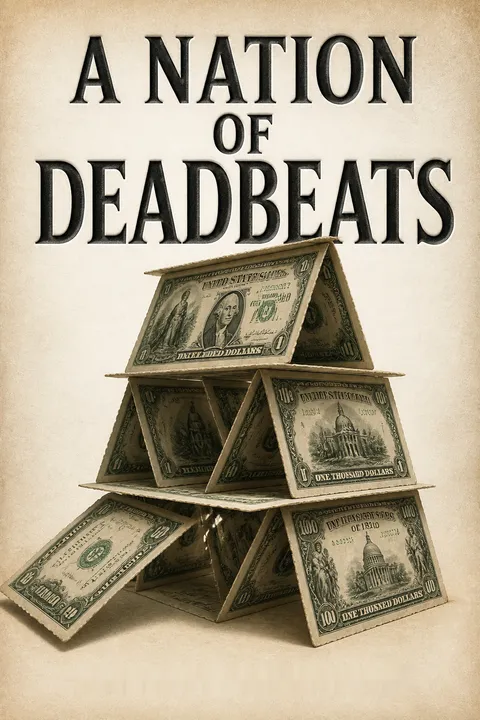
A Nation of Deadbeats examines America's financial panics from 1792 to 1929, revealing recurring patterns of asset bubbles, over-leveraging, and government intervention. Reviewers praise Nelson's chronological approach connecting economic crises to major political shifts, though some find the financial instruments complex and sourcing inadequate. The book illuminates overlooked panics (1792, 1819, 1837, 1857, 1873, 1893, 1907) that reshaped American history. Readers appreciate its accessibility and relevance to modern crises, though a few question the author's depth of economic understanding. Most consider it essential reading for understanding America's cyclical financial history.
People Also Read


Download PDF
Download EPUB
.epub digital book format is ideal for reading ebooks on phones, tablets, and e-readers.








































