
Key Takeaways
1. Objects as Our Earliest Storytellers
The book includes all sorts of objects, carefully designed and then either admired and preserved or used, broken and thrown away.
Silent witnesses. Objects are invaluable historical documents, especially for periods or cultures without written records. They offer unique insights into societies, environments, and human interactions, often revealing more than texts alone. From ancient tools to discarded pottery, these artifacts communicate across millennia, allowing us to reconstruct past lives and beliefs.
Making us human. The earliest human-made objects, like the Olduvai Stone Chopping Tool (1.8–2 million years old) and the Olduvai Handaxe (1.2–1.4 million years old), mark a pivotal moment in human evolution. These tools demonstrate:
- Early cognitive leaps: imagining a shape within a stone.
- Development of language: brain areas for tool-making overlap with speech.
- Dependency on technology: humans became unable to survive without the things they made.
This fundamental relationship between humans and their creations is what distinguishes us from other animals.
Unveiling the past. Modern scientific techniques continually yield new information from ancient objects without damaging them. For instance, CT scans of the Mummy of Hornedjitef (240 BC) reveal details about his health, diet, and mummification practices, while chemical analysis of materials helps reconstruct ancient trade networks. These methods allow us to place individuals within broader societal and economic contexts, enriching our understanding of ancient civilizations.
2. Agriculture: Reshaping Humanity and Its Gods
As the climate warmed up across the world and people gradually shifted from hunting and gathering to a more settled way of life based on farming, our relationship to the natural world was transformed.
A global revolution. Around 11,000 years ago, the end of the last Ice Age brought rapid climate change, leading to the independent development of farming in multiple regions worldwide. This shift from nomadic hunting and gathering to settled agriculture profoundly altered human life, creating:
- New food sources: selectively cultivated plants like wheat, rice, taro, and maize.
- Stable communities: allowing larger populations to live together.
- New social structures: with specialized roles and increased leisure.
The Bird-shaped Pestle (6000–2000 BC) from Papua New Guinea exemplifies early food preparation, while the Ain Sakhri Lovers Figurine (9000 BC) suggests new forms of human relationships and art in settled societies.
Divine sustenance. With settled life came a dependence on predictable weather and fertile land, leading to the emergence of new gods associated with food and climate. The Egyptian Clay Model of Cattle (3500 BC) shows the veneration of animals crucial for survival, while the Maya Maize God Statue (AD 715) illustrates a deity embodying the very substance of human creation and sustenance. These gods were central to ensuring the cyclical return of crops and the well-being of communities.
Dietary evolution. The adoption of new crops often required significant human ingenuity to make them edible. Many wild plants were indigestible or even poisonous raw, necessitating processes like soaking, boiling, or grinding. This selective adaptation, as seen with maize requiring lime treatment, highlights how human brains enabled us to exploit difficult food sources, fundamentally changing our diets and, over generations, our biology.
3. Cities and States: The Birth of Bureaucracy and Power
Coordinating groups of people on this scale obviously required new systems of power and control, and the systems devised in Mesopotamia around 3000 BC have proved astonishingly resilient.
Urban foundations. The world's first cities and states emerged in fertile river valleys like the Nile, Tigris, and Euphrates, supporting populations of tens of thousands. This unprecedented concentration of people necessitated new forms of governance beyond tribal structures. The King Den’s Sandal Label (2985 BC) from Egypt illustrates early pharaonic power, projecting the ruler as a divine, conquering commander-in-chief who guaranteed law and order through force.
Wealth and warfare. The Standard of Ur (2600–2400 BC) from Mesopotamia vividly depicts the dual nature of early urban power:
- Economic prosperity: one side shows citizens bringing tribute, supporting an elite.
- Military might: the other side portrays the king leading chariots in battle, trampling enemies.
This object, made from exotic materials like lapis lazuli from Afghanistan and red marble from India, demonstrates the extensive trade networks and specialized craftsmanship enabled by agricultural surpluses and centralized control.
Fragile empires. Not all early urban civilizations endured. The Indus Seal (2500–2000 BC) is a relic of the Indus Valley civilization, a highly organized urban culture with advanced sanitation and extensive trade, yet no clear evidence of kings or warfare. This civilization mysteriously collapsed around 1900 BC, likely due to climate change and deforestation, reminding us of the fragility of even sophisticated societies.
4. Writing: From Records to Literature and Ideas
Of all mankind’s great advances, the development of writing is surely the giant: it could be argued that it has had more impact on the evolution of human society than any other single invention.
Bureaucracy's birth. Early writing emerged around 5,000 years ago, primarily for practical record-keeping in complex urban states. The Early Writing Tablet (3100–3000 BC) from Mesopotamia, detailing beer rations, exemplifies this. Writing was essential for managing large populations, coordinating resources, and administering temples and trade, laying the groundwork for state control and public finance.
From facts to fiction. The crucial breakthrough to true writing came when symbols represented sounds, making phonetic language possible. This allowed writing to move beyond mere record-keeping to the investigation of ideas and the creation of literature. The Flood Tablet (700–600 BC), part of the Epic of Gilgamesh, demonstrates how ancient myths were recorded, predating biblical narratives and becoming the first great epic poem of world literature.
Transforming thought. Writing profoundly changed the human mind and society:
- Complex thought: enabling higher mathematics and philosophical arguments.
- New entities: creating concepts like money, corporations, and complex social structures.
- Individual authorship: fixing narratives and personal visions.
- Global literature: allowing stories to transcend language barriers through translation.
The Rhind Mathematical Papyrus (1550 BC) further illustrates the practical application of writing in Egyptian administration, showcasing the numeracy required for a complex state.
5. Empires: Projecting Power Through Image and Tolerance
Although there had been empires before, this was the first time regional superpowers emerged in different parts of the globe.
Imperial iconography. Rulers of vast empires, from Alexander the Great to Augustus, understood the power of images to project authority. The Coin with Head of Alexander (305–281 BC), minted posthumously by his successor Lysimachus, shows how a dead leader's image could be appropriated to legitimize new regimes, asserting divine connection and military prowess. This practice of image manipulation became a timeless political ploy.
Benevolent rule. Emperor Ashoka (238 BC) of India, after a brutal conquest, converted to Buddhism and promoted a philosophy of pluralistic, humane, and non-violent statecraft. His Pillar of Ashoka edicts, inscribed in local dialects, advocated religious tolerance, human rights, and education, establishing a tradition that influenced figures like Mahatma Gandhi and remains central to Indian political philosophy.
Strategic tolerance. The Roman Head of Augustus (27–25 BC) and the Ottoman Tughra of Suleiman the Magnificent (1520–1566) demonstrate different approaches to imperial control. Augustus's idealized image projected eternal youth and power across the Roman Empire, while Suleiman's tughra, a calligraphic emblem, symbolized his authority over a vast, multi-ethnic Islamic state. Both empires, at times, practiced strategic religious tolerance, as seen in Shah Abbas I building a Christian cathedral in Shi'a Isfahan, recognizing the economic and political benefits of diversity.
6. Global Connections: Trade, Faith, and Cultural Exchange
The Silk Road from China to the Mediterranean was at its peak between AD 500 and 800, the time of the so-called ‘Dark Ages’ in western Europe.
Interconnected worlds. Despite geographical distances, vast networks of trade connected continents, facilitating the exchange of goods, ideas, and religions. The Silk Road and Indian Ocean maritime routes were crucial arteries:
- Buddhism spread from India to China, Korea, and Indonesia (Borobudur Buddha Head, AD 780–840).
- Luxury goods like Chinese porcelain (Kilwa Pot Sherds, AD 900–1400) reached East Africa.
- Technologies and artistic styles diffused, as seen in the Korean Roof Tile (AD 700–800) influenced by Tang China.
These connections fostered cosmopolitan cultures and challenged Eurocentric views of history.
Syncretism and adaptation. Religions often adapted to local contexts, absorbing existing beliefs and practices. In Java, the Hindu epic Mahabharata was performed by Muslim puppeteers using the Shadow Puppet of Bima (AD 1600–1800), demonstrating a relaxed compromise between faiths. Similarly, the Hinton St Mary Mosaic (AD 300–400) in Roman Britain shows Christ alongside pagan deities, reflecting early Christianity's accommodation within a polytheistic world.
Scientific synthesis. The Hebrew Astrolabe (AD 1345–1355) from Spain exemplifies a vibrant intellectual synthesis, combining Classical Greek astronomy with Muslim, Jewish, and Christian scholarship. This period of convivencia in medieval Spain fostered scientific and philosophical advancements that profoundly influenced Europe, showcasing how diverse communities could coexist and contribute to shared knowledge.
7. The Human Body: Art, Ritual, and Identity
The human body, in all its forms, has been a constant subject of art and a canvas for expressing identity, belief, and social status across diverse cultures.
Sacred suffering. In many cultures, the body was central to religious rituals and expressions of piety. The Maya Relief of Royal Blood-letting (AD 700–750) depicts a queen piercing her tongue with thorns, an act of self-mortification intended to induce visionary trances and propitiate gods for the kingdom's success. This highlights how pain could be a pathway to transcendental experience and a demonstration of sacred power.
Divine forms. Religious art often sought to give physical form to deities or spiritual beings. The Statue of Tara (AD 700–900) from Sri Lanka, a gilded bronze figure of a Bodhisattva, embodies compassion and the power to save, reflecting a Buddhist tradition that combines divinity with sensuality. Similarly, the Shiva and Parvati Sculpture (AD 1100–1300) from India portrays God as a joyous, loving couple, emphasizing the divine nature of physical love and the integration of male and female aspects in the divine.
Ancestors and status. The body also served as a canvas for expressing social hierarchy and ancestral connections. The Ife Head (AD 1400–1500) from Nigeria, a brass portrait of a royal figure, exemplifies a sophisticated African artistic tradition that emphasized the head as the seat of the soul and identity. The Huastec Goddess Sculpture (AD 900–1521) from Mexico, with its geometric form and elaborate headdress, may represent either an elite figure or a mother goddess, reflecting complex ideas about fertility and purification.
8. Europe's Expansion: Technology, Trade, and Conflict
In the course of those 200 years Europe’s view of the world and its place in it was completely transformed.
Maritime revolution. Between 1450 and 1650, European maritime empires emerged, driven by new naval technologies like the galleon. The Mechanical Galleon (AD 1585) symbolizes this era, representing both advanced shipbuilding and the European state as a complex, ordered mechanism. These ships enabled Europeans to explore and connect with distant cultures, initiating the first truly global economy.
First encounters. European expansion led to varied interactions with indigenous societies:
- Benin Plaque: The Oba with Europeans (AD 1500–1600) from Nigeria documents a mutually beneficial trade relationship between the powerful Benin kingdom and Portuguese sailors, exchanging brass for ivory and pepper.
- Hawaiian Feather Helmet (AD 1700–1800) from Captain Cook's voyages illustrates fatal misunderstandings between Europeans and Hawaiians, highlighting the clash of different worldviews and the tragic consequences of cultural misinterpretation.
- Australian Bark Shield (AD 1770) from Botany Bay marks the "First Encounter" between Europeans and Aboriginal Australians, revealing a profound disconnect in understanding land ownership and communication, leading to centuries of dispossession.
Imperial ambitions. The Double-headed Serpent (AD 1400–1600) from Aztec Mexico, a turquoise mosaic, embodies the artistic and political power of the Aztec Empire, but also the systematic oppression of its subject peoples, who allied with the Spanish invaders. This object, possibly a gift to Cortés, symbolizes the destruction of a great civilization and the imposition of a new colonial order.
9. Mass Production and Global Money
For the peso de ocho reales, the Spanish piece of eight, was the first truly global money.
Global currency. The discovery of vast silver mines in Spanish America, particularly Potosí (Bolivia), led to the minting of Pieces of Eight (AD 1573–1598). These coins became the first truly global currency, circulating across Europe, Asia, Africa, and the Americas, underpinning the nascent world economy and financing Spain's imperial ambitions. This influx of silver had profound and often destabilizing effects on global financial markets.
Industrial transformation. The Industrial Revolution in Europe and America (1780–1914) transformed agricultural societies into industrial powerhouses, leading to mass production and consumption. The Early Victorian Tea Set (AD 1840–1845) symbolizes this shift, representing:
- Global trade: tea from India/China, sugar from the Caribbean.
- Social change: tea became a popular drink, promoted for temperance and social control among the working classes.
- Technological advances: mass-produced pottery made luxuries affordable.
Cultural exchange and resistance. Japan, initially isolated, was forced to open its ports by American gunships in 1853. Hokusai’s The Great Wave (AD 1830–1833), a woodblock print, reflects Japan's internal anxieties and external influences, incorporating European perspective and Prussian blue pigment. This image became an emblem of Japan's complex relationship with the modern world, influencing European art in return.
10. Ideologies and Identity: The 20th Century's Legacy
The twentieth century and beginning of the twenty-first were an era of unprecedented conflict, social change and scientific development.
Revolutionary art. The Russian Revolutionary Plate (AD 1921) embodies the Bolshevik dream of a new egalitarian society, transforming imperial porcelain into Soviet propaganda. It symbolizes the ideological struggle between liberal democracy and central state direction that defined much of the 20th century, showcasing how art was harnessed to build a new world and motivate the proletariat.
Post-colonial struggles. The Throne of Weapons (AD 2001) from Mozambique is a powerful monument to the victims of civil war, constructed from disarmed weapons. It represents the violent legacy of colonialism and the Cold War's ideological scrambles in Africa, but also a message of hope and reconciliation, transforming instruments of death into symbols of peace and rebuilding.
Evolving freedoms. David Hockney’s In the Dull Village (AD 1966) reflects the social and sexual revolutions of the 1960s, particularly the fight for gay rights. Published as homosexuality was being decriminalized in the UK, it challenged established norms and contributed to the broader movement for individual freedoms and human rights, highlighting the ongoing negotiation of societal values.
Globalized finance and ethics. The Credit Card (AD 2009) symbolizes the modern global economy, where money has lost its materiality and financial transactions transcend national boundaries. The emergence of Shariah-compliant banking, as seen on the HSBC Amanah card, reflects the return of religious and ethical considerations to the center of economic life, challenging purely secular financial models.
Review Summary
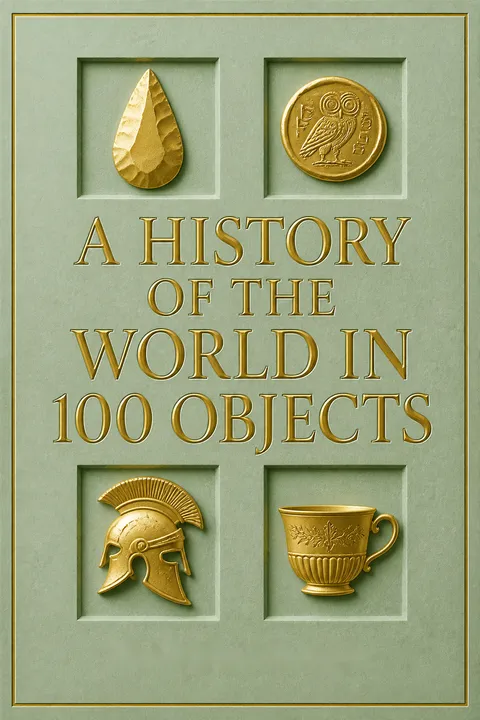
A History of the World in 100 Objects by Neil MacGregor presents human history through artifacts from the British Museum, spanning from two million years ago to 2010. Readers praise MacGregor's engaging writing style and ability to make objects reveal cultural stories. The book originated as a BBC Radio 4 series, structured into 100 short, accessible chapters. While many appreciate the global perspective and inclusion of ordinary objects alongside famous pieces, some criticize the British Museum's colonial acquisition methods and Eurocentric viewpoints. Most reviewers found it informative and entertaining, ideal for casual reading or as a reference guide to world history.
People Also Read


Download PDF
Download EPUB
.epub digital book format is ideal for reading ebooks on phones, tablets, and e-readers.








































