
Key Takeaways
1. The "Master Narrative" of America overlooks its multicultural reality.
"Race," observed Toni Morrison, has functioned as a "metaphor" necessary to the "construction of Americanness" : in the creation of our national identity, "American" has been defined as "white."
Challenging the narrative. The traditional "Master Narrative" of American history, popularized by figures like Frederick Jackson Turner and Oscar Handlin, presents a Eurocentric view where America was settled by European immigrants and "Americans are white." This narrative designates non-white groups as "the Other"—different, inferior, and unassimilable, leaving many feeling excluded from their own nation's story.
Demographic shifts. This narrow definition is increasingly challenged by America's expanding racial diversity. Today, one-third of Americans do not trace their ancestry to Europe, and in places like California, minorities are already the majority. This demographic shift highlights the urgent need for a more inclusive and accurate understanding of American history, recognizing that "Not all of us came originally from Europe!"
Inclusive history. The book argues that America is a nation "peopled by the world," and its true history is a "teeming nation of nations." By studying diversity inclusively and comparatively, focusing on groups like African Americans, Asian Americans, Irish Americans, Jewish Americans, Mexican Americans, Muslim Americans, and Native Americans, we can recover the "missing chapters" and understand how America became what it is today.
2. Early English colonization established patterns of "othering" and dispossession.
The Tempest, studied in relationship to its context, can help us answer these questions.
A theatrical preview. William Shakespeare's play The Tempest (1611) serves as a metaphor for early English expansion, reflecting the "othering" of indigenous peoples. Caliban, depicted as a "savage" and "born devil" with dark, "freckled" skin, was a racialized representation that resonated with English perceptions of both the "wild Irish" and Native Americans. This play foreshadowed the racial and cultural hierarchies that would define colonial America.
Irish "savagery." Before colonizing America, the English practiced brutal tactics in Ireland, defining the Catholic Irish as "pagan savages" lacking "civilization." They confiscated land, prohibited intermarriage, and committed atrocities, justifying their actions by portraying the Irish as lazy, brutish, and rebellious. This experience provided a "rehearsal" for the subsequent treatment of Native Americans.
Virginia's violent conquest. In Virginia, English colonizers, many veterans of Irish wars, quickly moved from dependency on Powhatan Indians for survival to violent dispossession. Driven by the insatiable demand for land for tobacco cultivation, they waged "total war," destroying villages and crops, and aiming to "root out [the Indians] from being any longer a people," thereby clearing the land for white settlement.
3. Slavery's rise was a calculated response to class conflict, solidifying racial hierarchy.
The rebels forced Berkeley to escape by ship and burned Jamestown to the ground.
Early labor dynamics. The first Africans in Virginia in 1619 were likely indentured servants, working alongside white indentured servants. Both groups experienced harsh exploitation and sometimes ran away or formed relationships together. However, Africans were gradually degraded into lifelong servitude, becoming property that could be inherited or gifted.
Bacon's Rebellion. The turning point was Bacon's Rebellion in 1676, a large-scale interracial uprising of discontented white indentured servants, slaves, and landless freemen against the elite. This "giddy multitude" threatened the social order, forcing the Virginia elite to choose between opening economic opportunities to poor whites or reorganizing society based on class and race.
"White over Black." After the rebellion, planters systematically turned to Africa for their primary labor supply, institutionalizing slavery and denying enslaved Africans the right to bear arms. New laws sharpened the "color line," defining who was "black" (including mulattoes) and restricting their freedom. This calculated shift created a caste labor system, ensuring social stability for the elite by dividing the working class along racial lines, with tragic consequences for centuries.
4. America's economic expansion fueled the displacement of Native Americans and the demand for diverse labor.
To follow to the tomb the last of his race and tread on the graves of extinct nations excite melancholy reflections.
Jackson's "progress." President Andrew Jackson, a hero of Indian wars and land speculator, championed Indian removal as moral and inevitable "progress." He justified the forced migration of tribes like the Choctaws and Cherokees westward, arguing that their disappearance was a natural consequence of advancing "civilization" and clearing the way for the Cotton Kingdom.
The Trail of Tears. The Choctaws and Cherokees, despite adopting "civilized" practices like farming and even owning slaves, were dispossessed through fraudulent treaties and state laws. The "Trail of Tears" saw thousands die from hunger, cold, and disease during forced marches, a process Alexis de Tocqueville observed as whites exterminating men "with singular felicity, tranquilly, legally, philanthropically."
End of the frontier. The relentless westward expansion, driven by the Market Revolution and the railroad, brought an end to the frontier and the traditional way of life for Plains Indians like the Pawnees. The decimation of the buffalo, their main food source, and the appropriation of their lands for white settlement and railroads, symbolized the triumph of "civilization" over "savagery," leaving Indians as "foreigners in their native land."
5. Irish immigrants faced nativism and leveraged "whiteness" for upward mobility.
"In a country of the whites where [white workers] find it difficult to earn a subsistence," they asked, "what right has the negro either to preference or to equality, or to admission?"
Exiles from Ireland. Millions of Irish, driven by English oppression, land confiscation, and the devastating Potato Famine, became "exiles" in America. They arrived impoverished, often in unsanitary conditions, and were forced into dangerous, low-wage labor in canal and railroad construction, earning the saying "an Irishman buried under every tie."
Nativism and "Irish niggers." As Catholics in a fiercely Protestant society, the Irish faced virulent nativism, stereotyped as ignorant, inferior, and "savage," often compared to blacks as "Irish niggers." They were seen as an unruly, disorderly class, threatening social stability and racial purity.
Leveraging "whiteness." To escape their degraded status and assimilate, many Irish immigrants actively promoted their "whiteness" and attacked blacks, competing for jobs and opposing black suffrage. Their political power, rooted in urban concentrations and high naturalization rates, allowed them to monopolize jobs in city services and unions, achieving significant upward mobility and securing "the wages of whiteness" by excluding other racial minorities.
6. Chinese immigrants built the West's infrastructure and agriculture, enduring severe exclusion.
"They call us ‘Chink,’" complained an old laundryman, cursing the "white demons." "They think we no good! America cut us off. No more come now, too bad!"
Gold Mountain dreams. Chinese migrants, fleeing British colonialism, peasant rebellions, and economic hardship in China, sought "Gold Mountain" in America, dreaming of wealth and opportunity. They arrived as free laborers, many under the "credit-ticket system," intending to return home, but often found themselves building the transcontinental railroad and developing California's agriculture.
Indispensable labor, unwelcome settlers. Chinese workers were praised for their industry and reliability, especially in hazardous tasks like railroad construction, where they comprised 90% of the workforce. However, their success provoked a nativist backlash, leading to the "foreign miners' tax" and violent "driving out" from mining camps and towns.
Exclusion and "yellow proletariat." The 1882 Chinese Exclusion Act, the first law to prohibit immigration based on nationality, effectively created a "yellow proletariat"—a permanently degraded, politically proscribed labor force. Denied citizenship and facing widespread discrimination, many Chinese men were forced into self-employment, like laundries, and lived as "bachelors" due to laws barring Chinese women, creating a unique "colony" in America.
7. Jewish immigrants, fleeing persecution, found both opportunity and anti-Semitism in America.
"There is a land, America, Where everyone lives free."
Exodus from Russia. Fleeing violent pogroms and pervasive anti-Semitism in Russia's Pale of Settlement, Jewish immigrants saw America as "the Promised Land" and a "Garden of Eden." Unlike most other European groups, they came as families, intending to settle permanently, driven by a desperate need for religious freedom and economic opportunity.
A vibrant, crowded "shtetl." Most settled in New York's Lower East Side, transforming it into a bustling, overcrowded "shtetl" with a "symphony of discordant noises" and "breathless enterprise." Despite squalid tenement conditions, they built a vibrant community with landsmanshafts, cafes, and peddlers, eager to shed their "greenhorn" identity and embrace American ways.
Garment industry and anti-Semitism. Many Jewish immigrants, particularly skilled tailors and seamstresses, found work in New York's booming garment industry, often in dangerous sweatshops. Their labor militancy led to major strikes, fostering a strong Jewish-American identity. However, their economic success and increasing numbers also fueled anti-Semitism, leading to discriminatory quotas at elite universities and restrictive immigration laws in 1924.
8. Mexican Americans became "foreigners in their native land," enduring exploitation and fighting for dignity.
"Our race, our unfortunate people will have to wander in search of hospitality in a strange land, only to be ejected later."
Conquest and displacement. The U.S. war against Mexico (1846-48) resulted in the annexation of vast territories, transforming Mexicans into "foreigners in their native land." Despite treaty guarantees, they faced political disenfranchisement, land loss through legal chicanery and economic pressures, and racial discrimination, often being stereotyped as lazy and inferior.
Caste labor system. Mexicans became an indispensable, yet exploited, labor force in the Southwest's expanding economy, working in agriculture, railroads, and mines. They were relegated to low-wage, unskilled jobs, often paid less than Anglos for the same work, and subjected to harsh conditions in migrant labor camps, where they were seen as "here today and elsewhere tomorrow."
Resistance and identity. Despite exploitation, Mexican workers actively resisted through strikes, forming interethnic unions (like the Japanese-Mexican Labor Association) and mutualistas (benevolent associations) to foster solidarity and cultural pride. These organizations reinforced a dynamic Mexican-American identity, a fierce determination to claim their rights and dignity in "occupied" Mexico, even as they built a new "barrio" world.
9. World War II exposed America's racial hypocrisy, igniting demands for equality from all minorities.
"No loyal citizen of the United States should be denied the democratic right to exercise the responsibilities of his citizenship, regardless of his ancestry."
Japanese American internment. Following the attack on Pearl Harbor, 120,000 Japanese Americans on the West Coast, two-thirds of them U.S. citizens, were forcibly removed to internment camps based on racial prejudice, not military necessity. This "tremendous hole in our constitutional system" was a stark contradiction to America's wartime rhetoric of fighting for freedom.
Fighting for democracy abroad and at home. African Americans served in a segregated military, facing discrimination and degrading assignments, yet fought heroically in combat units like the Tuskegee Airmen and the 761st Tank Battalion. On the home front, A. Philip Randolph's threat of a march on Washington forced President Roosevelt to issue an executive order banning discrimination in defense industries, opening new opportunities for black workers, including women.
Allies against racism. The war also forced a reevaluation of anti-Chinese laws, leading to the repeal of the Chinese Exclusion Act in 1943, partly to "silence the distorted Japanese propaganda." Mexican Americans, serving with distinction and suffering high casualty rates, fought for "Americans All," while Native Americans, like the Navajo code talkers, used their unique cultural heritage to aid the war effort, demonstrating the value of America's diversity.
10. The Civil Rights Movement achieved legal victories but revealed persistent economic and social divides.
"There comes a time when people get tired. We are here this evening to say to those who have mistreated us so long that we are tired—tired of being segregated and humiliated; tired of being kicked about by the brutal feet of oppression."
Rising winds for justice. Post-WWII, a "wind of determination" for freedom and equality swept through minority communities. Japanese Americans won landmark court cases against discriminatory land laws and gained naturalized citizenship, eventually securing redress for internment. Mexican Americans, through organizations like the American GI Forum, fought for desegregation and economic justice, setting precedents for future civil rights victories.
The Montgomery moment. The Civil Rights Movement, sparked by Rosa Parks' defiance and led by Martin Luther King, Jr., shifted the struggle from courts to communities. The Montgomery bus boycott, sit-ins, and freedom rides, driven by nonviolent direct action, challenged segregation and inspired a generation to fight for dignity and self-respect, with significant support from Jewish Americans who remembered their own history of persecution.
Dreams deferred. Despite legal victories like Brown v. Board of Education and the Civil Rights Act of 1964, structural economic inequality persisted, particularly in northern ghettos. The "airtight cage of poverty," exacerbated by deindustrialization and suburbanization, led to urban unrest like the Watts riot, revealing a class divide within black America and a shift towards Black Power and separatist ideologies that challenged the integrationist vision.
11. New waves of immigrants and refugees continue to reshape America's diverse identity.
"A half-century from now, when your own grandchildren are in college, there will be no majority race in America."
Global "tempests" and new arrivals. Recent decades have seen new waves of immigrants and refugees, fleeing political strife, economic hardship, and war from Russia, Ireland, China, Vietnam, and Afghanistan. These "tempest-tost" individuals, often arriving with little, have sought sanctuary and a fresh start, transforming America into an even more complex multicultural tapestry.
Challenges and reinvention. These newcomers face unique challenges, from language barriers and underemployment to nativist backlashes and the struggle to maintain cultural identity while adapting to American life. Yet, like earlier generations, they are reinventing themselves, building new communities, and contributing to the nation's economy and culture, from Vietnamese "Little Saigons" to Afghan "Little Kabuls."
A multiracial destiny. America's future is undeniably multiracial, a "borderland" where diverse cultures and peoples "edge each other." The challenge is to move beyond the "black/white binary" and embrace an inclusive history that acknowledges the "varied carols" and "mystic chords of memory" of all its peoples. This "re-visioned" history is essential for building a truly multiracial democracy where "equality is in the air we breathe."
Review Summary
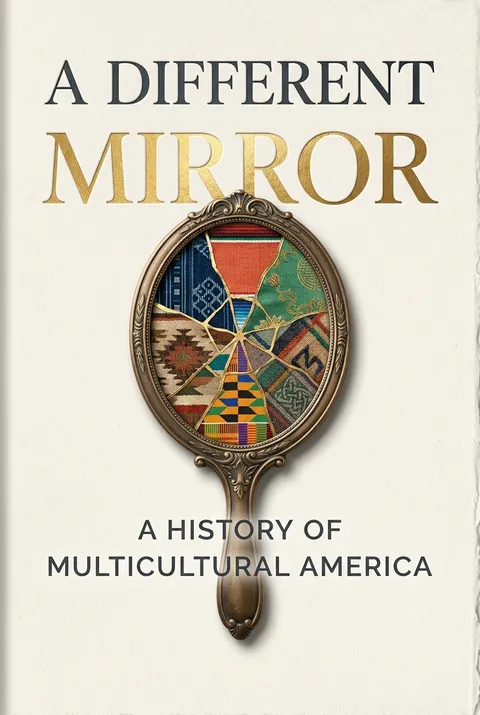
A Different Mirror by Ronald Takaki examines American history through the experiences of diverse ethnic groups including Native Americans, African Americans, Irish, Chinese, Japanese, Mexican, and Jewish Americans. Readers praise its accessible writing style and use of personal accounts to illuminate overlooked histories of immigration, discrimination, and resilience. Many reviewers appreciate how it challenges traditional Eurocentric narratives and reveals systemic racism throughout American development. Some critics note the book can feel formulaic or lacks analytical depth, while a few dismiss it as biased. Overall, most consider it essential reading for understanding America's multicultural reality, though its density and 440+ pages may challenge casual readers.
People Also Read






Download PDF
Download EPUB
.epub digital book format is ideal for reading ebooks on phones, tablets, and e-readers.








































