

Key Takeaways
The same people clash on drugs, taxes, and war for one hidden reason
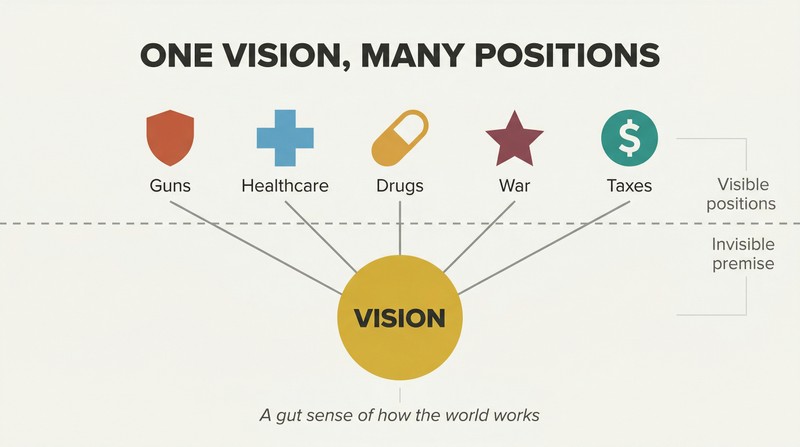
A hidden pattern explains political clustering. It's not coincidence that someone's position on gun control predicts their stance on healthcare, drug legalization, and foreign policy. Sowell argues these alignments stem from fundamentally different premises about how the world works — premises so deep most people never examine them. He calls these premises "visions" — what Schumpeter termed a "pre-analytic cognitive act." A vision is a gut sense of causation that precedes formal reasoning.
Visions function like maps. They simplify the overwhelming complexity of reality, highlighting certain paths while omitting others. They're indispensable for navigating the social world, but dangerous when confused with reality itself. Sowell's purpose is to make these invisible assumptions visible — not to determine which vision is correct, but to reveal the logic behind each.
Every political battle traces back to two rival views of human nature
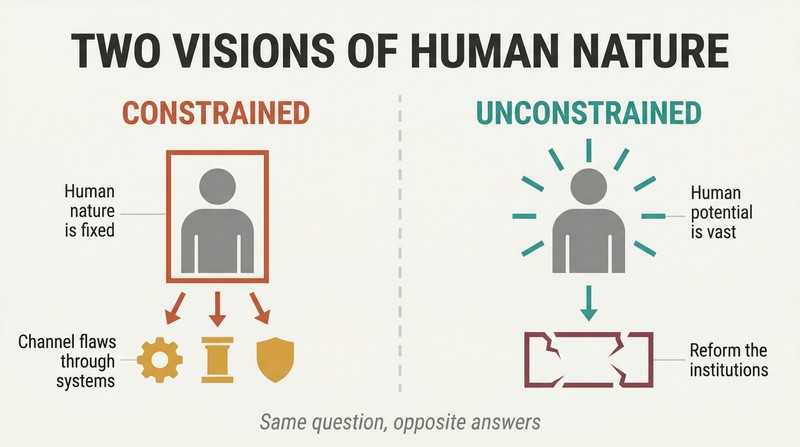
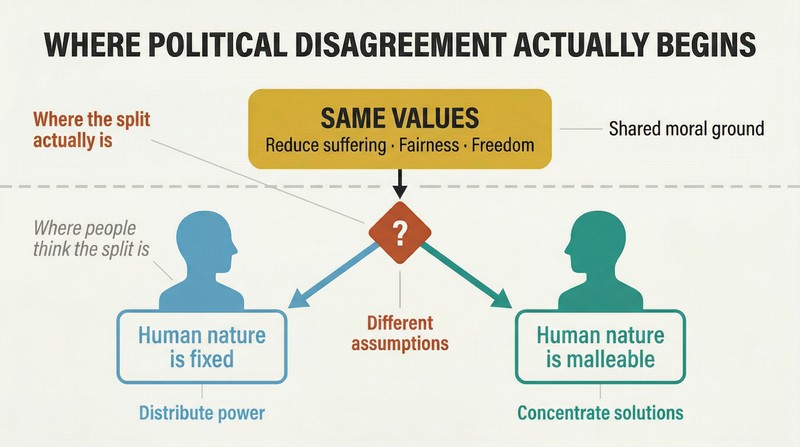
Two master visions split humanity. The constrained vision — championed by Adam Smith, Edmund Burke, the authors of The Federalist Papers, and later Hayek and Friedman — holds that human nature is permanently limited: selfish, short-sighted, and largely unchangeable. Society's task is to channel these flaws productively through evolved systems like markets, traditions, and constitutional checks.
The unconstrained vision flips this entirely. William Godwin, Condorcet, Rousseau, and later thinkers like Galbraith and Dworkin see human potential as vast and untapped. The evils of the world result from bad institutions, not inherent human limitation. Neither vision claims humans are completely constrained or perfectible — the question is which assumption sits at the center of your theory. That foundational choice ripples outward into every policy domain.
One side sees only trade-offs where the other insists solutions exist
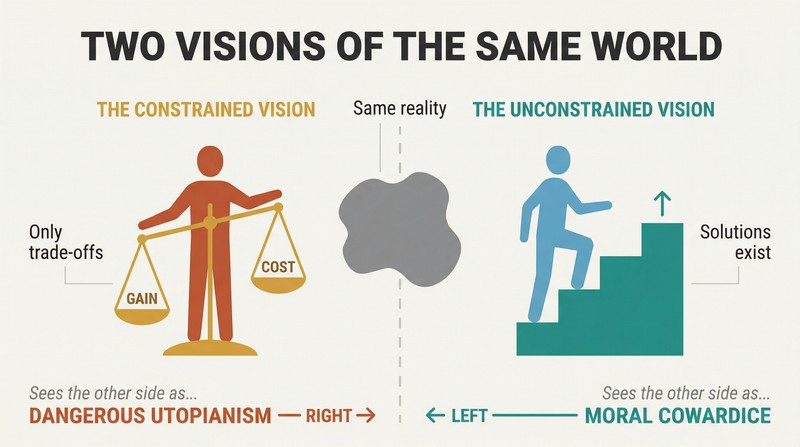
Prudence vs. perfectibility defines the split. Burke called prudence "the first of all virtues" because in a world of inherent limitations, carefully weighing competing costs is the best anyone can do. Markets reward the undeserving, punishment is harsh, inequality persists — all painful but unavoidable trade-offs. The unconstrained vision rejects this resignation. Condorcet predicted people would eventually fulfill duties "by a natural inclination" that today costs effort. Godwin argued man is "perfectible" — not reaching perfection, but capable of continual improvement without fixed limit.
The conflict is visceral. When you believe solutions exist, accepting trade-offs feels like moral cowardice. When you don't, pursuing solutions feels like dangerous utopianism. This is why each side finds the other's position not just wrong but morally inexcusable.
Political opponents usually share your values — not your assumptions
The proof is in the conversions. Both Adam Smith and William Godwin were revolted by inequality and privilege in the eighteenth century. Both Milton Friedman and Ronald Dworkin found modern economic disparities offensive. The difference was causal, not moral. Smith believed human nature couldn't be trusted with concentrated power; Godwin believed reason could eventually make redistribution voluntary.
Mass ideological shifts confirm this. When intellectuals embraced Marxism during the Great Depression, their values didn't change — their vision of what capitalism could deliver did. When they abandoned Marxism after the Nazi-Soviet pact of 1939 or the Hungarian uprising of 1956, they experienced the same horror at suffering. Only their vision of who was causing it shifted.
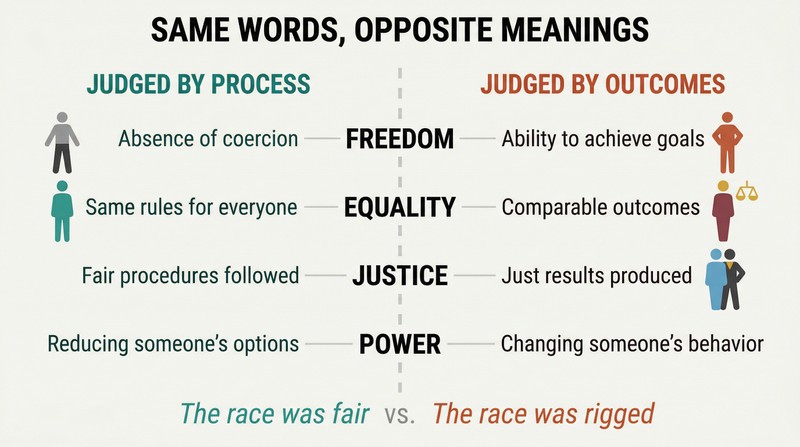
One vision judges fairness by rules; the other by outcomes
Freedom, equality, justice, and power all split into opposing definitions. In the constrained vision, these are all process characteristics:
1. Freedom = absence of coercion
2. Equality = same rules for everyone
3. Justice = following agreed procedures
4. Power = reducing someone's existing options
In the unconstrained vision, these same words are result characteristics:
1. Freedom = effective ability to achieve goals
2. Equality = comparable outcomes
3. Justice = just results regardless of procedure
4. Power = ability to change someone's behavior
This semantic gap explains why debates go nowhere. One side says "the race was fair" because the rules were equal. The other says "the race was rigged" because the starting positions weren't. They use identical words to describe incompatible concepts.
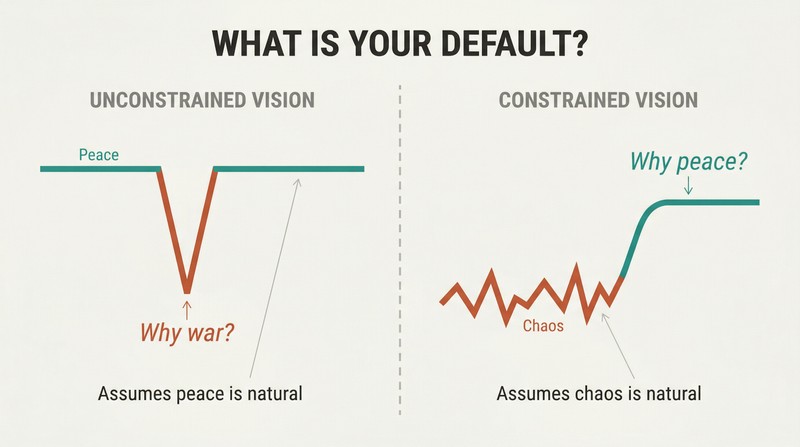
Seek the causes of peace, not the special causes of war
The default state matters enormously. If human nature is inherently peaceful, then war and crime demand special explanation — bad institutions, poverty, discrimination. But if human nature is inherently aggressive and selfish, then war and crime are the natural state, and what requires explanation is how civilization restrains them. The Federalist Papers took it as obvious that the thirteen colonies, if disunited, would be perpetually at war. No special cause needed.
Crime follows the same logic. The constrained vision sees moral training and deterrence as fragile barriers holding back natural impulses. The unconstrained vision sees crime as evidence of social failure — fix poverty, discrimination, and alienation, and crime dissolves. One side asks "why did he rob?" The other asks "why don't more people rob?"
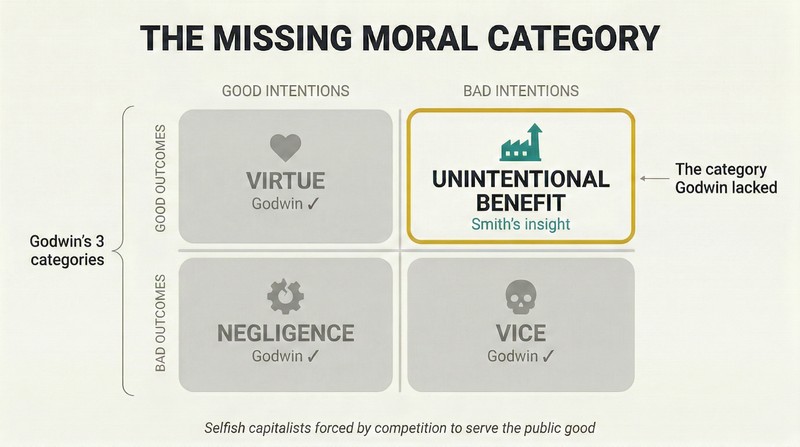
Smith despised capitalists but championed capitalism anyway
Unintentional benefit is the missing category. Godwin's moral framework classified actions into virtue (intentional benefit), vice (intentional harm), and negligence (unintentional harm). He had no place for unintentional benefit — precisely the concept at the heart of Smith's economics. Smith described capitalists as driven by "mean rapacity" who conspired against the public whenever they met. Yet competition forced them to serve consumers better than their intentions would ever suggest.
This inversion horrifies the unconstrained vision. If intentions define morality, then a system built on selfishness is inherently corrupt, however prosperous. If systemic outcomes matter, then widespread prosperity through selfish motives is morally justified — or at least the best available trade-off. The American Constitution reflected this logic: elaborate checks and balances designed for flawed humans, not angels.
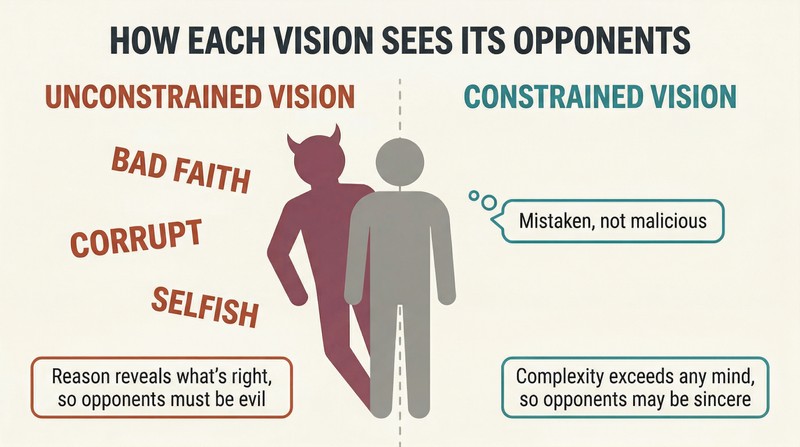
One vision demonizes opponents; the other merely thinks them mistaken
The logic of each vision predicts this asymmetry. If humans can clearly discern the common good through reason, then intelligent opponents must be morally corrupt or blinded by self-interest — otherwise why would they resist beneficial policies? The unconstrained vision thus tends toward accusations of bad faith, calls to unmask "real" motives, and charges of being apologists for privilege.
The constrained vision expects disagreement. If social complexity exceeds any individual's grasp, then even brilliant, well-meaning people can be dangerously wrong. Burke observed that adversaries "may do the worst of things without being the worst of men." Hayek's The Road to Serfdom was generous to opponents, calling them "single-minded idealists" — yet the book made him a moral leper to much of the left.
Social justice is paramount to one side, literally meaningless to the other
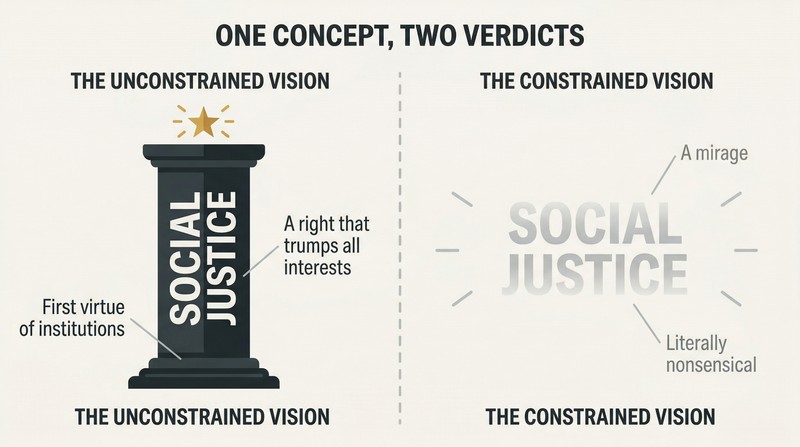
No other concept crystallizes the divide so sharply. Godwin's 1793 Enquiry may be the first treatise on social justice, arguing that every talent, moment of time, and shilling of property is owed to the common good. Rawls made justice the absolute "first virtue" of institutions — never to be traded off, even for a well-run society. Rights grounded in justice are "trumps" that always prevail over mere interests.
Hayek found the concept literally nonsensical. He called social justice "absurd," "a mirage," "a quasi-religious superstition," and "a hollow incantation." Demanding justice from an unplanned systemic process, he argued, is like demanding the weather be fair. Friedman and Posner don't even bother discussing it — the concept is either paramount or invisible.
Evidence can't settle political visions the way experiments settle physics
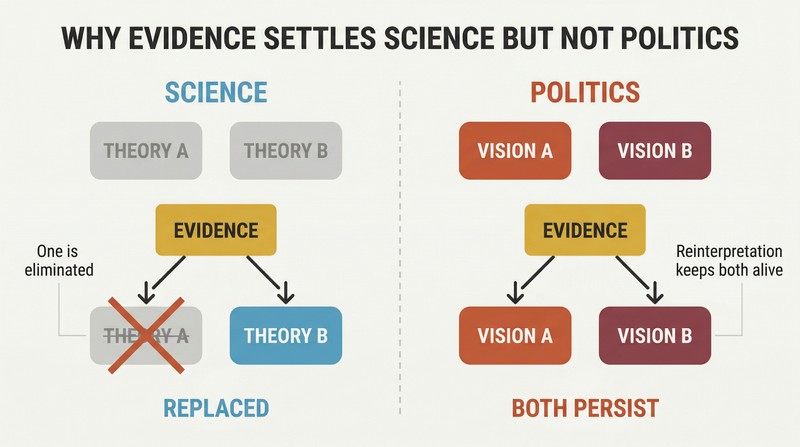
Science replaces paradigms; politics can't. The phlogiston theory didn't coexist with oxidation theory for centuries — one replaced the other when evidence accumulated. But the constrained and unconstrained visions have survived side by side for over two hundred years because social theories can't be tested in controlled experiments. You can't rerun history without Hitler or replay the Roman Empire with different policies.
Evidence gets absorbed, not resolved. Malthus's population theory was reformulated so both rising and falling living standards became "consistent" with it — making it unfalsifiable. The oft-repeated claim that broken black families were a "legacy of slavery" went unchallenged for decades until research revealed intact families were far more common among blacks during and after slavery than today. Visions survive because contradictory evidence can always be reinterpreted.
Analysis
Published in 1987, A Conflict of Visions reads as though it was written for the polarization crises of the 2020s. Sowell's central insight — that political disagreements across unrelated domains trace back to rival conceptions of human nature — anticipated the moral psychology of Jonathan Haidt (The Righteous Mind, 2012) and the evolutionary arguments of Steven Pinker (The Blank Slate, 2002) by decades. Where Haidt identified six moral foundations clustering differently in liberal and conservative minds, Sowell provides more parsimonious architecture: a single axis of variation — how constrained you believe human nature to be — that generates predictable downstream positions on economics, law, crime, war, and equality.
The framework's greatest strength is its charity. By demonstrating that opposing political camps derive logically from different causal premises, Sowell short-circuits the moralistic reflex to attribute opponents' views to stupidity or malice. This makes the book uniquely valuable for depolarization — not because it resolves the conflict, but because it makes it intelligible. In an era where social media rewards moral certainty and punishes nuance, understanding that your opponents may share your values but not your assumptions about human capability is genuinely radical.
Its primary limitation is the binary itself. Sowell acknowledges hybrid visions — Marxism, utilitarianism, libertarianism — but the dichotomy inevitably flattens real ideological diversity. Modern populists suspicious of both free markets and progressive social engineering fit neither mold. Religious nationalists invoke constrained-vision symbols while concentrating unconstrained power in charismatic leaders — precisely the fascist hybrid Sowell identifies but cannot fully integrate.
Sowell presents the analysis as neutral, but readers of his other works know his sympathies lie firmly with the constrained vision. The book's structure subtly reflects this: constrained arguments often receive the final word. Still, the framework's diagnostic power transcends its author's preferences. If you can identify which vision animates a policy proposal — and which unstated assumptions about human nature underpin it — you can predict its implications more clearly than any partisan label allows.
Review Summary
A Conflict of Visions explores two competing worldviews: constrained and unconstrained. The book offers insights into political differences, human nature, and social institutions. Readers appreciate Sowell's balanced approach and thought-provoking analysis, though some find it challenging to follow. Many consider it enlightening, praising its depth and relevance to understanding political divides. While some criticize Sowell's bias, others commend his intellectual honesty. The book's enduring popularity stems from its ability to shed light on fundamental ideological differences.
People Also Read


Glossary
Constrained vision
Human nature is permanently limitedA social vision holding that human beings are inherently selfish, intellectually limited, and morally flawed in ways that cannot be fundamentally changed. Social policy must therefore work within these constraints through evolved systemic processes (markets, traditions, constitutions) rather than attempt to redesign human nature. Associated with Adam Smith, Edmund Burke, Hayek, and Friedman.
Unconstrained vision
Human potential is vast and improvableA social vision holding that human nature has enormous untapped moral and intellectual potential that can be developed through better institutions, education, and social arrangements. Evils like war, poverty, and crime result from flawed institutions rather than inherent human limitation. Solutions—not mere trade-offs—are achievable. Associated with Godwin, Condorcet, Rousseau, and Dworkin.
Pre-analytic cognitive act
Gut sense preceding formal theoryA term borrowed from economist Joseph Schumpeter describing the intuitive sense of how the world works that precedes any systematic reasoning or theory-building. Sowell uses it to define a 'vision'—the foundational, often unexamined assumptions about causation from which theories are subsequently constructed and hypotheses derived.
Systemic rationality
Wisdom embedded in evolved processesThe form of rationality central to the constrained vision, in which knowledge and effective decision-making emerge from the interaction of countless individuals through evolved social processes—markets, traditions, legal precedents, languages—rather than from any individual's deliberate reasoning. The 'intelligence' is in the system, not in any participant.
Articulated rationality
Explicitly reasoned individual knowledgeThe form of rationality central to the unconstrained vision, in which knowledge consists of facts, logic, and principles that can be explicitly stated and debated. It privileges the cultivated reasoning of educated individuals over unarticulated customs or traditions, and is the basis for deliberate social planning and institutional design.
Surrogate decision-makers
Elites deciding for the collectiveIndividuals or institutions who exercise discretion on behalf of the broader population—judges, planners, regulators, or intellectual leaders. Central to the unconstrained vision, where those who have advanced furthest toward human potential guide collective decisions. The constrained vision views such concentration of discretion as dangerous, preferring decisions dispersed among millions through systemic processes.
Locus of discretion
Where social decisions originateOne of Sowell's two operational criteria for distinguishing constrained from unconstrained visions. It asks: Are social decisions made collectively by surrogate decision-makers (unconstrained), or do they emerge systemically from innumerable individuals exercising personal discretion in their own interest (constrained)? Combined with the mode of discretion, it provides a diagnostic framework for classifying social theories.
Mode of discretion
How social decisions are madeThe second of Sowell's two operational criteria for classifying visions. It asks: Are decisions made through explicitly articulated rationality aimed at the common good (unconstrained), or through self-interested individual choices within systemic incentive structures like competitive markets (constrained)? Together with the locus of discretion, it determines whether a social theory belongs to the constrained or unconstrained tradition.
FAQ
What's A Conflict of Visions about?
- Exploration of Ideological Conflicts: Thomas Sowell's book examines the fundamental ideological differences that shape political struggles, focusing on the underlying assumptions of various visions of human nature and society.
- Constrained vs. Unconstrained Visions: Sowell categorizes visions into two main types: the constrained vision, which sees human nature as limited and self-interested, and the unconstrained vision, which views human potential as expansive and capable of moral improvement.
- Historical Context: These conflicting visions have influenced political thought and action for centuries, shaping debates on justice, equality, and power.
Why should I read A Conflict of Visions by Thomas Sowell?
- Understanding Political Ideologies: The book provides insights into the ideological origins of political struggles, helping readers understand the motivations behind various political movements and policies.
- Framework for Analysis: Sowell offers a framework for analyzing contemporary issues by understanding the visions that underpin them, making it relevant for both political enthusiasts and scholars.
- Timeless Relevance: The themes discussed are not only historical but continue to resonate in modern political discourse, making the book a valuable resource for understanding current events.
What are the key takeaways of A Conflict of Visions?
- Two Core Visions: The primary takeaway is the distinction between constrained and unconstrained visions, which influence how individuals perceive human nature, morality, and social processes.
- Impact on Policy: Sowell illustrates how these visions lead to different policy prescriptions, particularly regarding issues like equality, justice, and the role of government.
- Historical Continuity: The book emphasizes that these ideological conflicts are not new but have persisted throughout history, affecting societal development and political thought.
What are the best quotes from A Conflict of Visions and what do they mean?
- “We will do almost anything for our visions, except think about them.”: This quote highlights how deeply held beliefs can drive actions, often without critical examination of their implications.
- “A conflict of visions differs from a conflict between contending interests.”: Sowell distinguishes between ideological disagreements and those based on self-interest, suggesting that understanding the former is crucial for resolving political disputes.
- “The peace and order of society is of more importance than even the relief of the miserable.”: This reflects the constrained vision's prioritization of systemic stability over direct interventions aimed at achieving equality or justice.
What are the differences between constrained and unconstrained visions in A Conflict of Visions?
- Nature of Man: The constrained vision views human nature as inherently flawed and self-interested, while the unconstrained vision sees potential for moral improvement and altruism.
- Approach to Solutions: Constrained vision advocates for trade-offs and systemic processes to manage human limitations, whereas the unconstrained vision seeks direct solutions to social problems through rational planning.
- Implications for Policy: These differing views lead to contrasting policy recommendations, with the constrained vision favoring limited government intervention and the unconstrained vision supporting more active roles for government in achieving social justice.
How does Thomas Sowell define knowledge and reason in A Conflict of Visions?
- Knowledge as Experience: In the constrained vision, knowledge is seen as a collective experience that evolves over time, emphasizing the importance of tradition and systemic processes.
- Articulated Rationality: The unconstrained vision prioritizes articulated rationality, where knowledge is derived from explicit reasoning and individual understanding, often leading to a belief in the capacity for social engineering.
- Role of Experts: Sowell discusses how the unconstrained vision relies on experts to guide social decisions, while the constrained vision emphasizes the wisdom of collective experience over individual expertise.
What role do visions play in social processes according to A Conflict of Visions?
- Guiding Framework: Visions serve as frameworks that shape how individuals and societies interpret events, make decisions, and interact with one another.
- Influence on Policy: The underlying vision affects policy outcomes, as those with a constrained vision focus on systemic processes, while those with an unconstrained vision advocate for direct interventions.
- Historical Context: Understanding these visions is essential for grasping the historical context of political ideologies and their evolution over time.
How does A Conflict of Visions relate to contemporary political issues?
- Relevance to Modern Politics: The book's exploration of constrained and unconstrained visions provides a lens through which to analyze current political debates, such as those surrounding social justice, economic inequality, and government intervention.
- Framework for Analysis: Readers can apply Sowell's framework to understand the motivations behind various political movements and the implications of their proposed policies.
- Enduring Ideological Conflicts: The ideological conflicts discussed in the book continue to manifest in contemporary political discourse, making it a timely resource for understanding ongoing debates.
What are the implications of Sowell's analysis for understanding justice in A Conflict of Visions?
- Justice as Process vs. Result: In the constrained vision, justice is defined by adherence to established processes and rules, while in the unconstrained vision, it is viewed as achieving equitable results.
- Moral Responsibility: Sowell emphasizes that the understanding of justice is deeply tied to the underlying vision of human nature, affecting how societies define and pursue justice.
- Consequences of Policy: The differing definitions of justice lead to contrasting policy approaches, with the constrained vision focusing on maintaining order and the unconstrained vision advocating for systemic changes to achieve fairness.
How does Thomas Sowell address the concept of equality in A Conflict of Visions?
- Equality of Process: The constrained vision emphasizes equality in terms of processes, ensuring that everyone is treated fairly under the same rules, regardless of the outcomes.
- Equality of Results: The unconstrained vision seeks to equalize outcomes, advocating for policies that address disparities in wealth and opportunity.
- Trade-offs and Consequences: Sowell discusses the trade-offs involved in pursuing equality, highlighting the potential negative consequences of policies aimed at achieving equal results, such as reduced incentives for productivity.
How does A Conflict of Visions explain the role of power in society?
- Power as Explanatory Tool: Sowell argues that the unconstrained vision attributes much of social change to the deliberate exertion of power, viewing unhappy social circumstances as the result of power dynamics.
- Systemic Processes: In contrast, the constrained vision sees many social outcomes as the result of systemic processes that are not controlled by any individual or group.
- Moral Implications: The differing views on power have significant moral implications, as the unconstrained vision often calls for intervention to correct perceived injustices, while the constrained vision warns against the dangers of concentrated power.
What insights does A Conflict of Visions provide on economic policies?
- Market vs. Central Planning: Sowell contrasts the constrained vision's support for market economies with the unconstrained vision's advocacy for central planning and regulation.
- Role of Incentives: The book discusses how the constrained vision emphasizes the importance of incentives in shaping economic behavior, while the unconstrained vision often overlooks these dynamics in favor of moral imperatives.
- Historical Context: Sowell places these economic debates within a historical context, showing how the two visions have influenced economic thought and policy decisions over time.
About the Author
Other books by Thomas Sowell

Download PDF
Download EPUB
.epub digital book format is ideal for reading ebooks on phones, tablets, and e-readers.








































