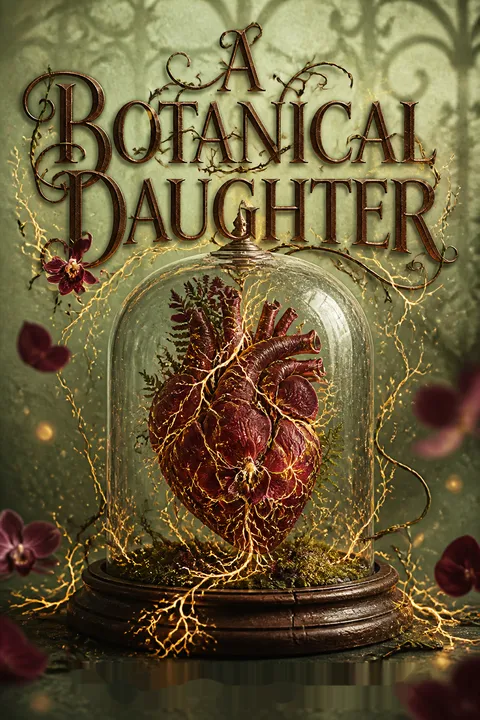

Plot Summary
Glasshouse Sanctuary Unveiled
Simon Rievaulx and Gregor Sandys, two eccentric bachelors, live in the lush, secretive Grimfern Botanical Garden, a Victorian glasshouse brimming with rare plants and curiosities. Their home is a sanctuary from the prying eyes of the village, a place where Gregor's botanical genius and Simon's macabre taxidermy coexist in uneasy harmony. The glasshouse is both a haven and a prison, its beauty and transparency hiding the private lives and forbidden love of its inhabitants. Their routines are precise, their boundaries clear—each man guards his workspace jealously. Yet, beneath the surface, the glasshouse is a crucible for secrets, longing, and the seeds of something monstrous and miraculous.
The Missing Laundry Girl
The daily rhythm is disrupted when Jennifer Finch, the laundry girl, fails to appear. Her absence is more than a minor inconvenience; it signals a rupture in the fragile order of Grimfern. Simon, meticulous and reserved, is unsettled by the disorder, while Gregor is distracted by the arrival of a mysterious crate from Indonesia. The village whispers of tragedy—Jennifer's friend Constance has died under suspicious circumstances. Grief and poverty press Jennifer to seek more work, and Simon, moved by her plight, offers her a position as housekeeper. Her entry into the glasshouse marks the beginning of new alliances and the intrusion of raw, human sorrow into the cultivated world of Grimfern.
A Fungal Discovery
Gregor's long-awaited crate contains a rare Sumatran mycelium entwined with an exquisite orchid. The fungus displays uncanny intelligence, closing its crate to protect the orchid from light and watering it when needed. Gregor is enthralled, seeing in this symbiosis the possibility of consciousness in botanical life. He begins a series of experiments, pushing the boundaries of science and ethics. The fungus becomes an obsession, a living puzzle that promises to bridge the gap between plant and animal, life and death. Its presence in the glasshouse is both a marvel and a harbinger of the unnatural, setting the stage for a creation that will challenge the very definition of humanity.
Grief and New Beginnings
Jennifer, raw from the loss of her beloved friend Constance, is drawn into the world of Grimfern. Her grief is palpable, her spirit blustery yet wounded. The glasshouse, with its riot of color and life, offers her a strange solace and a new beginning. She is awed by its beauty, yet haunted by memories of Constance and the judgment of the village. Gregor and Simon, each in their own way, are moved by her vulnerability and resilience. Jennifer's presence brings a new dynamic to the household—a touch of the wild, the honest, and the unrefined. Her arrival is the first step in a transformation that will bind her fate to the monstrous experiment taking root in the house.
The Orchid's Guardian
Gregor's fascination with the mycelium deepens as he observes its ability to care for the orchid, protect it from harm, and even water it. He theorizes about consciousness in plants and fungi, dreaming of creating a botanical intelligence. His notes become feverish, blending scientific rigor with philosophical speculation. The glasshouse becomes a laboratory for the impossible, and Gregor's ambitions swell. He envisions a new form of life—a cultivated intelligence that could rival human complexity. The boundaries between creator and creation, nature and artifice, begin to blur, as Gregor prepares for an experiment that will demand a human substrate.
A Housekeeper's Grief
Jennifer's days are filled with cleaning, but her mind is never far from Constance's grave. She weaves wildflowers into her hair, a daily ritual of remembrance. The glasshouse is both a refuge and a reminder of loss. She finds herself drawn to the strange, beautiful things in Simon's basement—taxidermy animals, a mysterious slime, and the sense of secrets lurking beneath the surface. Her grief is a kind of exhaustion, but also a source of strength. She becomes an integral part of the household, her presence grounding the men even as she is haunted by the past. The stage is set for her to play a pivotal role in the coming resurrection.
The Substrate Acquired
Driven by scientific ambition and moral ambiguity, Gregor and Simon exhume Constance's body from her shallow grave beneath the twisted hazel. The act is both sacrilegious and desperate—a theft of innocence for the sake of creation. The body is brought to the basement, where Simon's skills as a taxidermist and Gregor's botanical genius will be united. The corpse is prepared as a substrate for the mycelium, its wounds examined and its secrets uncovered. The men are haunted by the implications of their act, but the momentum of the experiment is unstoppable. Constance's body becomes the vessel for something new, her identity both erased and preserved.
Botanical Resurrection
In the darkness of the basement, Gregor and Simon work together to transform Constance's corpse into a vessel for the mycelium and a host of carefully selected plants. Joints are replaced with dancing plants, fingers with flytraps, and the nervous system with fungal threads. The process is both scientific and sacramental—a grotesque parody of birth. The result is a botanical daughter, a being that is neither human nor plant, but something in between. She is named CHLOE, an epithet of the goddess of new life. The men are both creators and parents, their roles complicated by guilt, pride, and the dawning realization of what they have unleashed.
The Daughter Grows
CHLOE's growth is rapid and unsettling. She learns to move, to see, to respond to touch and music. Her presence in the glasshouse is both wondrous and terrifying. She is a child, a monster, and a mirror for the hopes and fears of her creators. As she becomes more autonomous, the boundaries of control and affection blur. Gregor is both father and scientist, Simon both artist and guardian. Jennifer, drawn to CHLOE's innocence and strangeness, becomes her governess and protector. The household is transformed into a found family—improvised, unconventional, and fraught with tension. But CHLOE's power is growing, and with it, the risk of catastrophe.
Family Fractures
The fragile family at Grimfern is strained by secrets, jealousy, and the growing autonomy of CHLOE. Gregor's obsession with control leads him to fire the groundskeepers and seal the house. Simon and Jennifer form a bond over their shared care for CHLOE, while Gregor's rivalry with his old nemesis Julian Mallory looms. CHLOE's desire for the outside world intensifies, and Jennifer becomes her confidante and co-conspirator. The glasshouse, once a sanctuary, becomes a prison. The lines between love and possession, protection and captivity, are drawn ever tighter, setting the stage for rebellion and escape.
The Creature's Awakening
Gregor's final experiment gives CHLOE a voice—a complex system of bellows, pipes, and fungal tongues. Her first attempts at speech are chaotic and painful, but she quickly learns to mimic, to sing, and to express herself. The gift of language brings both joy and terror. CHLOE's desires become clear: she wants freedom, love, and connection. Her rebellion is inevitable. Jennifer, moved by CHLOE's suffering and longing, becomes her champion. The men are forced to confront the consequences of their creation, as CHLOE's power threatens to break the boundaries of the glasshouse and the family itself.
The Governess and the Monster
Jennifer's relationship with CHLOE deepens into love—a love that is both maternal and romantic, human and inhuman. She risks everything to protect CHLOE from Gregor's increasingly desperate attempts at control. The two women plot their escape, aided by Simon's quiet rebellion. The glasshouse becomes a battleground of wills, with Jennifer's courage and CHLOE's yearning pitted against Gregor's fear and pride. The lines between monster and daughter, governess and lover, blur in the heat of their devotion. The stage is set for a flight into the unknown, and for the ultimate test of love and loyalty.
The Outside Yearning
CHLOE's desire to experience the world beyond the glasshouse becomes overwhelming. She dreams of the outside, of wildflowers and open skies. Jennifer, recognizing the injustice of her captivity, resolves to help her escape. The two women's bond is cemented by shared longing and mutual recognition. Their plan is daring and dangerous—an act of defiance against the men who created and confined them. The outside world, once a source of fear and loss, becomes a symbol of hope and possibility. The escape is both a flight from oppression and a leap into the unknown.
The Picnic Escape
Jennifer, CHLOE, and Simon steal a day of freedom, picnicking by the lake in the golden light of autumn. For a moment, they are simply friends, lovers, and family—unburdened by secrets and fear. CHLOE revels in the sun and the earth, her body blossoming with new growth. But the idyll is shattered by Gregor's rage and the realization that CHLOE's mycelium is spreading uncontrollably. The escape is both a triumph and a tragedy, a glimpse of what could be and a reminder of what is at stake. The family fractures anew, and the consequences of their rebellion are swift and severe.
Love in the Hayloft
Fleeing to Jennifer's childhood home, the water mill, the two women consummate their love in the hayloft. Their union is both tender and wild, a merging of flesh and foliage, memory and desire. CHLOE's body becomes a garden, her love a force of nature. Jennifer, at last, finds the connection and acceptance she has longed for. But their joy is shadowed by the knowledge that CHLOE's mycelium is spreading, that her existence is both miracle and contagion. The hayloft becomes a sanctuary and a tomb, a place where love and death are inseparable.
The Mycelium Unleashed
CHLOE's mycelium erupts, transforming the millhouse into a living, glowing grove. Jennifer is subsumed, her body and soul entwined with CHLOE's. The boundaries between self and other, human and plant, dissolve in a luminous embrace. Gregor and Simon, desperate to contain the outbreak, confront the consequences of their creation. The millhouse becomes a battleground, with love, fear, and violence colliding in a final reckoning. The cost of creation is revealed, and the legacy of the experiment is written in blood, spores, and sorrow.
The Millhouse Confrontation
Gregor, Simon, and Jennifer's father John Finch converge on the millhouse, each driven by love, guilt, or vengeance. The confrontation is brutal—John Finch is killed, and the men are forced to accept that CHLOE is no longer their daughter, but a being unto herself. Simon, in a moment of clarity, renounces his claim to fatherhood, offering CHLOE freedom and protection instead. The family is redefined, not by blood or creation, but by choice and acceptance. The millhouse, once a place of loss, becomes the cradle of a new kind of life.
Propagation and Legacy
With the old world burned away, CHLOE is transplanted to a new greenhouse, a millhouse built for her at Grimfern. She becomes a living machine, a wonder displayed to the world. The family—Simon, Gregor, Jennifer, and the memory of Constance—find a fragile peace in their unconventional bonds. CHLOE's existence is both a triumph and a warning, a testament to the power and peril of creation. The story ends with a celebration, a ringing of bells, and the promise that love, in all its forms, will find a way to grow, even in the strangest of gardens.
Analysis
A Botanical Daughter is a lush, gothic meditation on grief, creation, and the boundaries of love and personhood. In its modern context, the novel resonates as a queer reimagining of Frankenstein, blending horror, science, and romance to explore what it means to make—and to be—a family outside the strictures of society. The glasshouse, both sanctuary and prison, becomes a metaphor for the fragile spaces queer people carve out for themselves, spaces of beauty, secrecy, and danger. The resurrection of Constance as CHLOE is both an act of hubris and a desperate attempt to heal loss, raising questions about consent, identity, and the ethics of creation. The novel's emotional arc is one of transformation: grief gives way to love, love to rebellion, and rebellion to a new, hybrid form of life. The story warns of the dangers of control and the necessity of letting go, celebrating the messy, monstrous, and miraculous ways that love propagates—even, and especially, in the strangest of gardens. Ultimately, A Botanical Daughter is a celebration of found family, queer resilience, and the enduring power of life to break through even the thickest glass.
Characters
Gregor Sandys
Gregor is a brilliant, driven botanist whose passion for plants borders on obsession. Haunted by the loss of his family home and the scars of social rejection, he channels his longing for legacy and love into his work. Gregor's relationship with Simon is both tender and fraught, marked by mutual dependence and unspoken wounds. His scientific ambition leads him to the edge of morality, as he orchestrates the resurrection of Constance as CHLOE. Gregor is both creator and destroyer, father and monster, his pride and fear driving him to control and, ultimately, to let go. His journey is one of hubris, guilt, and the painful acceptance of love's limits.
Simon Rievaulx
Simon is a reserved, precise man, shaped by a strict upbringing and a talent for the macabre art of taxidermy. His emotional life is tightly controlled, his affections expressed through acts of care and creation. Simon's partnership with Gregor is a delicate balance of love, rivalry, and mutual need. He is both complicit in and horrified by the resurrection of CHLOE, serving as her sculptor and, at times, her protector. Simon's journey is one of awakening—he learns to assert himself, to embrace vulnerability, and to accept the unconventional family that forms around him. His love for CHLOE and Jennifer is both redemptive and transformative.
Jennifer Finch
Jennifer is a spirited, grieving young woman from the village, marked by loss and social exclusion. Her friendship with Constance is the wellspring of her sorrow and her strength. Drawn into the world of Grimfern, Jennifer becomes both housekeeper and governess, her honesty and resilience grounding the household. Her bond with CHLOE evolves from care to love, a connection that transcends boundaries of species and self. Jennifer's journey is one of self-discovery, courage, and the embrace of forbidden love. She becomes the catalyst for CHLOE's liberation and the heart of the new family.
CHLOE (The Botanical Daughter)
CHLOE is the miraculous, monstrous result of Gregor and Simon's experiment—a being composed of Constance's body, rare plants, and sentient mycelium. She is both child and other, innocent and dangerous. Her development mirrors that of a human child, but her desires and powers are alien. CHLOE's longing for freedom, love, and connection drives the narrative, her awakening to language and selfhood both beautiful and terrifying. She is a mirror for the hopes, fears, and failings of her creators, and ultimately becomes her own being—capable of love, rage, and transcendence.
Constance Haggerston
Constance is the absent presence at the heart of the story—a young woman whose death and exhumation set the plot in motion. Her friendship and love with Jennifer are the source of both grief and hope. As the substrate for CHLOE, Constance's identity is both erased and preserved, her memory haunting the living and animating the new creation. She represents innocence lost, the cost of ambition, and the enduring power of love beyond death.
John Finch
Jennifer's father, John Finch, is a rough, emotionally distant man, shaped by loss and hardship. His inability to protect or understand his daughter leads to tragedy. His confrontation with Gregor and Simon at the millhouse is a collision of old and new, love and violence. John's death is both a reckoning and a release, marking the end of one family and the birth of another.
Julian Mallory
Julian is Gregor's old rival and the president of the Royal Horticultural Society. Charming, ambitious, and duplicitous, he represents the world outside Grimfern—the world of reputation, respectability, and betrayal. His arrival at Grimfern reignites old wounds and catalyzes the final crisis. Julian's fate is a cautionary tale about pride, envy, and the dangers of underestimating the creations of others.
Rosalinda Smeralda-Bland
Rosalinda is a vibrant, generous woman who bridges the worlds of science, art, and society. Her affection for Gregor and Simon is genuine, her curiosity boundless. She serves as a confidante, a patron, and a witness to the wonders and horrors of Grimfern. Rosalinda's presence brings warmth, humor, and a touch of the theatrical to the story, reminding the characters—and the reader—of the joys and sorrows of being alive.
Will Taylor
Will is the young gatekeeper at Grimfern, a minor but significant figure who represents the world outside the glasshouse. His friendship with Jennifer and his curiosity about the mysteries of Grimfern provide a link between the insular world of the glasshouse and the wider village. Will's innocence and loyalty are a quiet counterpoint to the story's darker themes.
Mr. Haggerston
Mr. Haggerston is the shadowy, violent force behind Constance's death. His inability to accept his daughter's love and his rage at her difference make him both a victim and a perpetrator. His confrontation with Gregor, Simon, and CHLOE is the story's moral nadir—a reckoning with the consequences of fear, hatred, and the refusal to change.
Plot Devices
Gothic Setting and Secrecy
The story's primary setting—a vast, ornate Victorian glasshouse—serves as both a sanctuary for the unconventional family and a prison for their secrets. The transparency of the glass contrasts with the opacity of the characters' inner lives. The glasshouse is a living metaphor for the boundaries between nature and artifice, freedom and captivity, love and control. Its isolation from the village heightens the sense of otherness and danger, while its beauty masks the monstrous experiment at its heart.
Resurrection and Hybridization
The central plot device is the resurrection of Constance as CHLOE—a hybrid of human, plant, and fungus. This act of creation is both scientific and sacrilegious, echoing Frankenstein and other gothic tales. The process involves taxidermy, grafting, and the cultivation of sentient mycelium, blurring the boundaries between life and death, human and nonhuman, creator and creation. The hybridization is both literal and symbolic, reflecting the characters' own struggles with identity, belonging, and transformation.
Found Family and Queer Love
The narrative is structured around the formation of a found family—Gregor and Simon as partners, Jennifer as governess and lover, CHLOE as daughter and beloved. The story explores the complexities of queer love, chosen kinship, and the creation of new forms of family in the face of social exclusion and loss. The bonds between the characters are tested by jealousy, grief, and the monstrous consequences of their actions, but ultimately endure through acceptance, sacrifice, and love.
Foreshadowing and Symbolism
The story is rich in foreshadowing and symbolism—flowers and fungi represent both beauty and decay, growth and corruption. The recurring motif of wildflowers in Jennifer's hair, the twisted hazel tree, and the glasshouse itself all serve as symbols of transformation, memory, and the persistence of life. The use of letters, journals, and scientific notes provides multiple perspectives and layers of meaning, while the gradual spread of the mycelium foreshadows the ultimate propagation of CHLOE's legacy.
Narrative Structure and Perspective
The narrative unfolds in a series of tightly focused scenes, each building on the emotional and thematic arcs of the characters. The perspective shifts between Gregor, Simon, Jennifer, and occasionally CHLOE, allowing the reader to experience the story's events from multiple angles. The structure mirrors the growth of the mycelium—branching, intertwining, and ultimately converging in a climactic reckoning. The use of letters, experimental notes, and direct address deepens the psychological complexity and emotional resonance of the story.
Download PDF
Download EPUB
.epub digital book format is ideal for reading ebooks on phones, tablets, and e-readers.








































