
Key Takeaways
1. A Royal Elopement Ignited Iberian Rivalry
At the heart of the greatest diplomatic and political agreement of the last five centuries were the relationships and passions of a handful of powerful individuals, linked by mutual animosity and personal obligations, quarrels, rivalries and hatreds that were decades old.
A personal defiance. The story of the world's division began with a teenage princess, Isabella of Castile, who in 1468 defied her half-brother King Enrique IV's attempts to marry her off to the aging King Afonso V of Portugal. Instead, Isabella secretly wed Ferdinand, the handsome young heir to Aragon, a move that promised to unite two powerful Spanish kingdoms and strengthen her claim to the Castilian throne. This act of personal will, driven by ambition and a desire for a suitable partner, directly challenged Enrique's authority and ignited a bitter family feud.
Civil war and consolidation. Isabella's marriage sparked a Castilian civil war, as King Enrique, supported by Afonso V, tried to disinherit her in favor of his daughter, Juana "La Beltraneja." The conflict culminated in the Battle of Toro in 1476, where Isabella and Ferdinand decisively defeated the Portuguese invasion. This victory solidified their rule, united Castile and Aragon, and established a powerful, unified Spain, but it also left a deep-seated animosity with Portugal, particularly with Afonso's successor, the ruthless and ambitious João II.
Seeds of future conflict. The personal animosity between the Iberian monarchs, rooted in this dynastic struggle, would profoundly influence future global events. João II, humiliated by the loss of Castile and the perceived treachery of Isabella and Ferdinand, became determined to expand Portugal's overseas empire and protect its maritime interests. This rivalry, born from a royal elopement, created a volatile political landscape that would soon demand an international solution to prevent further warfare.
2. Portugal's Maritime Monopoly, Papally Sanctioned
Together, the two bulls of Popes Nicholas and Calixtus set a powerful precedent.
Pioneering exploration. Portugal, under figures like Prince Henry the Navigator (whose historical role is debated), embarked on decades of state-sponsored maritime exploration down the African coast starting in the early 15th century. Driven by a quest for gold, slaves, and a sea route to the Indies, Portuguese mariners systematically charted unknown waters, overcoming formidable barriers like Cape Bojador and establishing lucrative trading posts. This sustained effort built Portugal into Europe's foremost maritime power.
Papal endorsement. To protect its significant investments and discoveries, Portugal sought and received papal sanction for its monopoly over these new territories. Pope Nicholas V's bull Romanus Pontifex (1455) and Pope Calixtus III's bull (1456) granted Portugal exclusive rights to all lands discovered "from the Capes of Bojador and Nam" and "as far as and through all Guinea, and past that southern shore all the way to the Indies." These decrees established a powerful precedent for papal authority in allocating newly discovered non-Christian lands.
A blueprint for claims. The Treaty of Alcáçovas (1479), which formally ended the Castilian succession war, further solidified Portugal's monopoly over African trade and all future discoveries south of the Canary Islands. This treaty, ratified by Pope Sixtus IV's bull Aeterni Regis (1481), effectively closed the eastern and southern Atlantic to other European nations. This framework of papal-backed territorial claims would soon be tested by an ambitious Genoese mariner and his Spanish patrons.
3. Columbus's Audacious Vision, Spain's Opportunity
By the early 1480s, according to the biography written by his son Ferdinand, Columbus “began to speculate that if the Portuguese could sail so far south, it should be possible to sail as far westward, and that it was logical to expect to find land in that direction.”
A grand proposal. Christopher Columbus, a Genoese mariner and cartographer living in Lisbon, developed a bold plan to reach the Indies by sailing west across the Atlantic. His "Enterprise of the Indies" was based on a selective interpretation of ancient geographers like Ptolemy, who vastly underestimated the Earth's circumference and exaggerated Asia's eastern extent, making the westward journey seem feasible. Columbus sought royal patronage for this audacious, yet potentially lucrative, venture.
Portuguese rejection. In 1484, Columbus presented his plan to King João II of Portugal and his maritime committee, the Junta dos Matemáticos. Despite João's interest in global expansion, the Junta rejected Columbus's proposal, deeming his calculations of Earth's size too small and his demands for personal reward exorbitant. They advised continuing Portugal's proven strategy of exploring the African coast, a decision João II would later deeply regret, especially after Bartolomeu Dias successfully rounded the Cape of Good Hope in 1488.
Spanish patronage. Undeterred, Columbus fled Portugal for Spain in 1485, eventually securing an audience with Ferdinand and Isabella. After years of delays due to the Granada War and initial skepticism from Spanish experts, the monarchs finally agreed to fund his voyage in 1492. This decision was driven by:
- Desire to rival Portugal's maritime success
- Need for new revenue after the costly Granada campaign
- Opportunity to channel restless hidalgos (nobles) into foreign conquest
- Antipathy towards João II and the Portuguese monopoly
Columbus's success would soon force a confrontation over global dominion.
4. A Corrupt Pope Divided the World
Possibly the speed with which this [the pope’s] statement was made was assisted by the present of a little Spanish gold, some of which had been brought back by Columbus and given to the monarchs in Barcelona.
A Borgia ascends. In 1492, the same year Columbus sailed, Rodrigo Borgia, a wealthy and politically astute cardinal from Aragon, became Pope Alexander VI. Known for his corruption, nepotism, and lavish lifestyle, Alexander VI maintained strong ties to his Spanish homeland and to Ferdinand and Isabella, who had supported his family's political ambitions. This connection would prove crucial in the impending international dispute.
The diplomatic crisis. Upon Columbus's triumphant return in March 1493, King João II immediately claimed the newly discovered lands for Portugal, citing the Treaty of Alcáçovas and earlier papal bulls. Ferdinand and Isabella, eager to secure their discoveries and prevent war, swiftly dispatched an envoy to Rome, appealing to Alexander VI for a definitive ruling. The pope's decision would determine the fate of vast, unknown territories and the future of European expansion.
The line of demarcation. Between May and September 1493, Alexander VI issued a series of bulls, most notably Inter Caetera (May 4, 1493), which drew an imaginary line of demarcation 100 leagues west of the Azores and Cape Verde Islands. All lands discovered or to be discovered west of this line were granted exclusively to Spain, while everything to the east belonged to Portugal. This audacious decree, backed by the threat of excommunication, aimed to prevent war between the two Catholic powers and legitimize their colonial claims, though its long-term implications were unforeseen.
5. Magellan's Circumnavigation Challenged the Global Divide
"God willing, I will come to you soon," Magellan replied, "if not by way of Portugal, then by way of Castile."
A scorned mariner. Ferdinand Magellan, a Portuguese noble and veteran of Portugal's Asian campaigns, was humiliated by King Manuel I in 1517, denied a promotion, and publicly insulted. Driven by pride and a desire for revenge, Magellan renounced his Portuguese citizenship and offered his services to Spain. He proposed a daring plan: to find a westward strait through the Americas to reach the Spice Islands, which he argued lay in Spain's half of the world according to the Treaty of Tordesillas.
Spain's gamble. Young King Charles I of Spain (later Emperor Charles V), eager to challenge Portugal's lucrative spice monopoly and consolidate his own power, quickly accepted Magellan's proposal in 1519. Despite Portuguese diplomatic pressure and assassination threats against Magellan, Charles provided him with a fleet of five ships. The expedition's objective was to prove that the Spice Islands fell within the Spanish demarcation, thereby securing immense wealth for Spain without violating existing treaties.
The world revealed. Magellan's epic circumnavigation (1519-1522), though costing him his life in the Philippines, proved the true, immense scale of the Pacific Ocean and the Earth itself, shattering the Ptolemaic world view. The return of the Victoria, laden with spices, confirmed the feasibility of a westward route, but also ignited a fierce dispute over the Moluccas' sovereignty. The Treaty of Zaragoza (1529) eventually settled this, moving the demarcation line further east and selling Spain's claim to the Spice Islands to Portugal for a hefty sum, allowing Spain to focus on its burgeoning American empire.
6. Spain's American Empire Fueled by Gold and Conquest
"I came here to get rich, not to till the soil like a peasant."
Conquest and exploitation. While Magellan was circumnavigating the globe, Hernán Cortés led a small force from Cuba to Mexico in 1519, initiating the brutal conquest of the Aztec Empire. Using a combination of diplomacy, intimidation, and superior weaponry, Cortés, followed by other conquistadors like Francisco Pizarro in Peru, subjugated vast indigenous empires. This era was marked by:
- Ruthless military campaigns
- Massive plunder of gold and silver
- Widespread enslavement and forced labor of native populations
Disease as a weapon. European diseases like smallpox, influenza, and measles, to which indigenous Americans had no immunity, proved far more devastating than Spanish arms. These epidemics decimated native populations, with mortality rates reaching up to 90% in some regions, creating a demographic catastrophe that facilitated Spanish conquest and colonization. The resulting labor shortages led to the increased importation of African slaves.
A regulated monopoly. The vast wealth flowing from the Americas, particularly gold and silver bullion, transformed Spain into Europe's richest nation. The Spanish crown established the Casa de Contratación in Seville (1503) to rigorously control all trade with the New World, ensuring a strict monopoly. This system, while enriching the monarchy, also fostered:
- Excessive bureaucracy and taxation
- Inefficiency and corruption
- Dependence on American bullion, stifling domestic industry
This rigid monopoly would soon become a target for other European powers.
7. The Reformation Undermined Papal Authority and Global Monopolies
"The Pope had no right to partition the world and to give and take kingdoms to whomever he pleased."
A challenge to authority. In 1517, Martin Luther's Ninety-Five Theses ignited the Protestant Reformation, fundamentally challenging the spiritual and temporal authority of the Catholic Church and the Pope. This religious upheaval fractured European unity, leading to generations of brutal religious wars. For nations like England and the Dutch Republic, breaking with Rome meant they no longer felt bound by papal decrees, including Alexander VI's division of the world.
Economic and religious alignment. The religious divide in Europe increasingly aligned with economic interests. Catholic Spain and Portugal, beneficiaries of the Treaty of Tordesillas, staunchly defended their papal-sanctioned global monopolies. Protestant nations, excluded from these lucrative territories, found a theological justification to challenge them. This created a powerful incentive to:
- Reject papal authority in secular affairs
- Engage in "piracy" against Iberian shipping
- Seek their own colonial and trade opportunities
Privateers and plunder. English mariners like Sir John Hawkins and Francis Drake openly defied Spanish law, trading illegally and plundering Spanish treasure fleets in the Caribbean. These "privateers," often secretly sanctioned by Queen Elizabeth I, became national heroes, directly challenging Spain's claim to exclusive dominion over the Americas. Drake's circumnavigation (1577-1580), mirroring Magellan's, further demonstrated the vulnerability of Spain's global empire and the diminishing power of the Tordesillas line.
8. The Dutch Championed "Freedom of the Seas"
The concept that he championed, that the oceans and seas are not owned by any nation and are open to ships regardless of their nationality—something that seems completely natural today— was a radical concept in Grotius’s time.
A new maritime power. The Dutch Republic, embroiled in a long war for independence from Spain, emerged as a formidable maritime and commercial power in the late 16th century. Denied access to Portuguese spice markets by Philip II, Dutch merchants, aided by Portuguese maritime intelligence, launched their own expeditions to the East Indies. These voyages, initially private ventures, quickly evolved into the powerful Dutch East India Company (VOC), which aggressively challenged Portugal's spice monopoly.
Grotius's legal challenge. In 1609, the young Dutch lawyer Hugo Grotius anonymously published Mare Liberum ("The Free Sea"). This groundbreaking treatise provided a philosophical and legal argument against the Spanish and Portuguese claims of exclusive dominion over the oceans, which stemmed from the Treaty of Tordesillas. Grotius argued that:
- The sea, by natural law, is common to all and cannot be owned.
- All nations have a right to free navigation and trade.
- Papal donations had no temporal authority over non-Christian lands or peoples.
The "battle of the books." Mare Liberum sparked a fierce international debate, known as "the battle of the books," between the concepts of mare liberum (free sea) and mare clausum (closed sea). While Iberian theorists defended their monopolies, English and Scottish jurists, like John Selden, argued for national control over coastal waters, but generally supported the principle of open high seas against Spanish and Portuguese claims. This intellectual struggle laid the groundwork for modern international law of the sea.
9. The Treaty's Legacy: Shaping Modern Geopolitics
It is hard to conceive of another political decision that has had as great an impact on the makeup of today’s world as Pope Alexander VI’s bulls and the Treaty of Tordesillas.
A fading phantom. The Treaty of Tordesillas, though initially powerful, gradually lost its force as papal authority waned and other European nations developed their own maritime capabilities. A series of 17th and 18th-century treaties, such as the Munster Treaties and the Treaty of Madrid, formally eroded Spain and Portugal's exclusive claims, recognizing the presence of other European colonies and trade routes. By the mid-17th century, Spain had largely lost control of the Caribbean to English, Dutch, and French buccaneers and settlers.
Enduring influence. Despite its eventual obsolescence, the Treaty of Tordesillas left an indelible mark on global political geography and international law. It directly shaped:
- Colonial patterns: Spain focused on Central and South America, while Portugal dominated Brazil and parts of Africa/Asia. Other European powers were pushed to North America and other parts of Asia.
- Cultural and linguistic divides: The treaty explains why Brazil is Portuguese-speaking, and the Philippines (technically in Portugal's half) became Spanish-speaking due to later conquest.
- International law: Grotius's challenge to the treaty's absolutism initiated the philosophical progression towards modern concepts of freedom of the seas and international relations, culminating in the UN Convention on the Law of the Sea.
A cautionary tale. The treaty serves as a powerful reminder that monumental historical events often stem from seemingly mundane origins, like a royal family feud. Its legacy underscores the importance of establishing equitable international frameworks to prevent personal animosity and arbitrary power from leading to global conflict and injustice, advocating for open communication and shared resources over exclusive monopolies.
Review Summary
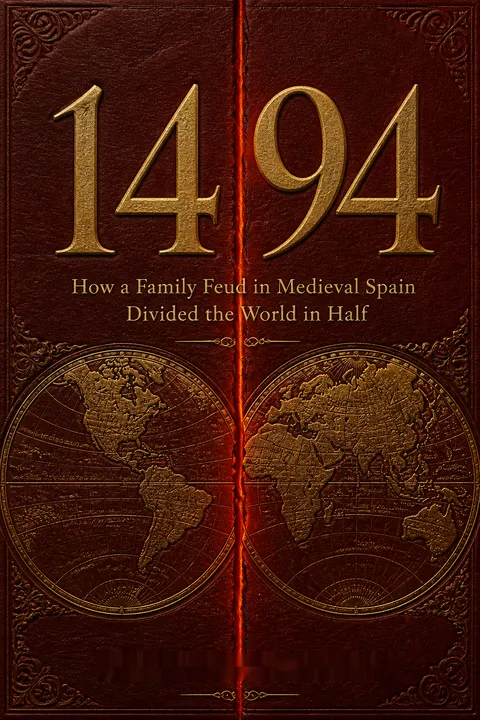
1494 by Stephen R. Bown examines the Treaty of Tordesillas, which divided the world between Spain and Portugal. Reviews are mixed (3.89/5). Critics question whether the treaty significantly impacted history beyond preventing war, calling the central thesis weak. However, most readers praise Bown's accessible, engaging writing style that brings historical figures and events to life. The book covers royal family dynamics, Columbus's voyages, and later challenges from other nations. Readers appreciate learning about lesser-known history, though some find the narrative meanders or becomes less compelling in later chapters.
People Also Read





About the Author
Other books by Stephen R. Bown
Download PDF
Download EPUB
.epub digital book format is ideal for reading ebooks on phones, tablets, and e-readers.








































